420J2 vs 430 Stainless Steel for Vegetable Peelers: Which Is Better?
420J2 vs 430 Stainless Steel for Vegetable Peelers: Which Is Better?
When choosing a stainless steel vegetable peeler, the blade material can affect hardness, edge performance, corrosion resistance, durability and manufacturing cost. Two stainless steel grades that may appear in kitchen peelers are 420J2 and 430, but they have different properties and are suited to different applications.
Quick answer: 420J2 is generally more suitable for a vegetable peeler blade when hardness and edge performance are priorities because it is a martensitic stainless steel that can be hardened through heat treatment. 430 is a ferritic stainless steel with higher chromium content and is widely used in kitchenware and other components where corrosion resistance and forming characteristics are important. The better choice depends on the specific peeler design, blade requirements and target market.
For vegetable peelers, however, stainless steel grade is only one part of the equation. Blade thickness, blade geometry, heat treatment, sharpening, surface finish and manufacturing consistency can also affect the actual peeling experience.
420J2 vs 430 Stainless Steel: Quick Comparison
| Feature | 420J2 Stainless Steel | 430 Stainless Steel |
|---|---|---|
| Stainless steel type | Martensitic | Ferritic |
| Typical chromium content | 12–14% | Typically around 16–18% |
| Carbon content | Higher | Lower |
| Heat treatment | Can be hardened by heat treatment | Not hardened through quenching in the same way |
| Hardness potential | Higher | Lower |
| Corrosion resistance | Good | Generally good, with higher chromium content |
| Typical applications | Cutting tools, blades and other components requiring hardness | Kitchenware, appliances and other formed stainless steel components |
| Vegetable peeler blade | Well suited to blade applications | Can be used depending on product design |
The key difference is not simply that one grade is “better” than the other. 420J2 and 430 belong to different stainless steel families and are optimized for different properties. JFE Steel identifies SUS420J2 as a stainless steel for cutlery and cutting tools and notes its higher quenching hardness compared with SUS420J1.
What Is 420J2 Stainless Steel?
420J2 is a martensitic stainless steel commonly associated with cutting tools and blade applications. According to JFE Steel, SUS420J2 contains approximately 12–14% chromium and 0.26–0.40% carbon under the JIS specification. Its relatively higher carbon content allows it to achieve higher hardness through appropriate heat treatment.
Why Is 420J2 Used for Blades?
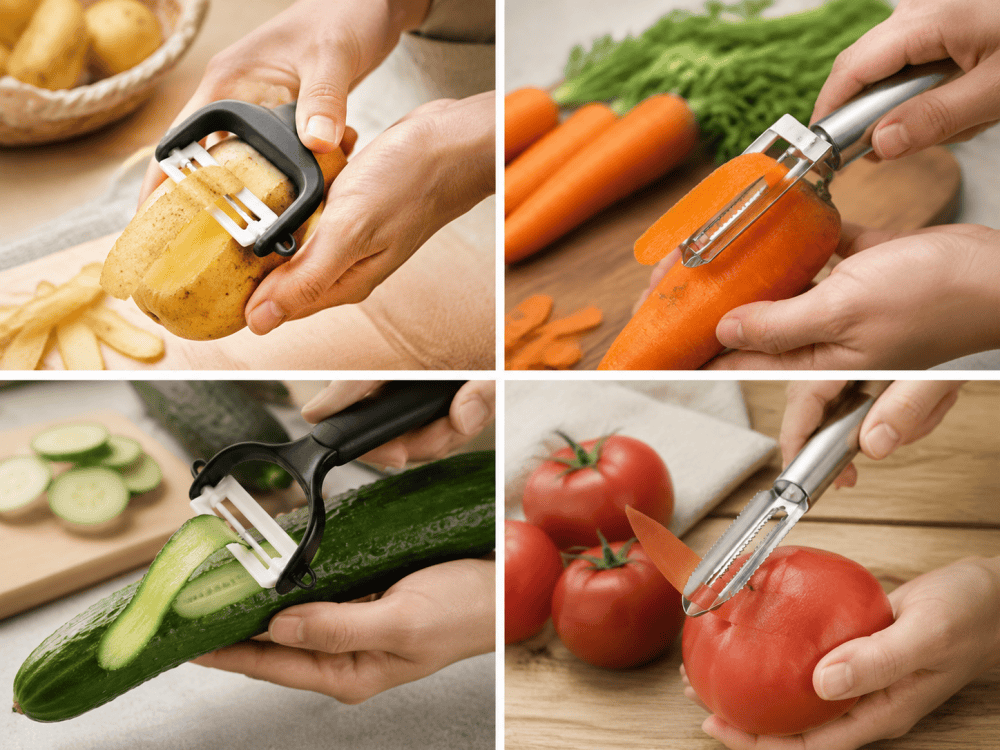
A vegetable peeler blade needs to create a controlled cutting edge while remaining thin enough to remove a layer of skin without taking excessive material from the food. Hardness is therefore an important consideration.
Because 420J2 can be hardened through heat treatment, it can be used for cutting edges and other applications where hardness is important. JFE Steel specifically lists SUS420J2 for cutting tools, while Yamashin also lists applications including blades and other components.
What Is 430 Stainless Steel?
430 is a ferritic stainless steel commonly used in kitchenware, household appliances and food-equipment applications. It generally contains more chromium and less carbon than 420J2.
The International Stainless Steel Forum identifies Type 430 as a commonly used ferritic grade in commercial food equipment. Ferritic stainless steels are also widely used in household appliances and kitchen-related applications because of their corrosion resistance, forming characteristics and relatively stable material cost.
Is 430 Stainless Steel Suitable for Kitchen Products?
Yes. 430 is widely used in kitchen and food-equipment applications. Its properties can make it suitable for components that require corrosion resistance, a stainless appearance and practical forming characteristics.
However, a material that works well for general kitchenware does not necessarily have the same advantages for a thin cutting edge. This is why the intended component and manufacturing process should be considered when selecting stainless steel.
What Is the Difference Between 420J2 and 430?
1. Hardness
One of the most important differences is hardness potential. 420J2 is a martensitic grade that can be hardened through heat treatment. JFE Steel reports a higher quenching hardness for SUS420J2 than SUS420J1 and identifies it as a cutlery-grade stainless steel.
430 is ferritic and does not gain hardness through quenching in the same way. For this reason, 420J2 is generally more naturally suited to applications where a hardened cutting edge is required.
2. Corrosion Resistance
Both 420J2 and 430 are stainless steels with useful corrosion resistance, but their alloy compositions are different. 430 typically contains more chromium, which contributes to its corrosion resistance.
World Stainless notes that Type 430 is widely used in food equipment and describes ferritic stainless steels as suitable for food-contact, high-temperature and wet-environment applications.
For a vegetable peeler, corrosion resistance is important because the blade may regularly contact water, food acids, detergents and moisture. Proper cleaning and drying are still important regardless of the stainless steel grade.
3. Cutting Edge Performance
For the blade of a vegetable peeler, hardness is only one part of cutting performance. The blade's shape, thickness, sharpening process and surface finish can all influence how smoothly the peeler moves through vegetables and fruit.
420J2 can be a practical choice when blade hardness and edge performance are priorities. However, buyers should not assume that every 420J2 peeler will perform identically.
4. Forming and Manufacturing
430 is widely used in formed stainless steel components and food equipment. Its ferritic structure makes it useful for applications involving forming and general kitchen components.
420J2, meanwhile, requires appropriate heat-treatment and blade-processing considerations when used for cutting applications. The manufacturing process therefore matters as much as the nominal steel grade.
Is 420J2 Better Than 430 for a Vegetable Peeler?
For a vegetable peeler blade, 420J2 is generally more suitable when hardness and edge performance are the main priorities. Its ability to be hardened through heat treatment makes it well suited to cutting-tool applications.
However, this does not mean that 430 is an inferior stainless steel. 430 has its own advantages and is widely used in kitchenware and food-equipment applications.
The better material depends on what the product is designed to achieve.
| If Your Priority Is... | Material to Consider |
|---|---|
| Higher blade hardness | 420J2 |
| Cutting-edge applications | 420J2 |
| Heat-treated blade | 420J2 |
| General kitchen components | 430 |
| Corrosion resistance as a major consideration | 430 may be considered |
| Specific multi-function peeler designs | Evaluate the complete design |
Which Stainless Steel Is Best for a Vegetable Peeler Blade?
There is no single stainless steel grade that is automatically the best for every vegetable peeler. The correct choice depends on the product structure, intended use and manufacturing process.
Choose 420J2 When:
- Blade hardness is an important requirement.
- Edge performance is a major product feature.
- The blade will undergo appropriate heat treatment.
- The peeler is designed around a functional cutting edge.
- The product is positioned around durability and peeling performance.
Consider 430 When:
- Corrosion resistance is a major consideration.
- The stainless steel is being used for a non-cutting component.
- Forming characteristics are important to the product design.
- The product requires a stainless steel component with a clean metallic appearance.
- The specific peeler design has already been validated with 430 stainless steel.
Does Stainless Steel Grade Determine Vegetable Peeler Quality?
No. Stainless steel grade is important, but it is not the only factor that determines vegetable peeler quality.
Two peelers made from the same stainless steel grade can have different performance if their blade geometry, thickness, heat treatment, sharpening or manufacturing consistency is different.
When evaluating a vegetable peeler, consider the complete product:
- Blade material: What stainless steel grade is used?
- Blade thickness: Is the blade thickness appropriate for the intended use?
- Blade geometry: Does the blade design provide smooth and controlled peeling?
- Heat treatment: If 420J2 is used, is the blade properly heat treated?
- Sharpening: Is the cutting edge consistent from batch to batch?
- Surface finish: Is the blade smooth and properly finished?
- Handle design: Does the handle provide a comfortable and secure grip?
- Quality control: Are dimensions, materials and performance checked during production?
420J2 vs 430 for Wholesale Vegetable Peelers
For wholesale and private-label vegetable peelers, material selection should be considered together with product positioning, target market and production requirements.
For Retailers
Retail buyers may focus on peeling performance, appearance, durability, handle comfort, packaging and price positioning. A 420J2 blade can be useful for products where blade performance is a key selling point.
For Wholesalers
Wholesale buyers typically need to evaluate material consistency, MOQ, production capacity, unit cost, packaging and quality control. A supplier should be able to clearly identify the stainless steel grade used in the blade.
For Private-Label Brands
Private-label projects usually require more customization. Buyers may need to specify the blade material, handle material, handle color, logo, packaging and product configuration.
For these projects, the material decision should be confirmed during the sample-development stage rather than relying only on a product listing or catalog description.
What Should You Ask a Vegetable Peeler Supplier?
Before placing a wholesale or OEM order, ask the supplier:
- What stainless steel grade is used for the blade?
- Is the blade made from 420J2, 430 or another stainless steel?
- What is the blade thickness?
- Is the blade heat treated?
- How is the blade sharpened?
- Can the supplier provide product samples?
- Can the blade and handle colors be customized?
- Can the supplier provide custom logos and packaging?
- What is the MOQ for stock and customized products?
- What quality-control procedures are used during production?
A reliable supplier should be able to explain not only which stainless steel is used, but also how the material is processed into the finished vegetable peeler.
420J2 or 430: What Should You Choose?
If you are sourcing a vegetable peeler with a stainless steel cutting blade, 420J2 is a practical material to consider when hardness and edge performance are important. Its heat-treatment capability makes it particularly relevant to blade applications.
430 is also a widely used stainless steel for kitchen products and can be appropriate for specific peeler designs and components where corrosion resistance, forming and overall product requirements are prioritized.
The most important point is that the stainless steel grade should be evaluated together with the complete product design. Blade geometry, thickness, sharpening, heat treatment, handle construction and manufacturing consistency all contribute to the final user experience.
Kitlucy Stainless Steel Vegetable Peelers
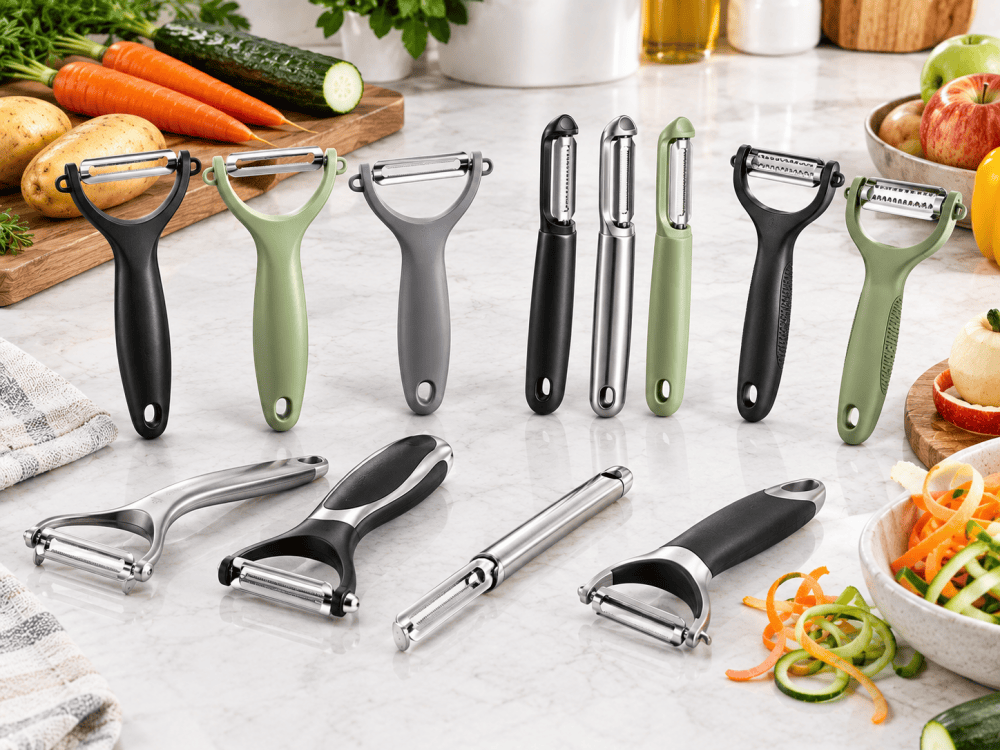
Kitlucy offers a range of stainless steel vegetable peelers for different kitchen applications, including Y-shaped peelers, P-shaped peelers, julienne peelers and multi-function peeler sets.
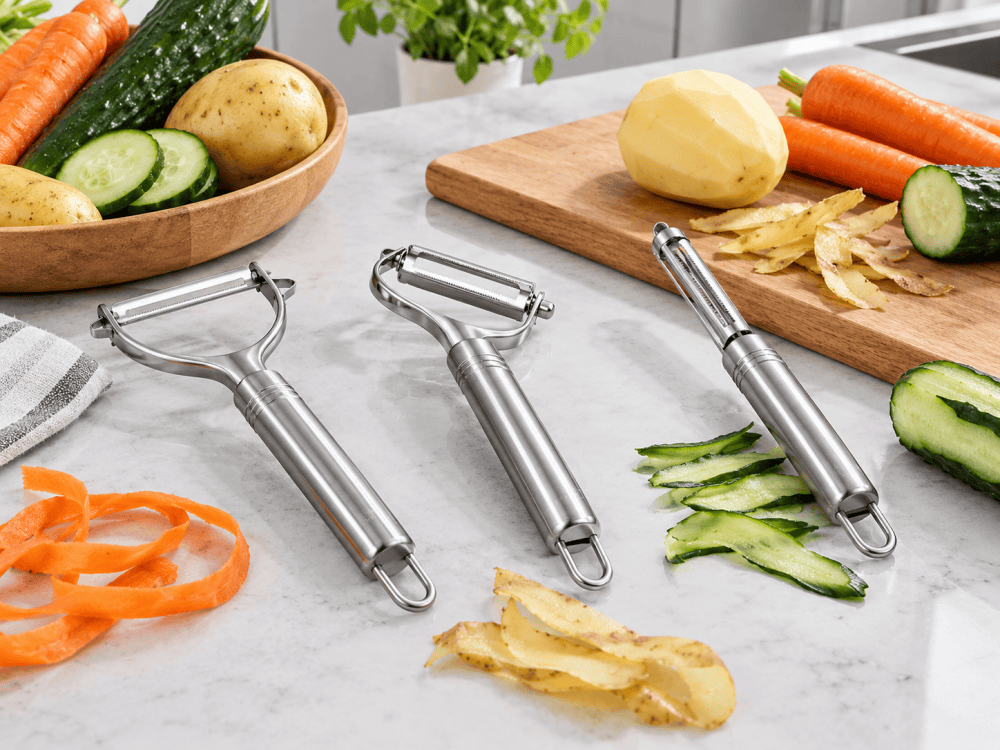
Current Kitlucy vegetable peeler products include models using 420J2 stainless steel blades with PP handles, as well as multi-function peeler sets using 430 stainless steel blades. This allows product development to be matched to different design and market requirements.
For wholesale and private-label projects, Kitlucy supports customization of product colors, logos and packaging, as well as OEM and ODM kitchen-tool development.
Looking for Custom Vegetable Peelers?
Kitlucy provides wholesale and custom vegetable peelers for retailers, distributors and private-label brands. From stainless steel blade selection and handle design to colors, logos and packaging, our team can help develop vegetable peelers according to your product requirements.
Contact Kitlucy to discuss your vegetable peeler project, material requirements and customization options.
Related Blogs