Are Silicone Baking Utensils Safe?
Are Silicone Baking Utensils Safe?
Silicone baking utensils are widely used for mixing, scraping, stirring, decorating, and handling food. Their flexibility, smooth surfaces, and resistance to heat make silicone a popular material for modern baking tools. But are silicone baking utensils actually safe for food contact?
In general, silicone baking utensils can be a suitable choice for food-contact applications when they are properly formulated, manufactured, and used according to their intended conditions.
However, the word "silicone" alone does not guarantee that every product has the same safety or performance characteristics. Food-contact safety depends on the material formulation, additives, manufacturing process, intended use, temperature conditions, and applicable regulatory requirements.
This guide explains what buyers and consumers should know about silicone baking utensil safety, including food contact, heat resistance, BPA, odors, cleaning, and supplier documentation.
Are Silicone Baking Utensils Safe?
Yes, silicone baking utensils can be safe for food contact when they are manufactured from appropriate materials and meet the requirements applicable to their intended use.
In the United States, the FDA regulates substances that come into contact with food. Food-contact substances must have an appropriate regulatory basis for their intended use, which can involve regulations in Title 21 of the Code of Federal Regulations, an effective Food Contact Substance Notification, or other recognized regulatory pathways. :contentReference[oaicite:1]{index=1}
This means that food-contact safety should be evaluated based on the finished product and its intended conditions of use, rather than simply assuming that all silicone products are identical.
Key takeaway: High-quality, appropriately manufactured silicone can be suitable for baking utensils, but buyers should verify the material specification, intended temperature range, food-contact compliance, and relevant testing or documentation for the target market.
Why Is Silicone Used for Baking Utensils?
Silicone has several properties that make it practical for baking tools.
- Flexible and easy to manipulate
- Suitable for many high-temperature kitchen applications
- Soft enough for use with many non-stick surfaces
- Easy to clean
- Resistant to moisture
- Available in many colors and shapes
- Suitable for different utensil designs
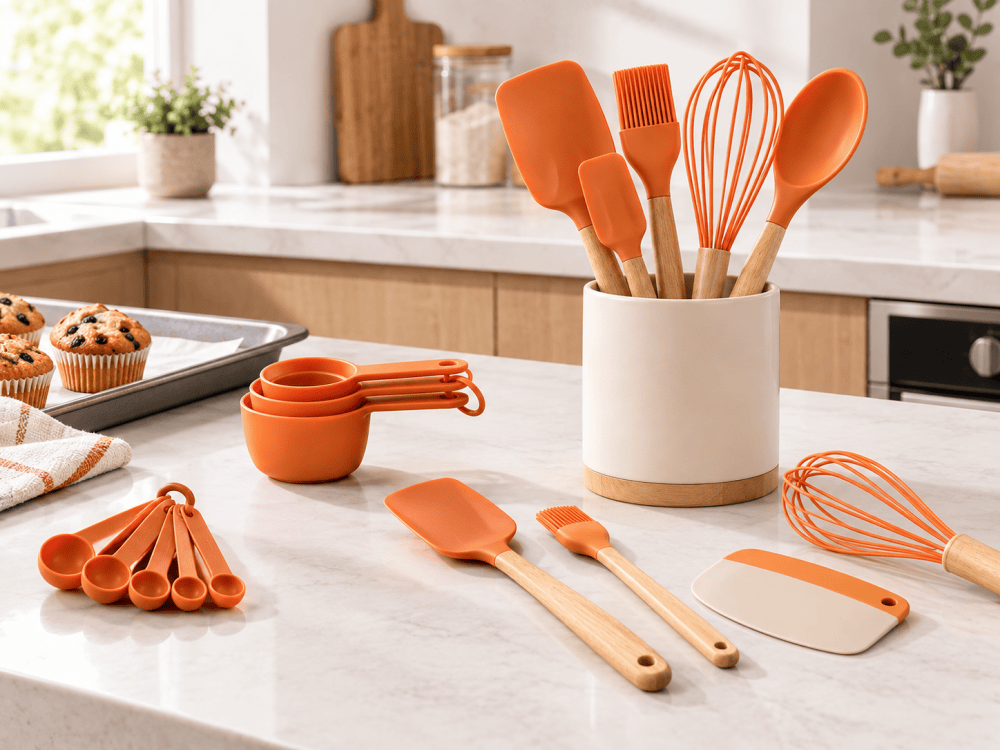
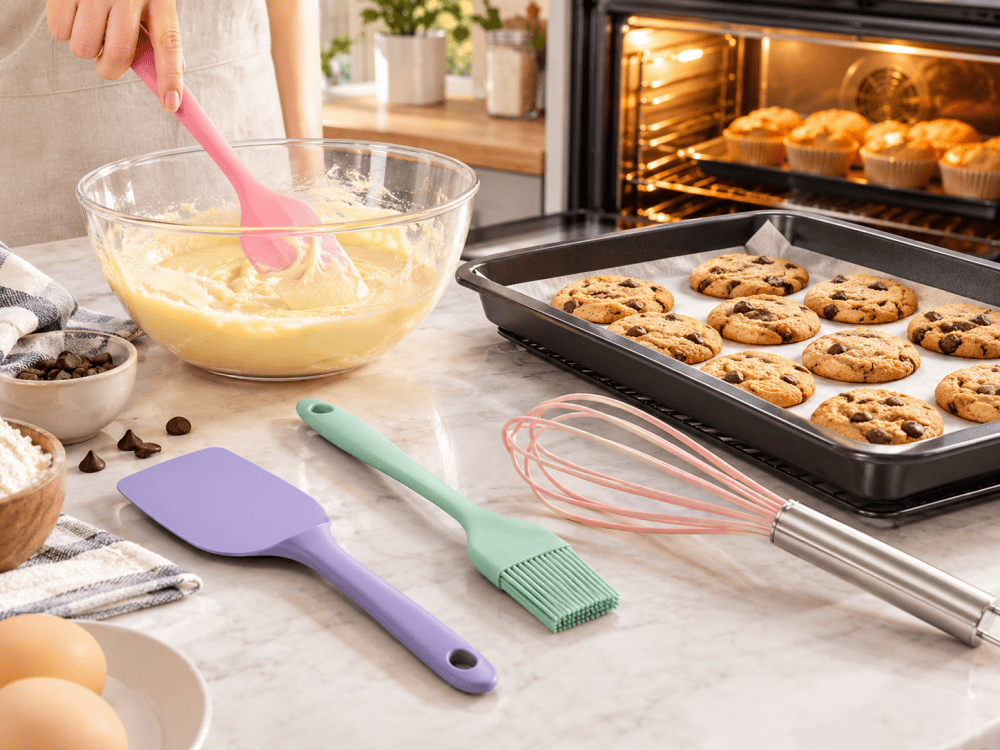
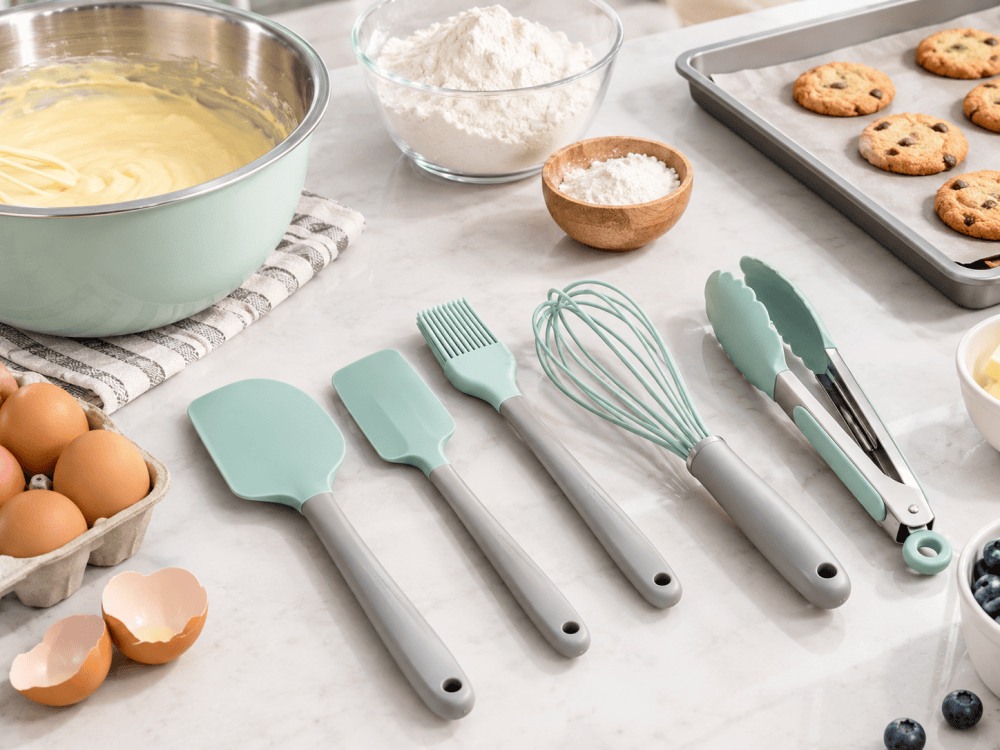
These properties make silicone useful for products such as spatulas, scrapers, pastry brushes, whisks, tongs, and baking utensil sets.
Is Silicone Safe at High Temperatures?
One of the main reasons silicone is popular for baking utensils is its ability to perform in relatively high-temperature kitchen environments.
However, silicone does not have one universal temperature rating. The maximum recommended temperature depends on the specific silicone formulation, product construction, and manufacturer's testing.
A silicone spatula, for example, may be designed for different conditions than a silicone pastry brush or a product containing a wooden or plastic handle.
Important: Always follow the manufacturer's stated temperature range. Do not assume that every silicone baking utensil can be exposed to the same temperature simply because it is made from silicone.
Does Silicone Release Harmful Chemicals When Heated?
The safety of a food-contact article is evaluated according to the substances that make up the article, their potential migration into food, and the intended conditions of use.
The FDA explains that food-contact substances are assessed with consideration of potential migration into food and toxicological information. The regulatory status of a food-contact material can depend on the individual substances reasonably expected to migrate from the finished article. :contentReference[oaicite:2]{index=2}
For this reason, it is not accurate to say that simply heating any silicone product is automatically safe or automatically unsafe.
Instead, buyers should consider whether the specific silicone product is designed and documented for its intended food-contact and temperature conditions.
Is Silicone BPA-Free?
Silicone and BPA are different materials. BPA, or bisphenol A, is a chemical used in the production of certain plastics and resins. Silicone is a different type of polymer material.
Therefore, silicone baking utensils are not made from BPA simply because they are plastic-like or flexible.
However, a product can contain multiple materials or components. For example, a silicone baking utensil may include a silicone head combined with a plastic, nylon, stainless steel, or wooden handle.
For buyers who specifically require BPA-free products, the safest approach is to verify the complete product specification and supplier documentation rather than evaluating only the silicone portion.
Does Silicone Contain Plastic?
Silicone and conventional plastics are different classes of polymeric materials.
Silicone is based on a silicon-oxygen backbone, while common plastics such as polypropylene and polyethylene have carbon-based polymer structures.
This difference gives silicone different physical properties, including its characteristic flexibility and temperature performance.
However, "silicone" should not automatically be interpreted as "completely natural." Silicone is a manufactured polymer material, and the final product may also contain other components depending on its design.
Can Silicone Baking Utensils Affect the Taste or Smell of Food?
Some silicone products may develop or retain odors, particularly after contact with strongly scented foods, oils, or cleaning products.
This does not automatically mean that the product is unsafe. Odor can be influenced by material formulation, manufacturing quality, curing, cleaning, storage, and the type of food involved.
For commercial products, persistent strong odors should be investigated rather than ignored.
Manufacturers should pay attention to material quality, curing processes, cleaning instructions, and finished-product quality control.
Are Silicone Baking Utensils Dishwasher Safe?
Many silicone baking utensils can be dishwasher safe, but this depends on the specific product.
A silicone utensil may include other materials that have different cleaning requirements. Wooden handles, adhesives, coatings, or certain plastic components may limit dishwasher suitability.
Before placing a silicone baking utensil in a dishwasher, users should follow the manufacturer's care instructions.
For B2B buyers, dishwasher suitability should be confirmed during product development and included in the product specification where relevant.
Can Silicone Baking Utensils Scratch Non-Stick Bakeware?
Silicone is commonly used with non-stick cookware and bakeware because its soft surface is generally less abrasive than rigid metal utensils.
For example, silicone spatulas and scrapers can help users remove batter, dough, or frosting from coated surfaces without using a sharp metal edge.
However, the performance of a finished utensil also depends on its design. A product with a rigid internal structure or exposed metal component should be evaluated separately.
How to Tell If Silicone Baking Utensils Are High Quality
Consumers may find it difficult to determine silicone quality simply by looking at a product. For B2B buyers, more detailed evaluation is possible.
1. Check the Material Specification
Ask the supplier what type of silicone is used and whether the material is intended for food-contact applications.
2. Check the Temperature Rating
Confirm the manufacturer's recommended operating temperature range and make sure it matches the intended application.
3. Check the Product Construction
Determine whether the utensil is made entirely from silicone or combines silicone with other materials.
The additional components can affect food-contact compliance, durability, cleaning, and temperature performance.
4. Check Relevant Testing and Documentation
For products intended for food contact, buyers should request documentation relevant to their target market and intended application.
In the United States, the FDA explains that the regulatory status of a food-contact material depends on the individual substances that are reasonably expected to migrate to food and whether those substances are covered by an applicable regulatory pathway. :contentReference[oaicite:3]{index=3}
5. Check Finished-Product Quality
Material compliance is only one part of product quality. Buyers should also inspect the finished utensil for:
- Surface defects
- Cracks or tears
- Incomplete molding
- Loose components
- Excessive odor
- Uneven edges
- Handle connection problems
What Should B2B Buyers Ask a Silicone Baking Utensil Supplier?
For importers, wholesalers, retailers, and private-label brands, supplier evaluation should go beyond asking whether a product is "food grade."
Useful questions to ask a supplier include:
- What silicone material is used?
- Is the silicone intended for food-contact applications?
- What is the recommended temperature range?
- Is the complete finished product dishwasher safe?
- Does the product contain other materials?
- What food-contact documentation is available?
- What testing has been performed on the finished product?
- Can the product be customized for private-label use?
- What packaging options are available?
- What quality-control procedures are used during production?
Silicone Baking Utensils vs Other Materials
Silicone is not necessarily the best material for every baking task. Different materials offer different performance characteristics.
| Material | Main Advantages | Potential Limitations | Common Baking Uses |
|---|---|---|---|
| Silicone | Flexible, easy to clean, suitable for many high-temperature applications, non-stick friendly | Less rigid than metal and product quality can vary | Spatulas, scrapers, brushes, baking sets |
| Stainless Steel | Rigid, durable and strong | May scratch some coated surfaces and can conduct heat | Whisks, measuring tools, pastry tools |
| Nylon | Lightweight and relatively rigid | Temperature performance varies by formulation | Spatulas, turners and kitchen utensils |
| Wood | Natural appearance and rigid structure | Requires more care and can absorb moisture | Spoons, rolling pins and mixing tools |
How to Use Silicone Baking Utensils Safely
Even a properly manufactured silicone utensil should be used according to its intended purpose.
- Follow the manufacturer's temperature instructions.
- Do not intentionally expose silicone utensils to temperatures beyond their rated range.
- Do not use damaged or severely degraded utensils.
- Keep silicone tools away from sharp knives and blades.
- Clean products according to the manufacturer's instructions.
- Allow utensils to dry properly after washing.
- Replace products that develop cracks, tears, or significant deterioration.
Are Silicone Baking Utensils Safe for Everyday Use?
For everyday baking, properly manufactured silicone utensils can be a practical food-contact option.
Their flexibility, smooth surfaces, easy cleaning, and compatibility with many baking applications make them particularly useful for spatulas, scrapers, pastry brushes, and utensil sets.
The key is not simply choosing "silicone," but choosing a product that is appropriately designed and manufactured for its intended use.
Silicone Baking Utensils for OEM and Private Label
Silicone baking utensils are also suitable for OEM and private-label kitchenware programs because the material can be used across a wide range of product shapes, colors, and designs.
Depending on the product, brands may customize:
- Silicone color
- Product dimensions
- Handle design
- Utensil shape
- Logo and branding
- Packaging
- Product combinations
- Complete baking utensil sets
For retailers and distributors, a coordinated silicone baking tool collection can help create a consistent product range while allowing different utensils to share the same color and design language.
Final Verdict: Are Silicone Baking Utensils Safe?
So, are silicone baking utensils safe?
Yes, they can be. Properly manufactured silicone baking utensils can be suitable for food-contact applications and offer practical advantages for baking, including flexibility, easy cleaning, and compatibility with many high-temperature kitchen tasks.
However, food-contact safety is not determined by the word "silicone" alone. The finished product, its components, intended use, temperature conditions, manufacturing process, and applicable regulatory requirements all matter.
For consumers: Choose products from reputable manufacturers and follow their use and care instructions.
For B2B buyers: Ask suppliers for material specifications, temperature ratings, relevant food-contact documentation, and finished-product testing information before placing large orders.
Frequently Asked Questions
Are silicone baking utensils safe?
Yes. Properly manufactured silicone baking utensils can be suitable for food-contact applications when they meet the requirements applicable to their intended use and are used according to the manufacturer's instructions.
Is silicone safe for baking?
Silicone can be suitable for baking applications because it can tolerate relatively high temperatures and is flexible and easy to clean. The specific temperature rating and food-contact suitability should be confirmed for each product.
Is silicone BPA-free?
Silicone and BPA are different materials. However, a finished silicone utensil may contain other components, so buyers who require BPA-free products should verify the complete product specification.
Does silicone release harmful chemicals when heated?
Food-contact safety depends on the specific material formulation, finished product, intended use, and potential migration under those conditions. Buyers should use silicone utensils within the manufacturer's specified temperature range and verify relevant food-contact documentation.
Can silicone baking utensils go in the dishwasher?
Many silicone baking utensils are dishwasher safe, but this depends on the product design and the materials used. Always follow the manufacturer's cleaning instructions.
Can silicone baking utensils scratch non-stick pans?
Silicone is generally well suited to non-stick cookware and bakeware because its soft surface is less likely to scratch coated surfaces than rigid metal utensils.
How can I tell if silicone baking utensils are food safe?
Check the manufacturer's material specification, intended food-contact use, temperature rating, and relevant compliance or testing documentation. For B2B purchasing, evaluate the complete finished product rather than relying only on a general "food grade" claim.
How long do silicone baking utensils last?
Their lifespan depends on material quality, frequency of use, temperature exposure, cleaning, and handling. Replace utensils when they develop significant cracks, tears, deformation, or other signs of deterioration.
Looking for Safe Silicone Baking Utensils?
Kitlucy supplies silicone baking tools and kitchenware products for wholesale, OEM, ODM, and private-label projects. Contact our team to discuss materials, product specifications, customization, packaging, and food-contact requirements for your target market.
Contact KitlucyRelated Blogs