Tart Pan vs Pie Pan: What's the Difference?
Tart Pan vs Pie Pan: What's the Difference?
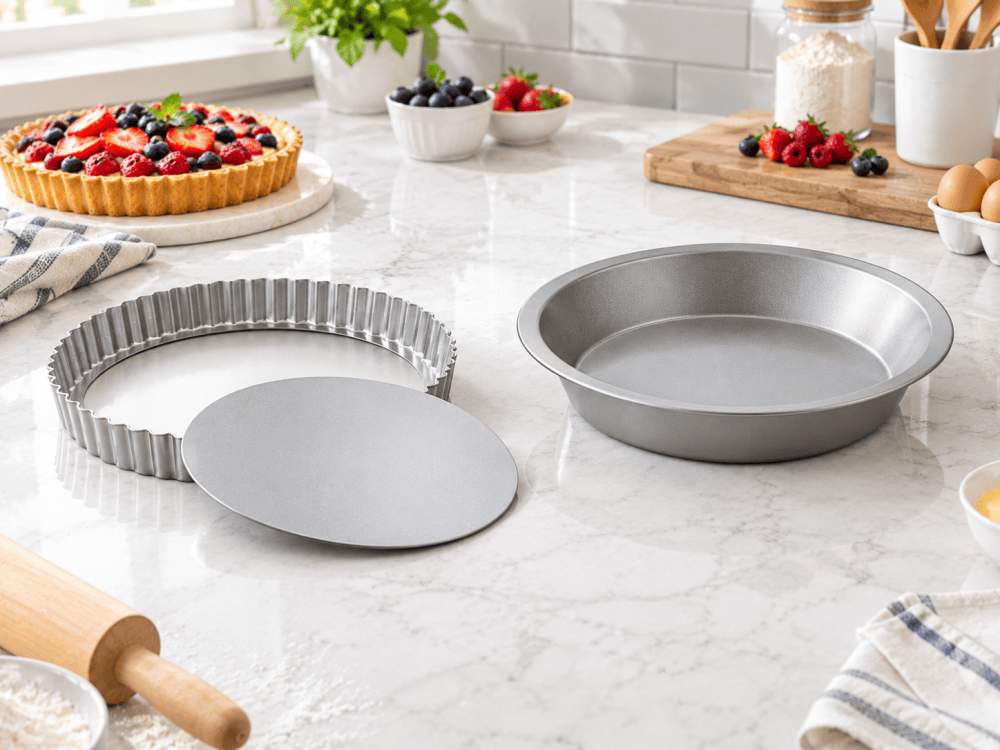
Tart pans and pie pans may look similar at first glance, but they are designed for different baking styles. The biggest differences are not simply the names of the pans. Depth, sidewall shape, bottom construction, filling capacity, and release method all affect how the finished bake looks and performs.
So, what is the difference between a tart pan and a pie pan? A tart pan is typically shallow with straight or fluted sides and frequently has a removable bottom. A pie pan is generally deeper with sloped sides and a fixed base.
These differences influence which recipes work best in each pan. A tart pan is especially useful for fruit tarts, custard tarts, chocolate tarts, and other pastry-forward desserts, while a pie pan is designed for traditional fruit pies, custard pies, cream pies, and savory pies.
Tart Pan vs Pie Pan: Quick Comparison
| Feature | Tart Pan | Pie Pan |
|---|---|---|
| Shape | Usually round, with straight or fluted sides | Usually round, with sloped sides |
| Depth | Generally shallow | Generally deeper |
| Bottom | Often removable | Usually fixed |
| Sidewalls | Straight or fluted | Sloped |
| Crust style | Structured pastry shell | Bottom crust, often with a top crust |
| Typical fillings | Fruit, custard, chocolate, cream, nuts and savory fillings | Fruit, custard, cream, pumpkin, pecan and savory fillings |
| Release | Often easier with a removable bottom | Usually served directly from the pan |
| Presentation | Defined, decorative pastry edge | Classic pie shape |
| Common materials | Aluminum, steel and coated metal | Aluminum, steel, glass, ceramic and other materials |
Nordic Ware currently describes the distinction similarly: its pie pans have deeper, sloped sides for thicker fillings, while its quiche and tart pan uses shallow, straight fluted sides and a removable bottom.
What Is a Tart Pan?
A tart pan is a baking pan specifically designed for making tarts. It is typically shallow and has straight or fluted sides that create the characteristic structured edge of a tart.
Many tart pans use a removable bottom. After baking, the bottom can be lifted away from the outer ring, helping the baker release the tart without turning it upside down or damaging the pastry crust.
This construction is particularly useful when presentation matters. The tart can be transferred to a serving plate while preserving its defined edges and delicate crust.
Tart pans are available in round, rectangular, mini and specialty formats. They may be made from aluminum, steel or coated metal, depending on the intended application and product design.
What Is a Pie Pan?
A pie pan, also called a pie plate or pie dish, is a baking vessel designed primarily for pies. Traditional pie pans are generally round and have sloped sides.
The sloped sidewalls make it easier to shape and crimp a pie crust around the edge. The deeper profile also provides more space for generous fillings.
Common pie-pan applications include:
- Apple pie
- Cherry pie
- Blueberry pie
- Pumpkin pie
- Pecan pie
- Chocolate cream pie
- Chicken pot pie
- Other sweet and savory pies
Unlike many tart pans, traditional pie pans generally have a fixed bottom. This means the finished pie is normally served directly from the pan or transferred carefully using a pie server.
Why Is a Tart Pan Shallower Than a Pie Pan?
The difference in depth is closely related to the structure of the finished food.
A tart is usually built around a relatively thin pastry shell and a defined filling layer. A shallower pan allows the crust to remain a prominent part of the finished dessert.
A pie can contain a larger volume of filling, sometimes covered with a second layer of pastry. A deeper pan provides additional capacity for these fillings.
In practical terms, tart pans emphasize the pastry shell and presentation, while pie pans provide more space for substantial fillings.
Tart Pan vs Pie Pan: Sidewall Shape
One of the easiest visual differences is the shape of the sidewalls.
Tart Pan: Straight or Fluted Sides
Tart pans commonly have straight sidewalls, often combined with fluting. This produces the distinctive vertical or decorative edge associated with traditional tarts.
The fluted edge is not simply decorative. It helps shape the pastry and gives the finished tart a recognizable appearance.
Pie Pan: Sloped Sides
Pie pans generally have sloped sidewalls. This shape provides space for filling and allows the crust to be formed and crimped around the rim.
The sloped design also contributes to the familiar appearance of traditional American-style pies.
Removable Bottom: The Biggest Structural Difference
One of the most important differences between a tart pan and a pie pan is the bottom construction.
Many tart pans have a removable bottom, while most traditional pie pans have a fixed bottom.
The removable bottom allows the baker to lift the baked tart out of the outer ring. This is especially useful when the tart has a fragile crust or when the final presentation needs to be clean and precise.
Modern tart pans commonly combine a removable bottom with fluted sidewalls. Current commercial examples include aluminum tart and quiche pans specifically designed around this construction.
A pie generally does not need this type of release mechanism because it is commonly served in the same dish in which it was baked.
Tart Pan vs Pie Pan: Which Is Better for Easy Release?
If easy release is a priority, a tart pan with a removable bottom is generally more convenient than a traditional fixed-bottom pie pan.
However, easy release also depends on the recipe, crust, surface treatment, preparation method, and pan construction.
For example, a coated tart pan may provide additional release performance, while a natural metal pan may require greasing, flouring, parchment or another preparation method depending on the recipe.
For B2B buyers, the quality of the removable-bottom mechanism is also important. The base should fit securely into the outer ring while still allowing the finished tart to be released efficiently.
Tart Pan vs Pie Pan: What Can You Bake?
| Recipe | Tart Pan | Pie Pan |
|---|---|---|
| Fruit tart | Excellent fit | Possible, but different shape |
| Lemon tart | Excellent fit | Possible |
| Chocolate tart | Excellent fit | Possible |
| Custard tart | Excellent fit | Possible |
| Apple pie | Not the typical choice | Excellent fit |
| Pumpkin pie | Possible with a suitable deeper design | Excellent fit |
| Traditional double-crust pie | Not the typical choice | Excellent fit |
| Quiche | Good if depth is sufficient | Possible |
| Savory vegetable tart | Excellent fit | Possible |
Can You Use a Tart Pan for a Pie?
Yes, but the result may not be the same as using a traditional pie pan.
A tart pan is usually shallower and has straighter sides, so it may not provide enough capacity for a deep pie filling. Its removable bottom can also be less suitable for recipes with very liquid fillings unless the pan is specifically designed for that application.
A tart pan is therefore better suited to recipes that match its shallow profile and pastry-shell structure.
Can You Use a Pie Pan for a Tart?
Yes. You can bake some tart recipes in a pie pan, but the finished tart will generally have a different shape.
The sloped sides of a pie pan will not create the same straight, fluted edge associated with a traditional tart pan. A fixed bottom can also make unmolding more difficult.
If the appearance and clean release of the tart are important, a dedicated tart pan is usually more suitable for the recipe.
Tart Pan vs Pie Pan: Material Differences
Both tart pans and pie pans are available in several materials. The material affects weight, heat transfer, durability, surface treatment, cleaning and overall product positioning.
| Material | Tart Pan Applications | Pie Pan Applications | Typical Characteristics |
|---|---|---|---|
| Aluminum | Common | Common | Lightweight and good thermal conductivity |
| Aluminized steel | Available | Available | Combines steel structure with aluminum-related surface characteristics |
| Stainless steel | Available | Available | Durable and corrosion resistant |
| Glass | Less common | Common | Allows visual monitoring of the crust in some designs |
| Ceramic | Available | Common | Heavy and often selected for presentation and serving |
For both categories, the material should be considered together with thickness, shape, surface treatment and intended use. There is no single material that is automatically best for every tart or pie application.
Aluminum Tart Pan vs Aluminum Pie Pan
Aluminum is widely used in both tart pans and pie pans because it combines relatively low weight with good thermal conductivity.
However, an aluminum tart pan and an aluminum pie pan can behave differently because their structures are different.
- An aluminum tart pan is commonly shallow with straight or fluted sides.
- An aluminum tart pan often has a removable bottom.
- An aluminum pie pan is generally deeper with sloped sides.
- An aluminum pie pan typically has a fixed bottom.
- The same base material does not make the two products interchangeable.
For bakeware product development, the material and geometry should therefore be evaluated together.
Nonstick Tart Pan vs Nonstick Pie Pan
Nonstick describes a surface treatment, not a pan category.
This means you can have a nonstick tart pan and a nonstick pie pan. The underlying substrate may be aluminum, steel, aluminized steel or another material.
When evaluating a nonstick bakeware product, buyers should consider:
- Base material
- Coating specification
- Coating durability
- Intended temperature range
- Recommended utensils
- Cleaning instructions
- Food-contact requirements
- Quality-control standards
For example, a current Nordic Ware quiche and tart pan combines formed aluminum construction with a nonstick coating and a removable bottom.
Tart Pan vs Pie Pan: Which One Should You Choose?
The right choice depends on what you plan to bake most often.
| If You Mainly Bake... | Consider... |
|---|---|
| Fruit tarts | Tart pan |
| Lemon or chocolate tarts | Tart pan |
| Custard tarts | Tart pan with suitable depth |
| Traditional apple or cherry pies | Pie pan |
| Pumpkin or pecan pie | Pie pan |
| Deep savory pies | Pie pan or deep baking dish |
| Quiche | Deeper tart or quiche pan |
| Structured pastry desserts | Tart pan with removable bottom |
How to Choose the Right Tart Pan or Pie Pan
1. Start With the Recipe
The recipe should determine the basic pan category. If the recipe depends on a shallow pastry shell and clean release, a tart pan is usually the more suitable format.
If the recipe requires a larger volume of filling or a traditional top-and-bottom pie crust, a pie pan is generally more appropriate.
2. Consider Depth
Depth affects filling capacity and baking behavior. Do not choose a pan based only on diameter. Two pans with the same diameter can have significantly different capacities if their depths differ.
3. Check the Side Shape
Choose fluted or straight sides when you want the classic tart appearance. Choose sloped sides when making traditional pies.
4. Decide on Removable Bottom Construction
If you need to remove the finished product from the pan for presentation, a removable-bottom tart pan can be useful.
For pies that are normally served directly from the baking dish, a fixed-bottom pie pan may be more practical.
5. Consider Material and Surface
Aluminum, steel, stainless steel, glass and ceramic each provide different combinations of weight, durability, thermal behavior and appearance.
If you choose a coated pan, also consider the coating specification and care requirements.
6. Check Cleaning Requirements
Cleaning instructions vary by material and coating. Some manufacturers recommend hand washing for coated bakeware to help preserve the surface.
Always follow the care instructions supplied with the specific pan rather than assuming that all bakeware has the same dishwasher or utensil requirements.
What Should B2B Buyers Consider When Sourcing Tart or Pie Pans?
For retailers, importers, wholesalers and private-label kitchenware brands, the tart-pan-versus-pie-pan decision also becomes a product-development question.
| Specification | What B2B Buyers Should Check |
|---|---|
| Product type | Tart pan, pie pan, quiche pan or multi-purpose bakeware |
| Shape | Round, rectangular, square, mini or custom |
| Dimensions | Diameter, length, width, depth and capacity |
| Material | Aluminum, steel, stainless steel or other specified material |
| Thickness | Material thickness and structural rigidity |
| Surface | Natural, anodized, nonstick or other finish |
| Bottom | Fixed, removable or specialty construction |
| Edge design | Fluted, straight, smooth or custom |
| Packaging | Bulk, individual, retail or private-label packaging |
| Customization | Logo, color, dimensions, coating, packaging and sets |
| Quality control | Dimensions, coating, deformation, surface and assembly consistency |
| Compliance | Material specifications and applicable food-contact documentation |
Can Tart and Pie Pans Be Made for OEM and Private Label?
Yes. Both tart pans and pie pans can be developed for OEM, ODM and private-label kitchenware programs, depending on the supplier's manufacturing capabilities.
Possible customization options include:
- Custom diameter or dimensions
- Custom depth
- Custom shape
- Fluted or smooth edges
- Fixed or removable bottom
- Material selection
- Surface treatment
- Nonstick coating
- Brand logo or marking
- Product color
- Retail packaging
- Custom product sets
For a new private-label bakeware product, buyers should confirm the tooling process, MOQ, sample approval, production lead time, packaging requirements, quality inspection and shipping terms before mass production.
Tart Pan vs Pie Pan: Common Mistakes to Avoid
Choosing Only by Diameter
A 9-inch tart pan and a 9-inch pie pan are not necessarily interchangeable. Their depth, sidewall angle and capacity can be very different.
Assuming Removable Bottom Means Leakproof
A removable bottom is designed primarily for release. It does not automatically make a pan suitable for very liquid fillings.
If the recipe contains a thin liquid filling, the pan's construction and recipe method should be considered carefully.
Assuming Nonstick Means Dishwasher Safe
Nonstick coatings can have specific care requirements. Some manufacturers recommend hand washing to extend coating life. Always check the product instructions.
Assuming All Aluminum Pans Perform the Same
Aluminum grade, thickness, forming method, surface condition and overall pan geometry can all affect performance. Material name alone is not enough to evaluate a finished bakeware product.
Frequently Asked Questions
What is the main difference between a tart pan and a pie pan?
The main differences are shape and construction. Tart pans are generally shallow with straight or fluted sides and often have removable bottoms. Pie pans are generally deeper, have sloped sides and usually have fixed bottoms.
Is a tart pan deeper than a pie pan?
Usually no. Tart pans are generally shallower than traditional pie pans, although exact dimensions vary by product and application.
Why does a tart pan have a removable bottom?
The removable bottom helps release the finished tart from the outer ring without turning it upside down, which can help protect a delicate crust and improve presentation.
Can I use a pie pan instead of a tart pan?
Yes, for some recipes. However, the finished product may have sloped rather than straight sides, and removing the tart may be more difficult if the pie pan has a fixed bottom.
Can I use a tart pan instead of a pie pan?
Sometimes, but a tart pan may not have enough depth or capacity for a traditional deep-filled pie. It is better suited to shallow pastry-based recipes.
Can you make quiche in a tart pan?
Yes. A tart pan with sufficient depth can be used for quiche. Some products are specifically designed as combination tart and quiche pans.
Are tart pans usually made of aluminum?
Aluminum is a common material for tart pans because it is lightweight and has good thermal conductivity. Steel and coated metal are also widely used.
Are pie pans and tart pans the same size?
They can have similar diameters, but size alone does not make them equivalent. Depth, sidewall shape and bottom construction can be substantially different.
Which pan is better for fruit tart: tart pan or pie pan?
A tart pan is generally designed for fruit tarts because its shallow profile, structured sides and often removable bottom suit the typical tart format.
Can tart pans be customized for private label?
Yes. Depending on the manufacturer, tart pans can be customized in dimensions, shapes, materials, surface treatments, logos, colors and packaging for OEM, ODM and private-label programs.
Final Takeaway: Tart Pan vs Pie Pan
The difference between a tart pan and a pie pan comes down mainly to depth, sidewall shape, bottom construction and intended application.
A tart pan is generally shallow, has straight or fluted sides, and often includes a removable bottom. It is designed for structured tarts where the pastry shell and final presentation are important.
A pie pan is generally deeper, has sloped sides and usually has a fixed bottom. It is designed for traditional pies with larger fillings and, in many recipes, a top crust.
Neither pan is universally better. The right choice depends on the recipe, filling depth, desired presentation, release method, material, surface treatment and baking requirements.
For kitchenware retailers and private-label brands, the same principle applies at the sourcing level: evaluate the complete product specification rather than choosing a pan based only on the name or diameter.
Looking for Custom Tart Pans or Pie Pans?
Kitlucy is a kitchenware brand under DKS-Group, supporting wholesale, OEM, ODM and private-label kitchenware and bakeware projects. Custom bakeware can be developed around your target market, product specifications, branding and packaging requirements.
Related Blogs