Aluminum Cake Molds: Types, Benefits, Safety & How to Choose
Aluminum Cake Molds: Types, Benefits, Safety & How to Choose
Are aluminum cake molds good for baking? Yes. Aluminum cake molds are widely used for baking because aluminum is lightweight, conducts heat efficiently, and can be formed into many cake pan and mold shapes. Common options include round cake pans, square pans, loaf pans, bundt-style molds, tart molds and custom-shaped baking molds. For B2B buyers, the right aluminum cake mold should be selected based on the cake type, dimensions, wall thickness, surface treatment, intended use, packaging and food-contact requirements.
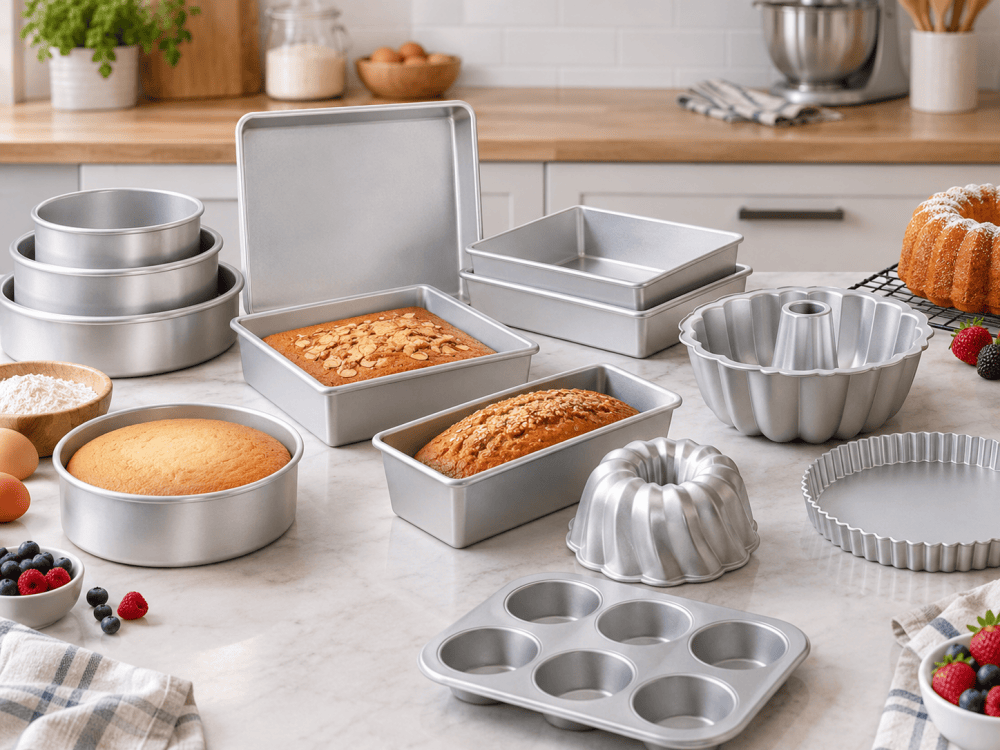
Aluminum cake molds, also called aluminium cake moulds in British English, are widely used in professional and home baking. They are available in many shapes and sizes, from simple round cake pans to decorative molds designed for specialty cakes and desserts.
For consumers, the main attraction is baking performance and ease of handling. For wholesalers, retailers, distributors and private-label kitchenware brands, aluminum cake molds offer a flexible product category that can be developed through different shapes, dimensions, finishes, coatings and packaging formats.
But not every aluminum cake mold is the same. Alloy selection, thickness, surface treatment, manufacturing quality and intended use can all affect the final product.
This guide explains what aluminum cake molds are, why aluminum is used for baking, the most common types, food-contact considerations, aluminum versus other baking materials, and how B2B buyers can choose an aluminum cake mold supplier.
What Is an Aluminum Cake Mold?
An aluminum cake mold is a baking mold or cake pan made primarily from aluminum or an aluminum alloy. The material can be formed into different shapes and dimensions for baking cakes, breads, tarts, pastries and other desserts.
In the United States, the term aluminum cake pan is often used interchangeably with aluminum cake mold, while the term aluminium cake mould is more common in British and international English.
The basic purpose is the same: to hold the batter or dough in a defined shape while allowing heat to transfer from the oven into the food.
| Term | Common Meaning | Typical Market Usage |
|---|---|---|
| Aluminum cake mold | General aluminum baking mold | U.S. and international markets |
| Aluminum cake pan | Usually refers to a flat-sided baking pan | Very common in the U.S. |
| Aluminium cake mould | British spelling of aluminum cake mold | UK and international searches |
| Aluminum baking mold | Broader term covering cake and dessert molds | B2B and international sourcing |
| Aluminum baking pan | General-purpose aluminum baking pan | Retail and wholesale |
Why Is Aluminum Used for Cake Molds?
Aluminum is commonly selected for baking molds because it offers a combination of low weight, good thermal conductivity, formability and practical durability.
1. Good Heat Conductivity
Aluminum transfers heat efficiently, which is one reason it is widely used for baking equipment.
Heat transfer affects how quickly the batter warms and how the cake develops during baking. The actual baking result also depends on oven temperature, pan thickness, pan color, surface treatment, recipe formulation and other variables.
2. Lightweight Construction
Aluminum is lighter than many steel-based alternatives. This can make larger cake molds easier to handle, move and package.
For commercial and household kitchens, lower weight can also be useful when storing multiple baking pans.
3. Easy to Form
Aluminum can be formed into many shapes, which makes it suitable for both standard and decorative cake molds.
Manufacturers can develop round, square, rectangular, fluted, ring-shaped and custom-shaped molds depending on the tooling and manufacturing process.
4. Suitable for Different Baking Products
Aluminum molds can be designed for cakes, breads, tarts, pastries and other oven-baked products.
The appropriate design depends on the recipe, food-contact requirements, temperature conditions and desired final shape.
What Types of Aluminum Cake Molds Are Available?
One of the biggest advantages of aluminum as a baking material is the range of shapes that can be developed.
| Aluminum Cake Mold Type | Typical Application | Potential B2B Positioning |
|---|---|---|
| Round cake pan | Layer cakes and standard cakes | Everyday baking |
| Square cake pan | Brownies, square cakes and desserts | Home baking and retail sets |
| Rectangular cake pan | Sheet cakes and larger baked products | Family-size and commercial baking |
| Loaf pan | Bread, pound cake and loaf cakes | Everyday bakeware |
| Bundt-style mold | Decorative ring cakes | Premium and specialty bakeware |
| Fluted cake mold | Decorative cakes and pastries | Specialty baking |
| Tart mold | Tarts and pastry products | Baking and dessert collections |
| Mini cake mold | Individual desserts | Gift sets and specialty baking |
| Custom-shaped mold | Themed and specialty cakes | OEM and private label |
What Are the Most Common Aluminum Cake Mold Shapes?
Round Aluminum Cake Molds
Round cake pans are among the most recognizable cake mold formats. They are commonly used for layered cakes, sponge cakes and other standard cake recipes.
For B2B buyers, round pans can be developed in different diameters and depths to create multiple SKUs for one product family.
Square and Rectangular Aluminum Cake Molds
Square and rectangular molds are useful for brownies, sheet cakes, snack cakes and other baked products.
They can also be combined into baking sets with multiple dimensions.
Loaf Aluminum Cake Molds
Loaf pans are commonly used for pound cakes, banana bread and other loaf-style baked products.
Their elongated shape makes them easy to differentiate from traditional round cake pans.
Bundt and Fluted Aluminum Cake Molds
Bundt-style and fluted molds create decorative patterns on the finished cake. These designs can be useful for brands targeting consumers interested in presentation as well as baking performance.
Custom-Shaped Aluminum Cake Molds
Custom shapes provide the greatest opportunity for OEM and private-label development.
Depending on the project, molds can be designed around specific themes, seasonal products, promotional campaigns or branded baking collections.
Are Aluminum Cake Molds Safe?
Aluminum cake molds can be suitable for food-contact baking applications when they are properly manufactured, finished and intended for that use. However, the word “aluminum” alone does not establish food-contact compliance. Buyers should evaluate the specific alloy, surface treatment, manufacturing process, intended food contact and applicable testing or regulatory documentation.
Food-contact safety is determined by the complete product and its intended conditions of use. In the United States, FDA regulates substances that come into contact with food, and food-contact substances subject to authorization must meet applicable safety requirements for their intended use.
For B2B buyers, this means that a supplier should be able to explain the material specification and provide relevant documentation where required.
Important: Avoid treating “food grade,” “FDA,” or “non-toxic” as complete proof of compliance without checking the actual material, product construction, intended use and supporting documentation.
Can Aluminum Cake Molds Leach Aluminum Into Food?
The question of aluminum migration depends on the specific material, food type, surface condition, temperature and contact conditions. It should therefore not be reduced to a simple “safe” or “unsafe” statement for every aluminum product.
For kitchenware brands selling into the U.S. market, the more useful approach is to confirm that the exact aluminum material and finished product are appropriate for the intended food-contact application and that the supplier can provide relevant compliance documentation or test reports.
Buyers should also pay attention to unusual alloys, coatings and surface treatments rather than evaluating only the word “aluminum.”
What About Aluminum Alloy Cake Molds?
Many aluminum baking products use aluminum alloys rather than commercially pure aluminum. Alloying elements can change properties such as strength, hardness, formability and manufacturing performance.
For B2B buyers, the important question is not simply whether a product is called “aluminum alloy.” The supplier should provide the actual material specification appropriate for the product and intended application.
This becomes particularly important when the product is being developed for a specific market, customer requirement or private-label program.
Are Aluminum Cake Molds Nonstick?
Not necessarily.
An aluminum cake mold can have an untreated metal surface, a nonstick coating, a ceramic-type coating or another surface treatment depending on the product design.
| Surface Type | Typical Characteristics | Buyer Considerations |
|---|---|---|
| Uncoated aluminum | Direct aluminum surface | Material specification and care instructions |
| Nonstick-coated aluminum | Designed to improve release | Coating durability and food-contact documentation |
| Colored or finished aluminum | Different appearance and surface characteristics | Surface treatment and intended use |
| Custom surface treatment | Developed for specific product requirements | Testing and production consistency |
A nonstick coating can improve food release, but it also introduces another material layer that should be evaluated separately from the aluminum substrate.
Aluminum Cake Mold vs Stainless Steel: Which Is Different?
Aluminum and stainless steel have different physical properties, so the choice depends on the intended baking application and product positioning.
| Feature | Aluminum | Stainless Steel |
|---|---|---|
| Weight | Generally lightweight | Generally heavier |
| Heat conductivity | High | Lower than aluminum |
| Formability | Suitable for many shapes | Also formable but generally requires different processing |
| Corrosion resistance | Depends on alloy and surface condition | Generally strong corrosion resistance |
| Appearance | Can be natural, finished or coated | Typically metallic stainless appearance |
| Common positioning | Baking performance and lightweight bakeware | Durability and long-term kitchen use |
There is no universal material winner. The better material depends on the product's intended use, target price, design, baking characteristics, durability requirements and manufacturing process.
Aluminum Cake Mold vs Silicone Mold
Aluminum and silicone represent very different approaches to cake mold design.
| Feature | Aluminum Cake Mold | Silicone Cake Mold |
|---|---|---|
| Structure | Rigid | Flexible |
| Heat transfer | High thermal conductivity | Lower thermal conductivity than metal |
| Shape stability | Strong | Flexible and may require support |
| Storage | Requires fixed storage space | Can often be folded or compressed |
| Design possibilities | Many rigid shapes | Many flexible shapes |
| Typical positioning | Traditional baking and structured cakes | Flexible molds and specialty baking |
For brands building a bakeware collection, aluminum and silicone do not necessarily compete for exactly the same use cases. They can also complement each other in a broader baking product range.
How to Choose an Aluminum Cake Mold
For consumers, choosing a cake mold often starts with size and shape. For B2B buyers, the selection process should go further.
1. Define the Cake or Baking Application
Start with the product that the mold is intended to make.
A round cake pan, loaf pan, tart mold and decorative bundt-style mold serve different purposes. Defining the application first makes it easier to determine the required dimensions and structure.
2. Choose the Correct Size
Diameter, length, width and depth all affect the finished product.
For a product range, consider whether customers need one standard size or multiple sizes sold individually or as a set.
3. Evaluate Wall Thickness
Wall thickness affects rigidity, weight, heat transfer characteristics, durability and manufacturing cost.
A thicker product may provide a different balance of rigidity and durability, while a lighter construction may be more economical and easier to handle.
4. Select the Surface Treatment
Decide whether the product should use uncoated aluminum or a surface treatment designed for easier release or a particular appearance.
For coated products, evaluate coating adhesion, durability, intended use and applicable food-contact documentation.
5. Check the Rim and Handles
Structural details such as rolled rims, reinforced edges and handles can influence handling and durability.
For larger molds, ergonomic handling can become especially important.
6. Confirm Cleaning and Care Requirements
Cleaning instructions should match the actual material and surface treatment. Some aluminum products may require different care from coated or stainless steel bakeware.
If dishwasher compatibility is intended as a selling point, the complete finished product should be evaluated for that use rather than assuming that every aluminum mold is dishwasher safe.
What Should B2B Buyers Check When Sourcing Aluminum Cake Molds?
For wholesalers, importers and private-label brands, product selection is only one part of the sourcing process.
- Material specification: Ask for the exact aluminum or aluminum alloy specification.
- Product dimensions: Confirm diameter, length, width and depth.
- Wall thickness: Make sure production specifications are clearly defined.
- Surface treatment: Confirm whether the product is coated or uncoated.
- Food-contact documentation: Request relevant documentation for the target market and intended use.
- Testing: Ask what product or material tests are available.
- Mold tooling: Clarify whether a new mold or tooling is required for custom designs.
- MOQ: Request separate MOQs for stock and customized products.
- Samples: Confirm sample availability and sample lead time.
- Packaging: Define retail packaging and shipping packaging requirements early.
- Quality control: Ask how dimensions, surface finish, coating and deformation are checked.
- Production lead time: Confirm both sample and mass-production timelines.
Can Aluminum Cake Molds Be Customized for OEM and Private Label?
Yes. Aluminum cake molds are suitable for OEM and private-label development because the shape, size, surface, packaging and product assortment can be customized according to the project.
| Customization Area | Possible Options |
|---|---|
| Shape | Round, square, rectangular, loaf, fluted, ring or custom shapes |
| Size | Custom diameter, length, width and depth |
| Wall thickness | Specified according to product requirements |
| Surface | Uncoated, finished or suitable coating options |
| Color | Natural metal appearance or suitable surface colors |
| Logo | Brand identification using an appropriate marking method |
| Packaging | Retail box, sleeve, insert, label or custom packaging |
| Product sets | Multiple sizes or coordinated bakeware collections |
Kitlucy's current website positions the company as a China-based kitchenware manufacturer offering OEM and ODM customization for cooking tools, kitchen gadgets and bakeware, including material selection, shapes, sizes, colors, logos and private-label packaging.
For an aluminum cake mold project, buyers should confirm the exact aluminum material, tooling requirements, surface treatment and food-contact documentation with the supplier before production.
How to Develop an Aluminum Cake Mold for Private Label
A typical private-label project can follow a structured development process.
- Define the target market: Determine whether the product is designed for home bakers, professional kitchens, specialty retailers or mass-market distribution.
- Select the cake mold type: Choose the shape, dimensions and intended baking application.
- Confirm material: Define the aluminum or aluminum alloy specification.
- Develop the design: Finalize wall thickness, rim, handles, surface and other structural details.
- Evaluate tooling: Determine whether existing tooling can be used or new tooling is required.
- Produce samples: Check dimensions, appearance, functionality and baking performance.
- Confirm documentation: Obtain applicable food-contact and testing documentation.
- Finalize packaging: Develop private-label packaging and shipping cartons.
- Approve mass production: Confirm the final specification and quality-control requirements.
Is Aluminum Better Than Steel for Cake Molds?
Not necessarily. Aluminum and steel have different properties. Aluminum is valued for its lightweight construction and high thermal conductivity, while steel-based bakeware can offer different characteristics in terms of rigidity, durability and heat behavior. The appropriate choice depends on the cake, baking process, target price and product positioning.
For consumers, the most important factors may be baking performance, weight and ease of use. For B2B buyers, material choice should also consider manufacturing cost, product durability, surface treatment, packaging, target market and compliance requirements.
Are Aluminum Cake Molds Good for Commercial Baking?
Aluminum cake molds can be used in commercial and professional baking applications when the product is appropriately designed and manufactured for the intended conditions.
Commercial buyers should pay particular attention to durability, dimensional consistency, cleaning requirements, production repeatability and food-contact documentation.
For high-volume operations, consistent dimensions across production batches can be just as important as the basic material selection.
Aluminum Cake Mold Buying Checklist
| Question | What to Confirm |
|---|---|
| What is the material? | Exact aluminum or aluminum alloy specification |
| What is the size? | Diameter, length, width and depth |
| How thick is the mold? | Defined wall and base thickness |
| Is it coated? | Surface treatment and coating specification |
| Is it suitable for food contact? | Documentation for intended use and market |
| Can the shape be customized? | Existing tooling or new tooling requirements |
| What is the MOQ? | Stock, custom color and custom tooling MOQs |
| Can packaging be customized? | Private-label retail and shipping packaging |
| What is the lead time? | Sample and mass-production timelines |
| How is quality controlled? | Dimensional, surface and production inspections |
Aluminum Cake Mold FAQ
What is an aluminum cake mold?
An aluminum cake mold is a baking mold made primarily from aluminum or an aluminum alloy. It can be produced in different shapes and sizes for cakes, breads, tarts and other baked products.
Is an aluminum cake mold the same as an aluminum cake pan?
The terms are often used interchangeably, especially in general baking discussions. “Aluminum cake pan” is particularly common in the U.S., while “aluminium cake mould” is more common in British and international English.
Are aluminum cake molds good for baking?
Yes. Aluminum is commonly used in bakeware because it is lightweight, formable and conducts heat efficiently. Actual baking performance depends on the complete pan design, thickness, surface treatment, oven conditions and recipe.
Are aluminum cake molds safe?
Aluminum cake molds can be suitable for food-contact baking when they are properly manufactured and intended for that use. Buyers should evaluate the specific material, surface treatment, intended conditions of use and relevant food-contact documentation rather than relying only on the word “aluminum.”
Are aluminum cake molds nonstick?
Not all aluminum cake molds are nonstick. Some have an untreated aluminum surface, while others use a suitable surface coating designed to improve food release.
Can aluminum cake molds be customized?
Yes. Depending on the supplier, aluminum cake molds can be customized in shape, dimensions, wall thickness, surface treatment, branding, packaging and set configuration.
What is the difference between aluminum cake molds and silicone molds?
Aluminum molds are rigid and have high thermal conductivity, while silicone molds are flexible and can be easier to store. They offer different baking characteristics and can serve different product applications.
What should I ask an aluminum cake mold supplier?
Ask about the exact aluminum specification, dimensions, thickness, surface treatment, food-contact documentation, testing, MOQ, tooling, samples, packaging, quality control and production lead time.
Can aluminum cake molds be used for private label?
Yes. Private-label aluminum cake molds can be developed with custom sizes, shapes, surface treatments, logos, packaging and product sets, depending on the supplier's manufacturing capabilities.
Final Takeaway
Aluminum cake molds are a versatile bakeware option for both consumer and B2B markets. Their lightweight construction, thermal conductivity and formability make aluminum suitable for a wide range of cake pans and baking molds.
For consumers, the key considerations are size, shape, surface treatment, baking application and care instructions. For wholesalers, distributors and private-label brands, the selection process should also include material specifications, wall thickness, tooling, food-contact documentation, quality control, MOQ and packaging.
There is no single aluminum cake mold that fits every baking application. A well-designed product range can include round, square, rectangular, loaf, fluted, tart, mini and custom-shaped molds to serve different customer needs.
Looking for Custom Aluminum Cake Molds?
Kitlucy provides OEM and ODM kitchenware and bakeware solutions for wholesalers, distributors, retailers and private-label brands. Custom product design, materials, sizes, colors, logos and packaging can be discussed according to your project requirements.
For aluminum cake mold projects, contact the Kitlucy team to discuss your desired shape, dimensions, material specifications, packaging and target market.
Related Blogs