Tart Pan With Removable Bottom: How It Works & How to Use It
Tart Pan With Removable Bottom: How It Works & How to Use It
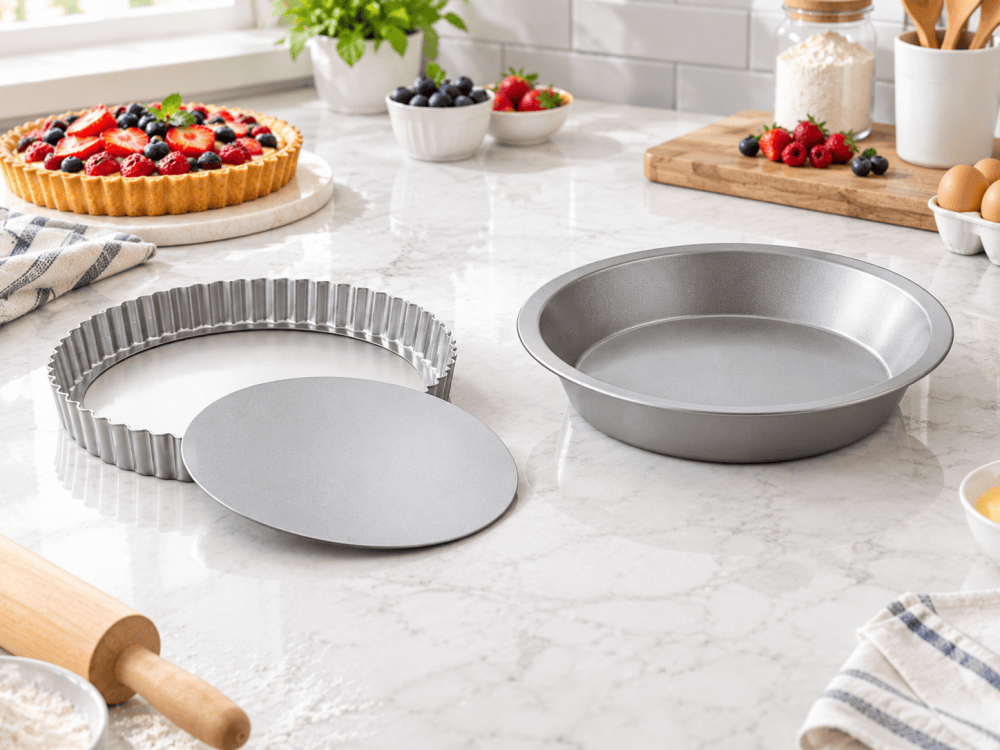
A tart pan with a removable bottom is designed with two main parts: a shaped outer pan or ring and a separate bottom insert. After the tart has baked and cooled, the bottom can be pushed upward through the ring, allowing the tart to be removed without turning the entire dessert upside down.
This design makes it easier to release delicate tart crusts while keeping the sides and decorative surface intact. To use one, place the removable bottom inside the pan, prepare and press the crust into the pan, add the filling, bake according to the recipe, cool the tart, and then carefully lift or push the bottom upward to release it.
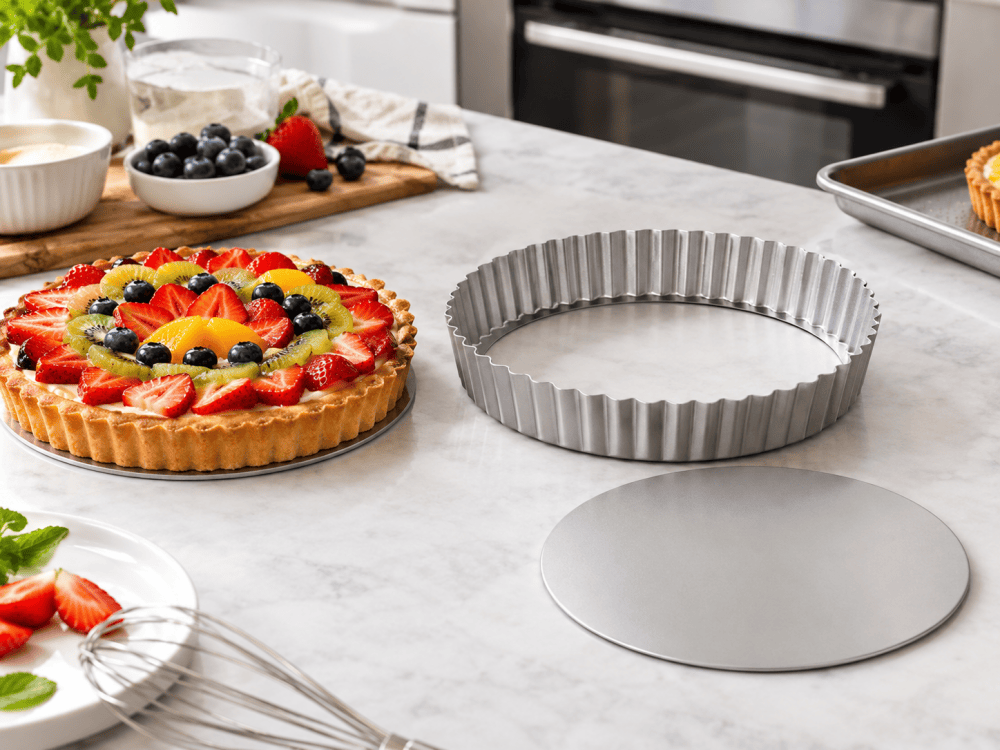
If you have never used a tart pan with a removable bottom, the design may look unusual at first. Unlike a traditional pie pan with a fixed base, a removable-bottom tart pan is specifically designed to make unmolding easier.
It is commonly used for fruit tarts, chocolate tarts, lemon tarts, custard tarts, pastry-based desserts, and some savory tarts or quiches.
For home bakers, the main benefit is easier release. For retailers, importers, and kitchenware brands, the removable-bottom structure is also an important product feature to consider when selecting tart pans for wholesale or private-label programs.
What Is a Tart Pan With a Removable Bottom?
A tart pan with a removable bottom is a shallow baking pan consisting of an outer ring or pan body and a separate flat bottom insert.
The bottom fits inside the outer ring during baking. Once the tart is finished and sufficiently cooled, the bottom can be pushed upward, allowing the tart to separate from the pan.
| Feature | Removable-Bottom Tart Pan | Traditional Fixed-Bottom Pan |
|---|---|---|
| Bottom | Separate removable insert | Attached to the pan |
| Typical shape | Shallow with straight or fluted sides | Varies by pan type |
| Unmolding | Designed for easier release | Usually requires lifting or turning the baked product |
| Best suited for | Tarts and delicate pastry desserts | General baking applications |
| Presentation | Helps preserve tart edges during release | May require more care when removing the tart |
Important: A removable bottom does not mean the bottom is loose during normal baking. When correctly fitted, the bottom sits inside the outer ring and supports the pastry while the tart bakes.
How Does a Tart Pan With a Removable Bottom Work?
The design is simple but useful.
1. The Bottom Insert Supports the Tart
The removable bottom provides the flat surface needed to support the pastry crust and filling during baking.
It functions much like the bottom of a conventional baking pan while remaining separate from the outer ring.
2. The Outer Ring Holds the Shape
The outer ring forms the sides of the tart. Many tart pans have straight or fluted side walls, which help create the characteristic tart shape.
During baking, the ring keeps the pastry against the sides while the bottom supports the base.
3. The Bottom Is Released After Baking
After baking, the tart should be allowed to cool sufficiently before removing it from the pan. The outer ring can then be lifted away while the removable bottom remains underneath the tart.
Depending on the pan design, the bottom may then be transferred to a serving surface or carefully lifted away from the crust.
How to Use a Tart Pan With a Removable Bottom
Using a removable-bottom tart pan is straightforward. The most important steps are preparing the pan correctly, supporting the pastry properly, and allowing the tart to cool before attempting to unmold it.
Step 1: Assemble the Tart Pan
Place the removable bottom inside the outer ring.
Make sure the bottom is sitting evenly and securely inside the ring before adding the pastry.
Step 2: Prepare the Crust
Roll out your tart dough according to the recipe and place it into the pan.
Gently press the dough into the bottom and along the side walls. Avoid stretching the dough excessively because stretched pastry can shrink during baking.
Step 3: Trim the Edges
Press the dough firmly into the fluted or straight sides, then trim excess dough around the rim.
A clean edge helps produce a more consistent finished tart and reduces the chance of uneven pastry around the top.
Step 4: Dock or Blind-Bake When Required
Some tart recipes require the crust to be docked with a fork or blind-baked before filling.
Follow the recipe instructions rather than assuming every tart requires the same preparation. Blind baking is particularly common when the filling does not need a long baking time or when the recipe calls for a pre-baked crust.
Step 5: Add the Filling
Once the crust is prepared, add the appropriate filling.
Depending on the recipe, this may include fruit, chocolate, custard, lemon curd, cream, nuts, vegetables, cheese, or other sweet or savory ingredients.
Step 6: Bake According to the Recipe
Place the assembled tart pan on a stable oven rack and bake according to the recipe and the pan manufacturer's instructions.
The appropriate baking temperature depends on the recipe, ingredients, pan material, coating, and oven. Do not assume that every tart pan has the same maximum temperature.
Step 7: Cool the Tart
Cooling is one of the most important steps when using a removable-bottom tart pan.
A hot tart crust can be fragile. Trying to remove it immediately may cause the pastry to crack, collapse, or separate from the filling.
Allow the tart to cool according to the recipe before attempting to release the outer ring.
Step 8: Remove the Outer Ring
Place the cooled tart on a stable surface. Carefully lift the outer ring upward.
The tart should remain supported by the removable bottom while the outer ring separates from the sides.
Step 9: Transfer the Tart if Necessary
If the recipe calls for serving the tart without the metal base, carefully transfer it from the removable bottom to a serving plate.
For particularly delicate tarts, keeping the tart on the removable base may be the safer option.
How Do You Remove a Tart From a Removable-Bottom Pan?
The easiest method is to cool the tart first and then separate the outer ring from the tart.
Unlike a fixed-bottom pie pan, you generally do not need to turn the entire tart upside down to remove it.
A basic removal process is:
- Allow the tart to cool sufficiently.
- Place the pan on a stable, flat surface.
- Hold the outer ring carefully.
- Lift the outer ring upward while keeping the tart supported by the removable bottom.
- Transfer the tart to a serving plate if required.
Why is this useful? The removable-bottom design reduces the need to flip or aggressively lift a delicate tart. This can help preserve the crust, decorative edges, and finished appearance.
Do You Need to Grease a Tart Pan With a Removable Bottom?
It depends on the pan, coating, dough, and recipe.
A nonstick tart pan may require little or no additional grease, but following the manufacturer's care and use instructions is still important.
An uncoated metal tart pan may benefit from a light layer of butter, oil, or another release method depending on the recipe.
Some pastry recipes also contain enough butter to reduce sticking naturally. However, this should not be treated as a universal rule.
| Pan Type | Typical Consideration |
|---|---|
| Nonstick tart pan | May require little additional grease depending on the recipe |
| Uncoated aluminum | Light greasing may help with release |
| Anodized aluminum | Follow the manufacturer's preparation instructions |
| Coated steel | Use according to the coating manufacturer's instructions |
Can You Use Parchment Paper With a Removable-Bottom Tart Pan?
Yes, parchment paper can be used in some tart recipes, but whether it is necessary depends on the recipe and the pan design.
A parchment circle can be placed on the bottom when a recipe calls for additional release assistance. However, parchment should not interfere with the removable-bottom mechanism or extend in a way that prevents the tart pan from sitting correctly.
For a well-designed nonstick tart pan, parchment may not always be necessary.
Can You Blind-Bake in a Tart Pan With a Removable Bottom?
Yes. A removable-bottom tart pan can be used for blind baking when the recipe requires it.
Blind baking means partially or fully baking the tart crust before adding certain fillings.
The removable bottom can make the finished crust easier to release, but the pastry still needs to be properly supported during baking.
For blind baking, bakers may use parchment and pie weights or another suitable method specified by the recipe.
What Can You Make in a Removable-Bottom Tart Pan?
A removable-bottom tart pan is primarily associated with tarts, but it can be used for a variety of baked dishes depending on its depth, diameter, material, and temperature rating.
| Application | Typical Example |
|---|---|
| Fruit tarts | Apple, berry, peach, pear or mixed-fruit tarts |
| Chocolate tarts | Chocolate ganache or chocolate cream tart |
| Lemon tarts | Lemon curd or citrus-based tart |
| Custard tarts | Egg, cream or milk-based fillings |
| Nut tarts | Almond, pecan or other nut fillings |
| Savory tarts | Vegetable, cheese or egg-based fillings |
| Quiche-style baking | Shallow egg and savory fillings when the pan depth is suitable |
Always check the pan dimensions and manufacturer's instructions before using a tart pan for an application that differs from its primary design.
Removable-Bottom Tart Pan vs Fixed-Bottom Tart Pan
Both designs can be used for baking tarts, but they offer different approaches to releasing the finished product.
| Feature | Removable Bottom | Fixed Bottom |
|---|---|---|
| Release method | Outer ring separates from the bottom | Entire tart is removed from the fixed pan |
| Delicate crusts | Generally easier to release | May require more careful lifting |
| Presentation | Designed for clean tart presentation | Depends more on recipe and release technique |
| Cleaning | Separate components can require additional handling | Simple one-piece structure |
| Storage | Bottom and ring may separate | Single-piece storage |
The removable-bottom design is especially useful when the finished tart needs to retain its delicate crust and defined side profile.
Removable-Bottom Tart Pan vs Springform Pan
These two pan designs can look similar because both can make baked goods easier to release, but they are not the same product.
A removable-bottom tart pan generally has a shallow profile and is designed specifically for tart-style pastry.
A springform pan normally uses a latch or spring mechanism to open the side wall. It is commonly associated with cheesecakes and other taller baked goods.
| Feature | Removable-Bottom Tart Pan | Springform Pan |
|---|---|---|
| Typical profile | Shallow | Usually deeper |
| Side wall | Often straight or fluted | Generally vertical |
| Release mechanism | Bottom separates from outer ring | Side wall opens with a latch |
| Common applications | Tarts and shallow pastry desserts | Cheesecake and taller baked desserts |
What Materials Are Used for Removable-Bottom Tart Pans?
Removable-bottom tart pans are commonly made from metals such as aluminum or steel, sometimes with a surface treatment or nonstick coating.
Aluminum
Aluminum is widely used in bakeware because it is lightweight, conductive, and easy to form into different shapes.
It can be produced as natural aluminum or with different surface treatments, depending on the product design.
Steel
Steel and aluminized steel are also used for tart pans. They can provide a rigid structure and may be combined with a coating or other surface treatment.
Nonstick Coatings
A nonstick surface is a surface treatment or coating, not a separate base material category.
For example, an aluminum tart pan can have a nonstick coating, while another aluminum tart pan can have an uncoated or treated surface.
For B2B buyers: When comparing tart pans, ask about both the base material and the surface treatment. “Aluminum” and “nonstick” describe different aspects of the product and should not automatically be treated as alternatives.
How to Choose a Tart Pan With a Removable Bottom
If you are choosing a tart pan for personal baking, focus on size, shape, release performance, material, and care requirements.
For commercial buyers, importers, retailers, and private-label brands, the evaluation should also include specifications, testing, packaging, customization, and supply capability.
1. Choose the Right Size
Consider the recipe, serving size, oven capacity, and desired tart thickness.
Common retail products are available in different diameters and shapes, but there is no single size that is best for every tart.
2. Check the Bottom Design
The removable bottom should fit properly inside the outer ring.
A good fit helps provide stable support during baking while still allowing the finished tart to be released.
3. Consider the Side Design
Fluted sides can create the traditional decorative tart edge, while straight sides provide a different visual appearance.
The choice is primarily determined by the desired product style and application.
4. Check the Material and Surface
Consider aluminum, steel, aluminized steel, anodized surfaces, or coated surfaces according to the intended application.
For food-contact products, buyers should also verify the applicable material specifications and compliance documentation for the target market.
5. Check Temperature and Care Instructions
Do not assume that all tart pans have the same oven temperature rating.
Maximum temperature, dishwasher suitability, utensil restrictions, and cleaning recommendations can vary by material and coating.
What Should B2B Buyers Check When Sourcing Removable-Bottom Tart Pans?
For wholesale and private-label projects, the physical design is only one part of supplier evaluation.
| Specification | What to Confirm |
|---|---|
| Material | Exact metal type, alloy or substrate specification |
| Dimensions | Diameter, length, width, depth and bottom dimensions |
| Thickness | Material thickness and structural requirements |
| Bottom | Removable-bottom design and fit |
| Surface | Natural, anodized, coated or nonstick finish |
| Temperature rating | Recommended operating range and limitations |
| Food-contact compliance | Applicable documentation and test reports for the target market |
| Packaging | Individual packaging, retail boxes, bulk cartons and labeling |
| Customization | Size, shape, surface, logo, packaging and product sets |
| MOQ | Stock MOQ and custom-production MOQ |
Can Removable-Bottom Tart Pans Be Customized for OEM and Private Label?
Yes. Depending on the supplier's manufacturing capabilities, removable-bottom tart pans can be developed for OEM, ODM, and private-label programs.
Customization may include:
- Pan diameter and dimensions
- Pan depth
- Round, rectangular or specialty shapes
- Fluted or straight side walls
- Material selection
- Material thickness
- Surface treatment or coating
- Logo or brand marking
- Retail packaging
- Product sets
For custom development, buyers should define the intended market, product dimensions, material specification, surface treatment, packaging requirements, target price, MOQ, and required compliance documents before production begins.
Common Mistakes When Using a Tart Pan With a Removable Bottom
Removing the Tart While It Is Too Hot
A hot pastry crust can be fragile. Removing it immediately after baking can increase the risk of cracking or deformation.
Forcing the Bottom
The removable bottom should move according to the design of the pan. Do not force it aggressively if the tart is stuck.
Ignoring the Pan's Coating
Some coatings can be damaged by metal utensils, abrasive cleaners, or excessive heat. Always follow the product's care instructions.
Using the Pan Outside Its Intended Application
A tart pan designed for baking should not automatically be assumed to be suitable for direct stovetop heating, open flames, or other high-heat applications.
Assuming Every Removable-Bottom Pan Is Leakproof
The joint between the removable bottom and outer ring can behave differently from a one-piece pan. Very liquid fillings may require a recipe-specific approach or additional crust preparation.
How Do You Stop Tart Dough From Sticking to the Pan?
Several factors affect sticking, including the pan surface, dough composition, preparation method, baking conditions, and cooling time.
Depending on the product and recipe, common approaches include:
- Using a suitable nonstick tart pan
- Lightly greasing an uncoated pan when appropriate
- Following the pastry recipe's recommended preparation method
- Avoiding excessive moisture around the crust
- Allowing the tart to cool before attempting release
- Using parchment where appropriate
If sticking occurs repeatedly, the issue may be related to the pan surface, recipe formulation, insufficient preparation, or removing the tart before it has cooled sufficiently.
Frequently Asked Questions About Tart Pans With Removable Bottoms
What is a tart pan with a removable bottom?
A tart pan with a removable bottom is a shallow baking pan consisting of an outer ring and a separate bottom insert. The bottom supports the tart during baking and helps make the finished tart easier to release.
How does a removable-bottom tart pan work?
The removable bottom sits inside the outer ring during baking. After the tart cools, the outer ring can be lifted away, leaving the tart supported by the removable bottom.
How do you remove a tart from a tart pan with a removable bottom?
Allow the tart to cool first, then carefully lift the outer ring away from the tart. The removable bottom supports the tart during this process.
Do you need to grease a removable-bottom tart pan?
Not always. The need for greasing depends on the pan surface, coating, dough, and recipe. Follow the manufacturer's instructions and the recipe's preparation requirements.
Can you blind-bake in a removable-bottom tart pan?
Yes. A removable-bottom tart pan can be used for blind baking when the recipe requires a pre-baked tart crust.
Can you bake a tart without a removable-bottom pan?
Yes. A tart can be baked in other suitable pans, but a removable-bottom tart pan is specifically designed to make release and presentation easier.
Are removable-bottom tart pans leakproof?
Not necessarily. The removable joint can behave differently from a one-piece pan, so very liquid fillings may require additional crust preparation or a different pan design.
What is the difference between a removable-bottom tart pan and a pie pan?
A tart pan is generally shallower and often has straight or fluted sides with a removable bottom. A traditional pie pan is usually deeper, has sloped sides, and commonly has a fixed bottom.
What materials are used for tart pans with removable bottoms?
Common materials include aluminum, steel, aluminized steel, and coated metal constructions. The exact material and surface treatment should be evaluated according to the intended application.
Can tart pans with removable bottoms be used for private label products?
Yes. Depending on the supplier, OEM and private-label programs can include custom dimensions, materials, surface treatments, logos, packaging, and product sets.
Final Takeaway
A tart pan with a removable bottom is designed to make tart baking and release easier. The removable bottom supports the pastry during baking while allowing the outer ring to be separated after the tart has cooled.
The basic process is simple: assemble the pan, prepare the crust, add the filling, bake, cool, remove the outer ring, and transfer the tart if needed.
When selecting a tart pan, consider the size, side design, bottom structure, material, surface treatment, temperature rating, cleaning requirements, and intended application.
For wholesale and private-label buyers, supplier evaluation should go further by checking material specifications, food-contact documentation, dimensions, thickness, MOQ, packaging, customization options, quality control, and production capability.
Looking for Custom Tart Pans for Your Brand?
Kitlucy provides kitchenware and bakeware solutions for distributors, retailers, importers, and private-label brands. Depending on the project, tart pans can be developed with customized sizes, shapes, materials, surface treatments, logos, packaging, and product sets.
Contact Kitlucy to discuss your tart pan OEM, ODM, wholesale, or private-label requirements.
Related Blogs