

304 vs. 430 Stainless Steel Kitchen Utensils: Which Is Better?
When comparing stainless steel kitchen utensils, 304 and 430 are two grades buyers may encounter. They can look almost identical, but their composition, corrosion resistance, magnetic properties, and cost are different. Choosing the right one affects product performance, manufacturing decisions, and the value of a kitchen utensil collection.
1. What Is the Difference Between 304 and 430 Stainless Steel?
The main difference comes from their alloy composition and metallurgical structure. Both grades contain chromium, which helps stainless steel resist corrosion. However, 304 also contains a significant amount of nickel, while 430 contains very little nickel.
304 Stainless Steel: An Austenitic Grade
304 stainless steel is commonly known as 18/8 stainless steel, referring to its approximate chromium and nickel content. Its typical composition includes around 18% chromium and 8% nickel, although the exact limits depend on the applicable material standard.
The combination of chromium and nickel gives 304 a useful balance of corrosion resistance, formability, and toughness. It is widely used in food-processing equipment, kitchen sinks, containers, cookware, and food-contact components.
For kitchen utensil manufacturers, 304 is useful when a product needs to be formed, stamped, bent, or fabricated into a durable shape while maintaining good resistance to everyday kitchen exposure.
430 Stainless Steel: A Ferritic Grade
430 stainless steel is a ferritic grade containing approximately 16–18% chromium and very little nickel. Unlike 304, it has a magnetic structure and is generally less expensive because it does not rely on a substantial nickel content.
Grade 430 is used in kitchen-related applications such as appliance panels, decorative components, housings, and certain food-handling applications where the exposure conditions are suitable.
Although 430 has useful corrosion resistance, it generally provides less protection than 304 in more demanding wet or chloride-containing environments. It should therefore be selected according to the actual use conditions rather than simply because it is stainless steel.
2. 304 vs. 430 Stainless Steel: Key Differences at a Glance
| Comparison | 304 Stainless Steel | 430 Stainless Steel |
|---|---|---|
| Steel family | Austenitic | Ferritic |
| Chromium content | Typically around 18% | Typically around 16–18% |
| Nickel content | Typically around 8% or more, depending on specification | Very low, generally less than 0.75% |
| Magnetic properties | Generally non-magnetic in the annealed condition | Magnetic |
| Corrosion resistance | Generally higher | Moderate; suitable for less demanding conditions |
| Formability | Generally very good, including deep drawing | Good for many forming operations, but different from 304 |
| Weldability | Generally good | More limited for some fabrication conditions |
| Relative material cost | Usually higher | Usually lower |
| Typical applications | Food-contact equipment, sinks, containers, and kitchen utensils | Appliance components, panels, trim, and selected kitchen products |
Note: These are general comparisons, not guaranteed values for every supplier or finished product. Actual composition and performance should be checked against the material specification and test documentation.
3. Corrosion Resistance: Why 304 Usually Performs Better
Corrosion resistance is one of the most important considerations when choosing stainless steel for kitchen utensils. These products may come into contact with water, food acids, salt, oils, detergents, and repeated cleaning cycles.
How 304 Performs in Everyday Kitchen Use
304 stainless steel offers good resistance to many common food and kitchen environments. Its chromium content helps form a thin passive oxide layer on the surface, while nickel contributes to the alloy's overall properties.
This makes 304 a strong general-purpose option for utensils that are frequently washed or used with different ingredients, including mildly acidic foods.
However, 304 is not corrosion-proof. Prolonged exposure to concentrated salt, chloride-containing cleaners, bleach, or harsh chemicals can cause staining, pitting, or other forms of corrosion. Food residue and moisture should not be left on the surface for extended periods.
How 430 Performs in Everyday Kitchen Use
430 stainless steel provides corrosion resistance in many mild environments, but it is generally less resistant than 304. Its performance may be adequate for products that experience limited moisture exposure and are cleaned and dried properly.
For utensils used frequently with salty foods, acidic ingredients, or aggressive cleaning conditions, 430 may require more careful evaluation. Surface staining and corrosion become more relevant when the product is exposed to unfavorable conditions over time.
Practical takeaway: If a utensil will be used frequently in wet food-preparation environments, 304 is usually the safer material choice from a corrosion-resistance perspective. If the product has less demanding exposure conditions, 430 may be worth considering after performance testing.
4. Magnetic Properties: Is 304 or 430 Magnetic?
One easy-to-notice difference between these two grades is their response to a magnet.
- 304 stainless steel: Generally non-magnetic in its annealed condition, although some magnetism may develop after cold working or forming.
- 430 stainless steel: Magnetic because it belongs to the ferritic stainless steel family.
This difference is useful during preliminary material identification. However, a magnet test cannot reliably prove that a product is 304 or 430. Processing can affect the magnetic response of 304, and other stainless steel grades may also be magnetic.
For buyers and importers, material certificates and appropriate verification methods are more reliable than using a magnet alone.
5. Which Grade Is Better for Different Kitchen Utensils?
There is no single stainless steel grade that is automatically best for every kitchen utensil. The right material depends on how the product is designed, how often it is used, and what conditions it will encounter.
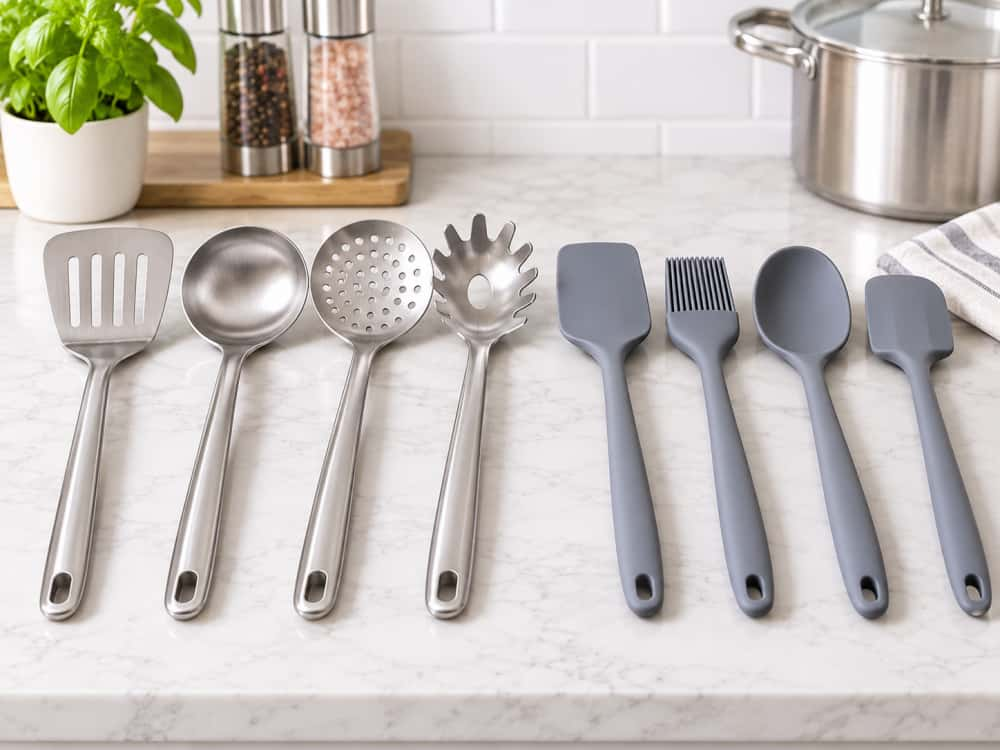
Cooking Spoons, Ladles, and Slotted Spoons
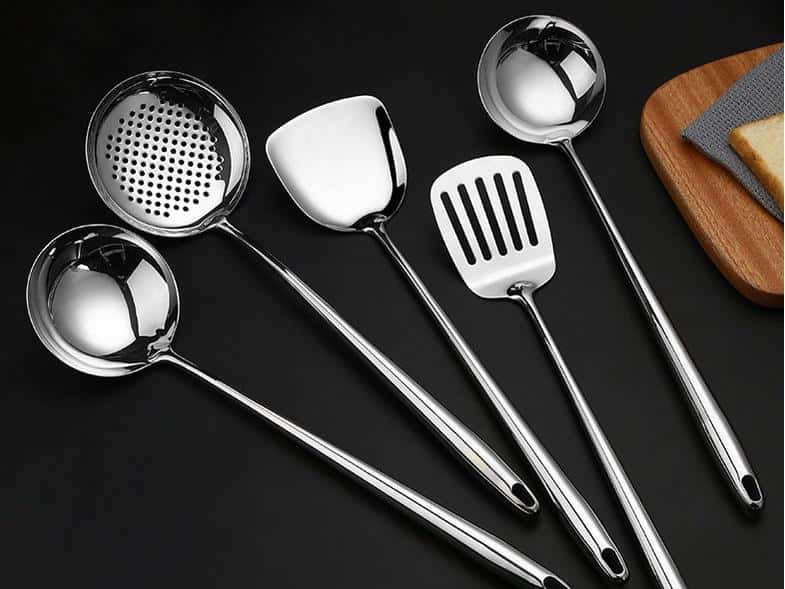
Cooking spoons and ladles often come into contact with hot liquids, sauces, oils, and food residue. They are also washed regularly. For these products, 304 is generally a suitable choice when corrosion resistance and long-term appearance are priorities.
430 may be considered for selected designs where the exposure conditions are less demanding and the finished product has been evaluated for its intended use.
Kitchen Tongs and Whisks
Kitchen tongs and whisks may have multiple bends, joints, wire connections, or welded areas. In addition to the steel grade, buyers should evaluate construction quality, joint design, surface finish, and cleaning accessibility.
304 is often preferable when the product will be washed frequently or used in demanding food-preparation environments. A well-designed product also needs to avoid gaps where food particles and moisture can accumulate.
Spatulas, Turner Tools, and Serving Utensils
For stainless steel spatulas and turners, both material properties and structural design matter. The blade thickness, edge shape, handle connection, and resistance to bending all influence the finished product's performance.
304 can be a good option for premium kitchen utensil collections. 430 may be considered for suitable designs where the product specification and intended environment allow it.
Kitchen Utensil Handles and Decorative Components
Not every component of a kitchen utensil has the same exposure requirements. A decorative metal handle cover or an external component may not experience the same conditions as a spoon or ladle bowl that directly contacts food.
This creates opportunities for manufacturers to evaluate different materials for different components. However, any material used in a food-contact area must be appropriate for that application and supported by relevant compliance evidence.
6. 304 vs. 430: Which Is More Cost-Effective?
430 stainless steel is generally less expensive than 304 because it contains very little nickel. Since nickel is an important alloying element in 304, changes in nickel prices can influence the cost difference between the two grades.
For manufacturers and wholesale buyers, material cost is only one part of the total product cost. The final quotation may also depend on:
- Material thickness and total weight
- Product dimensions and design complexity
- Stamping, bending, welding, and polishing processes
- Handle materials and connection methods
- Surface finishing requirements
- Inspection standards and packaging specifications
- Order quantity and production arrangements
A lower-cost material does not automatically create a more cost-effective product. If the selected grade cannot withstand the product's real operating conditions, corrosion complaints, returns, and replacement costs may reduce the initial savings.
For B2B buyers, the better approach is to compare the complete product specification and expected performance rather than evaluating material price alone.
7. How to Choose Between 304 and 430 for Kitchen Utensil Sourcing
For importers, wholesalers, retailers, and private-label brands, choosing a material should be part of the product development process. Before confirming a specification, consider the following points.
1. Define the Product's Intended Use
Identify whether the utensil will be used for cooking, serving, food preparation, or decorative purposes. A ladle used daily in hot soup has different requirements from a decorative kitchen accessory.
2. Evaluate Food and Cleaning Exposure
Consider contact with salt, acidic ingredients, moisture, hot water, detergents, and cleaning chemicals. Frequent washing and prolonged exposure to food residue should be included in the evaluation.
3. Confirm the Exact Material Grade
Do not rely only on general descriptions such as "stainless steel" or "food-grade stainless steel." Specify the intended grade in the purchase agreement and request supporting material documentation. Where necessary, use suitable material verification testing.
4. Inspect Construction and Surface Finish
Check for rough edges, incomplete polishing, poor welds, loose connections, and gaps that may trap food residue. A suitable material can still result in a poor-quality utensil if manufacturing and finishing are inadequate.
5. Check Food-Contact Compliance
Food-contact compliance depends on the finished article, its intended use, manufacturing conditions, and the regulations of the destination market. A 304 or 430 material designation alone does not prove that the finished utensil meets every applicable requirement.
- Confirm the material grade and specification.
- Request material certificates or other appropriate verification records.
- Review the finished product's food-contact compliance documentation.
- Evaluate corrosion resistance under relevant use and cleaning conditions.
- Inspect welds, joints, edges, and surface finish.
- Confirm that samples match the approved production specification.
8. Is 304 Always Better Than 430?
Not necessarily. 304 generally offers better corrosion resistance and is a versatile option for many kitchen utensils, but it also usually costs more. 430 can be a reasonable choice when the product's design and operating environment do not require the higher corrosion resistance of 304.
The decision should be based on the relationship between material properties, product function, manufacturing requirements, and target market positioning.
For example, a premium utensil set designed for frequent cooking and washing may benefit from 304 stainless steel. A product with less demanding exposure conditions and a more price-sensitive positioning may be evaluated using 430, provided that the finished product meets its performance and compliance requirements.
In other words, the best material is not always the most expensive one. It is the grade that reliably meets the product's actual requirements.
9. Frequently Asked Questions
Is 304 stainless steel better than 430 for kitchen utensils?
In general, yes, when corrosion resistance is the main priority. 304 usually performs better in wet environments and with frequent contact with food and cleaning agents. However, 430 can be suitable for less demanding applications when properly specified and tested.
Is 430 stainless steel safe for food contact?
430 stainless steel can be used in certain food-contact applications. Suitability depends on the finished product, intended conditions of use, manufacturing quality, and applicable market requirements. The grade name alone is not proof of food-contact compliance.
Does 304 stainless steel rust?
Yes, it can corrode under unfavorable conditions. High chloride exposure, salt deposits, bleach, harsh chemicals, and poor cleaning practices can cause staining or pitting. Proper material selection and maintenance are still important.
Why is 430 stainless steel magnetic while 304 is usually not?
430 is a ferritic stainless steel, which is magnetic. 304 is an austenitic stainless steel and is generally non-magnetic in its annealed condition. Cold working can make some 304 products slightly magnetic.
Can a magnet test identify 304 stainless steel?
No. A magnet test is only a preliminary check. Some formed 304 products may show magnetic attraction, and magnetism does not uniquely identify a stainless steel grade. Material documentation and suitable testing provide stronger verification.
Is 430 stainless steel cheaper than 304?
Usually. 430 contains very little nickel, while 304 contains a significant amount. However, actual prices depend on market conditions, material thickness, processing, and supplier quotations.
Which stainless steel grade is better for a premium kitchen utensil set?
304 is often a strong choice for premium kitchen utensil sets because of its corrosion resistance and versatility. Buyers should still evaluate the finished product's construction, polishing, handle design, and food-contact documentation.
Conclusion
When comparing 304 vs. 430 stainless steel kitchen utensils, the most important differences are corrosion resistance, nickel content, magnetic properties, and cost. 304 is generally better suited to utensils that experience frequent washing and regular contact with food and moisture. 430 offers a more economical alternative for selected products and less demanding environments.
For kitchenware brands and wholesale buyers, material selection should always be connected to product function, quality requirements, and target market expectations. A clear material specification, reliable manufacturing process, and appropriate compliance documentation are all essential to developing a competitive kitchen utensil range.
Looking for a Kitchen Utensil Manufacturing Partner?
Whether you are developing a stainless steel kitchen utensil set, expanding an existing product range, or creating a private-label collection, choosing the right material and product construction is an important first step.
Kitlucy supports kitchenware buyers with product development and customization solutions. Contact our team to discuss your product requirements, material preferences, and OEM/ODM project.
Contact KitlucyRelated Blogs