

Stainless Steel vs. Silicone Kitchen Utensils: Which Should You Choose?
When choosing kitchen utensils, material matters just as much as design. Stainless steel and silicone are two popular options, but they serve different purposes. Stainless steel offers strength, rigidity, and a durable working edge, while silicone provides flexibility and helps protect delicate cookware surfaces. So, which material is better for everyday cooking? The answer depends on the utensils you use, the cookware you own, and the way you prepare food.
1. What Is the Difference Between Stainless Steel and Silicone Kitchen Utensils?
Stainless steel and silicone differ in their composition, structure, and physical properties. These differences explain why they perform better in different kitchen situations.
What Are Stainless Steel Kitchen Utensils?
Stainless steel is a metal alloy primarily made from iron and chromium, with other elements such as nickel added in certain grades. Chromium helps form a protective surface layer that improves resistance to rust and corrosion.
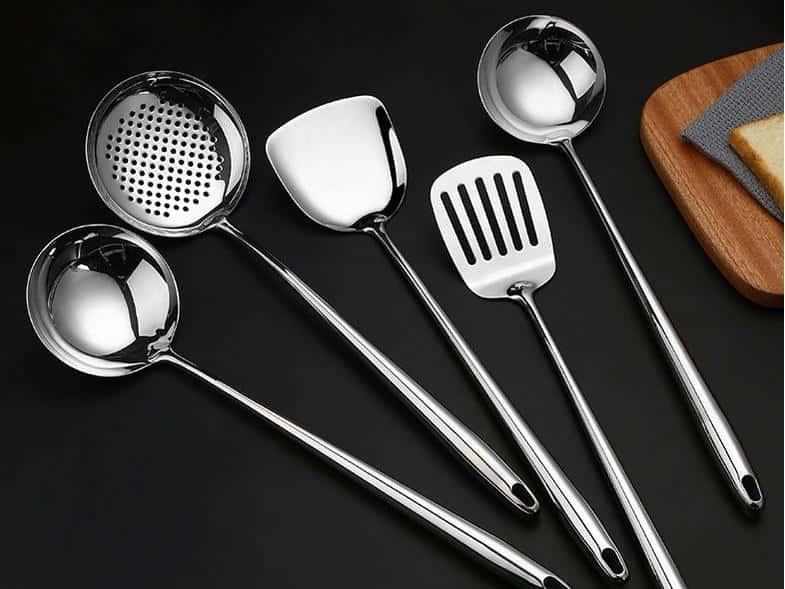
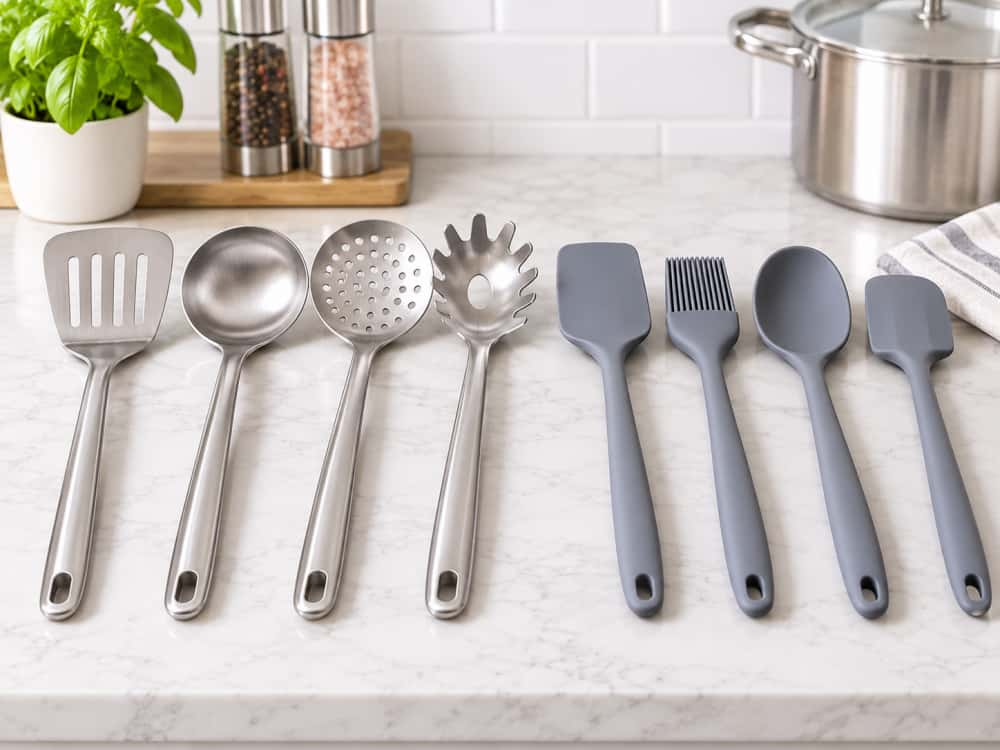
In kitchen utensils, stainless steel is valued for its rigidity, strength, wear resistance, and smooth surface. It is commonly used for ladles, serving spoons, skimmers, whisks, tongs, turners, and other tools that need to maintain their shape under pressure.
Different stainless steel grades are used in kitchenware manufacturing. For example, 304 stainless steel is commonly selected where corrosion resistance is important, while 430 stainless steel may be used for certain applications where its properties and cost are suitable.
What Are Silicone Kitchen Utensils?
Silicone is a synthetic elastomer made from a silicon-oxygen polymer structure. Unlike rigid metals, it is flexible and can bend under pressure without permanently changing shape when properly designed and used.
Food-contact silicone is widely used in spatulas, cooking spoons, turners, pastry brushes, whisks, and utensil sets. Its flexibility makes it particularly useful for scraping mixing bowls, folding ingredients, and working with nonstick cookware.
However, not all silicone products have the same formulation or performance. Material quality, construction, reinforcement, and the manufacturer's stated temperature limit all matter when evaluating a finished utensil.
2. Stainless Steel vs. Silicone Kitchen Utensils: Key Differences
Before looking at individual products, it helps to compare the two materials across the features that matter most in everyday cooking.
| Comparison | Stainless Steel | Silicone |
|---|---|---|
| Material structure | Rigid metal alloy | Flexible synthetic elastomer |
| Durability | Generally strong and resistant to bending and wear | Flexible and durable when properly formulated, but may tear or degrade under unsuitable conditions |
| Flexibility | Low; maintains a firm shape | High; bends and conforms to surfaces |
| Cookware compatibility | Suitable for many uncoated metal cookware surfaces; may scratch coatings | Generally suitable for nonstick and coated cookware when approved by the cookware manufacturer |
| Heat resistance | High for the metal working end; handle and joints may have lower limits | Depends on the exact silicone formulation and finished utensil design |
| Food scraping | Firm edge works well for lifting and turning | Flexible edge is useful for scraping bowls and pans |
| Cleaning | Smooth surfaces are generally easy to clean | Generally easy to clean, but joints and surface damage need attention |
| Common applications | Ladles, tongs, whisks, skimmers, serving spoons | Spatulas, turners, cooking spoons, pastry brushes, bowl scrapers |
| Typical appearance | Metallic, polished, or brushed finish | Available in a wide range of colors and shapes |
Note: These are general material comparisons. Actual performance depends on the grade or formulation, product construction, surface finish, handle materials, and manufacturer's use instructions.
3. Durability: Which Kitchen Utensils Last Longer?
Durability is an important factor when choosing kitchen utensils, especially for households that cook frequently or buyers developing products for long-term retail sales.
Stainless Steel: Strong and Shape-Retaining
Stainless steel utensils are known for their rigid structure. A well-made stainless steel ladle or turner can withstand repeated stirring, lifting, and turning without easily losing its original shape.
Stainless steel is also resistant to many common forms of everyday wear. Unlike softer materials, it does not normally tear or deform under ordinary kitchen use. Its corrosion resistance, however, depends on the steel grade, surface condition, and exposure to moisture, salts, and cleaning chemicals.
For products that require a firm working edge or a strong metal structure, stainless steel is often the more suitable option.
Silicone: Flexible but Dependent on Material Quality
Silicone utensils offer a different type of durability. Their flexibility allows them to bend during use, making them useful for scraping and mixing without the same rigid contact associated with metal tools.
However, silicone is not immune to wear. Repeated exposure to unsuitable temperatures, sharp objects, excessive pulling, or poor-quality material can lead to tearing, surface deterioration, deformation, or loss of performance.
Some silicone utensils also have a reinforced internal structure or a separate handle. In these designs, the connection between the silicone head and the handle can become a potential weak point if it is poorly constructed.
Which is more durable? Stainless steel is generally the stronger choice for rigid, load-bearing kitchen tasks. High-quality silicone can also provide long service in flexible applications, but its performance depends more heavily on formulation, design, and use conditions.
4. Heat Resistance: Can Stainless Steel and Silicone Handle High Temperatures?
Both materials are used in cooking environments, but their heat performance should be evaluated differently.
Stainless Steel and High-Temperature Cooking
The metal working end of a stainless steel utensil can generally tolerate the high temperatures encountered in ordinary stovetop cooking. This makes stainless steel suitable for stirring hot sauces, lifting food from pans, and handling ingredients during high-temperature cooking.
However, the entire utensil should not automatically be considered heat-proof. Handles made from plastic, silicone, wood, or other materials may have different temperature limits. Welded joints, coatings, and decorative components also need to be considered.
Another practical point is that stainless steel conducts heat. A metal handle left in a hot pan can become uncomfortable or unsafe to touch. Always follow the manufacturer's instructions and use a heat-resistant grip when necessary.
Silicone and Temperature Limits
Silicone is popular because many formulations can withstand a relatively wide temperature range. It is commonly used for cooking utensils that come into contact with hot food and cookware.
However, there is no single maximum temperature that applies to every silicone utensil. The limit depends on the material formulation, reinforcement, product structure, and manufacturing quality.
For this reason, buyers should check the manufacturer's stated temperature range for the finished utensil rather than relying on a general claim about silicone as a material.
Continuous exposure to temperatures near or beyond a product's rated limit may shorten its service life. Silicone utensils should also not be left resting against a hot burner or exposed directly to flames unless the product is specifically designed for that use.
Which is better for heat? Stainless steel is generally the more suitable choice for the metal working end in high-temperature cooking. Silicone is also useful for many hot-food applications, provided the utensil is used within its specified temperature range.
5. Cookware Compatibility: Which Material Is Better for Nonstick Pans?
Cookware compatibility is one of the biggest differences between stainless steel and silicone kitchen utensils.
Silicone Is a Good Choice for Nonstick Cookware
Nonstick cookware often has a coating designed to reduce food sticking and make cleaning easier. Using hard or sharp metal tools on these surfaces can create scratches or damage the coating over time.
Silicone utensils are softer and more flexible than stainless steel. When used correctly, they are generally a better choice for stirring, flipping, and scraping food in nonstick pans.
They are especially useful for:
- Flipping eggs and pancakes
- Stirring sauces in coated saucepans
- Scraping food from the bottom of nonstick pans
- Folding ingredients in mixing bowls
- Turning delicate foods without using a hard metal edge
Stainless Steel Is Better Suited to Many Uncoated Cookware Surfaces
Stainless steel utensils are often a practical match for uncoated stainless steel cookware and other durable cooking surfaces when the cookware manufacturer permits their use.
Their rigid structure is useful for turning food, lifting ingredients, and handling tasks that require more force. However, metal utensils can leave marks or scratches on some cookware surfaces, including certain coated or polished finishes.
It is important to distinguish between uncoated stainless steel cookware and nonstick cookware with a stainless steel exterior. The exterior material does not necessarily determine which utensils are safe for the cooking surface.
Practical tip: If your kitchen mainly uses nonstick cookware, silicone utensils are usually the better everyday choice. If you use uncoated metal cookware, stainless steel tools can offer better rigidity and control. Always follow the cookware manufacturer's utensil recommendations.
6. Cleaning and Maintenance: Which Is Easier to Care For?
Both stainless steel and silicone utensils can be easy to maintain, but their cleaning requirements are not identical.
Cleaning Stainless Steel Utensils
Stainless steel has a smooth, non-porous surface that is generally easy to wash. Most everyday food residue can be removed with warm water, dish soap, and a soft sponge.
To keep stainless steel utensils in good condition:
- Wash away food residue soon after use.
- Dry the utensils to reduce water spots.
- Avoid prolonged exposure to salt, harsh chemicals, and bleach.
- Use suitable cleaners for stubborn stains or discoloration.
- Inspect welded joints and handle connections for residue buildup.
Some stainless steel utensils are dishwasher-safe, but this depends on their construction and handle materials. Check the manufacturer's care instructions before placing them in a dishwasher.
Cleaning Silicone Utensils
Silicone utensils are generally easy to wash because their flexible surfaces release many food residues without much effort. Most can be cleaned with warm water and dish soap.
However, grease and strong food odors may remain on some products, especially when the material has an unsuitable surface finish or has been exposed to heavy cooking residue.
For better maintenance:
- Wash utensils promptly after use.
- Use warm water and a suitable dishwashing detergent.
- Pay attention to the connection between silicone heads and handles.
- Check for cuts, tears, or changes in surface condition.
- Follow the product's dishwasher instructions rather than assuming every silicone utensil is dishwasher-safe.
Which is easier to clean? Both materials are relatively easy to clean when they have a smooth, well-designed surface. Product construction often matters more than the material itself. One-piece designs can reduce the number of gaps where food residue may collect.
7. Which Material Is Better for Different Kitchen Utensils?
Instead of choosing one material for every tool, it is more useful to match the material to the function of each utensil.
Cooking Spoons and Ladles
Stainless steel cooking spoons and ladles offer a firm structure for stirring soups, serving sauces, and transferring hot liquids. They are particularly suitable for uncoated cookware and serving applications.
Silicone cooking spoons are more flexible and can be useful when stirring in nonstick pans or scraping food from curved surfaces. Their softness is also helpful when working with delicate cookware.
Spatulas and Turners
Stainless steel turners are useful for lifting, flipping, and transferring foods that need a firm, thin edge. They are often used with suitable uncoated cooking surfaces.
Silicone spatulas and turners are better suited to nonstick pans, delicate foods, and tasks that require a flexible edge. A silicone spatula can also scrape the sides of mixing bowls more effectively than a rigid metal tool.
Kitchen Tongs
Stainless steel tongs provide a strong gripping structure and are widely used for turning meat, lifting vegetables, and handling food on grills or in pans.
Silicone-tipped stainless steel tongs combine a rigid metal body with softer contact surfaces. This hybrid design can offer better grip while reducing direct metal contact with coated cookware.
Whisks
Stainless steel whisks are suitable for beating eggs, mixing sauces, and incorporating air into ingredients. Their metal wires provide a firm structure for repeated whisking.
Silicone-coated whisks can be useful when mixing in nonstick cookware. However, buyers should evaluate the coating quality, wire structure, and temperature rating of the complete product.
Pastry Brushes and Bowl Scrapers
Silicone is often the more practical material for pastry brushes and flexible bowl scrapers. It can distribute oil, butter, sauces, and egg wash while reaching curved surfaces and corners.
Stainless steel is less commonly used for these flexible applications because it does not offer the same ability to conform to a surface.
8. Are Stainless Steel or Silicone Kitchen Utensils Safer?
Both stainless steel and silicone can be used in food-contact kitchen products. However, material names alone do not prove that a finished utensil is safe or compliant with every food-contact regulation.
Stainless Steel Food-Contact Considerations
For stainless steel utensils, buyers should consider the exact grade, surface finish, manufacturing process, and intended food-contact conditions.
Different stainless steel grades have different alloy compositions and corrosion resistance. A product labeled simply as "stainless steel" does not provide enough information to identify its exact material specification.
Material certificates and appropriate verification records can help buyers confirm that the supplied steel matches the agreed specification.
Silicone Food-Contact Considerations
For silicone utensils, the formulation and quality of the finished product are important. Buyers should request relevant food-contact documentation and verify that the product is suitable for its intended temperature and use conditions.
Claims such as "food-grade," "BPA-free," or "heat-resistant" should not be treated as substitutes for appropriate testing and compliance documentation. BPA-free alone does not establish that a silicone utensil meets all applicable food-contact requirements.
What Should Buyers Check?
- Material specifications for stainless steel or silicone
- Food-contact compliance documentation for the intended market
- Temperature limits for the complete utensil
- Surface quality, joints, and handle connections
- Resistance to expected cleaning and use conditions
- Consistency between approved samples and mass production
Food-contact requirements vary by destination market and product category. Importers and private-label brands should confirm the applicable regulations for their products rather than relying on a general material claim.
9. Stainless Steel vs. Silicone Kitchen Utensils: Which Should You Choose?
The best choice depends on how you cook, what cookware you use, and which tasks you perform most often.
Choose Stainless Steel If:
- You prefer rigid utensils with a firm working edge.
- You frequently lift, turn, or serve heavier foods.
- You use uncoated stainless steel or other durable cookware surfaces.
- You want metal utensils with a classic, professional appearance.
- You need tools that maintain their shape during repeated use.
Choose Silicone If:
- You regularly cook with nonstick or coated cookware.
- You need flexible edges for scraping bowls and pans.
- You prepare delicate foods such as eggs and pancakes.
- You prefer lightweight utensils in different colors and designs.
- You need tools for mixing, folding, spreading, and scraping.
Consider a Combination of Both
Many kitchens benefit from having both materials available. Stainless steel can handle tasks that require strength and rigidity, while silicone can protect coated cookware and provide flexibility for mixing and scraping.
A mixed-material utensil collection may include stainless steel ladles and tongs, silicone spatulas and cooking spoons, and silicone-tipped tools for nonstick cookware.
This approach provides more versatility than relying on one material for every cooking task.
10. What Should Buyers Consider When Sourcing Stainless Steel and Silicone Utensils?
For kitchenware importers, wholesalers, retailers, and private-label brands, choosing between stainless steel and silicone is also a product-positioning decision. Each material offers different opportunities in terms of design, manufacturing, price, and retail presentation.
Material and Product Specifications
For stainless steel utensils, define the steel grade, thickness, surface finish, and handle construction. For silicone utensils, confirm the formulation, hardness or flexibility requirements, reinforcement structure, and temperature rating.
These details should be included in the product specification rather than left to general descriptions such as "premium stainless steel" or "high-temperature silicone."
Product Structure and Manufacturing Quality
For stainless steel products, inspect forming, welding, polishing, edge finishing, and handle connections. For silicone products, evaluate molding quality, surface consistency, shape retention, and the connection between the silicone head and any internal or external handle.
Hybrid products, such as stainless steel utensils with silicone handles or silicone-tipped tongs, require additional attention to the connection between different materials.
Target Market and Product Positioning
Stainless steel utensil sets often appeal to buyers looking for a durable, professional, or classic kitchen appearance. Silicone utensil sets can offer more color options, flexible functions, and compatibility with nonstick cookware.
Retailers may also consider mixed-material collections to cover different consumer needs and price segments.
Packaging and Private-Label Customization
Both material categories offer opportunities for private-label development. Buyers can evaluate product combinations, handle designs, colors, surface finishes, logo application, retail packaging, and set configurations.
When developing a new range, it is useful to test representative samples before confirming the final specifications and mass-production requirements.
11. Frequently Asked Questions
Are stainless steel or silicone kitchen utensils better?
Neither material is better for every task. Stainless steel is stronger and more rigid, making it suitable for lifting, turning, and serving. Silicone is more flexible and generally better for nonstick cookware, mixing, and scraping.
Can you use stainless steel utensils on nonstick pans?
Metal utensils can scratch or damage many nonstick coatings. Silicone or other cookware-approved soft utensils are generally a better choice. Always check the cookware manufacturer's recommendations.
Can silicone kitchen utensils withstand high heat?
Many silicone utensils are designed for hot cooking applications, but their temperature limits vary by formulation and product construction. Check the manufacturer's stated temperature rating for the complete utensil.
Do silicone kitchen utensils melt?
Silicone utensils can degrade or become damaged if exposed to temperatures beyond their specified limits or to direct heat sources for which they are not designed. Use them according to the manufacturer's instructions.
Are stainless steel kitchen utensils dishwasher-safe?
Many stainless steel utensils can be washed in a dishwasher, but this depends on the product design and handle materials. Check the manufacturer's care instructions, especially for products with plastic, silicone, or wooden components.
Do silicone utensils absorb food odors?
Some silicone utensils may retain strong food odors or greasy residue, particularly after repeated use. Prompt cleaning and a suitable washing method can help reduce this issue. Material quality and surface finish also matter.
Are stainless steel and silicone utensils safe for food contact?
Both materials can be used in food-contact products when the finished utensil is appropriately manufactured and meets the applicable requirements for its intended use and market. Buyers should review relevant material and compliance documentation.
Can stainless steel and silicone be used together in one utensil?
Yes. Many kitchen tools combine a stainless steel structure with silicone tips, heads, or handles. These hybrid designs can provide metal strength with softer contact surfaces. Buyers should pay attention to connection quality, temperature limits, and cleaning access.
Conclusion
When comparing stainless steel vs. silicone kitchen utensils, the most important difference is how each material performs during cooking. Stainless steel offers rigidity, strength, and a durable working surface. Silicone provides flexibility and is generally more suitable for nonstick cookware and tasks that require gentle contact.
For everyday kitchens, the most practical solution is often a combination of both. Use stainless steel for tasks that need firm control and silicone for mixing, scraping, and working with coated cookware.
For kitchenware brands and wholesale buyers, the right choice should also consider product function, material specifications, construction quality, food-contact requirements, and target market positioning.
Looking for Stainless Steel or Silicone Kitchen Utensils?
Whether you are developing a stainless steel utensil collection, a colorful silicone kitchen tool range, or a mixed-material product set, choosing the right materials and construction is essential to creating products that meet your market's needs.
Kitlucy supports kitchenware product development and customization for importers, retailers, and private-label brands. Contact our team to discuss your product ideas, specifications, and OEM/ODM requirements.
Contact KitlucyRelated Blogs