Aluminum Tart Pan: Benefits, Types & How to Choose
Aluminum Tart Pan: Benefits, Types & How to Choose
An aluminum tart pan is a shallow baking pan made primarily from aluminum and designed for tarts, pastry desserts, quiches, and other shallow baked foods. Aluminum is widely used for tart pans because it is lightweight, conductive, easy to form, and suitable for producing different shapes and sizes.
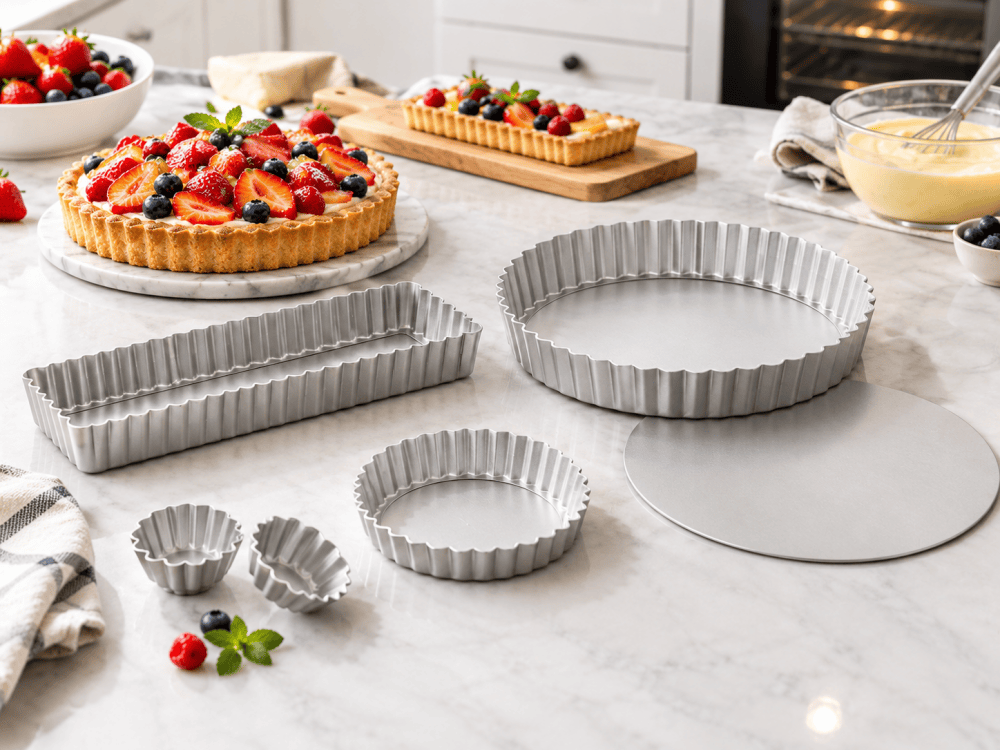
Aluminum tart pans are available in several configurations, including natural aluminum, anodized aluminum, coated aluminum, round tart pans, rectangular tart pans, mini tart pans, and removable-bottom designs. The right option depends on the recipe, desired baking performance, surface requirements, pan size, release characteristics, and intended use.
If you are choosing a tart pan for home baking, the material can affect how the pan handles heat, how quickly it responds to temperature changes, how much it weighs, and how easy it is to clean.
For retailers, importers, distributors, and private-label kitchenware brands, aluminum tart pans also offer flexible opportunities for customization, including different sizes, shapes, surface treatments, packaging, and product sets.
What Is an Aluminum Tart Pan?
An aluminum tart pan is a tart baking pan manufactured primarily from aluminum or an aluminum-based construction.
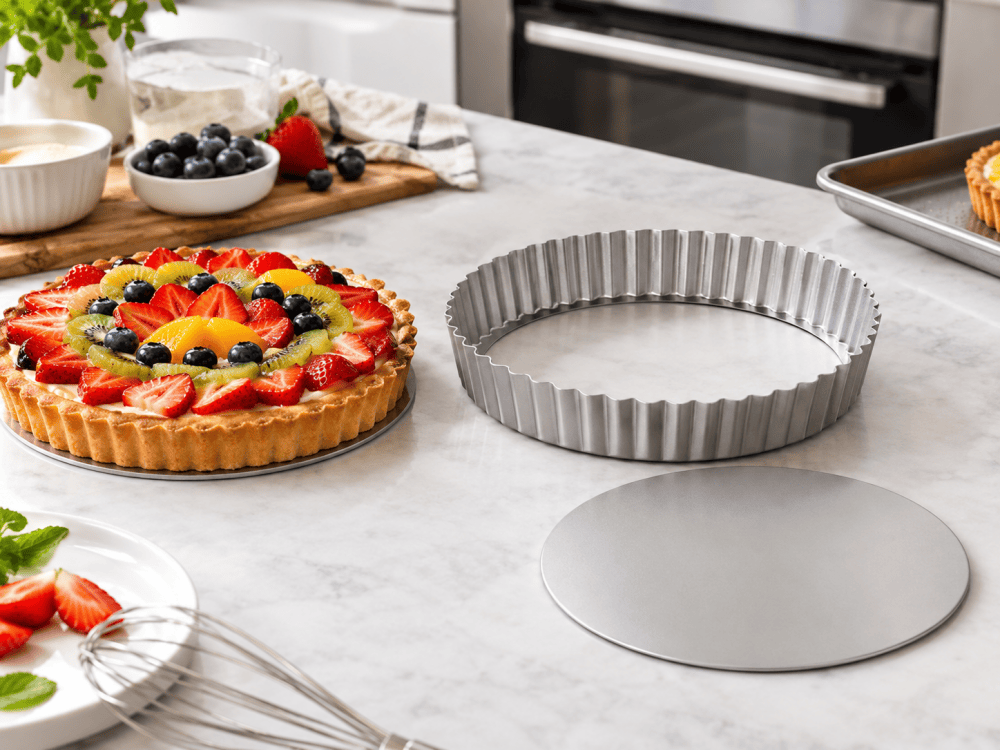
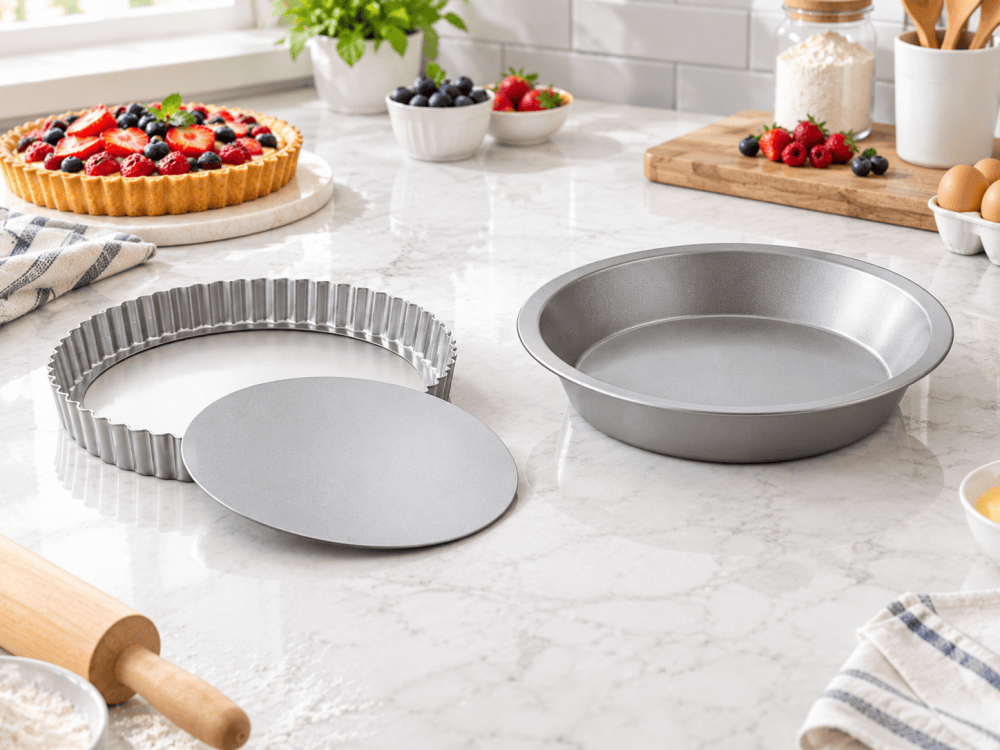
Tart pans are generally shallower than many traditional pie pans and often feature straight or fluted side walls. Many models also have a removable bottom, which helps release the finished tart without requiring the entire dessert to be turned upside down.
Aluminum is commonly selected because it combines relatively low weight with good thermal conductivity and can be formed into different bakeware shapes.
In simple terms: an aluminum tart pan combines the shape and structure of a tart pan with the lightweight and heat-conductive characteristics of aluminum.
What Are the Benefits of Aluminum Tart Pans?
Aluminum tart pans have several characteristics that make them popular for both home and commercial baking applications.
1. Good Thermal Conductivity
Aluminum transfers heat efficiently through the pan. This is one reason aluminum is widely used in baking equipment and bakeware.
For tart baking, the pan material influences how heat reaches the pastry and can contribute to consistent baking performance when the pan is used correctly.
However, the final baking result also depends on oven temperature, dough formulation, filling, pan thickness, surface treatment, and other factors. Material alone does not determine baking performance.
2. Lightweight Construction
Aluminum is relatively lightweight compared with many steel-based bakeware constructions.
This can be useful when tart pans need to be handled frequently, stored in large quantities, or shipped as part of a wholesale or retail product line.
3. Easy to Form Into Different Shapes
Aluminum can be formed into many bakeware designs, making it suitable for round, rectangular, fluted, mini, specialty, and custom tart pans.
This flexibility is particularly useful for kitchenware brands developing multiple sizes or private-label bakeware collections.
4. Suitable for Different Tart Designs
Aluminum tart pans can be produced with different depths, side profiles, bottom designs, and surface treatments.
For example, a brand may choose a shallow round tart pan for traditional fruit tarts or a rectangular tart pan for a different presentation format.
5. Lightweight for Storage and Distribution
For B2B buyers, product weight can affect packaging, carton configuration, warehouse handling, and shipping costs.
A lightweight aluminum construction can therefore be useful when developing tart pans for wholesale distribution.
6. Available With Different Surface Treatments
Aluminum tart pans can be supplied with natural, anodized, or coated surfaces depending on the product design.
This gives buyers more flexibility when balancing release performance, appearance, durability, cleaning requirements, and target price.
What Types of Aluminum Tart Pans Are Available?
Aluminum tart pans are not limited to one design. The most suitable type depends on the recipe, presentation, serving size, and product positioning.
| Type | Typical Features | Common Applications |
|---|---|---|
| Round aluminum tart pan | Traditional round shape | Fruit, lemon, chocolate and custard tarts |
| Rectangular aluminum tart pan | Longer baking surface | Modern tart presentation and pastry bars |
| Square aluminum tart pan | Four straight sides | Square tarts and portioned desserts |
| Mini aluminum tart pan | Small individual portions | Mini tarts and individual desserts |
| Fluted aluminum tart pan | Decorative side profile | Traditional tart presentation |
| Removable-bottom aluminum tart pan | Separate bottom insert | Easy release and presentation |
| Deep aluminum tart pan | Greater side depth | Tarts and selected quiche-style applications |
| Custom aluminum tart pan | Customized dimensions or shape | OEM, ODM and private-label products |
Round vs Rectangular Aluminum Tart Pans
Round tart pans are the most recognizable format and are commonly associated with traditional tart recipes.
Rectangular tart pans provide a different presentation and can be useful for desserts that are cut into bars or smaller portions.
Neither shape is universally better. The choice depends on the intended recipe, serving format, oven space, packaging, and target customer.
| Consideration | Round Tart Pan | Rectangular Tart Pan |
|---|---|---|
| Traditional tart appearance | Strong fit | More contemporary |
| Portioning | Radial slices | Easy rectangular portions |
| Packaging | Common retail format | Requires suitable rectangular packaging |
| Product variety | Many standard sizes | Many specialty and custom sizes |
Natural Aluminum vs Anodized Aluminum Tart Pans
One important distinction is the difference between natural aluminum and anodized aluminum.
Natural Aluminum
Natural aluminum tart pans use an aluminum surface without an anodized layer.
They are lightweight and can provide the characteristic appearance and thermal behavior associated with aluminum bakeware.
Anodized Aluminum
Anodized aluminum has undergone an electrochemical surface treatment that changes the properties of the aluminum surface.
Anodized surfaces are often selected when a manufacturer or buyer wants a different surface characteristic, appearance, or durability profile.
| Feature | Natural Aluminum | Anodized Aluminum |
|---|---|---|
| Base material | Aluminum | Aluminum |
| Surface | Natural aluminum surface | Anodized surface layer |
| Appearance | Typical aluminum finish | Can have a different surface appearance |
| Product positioning | Traditional aluminum bakeware | Often positioned as a more specialized aluminum bakeware option |
| Care | Depends on product instructions | Depends on product and manufacturer instructions |
When comparing these options, buyers should evaluate the actual product specification rather than assuming that one surface is automatically better for every baking application.
Aluminum Tart Pan With Removable Bottom
A removable-bottom design is one of the most useful configurations for tart baking.
The pan normally consists of an outer ring and a separate bottom insert. During baking, the bottom supports the tart crust. After cooling, the outer ring can be lifted away, making it easier to release the finished tart.
This design is especially useful for delicate pastry crusts and tarts where preserving the decorative side profile is important.
For more information about the structure and correct use of this design, see our guide to tart pans with removable bottoms.
Aluminum Tart Pan vs Steel Tart Pan
Aluminum and steel tart pans can both be used for baking, but their material characteristics differ.
| Feature | Aluminum Tart Pan | Steel Tart Pan |
|---|---|---|
| Weight | Generally lightweight | Generally heavier |
| Thermal conductivity | High compared with many steels | Depends on steel construction |
| Formability | Suitable for many shapes | Suitable for many rigid designs |
| Rigidity | Depends strongly on thickness and design | Often provides strong structural rigidity |
| Surface options | Natural, anodized or coated options | Coated and other treated surfaces available |
| Best choice | Lightweight and heat-responsive bakeware applications | Applications where rigidity and structural feel are priorities |
The better choice depends on the specific tart recipe, pan construction, thickness, surface treatment, price target, and buyer requirements.
Aluminum Tart Pan vs Silicone Tart Mold
Aluminum and silicone represent two very different approaches to tart baking.
| Feature | Aluminum Tart Pan | Silicone Tart Mold |
|---|---|---|
| Structure | Rigid | Flexible |
| Shape retention | Strong | Depends on mold design and support |
| Heat response | Metal transfers heat efficiently | Silicone behaves differently because it is an elastomer |
| Release | Depends on surface and preparation | Flexibility can assist release |
| Storage | Requires rigid storage space | Can be compressed or folded depending on design |
| Best suited for | Traditional tart structure and defined edges | Flexible mold applications |
For tarts that require crisp, well-defined edges, a rigid metal pan can provide a different baking experience from a flexible silicone mold.
Are Aluminum Tart Pans Safe for Baking?
Aluminum is used in food-contact applications, but the safety of a finished aluminum tart pan should not be determined by the word “aluminum” alone.
Food-contact safety depends on the specific material, formulation, surface treatment, manufacturing process, intended food type, temperature, contact conditions, and applicable regulations.
The FDA maintains information on food-contact substances and specifies that authorization can depend on the intended use and conditions of use. Its framework considers factors such as the food type and temperature conditions under which a food-contact substance is used.
For B2B buyers sourcing aluminum bakeware for the U.S. market, it is therefore important to request appropriate material and food-contact documentation rather than relying only on a general claim such as “food grade.”
Important sourcing point: In December 2024, the FDA warned retailers and distributors about certain imported aluminum and aluminum-alloy cookware that had demonstrated potential to leach lead. This does not mean that aluminum cookware as a category is unsafe; it shows why the exact material, manufacturing quality, and food-contact testing of a finished product matter.
Can Aluminum Tart Pans Leach Aluminum Into Food?
Potential material migration depends on the specific aluminum construction, surface condition, food characteristics, temperature, duration of contact, and other conditions of use.
Acidic or salty foods can present different contact conditions from dry foods, and surface treatments can also change the behavior of the finished product.
For commercial kitchenware projects, the appropriate approach is not to make a blanket statement that every aluminum pan either does or does not leach. Instead, buyers should evaluate the specific finished product against the intended market and use conditions.
FDA food-contact requirements are based on specified substances and intended conditions of use, rather than a simple universal statement that every product made from a particular material is compliant in every application.
Does an Aluminum Tart Pan Need a Nonstick Coating?
No. An aluminum tart pan does not automatically need a nonstick coating.
An aluminum pan can have a natural metal surface, an anodized surface, or a separate coating depending on the product design.
Nonstick coatings can help with release, but coating performance depends on the specific coating system, application process, thickness, curing, and care instructions.
For buyers developing private-label bakeware, the decision should be based on the intended application and target market rather than simply adding a nonstick coating because it sounds more premium.
How to Choose the Right Aluminum Tart Pan
The best aluminum tart pan depends on how the product will be used. Before purchasing or sourcing one, consider the following factors.
1. Choose the Tart Pan Size
Consider the recipe, serving size, oven capacity, packaging dimensions, and target customer.
For B2B products, it can also be useful to develop a size range rather than relying on a single pan size.
2. Choose the Shape
Round, rectangular, square, mini, and specialty shapes can serve different baking and presentation requirements.
3. Decide Whether You Need a Removable Bottom
If easy release and clean presentation are important, a removable-bottom design can be useful.
If the product needs to be simple, stackable, and cost-efficient, a fixed-bottom design may be considered.
4. Consider the Material Thickness
Thickness affects rigidity, weight, durability, thermal behavior, and product cost.
For commercial or wholesale projects, buyers should specify thickness rather than asking only for an “aluminum tart pan.”
5. Choose the Surface
Consider natural aluminum, anodized aluminum, or a coated surface depending on the required release performance, appearance, durability, and care instructions.
6. Check the Temperature Rating
Do not assume that every aluminum tart pan has the same oven or temperature rating.
The actual limit can depend on the base material, coating, handles, coatings, adhesives, and overall construction.
7. Consider Cleaning Requirements
Cleaning recommendations can vary significantly between natural aluminum, anodized aluminum, and coated products.
Buyers should check whether hand washing or dishwasher use is recommended and whether abrasive cleaners or metal utensils should be avoided.
8. Verify Food-Contact Documentation
For commercial products, especially those intended for the U.S. or other regulated markets, ask suppliers for relevant material specifications, declarations, testing documentation, and compliance information for the intended use.
What Should B2B Buyers Check When Sourcing Aluminum Tart Pans?
For importers, distributors, retailers, and private-label brands, the product specification should be more detailed than simply “aluminum tart pan.”
| Item | What to Confirm |
|---|---|
| Material | Exact aluminum grade or material specification |
| Thickness | Material thickness and tolerance |
| Shape | Round, rectangular, square, mini or custom |
| Dimensions | Diameter, length, width, depth and bottom dimensions |
| Bottom | Fixed or removable-bottom design |
| Surface | Natural, anodized or coated finish |
| Temperature | Recommended oven temperature and limitations |
| Food-contact compliance | Applicable documentation and testing for the target market |
| Packaging | Individual packaging, retail box and master carton requirements |
| MOQ | Stock MOQ and custom-production MOQ |
| Customization | Size, shape, surface, logo, color and packaging |
| Quality control | Dimensional inspection, surface inspection and functional checks |
Can Aluminum Tart Pans Be Customized for OEM and Private Label?
Yes. Aluminum tart pans are suitable for many OEM, ODM, and private-label bakeware projects.
Depending on the supplier's production capabilities, buyers may be able to customize:
- Pan diameter
- Length and width
- Pan depth
- Material thickness
- Round, square or rectangular shapes
- Fluted or straight side walls
- Fixed or removable bottom
- Natural or anodized aluminum
- Surface coating
- Logo or brand marking
- Retail packaging
- Product sets
- Color or packaging design where applicable
For custom projects, it is important to finalize the technical specification before tooling or mass production begins.
Aluminum Tart Pan Wholesale: What Buyers Should Consider
Wholesale tart pan sourcing involves more than finding the lowest unit price.
Buyers should compare the total product specification, including material, thickness, dimensions, surface treatment, packaging, MOQ, production lead time, inspection standards, and shipping configuration.
A lower unit price may not represent a lower total sourcing cost if the pan is thinner than required, has unsuitable packaging, requires higher shipping volume, or does not meet the target market's documentation requirements.
Stock vs Custom Aluminum Tart Pans
| Option | Best For | Main Considerations |
|---|---|---|
| Stock tart pans | Testing demand and standard retail products | Limited customization |
| OEM tart pans | Existing designs with brand customization | Logo, packaging and selected specifications |
| ODM tart pans | Brands seeking product development support | Design adaptation and product development |
| Custom tart pans | Unique product concepts | Tooling, MOQ, development time and testing |
Aluminum Tart Pan Buying Checklist
Before purchasing an aluminum tart pan, use this checklist:
- What tart or baking application will the pan be used for?
- What size and shape do you need?
- Do you need a removable bottom?
- What aluminum material specification is being used?
- What is the material thickness?
- Is the surface natural, anodized, or coated?
- What is the manufacturer's recommended temperature range?
- How should the pan be cleaned?
- Is it intended for dishwasher use?
- What food-contact documentation is available?
- What is the MOQ?
- Can the size, logo, and packaging be customized?
- Can the supplier provide samples before bulk production?
Frequently Asked Questions About Aluminum Tart Pans
What is an aluminum tart pan?
An aluminum tart pan is a shallow baking pan made primarily from aluminum and designed for tarts and other suitable baked foods. It can be produced in different shapes, sizes, surface treatments, and bottom configurations.
What are the benefits of aluminum tart pans?
Common benefits include lightweight construction, good thermal conductivity, formability, and availability in many shapes and sizes. Actual performance depends on the pan's design, thickness, surface treatment, and intended use.
Are aluminum tart pans good for baking?
Aluminum tart pans are widely used for baking because aluminum transfers heat efficiently and can be formed into rigid bakeware. The best pan depends on the recipe, pan construction, surface, and baking requirements.
Are aluminum tart pans safe?
Aluminum is used in food-contact applications, but the safety and compliance of a finished tart pan depend on its exact material, manufacturing process, surface treatment, intended use, and applicable food-contact requirements.
What is the difference between natural and anodized aluminum tart pans?
Natural aluminum has its conventional aluminum surface, while anodized aluminum has undergone an electrochemical surface treatment that changes the properties of the surface. The appropriate choice depends on the intended application and product specification.
Do aluminum tart pans need to be nonstick?
No. Aluminum tart pans can be made with natural, anodized, or coated surfaces. A nonstick coating may improve release, but it is not an inherent requirement for an aluminum tart pan.
Are aluminum tart pans better than steel tart pans?
Neither material is universally better. Aluminum is lightweight and highly conductive, while steel constructions can provide strong rigidity. The better choice depends on the specific pan design, thickness, surface, recipe, and intended use.
Can aluminum tart pans have removable bottoms?
Yes. Many aluminum tart pans are available with removable bottoms. This design can make it easier to release delicate tarts while preserving the tart's shape.
Can aluminum tart pans be customized?
Yes. Depending on the supplier, aluminum tart pans can be customized by size, shape, thickness, bottom design, surface treatment, logo, packaging, and product configuration.
What should I ask an aluminum tart pan supplier?
Ask about the exact material specification, thickness, dimensions, surface treatment, temperature rating, food-contact documentation, MOQ, samples, packaging, inspection process, customization options, and production lead time.
Final Takeaway
Aluminum tart pans are a versatile bakeware option because they combine lightweight construction, good thermal conductivity, and flexible forming possibilities.
They are available in many configurations, including round, rectangular, square, mini, fluted, removable-bottom, natural aluminum, anodized aluminum, and coated designs.
For home bakers, the key considerations are size, shape, surface, release characteristics, temperature rating, and cleaning requirements.
For wholesale and private-label buyers, the evaluation should also include material specifications, thickness, food-contact documentation, MOQ, packaging, customization, quality control, and supplier production capabilities.
Choosing the right aluminum tart pan is therefore less about finding one universally “best” design and more about matching the material, structure, surface, size, and manufacturing specification to the intended application.
Looking for Custom Aluminum Tart Pans?
Kitlucy provides kitchenware and bakeware solutions for distributors, retailers, importers, and private-label brands. Aluminum tart pan projects can be developed around different sizes, shapes, materials, surface treatments, packaging formats, and product configurations.
Contact Kitlucy to discuss your aluminum tart pan wholesale, OEM, ODM, or private-label requirements.
Related Blogs