

Best Kitchen Utensil Material: A Guide to Safe and Durable Choices
Choosing the best kitchen utensil material is about more than appearance or price. The material affects food-contact safety, heat resistance, cookware compatibility, durability, and everyday cooking performance. Whether you are buying a spatula for a non-stick pan, a turner for high-heat cooking, or a complete cooking utensil set, understanding the differences between materials can help you make a better decision.
Among the most widely used options, silicone, nylon, and stainless steel each have distinct advantages. But what is the best material for kitchen utensils? The answer depends on how the utensils will be used, the quality of the material, and the cookware they are designed to work with.
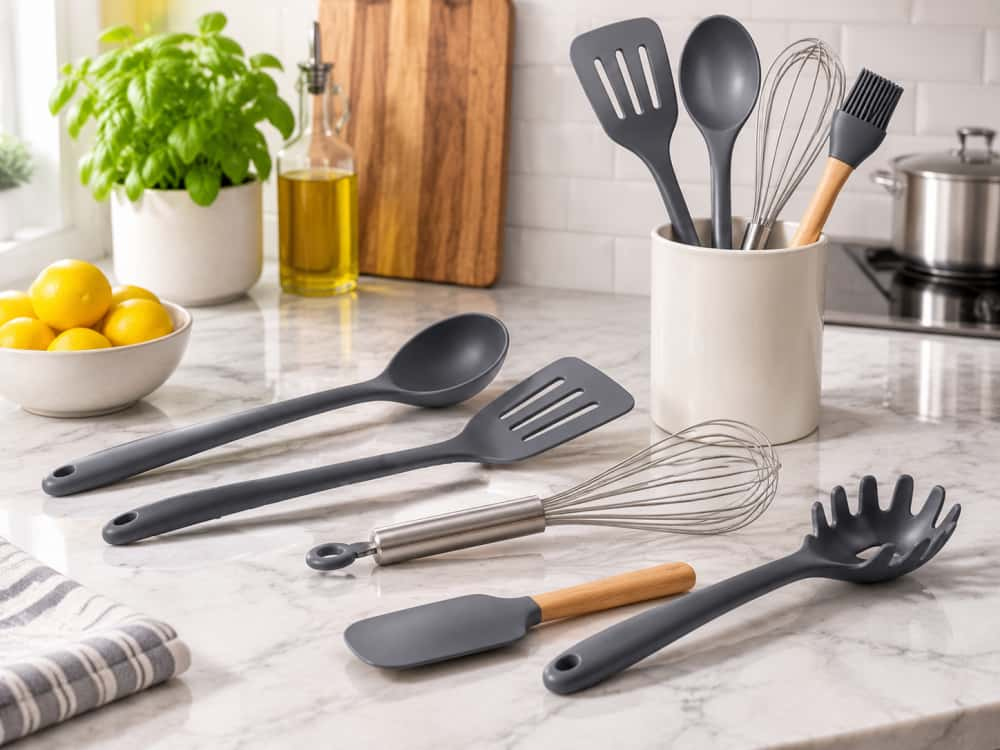
Food-grade silicone is a strong choice for flexible utensils used with non-stick cookware. Stainless steel is ideal for strength, durability, and high-temperature cooking tasks. Nylon is a lightweight and economical option, but its temperature limits and food-contact compliance should be checked carefully. For most kitchens, a combination of materials is more practical than relying on just one.
1. What Makes a Kitchen Utensil Material Safe?
Before comparing individual materials, it is important to understand what makes a kitchen utensil safe for food preparation. A utensil should not release harmful substances into food under its intended conditions of use, change the taste or smell of food, or deteriorate quickly during normal cooking and cleaning.
Food-contact safety is not determined by the material name alone. A product's formulation, manufacturing quality, surface finish, intended temperature range, and actual use conditions all matter.
Key Factors to Consider
- Food-contact compliance: Materials and finished products should meet the applicable food-contact requirements in the intended sales market.
- Temperature resistance: The utensil should be suitable for the temperatures and cooking methods for which it is marketed.
- Material stability: The material should maintain its structure and performance during normal use.
- Cookware compatibility: The utensil should not unnecessarily scratch or damage the cooking surface.
- Cleanability: Smooth surfaces and well-designed joints make utensils easier to wash and maintain.
- Product construction: Handles, cores, coatings, adhesives, and joints should also be suitable for their intended use.
For manufacturers and importers, food-contact compliance should be evaluated for the finished product and its intended conditions of use, rather than assumed from a material description alone. The European Commission's Joint Research Centre provides testing guidance for food-contact kitchenware made from plastics, silicone, metals, and other materials.
2. Silicone Kitchen Utensils: Best for Non-Stick Cookware
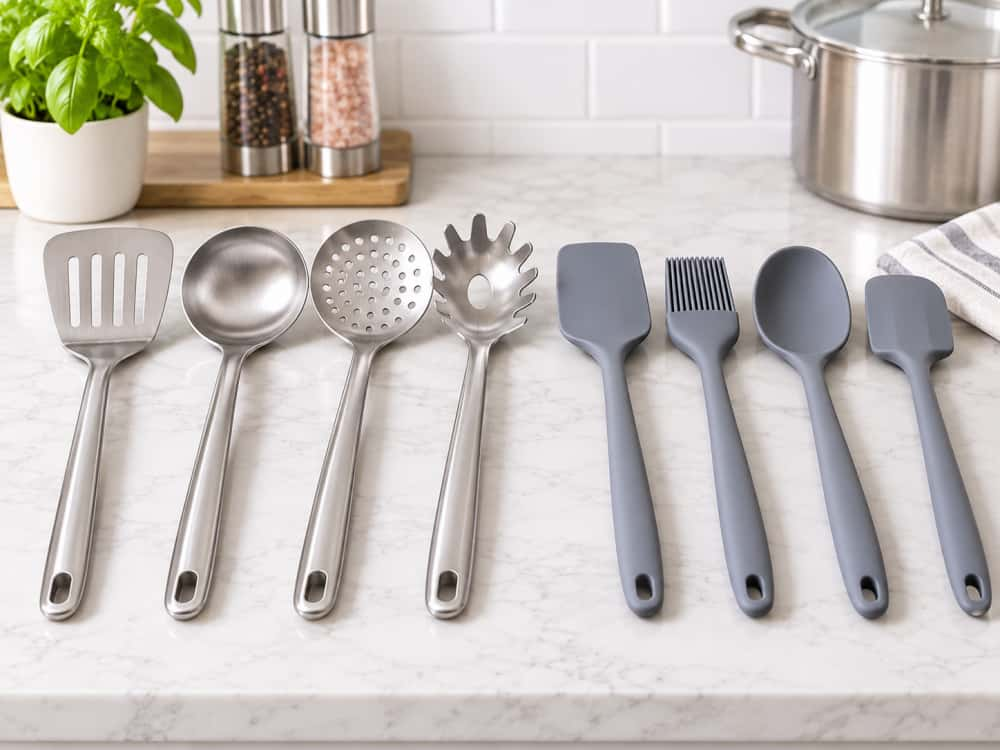
Silicone is one of the most popular materials for modern cooking utensils. Its flexibility, smooth surface, and compatibility with many non-stick cookware coatings make it suitable for spatulas, turners, cooking spoons, pastry brushes, and baking tools.
High-quality food-contact silicone is designed for use in food preparation. However, not all silicone products have the same formulation or temperature rating. Buyers should check the manufacturer's specifications and relevant compliance documentation before choosing a product.
Advantages of Silicone Utensils
- Cookware-friendly surface: Flexible silicone is less likely to scratch non-stick coatings during normal use.
- Heat resistance: Many silicone utensils are designed for hot cooking, although the maximum temperature varies by product.
- Flexibility: Silicone spatulas can scrape bowls and pans effectively and reach curved surfaces.
- Easy cleaning: Many one-piece silicone utensils have smooth surfaces and are dishwasher safe when the manufacturer permits it.
- Design flexibility: Silicone is available in a wide range of colors, shapes, and product styles.
Potential Limitations of Silicone
- Low-quality or poorly formulated products may not meet the expected food-contact requirements.
- Thin or poorly supported designs may bend too much when lifting heavy food.
- Some products have a silicone head attached to a separate handle, creating joints that need careful cleaning and inspection.
- Silicone utensils can retain odors or become stained depending on the food and product quality.
When Should You Choose Silicone?
Silicone is particularly suitable for:
- Non-stick frying pans and saucepans
- Scraping mixing bowls and baking containers
- Flexible spatulas and cooking spoons
- Pastry brushes and baking utensil sets
- Everyday cooking where flexibility and cookware protection are priorities
For example, silicone baking utensil sets can combine several flexible tools for mixing, scraping, spreading, and preparing food.
3. Nylon Kitchen Utensils: Lightweight and Economical
Nylon is commonly used in cooking spoons, slotted turners, ladles, pasta servers, and other everyday kitchen tools. It is lightweight, easy to mold into different shapes, and often more economical than silicone or stainless steel.
However, nylon deserves particular attention when evaluating the safest kitchen utensil materials. Nylon is a type of polyamide, and its performance depends on the specific formulation, manufacturing process, and temperature conditions.
Advantages of Nylon Utensils
- Lightweight construction: Nylon utensils are comfortable to handle during everyday cooking.
- Affordable pricing: They can be a cost-effective choice for household utensil sets and large-volume retail programs.
- Shape versatility: Nylon can be molded into turners, spoons, ladles, and other functional designs.
- Cookware compatibility: Properly designed nylon tools are generally more suitable for non-stick cookware than rigid metal utensils.
- Color options: Nylon supports a variety of colors and coordinated product designs.
Potential Limitations of Nylon
- Temperature limits: Nylon utensils can soften, deform, or deteriorate when exposed to temperatures beyond their specified limits.
- High-temperature contact: Some polyamide utensils may release substances into food under certain conditions.
- Surface wear: Scratched, cracked, or deformed utensils should be inspected and replaced when necessary.
- Product variation: Different nylon formulations and manufacturing processes can produce different performance and migration results.
The German Federal Institute for Risk Assessment (BfR) has issued guidance on polyamide kitchen utensils. It recommends keeping contact between polyamide utensils and hot food as brief as possible, particularly at temperatures above 70°C. This guidance highlights why material specifications and intended-use conditions matter when evaluating nylon products.
When Should You Choose Nylon?
Nylon can be a practical option for everyday utensils when the product is properly manufactured and used within its stated temperature range. It is often selected for lightweight cooking utensil sets, basic turners, spoons, and other tools where affordability is important.
For buyers, the key is not simply to ask whether a utensil is made from nylon. It is also important to verify the specific material formulation, food-contact testing, temperature rating, and care instructions.
Explore nylon cooking utensils for examples of this product category.
4. Stainless Steel Kitchen Utensils: Best for Strength and Durability
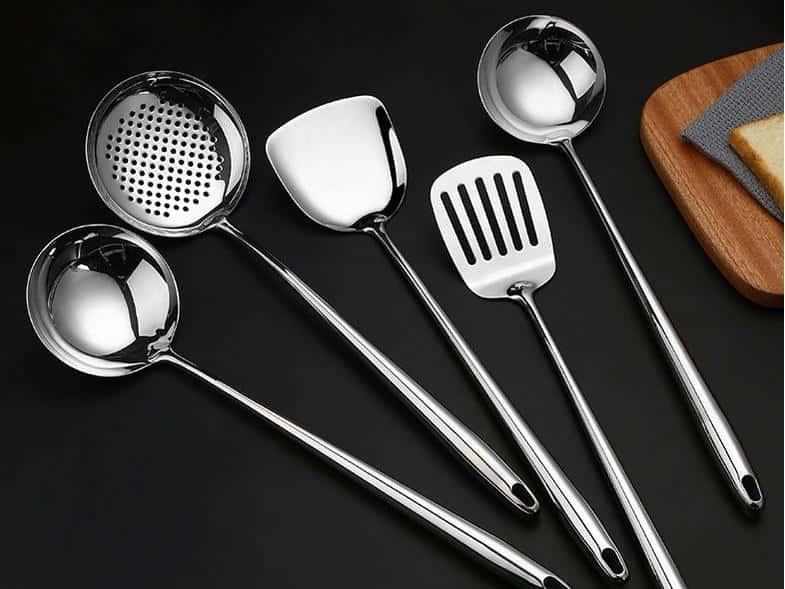
Stainless steel is widely used in kitchen utensils because of its strength, durability, heat resistance, and cleanable surface. It is a common choice for kitchen tongs, whisks, ladles, skimmers, serving spoons, and many commercial kitchen tools.
Food-contact stainless steel is valued for its corrosion resistance and ability to withstand repeated cleaning. However, stainless steel is not a single material grade. Different grades have different compositions and corrosion-resistance characteristics, so buyers should verify the grade and suitability for the intended application.
Advantages of Stainless Steel Utensils
- High strength: Stainless steel is suitable for tasks that require firm support and structural rigidity.
- Heat resistance: It can be used for many high-temperature cooking and food-preparation tasks.
- Durability: Well-made stainless steel utensils can withstand frequent use.
- Cleanable surface: Smooth stainless steel surfaces are generally easy to wash and maintain.
- Professional appearance: Stainless steel offers a clean, practical appearance for both home and commercial kitchens.
Potential Limitations of Stainless Steel
- Non-stick cookware compatibility: Rigid metal edges can scratch or damage non-stick coatings.
- Weight: Some stainless steel utensils are heavier than silicone or nylon alternatives.
- Heat transfer: Metal handles can become hot during cooking unless they are designed with heat protection.
- Grade selection: Corrosion resistance and performance depend on the stainless steel grade, construction, and use conditions.
When Should You Choose Stainless Steel?
Stainless steel is particularly suitable for:
- Kitchen tongs and serving tools
- Whisks and skimmers
- Sturdy ladles and cooking spoons
- Commercial kitchen applications
- Cooking tasks that require strength and rigid support
For example, restaurant-style kitchen utensil sets can combine durable construction with practical designs for frequent kitchen use.
5. Silicone vs. Nylon vs. Stainless Steel: Material Comparison
Each material offers different advantages. The best kitchen utensil material depends on the cooking task, cookware type, required durability, and product specifications.
| Comparison Factor | Silicone | Nylon | Stainless Steel |
|---|---|---|---|
| Food-contact suitability | Suitable when properly formulated and compliant | Suitable when properly formulated and compliant | Suitable when the grade and finished product meet applicable requirements |
| Heat resistance | Generally high; check product rating | More limited; check product rating carefully | Very high for normal cooking applications |
| Non-stick cookware | Very suitable | Generally suitable | Not recommended for coated surfaces unless specifically designed for them |
| Flexibility | High | Moderate | Low |
| Structural strength | Depends on design and internal support | Moderate; depends on design | High |
| Weight | Generally lightweight | Lightweight | Varies by thickness and construction |
| Typical applications | Spatulas, scrapers, baking tools | Turners, spoons, ladles | Tongs, whisks, skimmers, serving tools |
| Main consideration | Formulation, temperature rating, and construction | Temperature limits and food-contact migration testing | Steel grade, cookware compatibility, and handle design |
Important: This comparison describes general material characteristics, not a guarantee that every product made from a particular material is safe or suitable. Actual performance depends on product quality, construction, intended use, and the manufacturer's specifications.
6. What Is the Safest Kitchen Utensil Material?
If safety is the main priority, there is no single material that is automatically the safest in every situation. A properly manufactured food-contact silicone utensil, a compliant stainless steel utensil, and a compliant nylon utensil can all be suitable for their intended uses.
However, their practical safety considerations are different.
For Everyday Cooking
Food-contact silicone is a practical choice for many everyday kitchen tools, especially spatulas and turners used with non-stick cookware. Buyers should confirm the product's temperature rating and food-contact documentation.
For High-Temperature and Heavy-Duty Tasks
Food-contact stainless steel is a strong option when utensils need rigidity, strength, and resistance to repeated use. It should be used with cookware that is compatible with metal tools.
For Lightweight and Budget-Friendly Utensils
Nylon can be suitable for everyday cooking when its formulation and temperature rating are appropriate. Avoid leaving nylon tools in hot pans for extended periods, and follow the manufacturer's instructions.
In short, the safest kitchen utensil materials are those that are properly manufactured, tested for their intended food-contact conditions, and used according to their specifications.
7. How to Choose the Best Material for Kitchen Utensils
When deciding what material is best for kitchen utensils, start with the cookware and cooking tasks rather than choosing a material based on popularity alone.
1. Consider Your Cookware
- Non-stick cookware: Choose silicone or appropriately designed nylon utensils to reduce the risk of scratching the coating.
- Stainless steel cookware: Silicone, nylon, and stainless steel tools can all be considered, depending on the task.
- Cast iron cookware: Stainless steel and other sturdy utensils may be suitable, depending on the cooking technique.
2. Check the Temperature Rating
Different utensils have different maximum-use temperatures. Do not assume that all silicone products have the same heat resistance or that all nylon tools can be used in hot pans.
Check the manufacturer's stated temperature limit and avoid leaving plastic or silicone utensils in direct contact with hot cookware longer than recommended.
3. Evaluate the Construction
The design of a utensil can be just as important as the material itself. Consider:
- Whether the utensil is one-piece or assembled from multiple components
- Whether the handle is securely connected to the working head
- Whether joints and seams are easy to clean
- Whether the utensil has enough strength for its intended task
- Whether the handle provides a comfortable and secure grip
4. Review Cleaning and Maintenance Requirements
Many silicone and stainless steel utensils are dishwasher safe, but this should always be confirmed through product instructions. Nylon products may have more specific temperature and cleaning limitations. For multi-material utensils, the least heat-resistant component may determine the care requirements.
5. Look for Relevant Food-Contact Documentation
For products sold internationally, requirements can differ between markets. Depending on the destination, buyers may need to review applicable food-contact regulations, migration test reports, material specifications, and other supporting documents.
Do not rely only on a generic claim such as "BPA-free" or "food grade." These statements do not replace the appropriate compliance assessment for the complete product.
8. What Is the Best Material for Different Kitchen Utensils?
Not every utensil needs to be made from the same material. Matching the material to the function can create a more practical and versatile kitchen utensil collection.
| Kitchen Utensil | Suitable Material Options | Why It Works |
|---|---|---|
| Spatula | Silicone | Flexible and suitable for scraping and mixing |
| Slotted Turner | Silicone or nylon | Lightweight and generally compatible with non-stick cookware |
| Cooking Spoon | Silicone, nylon, or stainless steel | Choice depends on heat exposure and cooking style |
| Whisk | Stainless steel or silicone-coated wire | Provides the rigidity needed for whisking |
| Kitchen Tongs | Stainless steel with silicone tips | Combines structural strength with a softer contact surface |
| Ladle | Stainless steel, silicone, or nylon | Depends on pot type, temperature, and desired strength |
| Pastry Brush | Silicone | Flexible bristles and convenient cleaning |
| Skimmer | Stainless steel | Rigid construction for lifting and draining food |
A mixed-material utensil set can offer more flexibility than a set made entirely from one material. For example, silicone spatulas can be paired with stainless steel whisks and tongs to cover a wider range of cooking tasks.
9. What Should Buyers Look for When Sourcing Kitchen Utensils?
For importers, retailers, wholesalers, and private-label brands, choosing the best material for kitchen utensils involves more than comparing the price of silicone, nylon, and stainless steel.
A reliable sourcing process should evaluate the material, product construction, compliance documentation, manufacturing consistency, and packaging requirements together.
Material and Compliance Verification
- Confirm the exact material and grade used in each product component.
- Request relevant food-contact test reports for the intended market.
- Check whether testing covers the product's intended temperature and food-contact conditions.
- Verify that handles, coatings, joints, and other components are included in the product assessment where relevant.
Product Design and Quality Control
- Check the thickness and structural strength of the working head.
- Evaluate handle ergonomics, grip, and balance.
- Inspect joints and connections for secure assembly.
- Check for sharp edges, burrs, deformation, and surface defects.
- Confirm cleaning instructions and dishwasher claims through appropriate testing.
Customization and Private Label Considerations
Brands developing their own kitchen utensil collections may also need to consider:
- Custom colors and coordinated product collections
- Handle materials and ergonomic designs
- Silicone and stainless steel combination designs
- Product assortment and set configurations
- Retail packaging, logo placement, and labeling
- Market-specific compliance and documentation requirements
For B2B buyers, the best supplier is not necessarily the one offering the lowest unit price. Consistent product quality, reliable documentation, suitable production processes, and clear communication are also important factors.
10. Frequently Asked Questions About Kitchen Utensil Materials
What is the best material for kitchen utensils?
There is no single best material for every kitchen utensil. Silicone is a strong choice for flexible tools and non-stick cookware, stainless steel is suitable for durable and rigid utensils, and nylon is a lightweight and economical option when used within its specified temperature range.
What is the safest kitchen utensil material?
Food-contact silicone and stainless steel are commonly selected for their useful cooking properties, but safety depends on the specific product, material quality, manufacturing process, and intended use. Properly compliant nylon can also be suitable for its intended applications.
Are silicone kitchen utensils safer than nylon?
Not automatically. Both materials can be suitable for food contact when properly manufactured and tested. However, nylon utensils require particular attention to temperature limits and hot-food contact conditions. Always check the product specifications and care instructions.
Are stainless steel kitchen utensils safe?
Food-contact stainless steel is widely used because of its strength, cleanable surface, and corrosion resistance. Buyers should still verify the steel grade and suitability of the finished product for its intended food-contact conditions.
Are nylon cooking utensils safe for high heat?
Nylon utensils should only be used within the temperature range specified by the manufacturer. Some polyamide utensils may release substances into food under certain high-temperature conditions. Avoid prolonged contact with very hot food and cookware, and follow the product's instructions.
Are silicone utensils safe for non-stick cookware?
Yes. Properly designed silicone utensils are generally suitable for non-stick cookware because their flexible surfaces are less likely to scratch coatings during normal use. Avoid using damaged utensils and follow the cookware manufacturer's recommendations.
Can stainless steel utensils scratch non-stick pans?
Yes. Rigid stainless steel edges can scratch or damage non-stick coatings. Silicone or appropriately designed nylon utensils are generally better choices for coated cookware.
Are all food-grade silicone utensils heat-resistant?
Silicone products can have different temperature ratings depending on their formulation and construction. The term "food-grade" does not mean that every silicone utensil can withstand the same temperature. Check the manufacturer's stated maximum-use temperature.
Is a mixed-material kitchen utensil set better than a single-material set?
For many kitchens, yes. A mixed-material set can combine silicone spatulas for non-stick cookware, stainless steel whisks and tongs for strength, and other tools selected for specific tasks. The most useful combination depends on cooking habits and cookware.
What should importers check before buying kitchen utensils?
Importers should verify material specifications, food-contact compliance, temperature ratings, product construction, quality consistency, and packaging requirements. Testing and documentation should match the destination market and the product's intended conditions of use.
Conclusion: Choose the Right Material for the Right Cooking Task
The best kitchen utensil material depends on the balance of food-contact safety, heat resistance, durability, flexibility, and cookware compatibility.
Silicone is a practical choice for flexible tools and non-stick cookware. Stainless steel offers strength and durability for many cooking and serving tasks. Nylon provides a lightweight and economical alternative when its temperature limits and product specifications are respected.
Rather than looking for one material that does everything, consumers and buyers should select utensils according to their intended applications. For brands and distributors, evaluating material quality, product construction, and food-contact compliance is essential when developing a reliable kitchen utensil collection.
Looking for Reliable Kitchen Utensil Solutions?
Kitlucy offers a range of kitchen utensils and cooking tools for brands, retailers, wholesalers, and distributors. From silicone baking utensils to nylon cooking tools and stainless steel utensil designs, we support product selection and customized kitchenware solutions.
Whether you are developing a new product range, building a private-label collection, or sourcing kitchen utensil sets for your market, our team can help you explore suitable product options.
References and Further Reading
For readers who want to learn more about food-contact materials and kitchen utensil safety, the following resources provide additional technical guidance:
- German Federal Institute for Risk Assessment (BfR): Polyamide Kitchen Utensils – Guidance on polyamide utensils and contact with hot food.
- Finnish Food Authority: Metals and Alloys – Information about stainless steel and food-contact materials.
- European Commission Joint Research Centre: Testing Conditions for Kitchenware – Technical guidance covering plastics, metals, silicone, and other food-contact materials.
Related Blogs