Are Aluminum Cutting Boards Safe for Food Preparation?
Are Aluminum Cutting Boards Safe for Food Preparation?
Aluminum cutting boards may be suitable for certain food-preparation tasks, but their safety depends on the specific material, surface finish, manufacturing quality, and intended use. Not every aluminum board is automatically safe for direct food contact, and a product's appearance alone cannot establish its safety.
If you are considering an aluminum cutting board for your kitchen, restaurant, or product range, check whether the manufacturer can document its suitability for food contact. You should also consider how the surface interacts with knives, acidic ingredients, cleaning products, and repeated use.
1. What Determines Whether an Aluminum Cutting Board Is Safe?
Food-contact safety is not determined by the word "aluminum" alone. The important question is whether the finished product is suitable for its intended contact with food under actual conditions of use.
Material composition and quality
Aluminum products can differ in alloy composition, purity, manufacturing process, and surface condition. A reputable supplier should be able to identify the material used and provide relevant technical documentation.
For products intended for food preparation, buyers should pay particular attention to potential contaminants and the suitability of the finished material. A low price or polished appearance is not proof of food-contact safety.
Surface finish and condition
The surface of a cutting board affects how it performs during repeated food preparation. Scratches, rough areas, corrosion, damaged coatings, or exposed underlying material may change how a product should be used and maintained.
If a board has a coating, anodized finish, or another surface treatment, confirm that the finished surface is appropriate for the intended food-contact application. Do not assume that every coating or treatment is food-contact compliant simply because it is used on metal products.
Food-contact compliance and testing
Manufacturers and importers should verify that the finished product meets the applicable requirements in its target market. Depending on the product and market, relevant documentation may include material specifications, supplier declarations, and appropriate test reports.
For the US market, the FDA has warned about certain imported cookware made from aluminum and specific aluminum alloys that demonstrated the potential to leach lead into food. That warning concerns identified cookware products, not aluminum cutting boards as a category. It nevertheless highlights why material traceability and suitable testing matter when evaluating food-contact products.
Read the FDA's guidance on certain imported cookware for further context.
2. Can Aluminum Transfer Into Food?
Aluminum can interact with certain foods under some conditions. The amount of transfer, if any, depends on factors such as material composition, surface condition, contact time, temperature, and food chemistry.
For a cutting board, the relevant situation is usually contact with food at room temperature rather than prolonged cooking or storage. However, this difference does not eliminate the need to assess the actual product and its intended use.
Does cutting on aluminum automatically make food unsafe?
No. The presence of aluminum as a material does not, by itself, prove that a cutting board is unsafe. Equally, the fact that aluminum is widely used in food-related products does not establish that every aluminum surface is suitable for chopping.
The correct approach is to evaluate the finished product, its intended food-contact conditions, and the manufacturer's supporting evidence rather than relying on a broad claim about the material.
What about scratches and surface damage?
Repeated chopping can leave marks on a metal surface. Scratches do not automatically mean that a product is hazardous, but deep damage, rough edges, flaking coatings, or visible corrosion are reasons to stop using the board until its condition has been assessed.
A cutting board should have a stable, cleanable surface without defects that interfere with normal food preparation. Follow the manufacturer's guidance on inspection, maintenance, and replacement.
3. Are Aluminum Cutting Boards Safe for Acidic Foods?
Acidic ingredients such as lemons, tomatoes, vinegar, and citrus-based marinades can interact with some metals. Whether that interaction is significant depends on the particular aluminum material, its surface finish, and the conditions of contact.
For this reason, do not assume that an aluminum cutting board is suitable for every ingredient simply because it is marketed for kitchen use.
Before using an aluminum board for acidic foods:
- Check whether the manufacturer explicitly permits contact with acidic ingredients.
- Follow any restrictions relating to food types, contact time, or cleaning.
- Avoid leaving acidic foods or wet food residues on the surface longer than necessary.
- Inspect the board for discoloration, corrosion, pitting, or damage.
- Choose another suitable cutting surface if the manufacturer does not confirm the intended use.
4. Do Aluminum Cutting Boards Damage Knives?
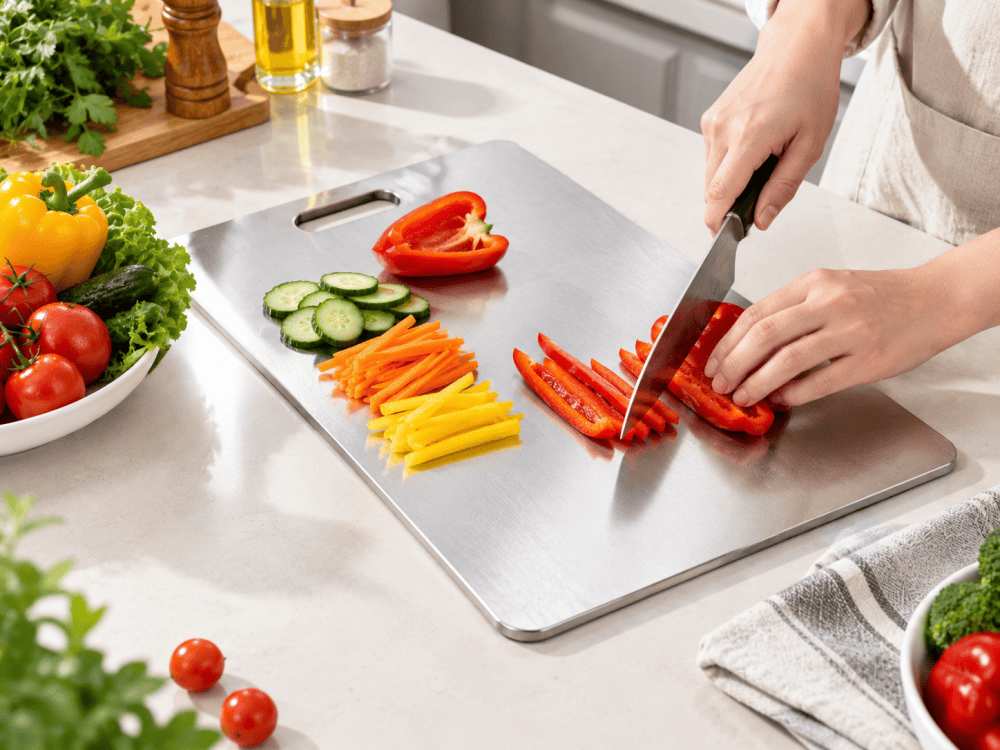
Knife performance is one of the main practical considerations when choosing an aluminum cutting board. Aluminum is a rigid metal, so it generally provides less cushioning for a knife edge than suitable wood or plastic cutting surfaces.
Repeated chopping against a hard surface can contribute to faster edge wear or affect how a knife feels during use. The result depends on the blade steel, edge geometry, cutting technique, and the board's surface condition.
For home cooks, chefs, and food-service businesses that use knives frequently, this can be an important disadvantage even when a board is otherwise suitable for food contact.
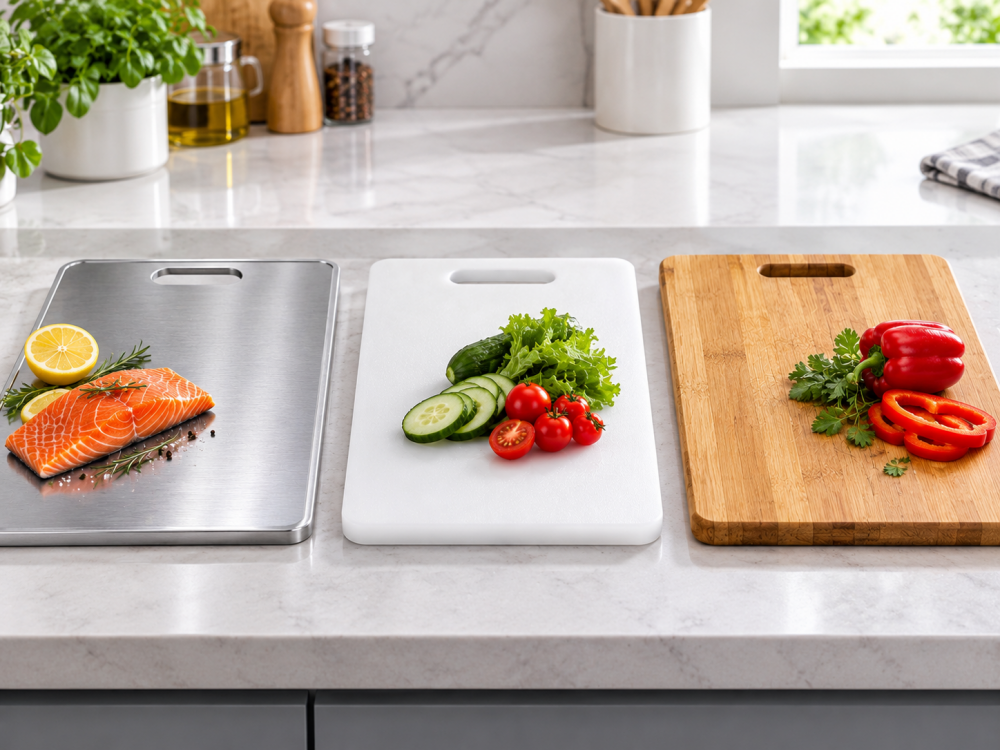
Aluminum vs. plastic vs. wood cutting boards
| Factor | Aluminum | Suitable plastic | Suitable wood |
|---|---|---|---|
| Food-contact suitability | Depends on alloy, finish, and product compliance | Depends on polymer, formulation, and intended use | Depends on wood type, construction, and maintenance |
| Knife-edge impact | Rigid surface may contribute to faster edge wear | Generally more forgiving than metal | Generally more forgiving than metal |
| Cleaning | Follow material- and finish-specific instructions | Often straightforward when designed for food preparation | Requires appropriate washing and thorough drying |
| Maintenance | Inspect for corrosion, surface damage, and finish deterioration | Inspect for deep grooves and wear | Inspect for deep cuts, cracks, and surface deterioration |
| Typical consideration | Material and surface suitability must be verified | Practical for many everyday kitchen tasks | Popular for general chopping and food preparation |
There is no single cutting board material that is best for every kitchen. Choose based on food-contact suitability, cleaning requirements, knife performance, durability, and the tasks the board is designed to handle.
For more background on aluminum boards, read our guide: What Is an Aluminum Cutting Board? Uses, Pros, Cons & Safety.
5. How to Use an Aluminum Cutting Board More Safely
If the manufacturer confirms that your aluminum cutting board is suitable for the intended food-contact use, follow these practices to help maintain a clean and serviceable surface.
Clean it after food preparation
Remove food scraps promptly and wash the board according to the manufacturer's instructions. Use an appropriate cleaning agent and rinse away residues where required. Cleaning removes food debris; sanitizing is a separate step and may be necessary depending on the food, setting, and applicable hygiene procedures.
Use only approved cleaning methods
Strong acids, strong alkalis, abrasive pads, and unsuitable chemical cleaners may damage certain aluminum surfaces or finishes. Do not use bleach, dishwasher cycles, or other aggressive cleaning methods unless the manufacturer confirms they are appropriate for that product.
For a more detailed maintenance routine, see How to Clean and Maintain an Aluminum Cutting Board.
Prevent cross-contamination
Separate raw meat, poultry, seafood, ready-to-eat foods, and produce according to your kitchen's food-safety procedures. Wash and, where required, sanitize the board and utensils between tasks. A metal surface should not be assumed to be self-sanitizing.
Inspect the board regularly
Check for deep scratches, sharp edges, pitting, corrosion, damaged coatings, or other deterioration. Stop using the board if it cannot be cleaned effectively or if its surface condition raises concerns about safe food contact.
6. How to Choose an Aluminum Cutting Board for Commercial Use
Restaurants, distributors, retailers, and private-label brands should evaluate more than appearance and unit price when sourcing an aluminum cutting board.
Verify the exact material
Ask for the material grade or alloy specification and confirm that the information applies to the actual product being supplied. If the board has a coating or surface treatment, request details about that finished surface as well.
Request relevant food-contact documentation
Ask the supplier for documentation appropriate to the product and destination market. Depending on the application, this may include declarations of compliance, material specifications, or test reports addressing relevant chemical migration or contaminants.
A general quality-management certificate is not a substitute for evidence that a particular finished product is suitable for its intended food-contact use.
Evaluate the surface and construction
Inspect sample products for sharp edges, burrs, rough areas, uneven finishes, and defects that could affect cleaning or use. Consider the board's thickness, stability, edge design, and resistance to expected wear.
Confirm cleaning and use instructions
Before placing a product on the market, make sure the instructions accurately describe suitable foods, cleaning methods, sanitizing procedures where applicable, and any limitations on use. Avoid unsupported claims such as "100% safe for all foods" or "suitable for every dishwasher."
Assess the intended market
Food-contact requirements can vary by destination market and product category. Importers and private-label brands should verify applicable requirements before approving mass production, rather than assuming that one document automatically covers every country or use case.
7. Are Aluminum Cutting Boards Better Than Plastic or Wood?
Not necessarily. Aluminum cutting boards may appeal to buyers looking for a metal surface, but they are not automatically a better choice for everyday chopping.
- Choose a suitable plastic cutting board when practical cleaning, everyday chopping, and a more forgiving knife-contact surface are priorities.
- Choose a suitable wood cutting board when you want a traditional chopping surface and are prepared to follow appropriate cleaning and drying practices.
- Consider an aluminum cutting board only when the specific product is designed for the intended food-contact application and its material, finish, maintenance needs, and effect on knives are acceptable.
For buyers comparing cutting board materials, the key is not to choose based on a single marketing claim. Assess the intended application, the quality of the finished product, and the supporting documentation.
8. Frequently Asked Questions
Are aluminum cutting boards safe for food preparation?
They may be suitable when made from appropriate materials, finished for the intended food-contact use, and maintained according to the manufacturer's instructions. Safety cannot be determined from the word "aluminum" alone.
Can aluminum from a cutting board get into food?
Aluminum can interact with food under certain conditions, but the extent depends on the material, surface condition, and contact conditions. For a specific cutting board, consult the manufacturer's technical information and relevant food-contact testing.
Can I cut lemons or tomatoes on an aluminum cutting board?
Check the manufacturer's instructions first. Acidic ingredients may interact with some aluminum surfaces, so do not assume every aluminum board is suitable for all acidic foods or prolonged contact.
Do aluminum cutting boards dull knives?
A rigid metal surface may contribute to faster knife-edge wear than more forgiving wood or plastic cutting surfaces. The effect depends on the blade, cutting technique, and surface condition.
Are aluminum cutting boards dishwasher-safe?
Not all aluminum cutting boards are dishwasher-safe. High temperatures, detergents, and other conditions may affect some materials or finishes. Use a dishwasher only if the manufacturer explicitly confirms that the specific product is suitable.
What should I check before buying an aluminum cutting board?
Check the material specification, surface finish, intended food-contact use, relevant compliance documentation, cleaning instructions, and product condition. Commercial buyers should also verify that the documentation and claims apply to the exact model being purchased.
Is aluminum safer than plastic for cutting food?
Neither material is automatically safer in every situation. Food-contact suitability depends on the specific material and finished product, while practical considerations include cleaning, surface wear, and knife performance. Compare products using their intended use and supporting documentation.
Looking for Kitchenware Solutions for Your Brand?
Kitlucy is a kitchenware brand under DKS-Group, focused on cooking and baking tools. For wholesale or private-label projects, buyers can discuss product requirements, customization options, packaging, and applicable food-contact documentation with the team.
When evaluating any cutting board project, confirm the proposed material, surface finish, intended use, and compliance requirements before production.
Contact KitlucyFinal Thoughts
So, are aluminum cutting boards safe for food preparation? The most accurate answer is that safety depends on the specific product, its material and surface finish, its suitability for food contact, and how it is used and maintained.
Before buying or sourcing one, verify the material and relevant documentation, follow the manufacturer's instructions, and consider whether a rigid metal surface is appropriate for your knives and food-preparation tasks. When these factors are unclear, choose a cutting board specifically designed and documented for your intended use.
Related Blogs