What Is an Aluminum Cutting Board? Uses, Pros, Cons & Safety
What Is an Aluminum Cutting Board? Uses, Pros, Cons & Safety
What is an aluminum cutting board? An aluminum cutting board is a cutting or food-preparation surface made primarily from aluminum or an aluminum alloy. It may be used for certain food-preparation, commercial, or specialized applications. However, aluminum is a rigid metal, so it is generally less forgiving on knife edges than suitable wood or plastic cutting boards. Its suitability for direct food contact depends on the specific alloy, surface finish, construction, and intended use.
Aluminum is widely used in cookware, bakeware, food-processing equipment, and other kitchen products because it is lightweight, conducts heat efficiently, and can be manufactured into different shapes. These characteristics may lead buyers to consider aluminum for cutting boards as well.
But is an aluminum cutting board a good choice for everyday food preparation? Is it safe for cutting vegetables, meat, and other ingredients? And how does it compare with plastic, wood, or stainless steel?
This guide explains what an aluminum cutting board is, how it differs from other cutting surfaces, its potential advantages and limitations, and what consumers and kitchenware buyers should evaluate before choosing one.
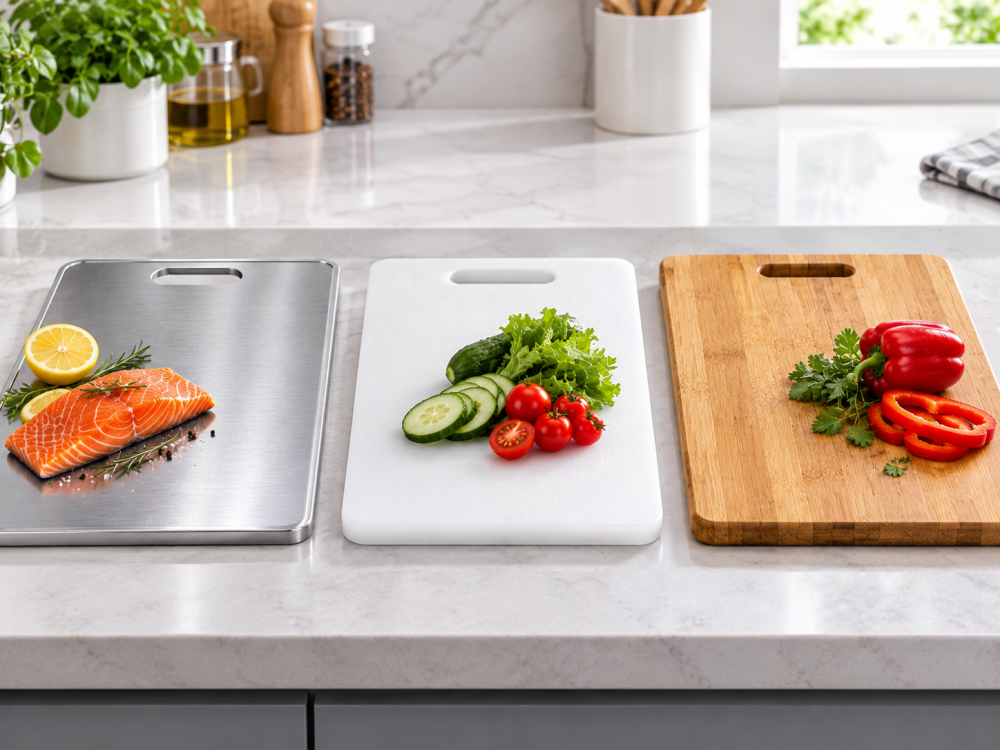
What Is an Aluminum Cutting Board Made Of?
An aluminum cutting board is generally made from aluminum or an aluminum alloy formed into a flat surface. Depending on the design, it may have a natural metal finish, a treated surface, rounded edges, a textured pattern, or other structural features.
Not every product marketed as an aluminum cutting board has the same construction. Some products may combine aluminum with other materials, while others may use a metal surface for a specialized preparation task rather than as a general-purpose chopping board.
When evaluating a product, buyers should confirm the following details:
- Base material: Whether the product is made from aluminum, an aluminum alloy, stainless steel, or a combination of materials.
- Surface finish: Whether the surface is untreated, anodized, coated, or otherwise treated.
- Thickness and rigidity: How the board is constructed and whether it can resist bending under expected use.
- Food-contact suitability: Whether the material and finished product are suitable for the intended foods and conditions of use.
- Intended application: Whether the product is designed for chopping, food presentation, processing, or another specific task.
Important distinction: An aluminum cutting board is not the same as an aluminum baking tray or a stainless steel cutting surface. Similar appearance does not mean identical material properties, food-contact suitability, or performance when used with knives.
What Are Aluminum Cutting Boards Used For?
The suitability of an aluminum cutting board depends on its design and intended application. Although aluminum is common in many kitchen products, that does not automatically make it suitable for everyday chopping.
1. Specialized Food Preparation
Some metal surfaces may be designed for particular food-preparation or processing tasks. Before using an aluminum surface for direct food contact, confirm that its material, finish, and construction are appropriate for that application.
2. Commercial or Industrial Applications
In commercial environments, the choice of a preparation surface may depend on sanitation procedures, durability, production requirements, and the type of food being handled. A metal surface should be evaluated against the relevant operational and food-contact requirements rather than selected on material name alone.
3. Specialized Kitchen Products
Some products described as metal cutting boards may be intended for specific tasks or niche markets. Buyers should examine the manufacturer's specifications to determine whether the product is designed for repeated knife contact or for another purpose.
For routine home cooking, suitable wood and plastic cutting boards are generally more practical choices because they are available in a wide range of designs intended for repeated cutting.
What Are the Advantages of Aluminum Cutting Boards?
Aluminum has several useful material properties. However, the benefits of aluminum as a general engineering material should not be confused with proof that it is the best material for a cutting board.
1. Lightweight Construction
Aluminum is relatively lightweight compared with many other metals. Depending on its thickness and construction, an aluminum board may be easier to handle than a similarly sized board made from a denser metal.
2. Corrosion Resistance Under Suitable Conditions
Aluminum naturally forms a thin oxide layer that helps protect its surface against further oxidation. Its corrosion performance nevertheless depends on the alloy, surface condition, food chemistry, cleaning products, and exposure conditions.
Acidic or salty foods and unsuitable cleaning chemicals may affect certain aluminum surfaces. A product's maintenance instructions should therefore be followed carefully.
3. Easy Metal Forming and Fabrication
Aluminum can be formed and fabricated into a variety of shapes and thicknesses. This can be useful in product development when a particular design, edge profile, or structural configuration is required.
4. Potential for Different Surface Finishes
Depending on the alloy and manufacturing process, aluminum products may have different finishes or surface treatments. These finishes can affect appearance, corrosion performance, cleaning requirements, and suitability for specific uses.
However, a smoother or more attractive finish does not by itself establish that a surface is suitable for direct food contact or repeated knife use.
What Are the Disadvantages of Aluminum Cutting Boards?
For general-purpose chopping, aluminum has important limitations that should be considered before choosing it over wood or plastic.
1. Aluminum Can Be Hard on Knife Edges
Aluminum is a rigid metal surface. Repeatedly cutting against a rigid surface can contribute to knife-edge wear, depending on the blade material, edge geometry, cutting technique, and surface characteristics.
For everyday chopping, many cooks prefer wood or suitable plastic boards because these materials provide a more forgiving cutting surface than rigid metal.
If protecting knife sharpness is a priority, a conventional aluminum board is generally not the first choice for routine chopping.
2. A Rigid Surface May Feel Uncomfortable During Chopping
A metal board does not provide the same cutting feel as a suitable wood or plastic board. Depending on the task, the rigid surface may feel less comfortable during repeated chopping and may produce more noticeable impact or noise.
3. Surface Scratches and Wear Need Consideration
Repeated contact with knives and utensils can mark a metal surface. Whether those marks affect performance or cleaning depends on their depth, the finish, and the product's maintenance requirements.
Buyers should follow the manufacturer's guidance for inspecting, cleaning, and replacing a product when the surface becomes damaged.
4. Food Compatibility Depends on the Specific Product
Aluminum can interact with certain foods, particularly under some acidic or salty conditions. The degree of interaction depends on the alloy, surface treatment, food composition, temperature, and contact time.
Therefore, it is not appropriate to assume that every aluminum surface is suitable for every food-preparation task.
Are Aluminum Cutting Boards Safe for Food?
An aluminum cutting board should only be used for food preparation when its specific material, surface finish, and finished-product construction are suitable for the intended food-contact conditions.
The word "aluminum" alone does not establish whether a product is safe for all foods or all cleaning and temperature conditions.
When evaluating an aluminum food-contact product, consider the following factors:
- Alloy composition: Confirm the specific material rather than relying only on a general product description.
- Surface treatment: Determine whether the surface is anodized, coated, untreated, or otherwise modified.
- Intended food use: Consider the types of foods that will contact the surface, including acidic and salty ingredients.
- Cleaning conditions: Confirm compatibility with the intended detergents, sanitizers, and cleaning procedures.
- Product documentation: Request relevant food-contact compliance documents and test reports for the target market and application.
- Surface condition: Inspect for deep scratches, peeling coatings, corrosion, or other damage that could affect continued use.
Food-contact requirements vary by market and intended use. In the United States, the FDA evaluates food-contact substances according to their authorized uses and conditions of use. Buyers should verify the specific product and its supporting documentation rather than assuming that all aluminum kitchen products meet the same requirements.
For example, the FDA has warned retailers and distributors about certain imported aluminum and aluminum-alloy cookware that may leach lead. This warning does not mean that all aluminum products contain lead; it demonstrates why material identity, manufacturing quality, and appropriate testing matter.
Can Aluminum Cutting Boards Damage Knives?
They can contribute to knife-edge wear during repeated cutting. Aluminum is a rigid metal, and its interaction with a knife edge differs from that of softer, more forgiving cutting-board materials.
The actual effect depends on several factors:
- The hardness and geometry of the knife edge
- The aluminum alloy and surface condition
- The force and angle used during cutting
- The frequency and type of cutting tasks
- The presence of surface damage or rough areas
For this reason, a conventional aluminum surface is generally not the preferred choice for frequent chopping with kitchen knives.
Wood and suitable plastic cutting boards are more common options for everyday preparation because they are designed to provide a more forgiving surface for knife work.

Aluminum vs Plastic Cutting Boards
Aluminum and plastic differ significantly in rigidity, cutting feel, weight, and typical kitchen applications. The better choice depends on the intended task.
| Feature | Aluminum Cutting Board | Plastic Cutting Board |
|---|---|---|
| Material | Aluminum or an aluminum alloy | Usually a food-contact polymer such as PP or HDPE |
| Surface rigidity | Rigid metal surface | Depends on polymer, thickness, and construction |
| Knife-edge considerations | Rigid surface may contribute to edge wear | Suitable plastic boards generally offer a more forgiving cutting surface |
| Weight | Relatively lightweight for a metal | Varies by polymer and thickness |
| Corrosion | Depends on alloy, finish, and exposure | Does not rust, although the material can still wear or degrade |
| Surface wear | Can develop scratches and marks | Can develop knife grooves and surface wear |
| Common use | Specialized applications when the design is suitable | General-purpose food preparation |
Plastic cutting boards are not all identical. For food preparation, buyers should select a suitable food-contact grade and follow the product's care and replacement instructions.
Aluminum vs Wood Cutting Boards
Wood is a popular choice for everyday chopping because it offers a different cutting feel from metal and is available in many durable designs. Its performance depends on the wood species, grain orientation, construction, finish, and maintenance.
| Feature | Aluminum | Wood |
|---|---|---|
| Cutting feel | Hard and rigid | Generally more forgiving to knife edges |
| Maintenance | Depends on alloy and surface finish | Often requires careful drying and, for some boards, periodic oiling |
| Moisture behavior | Does not absorb water like wood | Can absorb moisture and may warp or crack if poorly maintained |
| Appearance | Metallic finish | Natural grain and varied colors |
| Best suited for | Specific applications where the metal surface is appropriate | Many everyday chopping and food-preparation tasks |
Neither material should be judged by appearance alone. Food-contact suitability, cleaning, drying, surface condition, and the intended use all matter.
Is Aluminum Better Than Stainless Steel for a Cutting Board?
Aluminum and stainless steel are different metals with different properties. Aluminum is generally lighter, while stainless steel is commonly selected for its strength and corrosion resistance in many food-service applications.
However, stainless steel is also a rigid metal surface and is not automatically the best choice for routine knife chopping. A stainless steel preparation table, for example, serves a different purpose from a conventional cutting board designed to protect knife edges.
When comparing metal surfaces, evaluate the specific alloy, finish, construction, cleaning requirements, and intended task. If the primary purpose is everyday chopping, suitable wood or plastic boards are generally more practical starting points.
How to Choose the Right Cutting Board Material
Before purchasing a cutting board, consider what you prepare, how frequently you use knives, and how the board will be cleaned and maintained.
Choose a Suitable Plastic Board for Versatile Everyday Use
A suitable food-contact plastic board can be practical for routine kitchen preparation. Look for a product with clear material specifications, appropriate dimensions, a stable design, and care instructions that fit your kitchen routine.
Choose Wood for a Traditional Cutting Surface
Wood may be suitable if you prefer a natural appearance and a more forgiving cutting feel. Select a board designed for food preparation and follow its cleaning and drying instructions.
Consider Metal Surfaces for Specific Applications
If you are considering aluminum or stainless steel, confirm that the surface is designed for the task. Do not assume that a metal plate or tray can automatically replace a conventional cutting board.
Check Product Quality and Documentation
Regardless of material, look for a well-finished product with clear specifications, suitable food-contact documentation, and practical cleaning instructions.
What Should B2B Buyers Check When Sourcing Cutting Boards?
For importers, wholesalers, retailers, and private-label brands, material selection is only one part of a cutting-board sourcing decision.
Before placing a wholesale or OEM order, evaluate the following points:
- Material specification: Confirm the exact polymer, wood species, metal alloy, or composite construction.
- Dimensions and thickness: Match the board to the intended market and application.
- Surface finish: Check edges, corners, surface consistency, and any coating or treatment.
- Food-contact documentation: Request applicable compliance documents and test reports for the target market.
- Quality control: Ask about inspection procedures, batch consistency, and defect handling.
- Cleaning and maintenance: Ensure that the product's care instructions are clear and appropriate.
- Packaging: Consider retail packaging, protective packaging, labeling, and shipping requirements.
- Customization: Confirm whether the supplier can support sizes, colors, shapes, logos, and private-label packaging.
- MOQ and lead time: Confirm minimum order quantities, sampling arrangements, production lead times, and shipping terms.
These checks are particularly important when comparing products that look similar but use different materials or manufacturing processes.
Can Kitlucy Customize Cutting Boards for Wholesale?
Kitlucy is a kitchenware brand under DKS-Group, with more than 27 years of manufacturing experience through its group background. Its kitchenware offering includes cutting boards and other cooking and baking tools, with OEM and ODM customization options.
For a cutting-board project, buyers can discuss requirements such as product dimensions, shape, color, material, logo, set configuration, and packaging, subject to product feasibility and project specifications.
If your project specifically requires an aluminum cutting surface, confirm the exact material, intended application, food-contact documentation, surface finish, and production feasibility before proceeding. Do not assume that every cutting-board design or material is available as a standard Kitlucy product.
Looking for a Cutting Board Supplier for Your Brand?
Kitlucy supports kitchenware OEM and ODM projects for buyers looking for customized cutting boards, cooking tools, and baking products.
Share your target material, dimensions, design, packaging, and order requirements to discuss a suitable product solution.
Frequently Asked Questions
What is an aluminum cutting board?
An aluminum cutting board is a cutting or food-preparation surface made primarily from aluminum or an aluminum alloy. Its suitability depends on the design, surface finish, and intended application.
Are aluminum cutting boards safe?
They may be suitable for specific food-contact applications when the material, surface finish, and finished product meet the applicable requirements. Buyers should confirm the product's intended use and supporting documentation.
Are aluminum cutting boards good for knives?
Generally, they are not the first choice for everyday chopping. A rigid metal surface can contribute to knife-edge wear, while suitable wood and plastic boards provide a more forgiving cutting surface.
Can aluminum cutting boards rust?
Aluminum does not form iron rust, but it can oxidize and may corrode under certain conditions. Its resistance depends on the alloy, finish, food exposure, and cleaning chemicals.
Is aluminum better than plastic for cutting boards?
Not for every purpose. Suitable plastic boards are generally more practical for everyday chopping, while aluminum may be considered for specific applications where its metal properties are appropriate.
Is an aluminum cutting board the same as a stainless steel cutting board?
No. Aluminum and stainless steel are different materials with different weight, strength, corrosion, and surface characteristics. Neither should automatically be treated as an ideal surface for routine knife chopping.
What is the best material for a cutting board?
There is no single best material for every user. Suitable plastic and wood boards are common choices for everyday chopping. The right choice depends on the food-preparation task, knife use, maintenance, and product quality.
Final Takeaway
An aluminum cutting board is a metal food-preparation surface that may be suitable for certain specialized applications, but it is not automatically the best option for everyday chopping.
Its lightweight construction and metal properties can be useful in some designs. However, its rigid surface may contribute to knife-edge wear, and its suitability for direct food contact depends on the specific alloy, surface treatment, product construction, and intended use.
For most general-purpose kitchen preparation, suitable wood or plastic cutting boards are practical options to consider first. For specialized metal surfaces, confirm the manufacturer's specifications and food-contact documentation before use.
Related Blogs