End Grain Cutting Board Guide: Why Chefs Prefer It and How to Choose the Best One
End Grain Cutting Board Guide: Why Chefs Prefer It and How to Choose the Best One
Among all types of wooden cutting boards available today, the end grain cutting board is widely regarded as the gold standard. Loved by professional chefs, culinary schools, luxury kitchenware brands, and serious home cooks, these premium boards offer exceptional durability, superior knife protection, and timeless aesthetics.
Whether you're shopping for the best end grain cutting board, comparing end grain vs edge grain cutting board options, or sourcing products for your kitchenware business, understanding how end grain construction works can help you make smarter decisions.
Unlike ordinary cutting boards, end grain boards feature vertically oriented wood fibers that absorb knife impact rather than resisting it. This unique construction creates what many chefs describe as a "self-healing" surface that extends the life of both the board and expensive kitchen knives.
In this comprehensive guide, you'll learn:
- What an end grain cutting board actually is
- Why chefs prefer end grain over other constructions
- The differences between end grain, edge grain, and face grain boards
- Which woods perform best
- How to select the right board size and design
- Whether end grain boards justify their higher price
- How businesses can capitalize on growing consumer demand
What Is an End Grain Cutting Board?
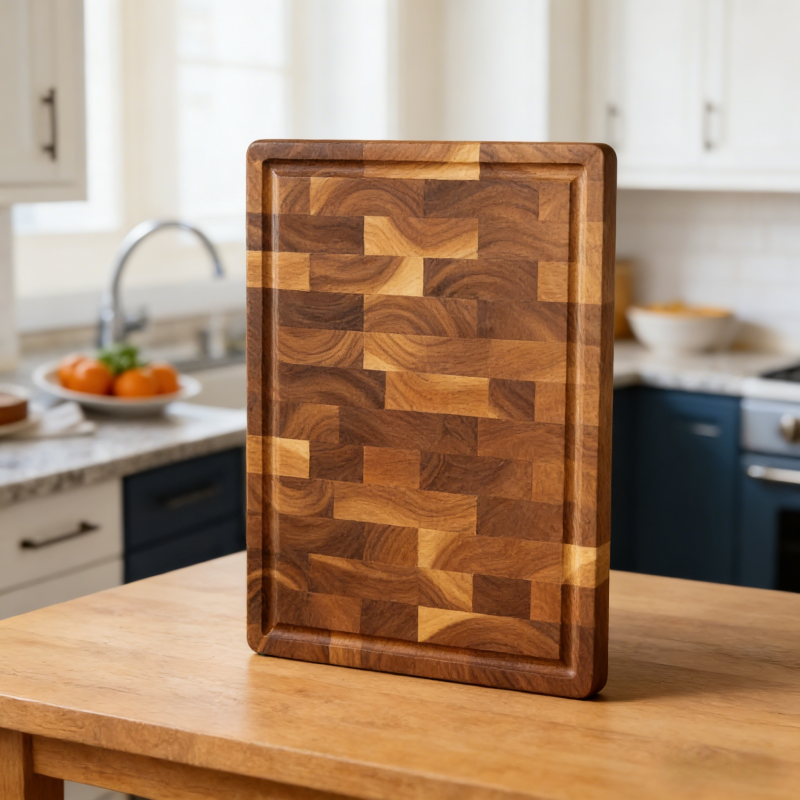
An end grain cutting board is constructed by arranging pieces of hardwood so that the ends of the wood fibers face upward toward the cutting surface.
Instead of exposing the long sides of the wood, manufacturers rotate individual blocks vertically before assembling them into a single board. This results in the distinctive checkerboard appearance commonly associated with premium butcher blocks.
The exposed wood fibers function almost like thousands of tiny bristles. When a knife blade contacts the surface, the fibers separate slightly before returning to their original position.
This characteristic provides two major benefits:
- Reduced wear on knife edges
- Improved resistance to visible knife marks
An end grain cutting board is made by orienting the ends of hardwood fibers upward, allowing knives to pass between fibers instead of cutting directly across them.
How End Grain Construction Works
To understand why end grain boards perform differently, it helps to compare them with other grain orientations.
Wood naturally consists of long cellular fibers that transport nutrients throughout the tree. These fibers create distinct grain directions that affect hardness, durability, and cutting performance.
Manufacturers can expose these fibers in three primary ways:
- Face grain
- Edge grain
- End grain
End grain construction exposes the fiber ends directly to the cutting surface.
Instead of forcing the knife edge across rigid fibers, the blade slips between them. After the cut, the fibers close again, minimizing permanent damage.
This "give" is the reason many chefs claim that end grain boards help preserve expensive Japanese and German knives.
Why Are End Grain Cutting Boards Considered Premium?
Several factors contribute to the premium reputation of end grain boards.
1. Superior Knife Friendliness
Knife enthusiasts often invest hundreds of dollars into chef's knives. Using an unsuitable cutting surface can accelerate dulling and increase sharpening frequency.
End grain boards provide a forgiving surface that reduces impact stress on the blade.
Over time, this can extend edge retention and improve overall knife performance.
2. Self-Healing Properties
One of the most celebrated characteristics of end grain wood cutting boards is their ability to conceal knife marks.
As wood fibers compress and rebound, shallow cuts become less visible compared with traditional boards.
Although not literally self-repairing, the visual effect significantly extends the
Best Wood for End Grain Cutting Boards
While end grain construction plays a major role in performance, the wood species used is equally important. The best end grain cutting boards combine proper construction with hardwoods that balance durability, stability, moisture resistance, and visual appeal.
Not all woods perform equally well. Softwoods tend to dent easily and absorb more moisture, while dense hardwoods offer superior longevity and food preparation performance.
The most popular choices include maple, walnut, acacia, and cherry.
Maple End Grain Cutting Board: The Industry Favorite
If you ask professional chefs and cutting board manufacturers which wood species they trust most, hard maple will likely top the list.
A maple end grain cutting board has long been considered the benchmark for premium butcher blocks.
Why Maple Is So Popular
- Dense, tight grain structure
- Excellent resistance to wear
- Neutral appearance that suits most kitchens
- Low porosity compared with many woods
- Outstanding balance between hardness and knife friendliness
Hard maple is commonly used in commercial butcher blocks throughout North America because it performs exceptionally well under repeated chopping.
Many of the best end grain cutting boards sold today use hard maple because it offers an ideal combination of durability, hygiene, and value.
Advantages of Maple End Grain Boards
- Long service life
- Excellent edge retention support
- Classic premium appearance
- Highly stable construction
- Easy to maintain
Potential Drawbacks
- Lighter color may show stains more easily
- Generally more expensive than acacia
- Heavier than some alternatives
Walnut End Grain Cutting Board: Luxury Meets Performance
A walnut end grain cutting board is often chosen by homeowners seeking a sophisticated appearance without sacrificing functionality.
Walnut's rich chocolate tones and striking grain patterns have made it one of the most desirable hardwoods in premium kitchenware.
Benefits of Walnut
- Elegant dark appearance
- Slightly softer than maple
- Gentle on knife edges
- Excellent dimensional stability
- High-end presentation value
Because walnut is somewhat softer than maple, many knife enthusiasts believe it offers even greater edge friendliness.
Disadvantages of Walnut
- Higher material costs
- Darker surfaces may hide food debris
- Can scratch more easily than maple
For consumers prioritizing aesthetics, an end grain walnut cutting board often represents the ultimate luxury choice.
Acacia End Grain Cutting Boards: Affordable Premium Appeal
Acacia has become increasingly popular in recent years due to its affordability and attractive appearance.
Many kitchenware brands use acacia to create visually striking end grain cutting boards that appeal to value-conscious consumers.
Why Buyers Like Acacia
- More affordable than walnut
- Natural variation in color
- Good moisture resistance
- Fast-growing renewable resource
- Excellent visual appeal
Acacia often occupies the sweet spot between premium appearance and accessible pricing.
Things to Consider
- Quality can vary significantly between manufacturers
- Hardness differs among acacia species
- Lower-end products may have inconsistent construction
Cherry End Grain Cutting Boards
Cherry offers a warm reddish hue that gradually deepens with age.
Although less common than maple or walnut, cherry remains a favorite among wood enthusiasts.
- Beautiful aging characteristics
- Smooth texture
- Moderate hardness
- Distinctive premium appearance
Cherry is particularly attractive in handcrafted and artisan cutting board collections.
Maple vs Walnut vs Acacia: Which Is Best?
Choosing the right wood often comes down to priorities.
| Feature | Maple | Walnut | Acacia |
|---|---|---|---|
| Durability | Excellent | Very Good | Good |
| Knife Friendliness | Excellent | Excellent | Good |
| Appearance | Classic | Luxury | Rustic |
| Moisture Resistance | Good | Good | Very Good |
| Price | Mid-High | Highest | Mid-Range |
| Commercial Use | Excellent | Good | Moderate |
Choose maple for professional performance, walnut for premium aesthetics, and acacia for value and visual appeal.
End Grain Cutting Board Designs: More Than Just Checkerboards
Modern consumers increasingly view cutting boards as decorative elements rather than purely functional tools.
As a result, end grain cutting board designs have evolved significantly.
Classic Checkerboard Design
The traditional checkerboard pattern remains the most recognizable style.
Alternating blocks create visual symmetry and timeless appeal.
Geometric Mosaic Designs
Manufacturers now combine multiple wood species to produce intricate patterns.
- Diamond layouts
- Chevron arrangements
- Basketweave effects
- Three-dimensional optical illusions
Striped Hybrid Designs
Some boards blend end grain and edge grain sections for a unique appearance.
These designs appeal to consumers seeking something beyond traditional butcher blocks.
Serving Board Combinations
Luxury brands increasingly market end grain boards as dual-purpose products suitable for:
- Food preparation
- Cheese presentation
- Charcuterie displays
- Tableside serving
How to Choose the Best End Grain Cutting Board
With so many options available, selecting the best end grain cutting board can feel overwhelming.
Consider the following factors before purchasing.
Size
- Small (12–14 inches): suitable for limited prep tasks.
- Medium (15–18 inches): ideal for most home kitchens.
- Large (18–24 inches): preferred by serious cooks and professionals.
Thickness
Thicker boards generally provide greater stability and durability.
- 1–1.5 inches: standard home use
- 2 inches: premium home and professional use
- 3 inches or more: butcher block applications
Weight
Heavier boards remain stable during chopping but can be difficult to move.
Feet and Handles
Rubber feet improve grip, while integrated handles enhance portability.
Wood Species
Choose the hardwood that best aligns with your performance expectations and budget.
For most households, a 16–18 inch maple end grain cutting board approximately 2 inches thick provides the best balance of usability, durability, and value.
Commercial vs Home Use: Which End Grain Board Do You Need?
| Feature | Home Kitchens | Commercial Kitchens |
|---|---|---|
| Recommended Size | 15–18 inches | 18–24+ inches |
| Thickness | 1.5–2 inches | 2–4 inches |
| Preferred Wood | Maple/Walnut | Maple |
| Design Priority | Appearance + Function | Performance |
| Budget | Moderate to Premium | Performance-Focused |
For restaurants and culinary institutions, durability typically outweighs aesthetics.
For homeowners, however, the board often serves as both a kitchen tool and a decorative centerpiece.
If you're sourcing end grain cutting boards for your brand or retail business, explore our customized manufacturing solutions:
Customized Cutting Board OEM Services
Need assistance selecting the right products for your market? Contact Our Team for Bulk Inquiries
How to Make an End Grain Cutting Board
One of the fastest-growing search queries related to this topic is:
"How to make an end grain cutting board."
The popularity of woodworking content on YouTube, Pinterest, and DIY blogs has encouraged many consumers to attempt building their own end grain butcher blocks.
Although professional manufacturing requires specialized equipment, understanding the process helps consumers appreciate why premium end grain cutting boards command higher prices.
Basic Steps for Making an End Grain Cutting Board
- Select suitable hardwoods such as maple, walnut, or cherry.
- Cut the lumber into uniform strips.
- Glue the strips edge-to-edge.
- Allow the adhesive to cure completely.
- Crosscut the glued panel into equal sections.
- Rotate each section 90 degrees to expose the end grain.
- Glue the blocks together again.
- Clamp tightly and allow full curing.
- Flatten the board using professional equipment.
- Sand progressively to achieve a smooth finish.
- Apply food-grade mineral oil and board conditioner.
While DIY projects can be rewarding, achieving perfectly flat surfaces and long-term structural stability often requires professional expertise.
End grain cutting boards involve multiple cutting, gluing, clamping, sanding, and finishing stages. Their labor-intensive construction significantly increases manufacturing complexity.
How to Maintain an End Grain Cutting Board
Even the best end grain cutting board requires routine maintenance to maximize its lifespan.
Unlike plastic boards that can simply be placed in a dishwasher, wooden boards need proper care to prevent drying, cracking, and warping.
Oil Regularly
Food-grade mineral oil is essential for maintaining moisture balance within the wood fibers.
- Weekly during the first month of ownership
- Every 3–4 weeks thereafter
- More frequently in dry climates
Wash Properly
- Use warm water and mild dish soap.
- Clean immediately after use.
- Avoid prolonged soaking.
- Rinse thoroughly.
Dry Vertically
Standing the board upright promotes airflow and prevents uneven moisture absorption.
Condition Periodically
Board creams containing mineral oil and beeswax provide additional protection and help maintain a rich appearance.
Common Mistakes That Ruin End Grain Cutting Boards
Many cutting board failures are preventable.
Avoid these common mistakes:
- Putting the board in the dishwasher
- Leaving it submerged in water
- Failing to oil it regularly
- Using harsh chemical cleaners
- Storing it near heat sources
- Ignoring small cracks that worsen over time
- Allowing moisture to accumulate underneath
The dishwasher is the fastest way to destroy an end grain cutting board. Excessive heat and moisture can lead to severe warping and glue failure.
Are End Grain Cutting Boards Hygienic?
Food safety is another common concern among consumers.
Some people assume wooden boards harbor bacteria more easily than plastic alternatives.
However, research suggests that hardwood cutting boards can be remarkably hygienic when properly maintained.
Why Hardwood Can Be Safe
- Dense hardwoods limit deep penetration of bacteria.
- Wood surfaces dry relatively quickly.
- Routine cleaning removes most contaminants.
- Regular oiling helps preserve surface integrity.
Consumers should still follow standard food safety practices, including separate boards for raw meats and ready-to-eat foods when appropriate.
Frequently Asked Questions About End Grain Cutting Boards
Are end grain cutting boards better for knives?
Yes. Their vertical wood fibers absorb impact and reduce stress on knife edges, helping blades stay sharp longer.
What is the best wood for an end grain cutting board?
Hard maple is often considered the best all-around choice, while walnut excels in aesthetics and acacia offers strong value.
Why are end grain cutting boards expensive?
They require more raw materials, multiple glue-up stages, precision machining, and extensive finishing.
Do end grain cutting boards crack easily?
Not when properly maintained. Regular oiling and correct storage significantly reduce cracking risks.
Can you cut raw meat on an end grain cutting board?
Yes, provided the board is cleaned thoroughly afterward using appropriate food safety practices.
How often should I oil my cutting board?
Most households benefit from oiling every three to four weeks.
Are maple end grain cutting boards better than walnut?
Maple generally offers slightly greater durability, while walnut provides premium aesthetics and excellent knife friendliness.
What thickness is best?
Approximately 2 inches is often considered ideal for balancing durability, stability, and usability.
Are end grain boards dishwasher safe?
No. Dishwashers can permanently damage wooden cutting boards.
Do professional chefs use end grain cutting boards?
Many chefs prefer them because of their durability and knife-preserving qualities.
Can end grain boards be refinished?
Yes. Light sanding followed by re-oiling can restore many worn surfaces.
Are end grain butcher block cutting boards worth it?
For consumers who cook frequently and value premium kitchen tools, most experts believe the investment is worthwhile.
Why End Grain Cutting Boards Continue to Grow in Popularity
Several trends are driving demand worldwide.
- Consumers increasingly invest in premium kitchen experiences.
- High-quality chef's knives require suitable cutting surfaces.
- Social media has elevated kitchen aesthetics.
- Wood products align with natural and sustainable lifestyles.
- Home cooking remains more popular than ever.
For kitchenware retailers and distributors, end grain cutting boards represent a high-value category capable of attracting both enthusiast consumers and gift buyers.
The combination of functionality, craftsmanship, and visual appeal positions end grain boards as a premium offering with strong long-term demand.
Conclusion
An end grain cutting board is far more than a simple kitchen accessory.
Its unique construction protects knife edges, resists visible wear, and delivers a level of craftsmanship rarely found in everyday kitchen tools.
Whether you choose a maple end grain cutting board for professional durability, a walnut end grain cutting board for luxurious presentation, or an acacia option that balances value and beauty, investing in a quality end grain board can transform the cooking experience.
Compared with edge grain alternatives, end grain boards offer superior knife friendliness and exceptional longevity, making them one of the smartest long-term investments for serious home cooks and professional chefs alike.
For brands, wholesalers, and distributors, this category also presents significant opportunities as consumers increasingly seek premium, aesthetically pleasing kitchen products built to last.
Looking for Custom End Grain Cutting Boards for Your Brand?
Kitlucy specializes in premium wooden kitchenware solutions designed for global brands, wholesalers, and retailers.
From maple and walnut end grain butcher blocks to customized packaging and private-label programs, we provide OEM and ODM services tailored to your market needs.
Related Blogs