Food-Grade vs Regular Silicone: What Is the Difference?
Food-Grade vs Regular Silicone: What Is the Difference?
Food-grade silicone is silicone formulated, manufactured, and tested for applications involving food contact, while regular silicone is a broader category that may be designed for industrial, technical, construction, electrical, medical, or other applications rather than direct food contact.
The key difference is not simply softness, color, flexibility, or heat resistance. For kitchenware, the more important factors are the silicone formulation, additives, manufacturing controls, intended use, food-contact compliance, and applicable testing requirements.
For products such as silicone spatulas, baking molds, pastry brushes, scrapers, and other kitchen tools, buyers should verify that the specific silicone material and finished product are suitable for the intended food-contact application.
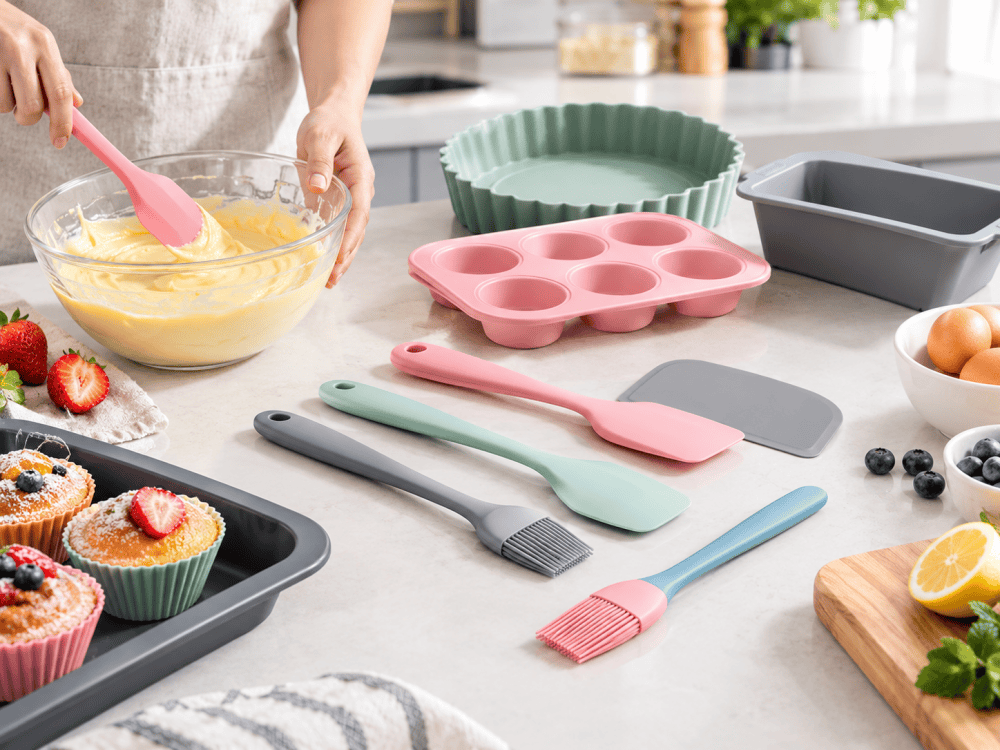
Silicone is widely used in modern kitchenware because it is flexible, durable, easy to clean, and capable of performing at elevated temperatures. Silicone spatulas, baking molds, pastry brushes, scrapers, kitchen utensil handles, and other cooking and baking products are common examples.
However, not every silicone product is automatically suitable for direct contact with food. This is why the terms food-grade silicone and regular silicone can create confusion for consumers, retailers, importers, and kitchenware brands.
So, what is the difference between food-grade and regular silicone? The answer involves more than appearance, softness, or heat resistance. Material formulation, additives, manufacturing controls, intended application, testing, and applicable food-contact requirements all need to be considered.
Food-Grade Silicone vs Regular Silicone: Quick Comparison
| Factor | Food-Grade Silicone | Regular Silicone |
|---|---|---|
| Primary purpose | Designed for applications involving food contact | Designed for a wider range of technical or industrial applications |
| Food contact | Can be suitable when the specific formulation and finished product meet applicable requirements | Should not be assumed suitable for food contact |
| Formulation | Selected with the intended food-contact application in mind | May contain materials or additives intended for non-food applications |
| Testing | May require food-contact migration or other applicable testing | Testing depends on its intended application |
| Kitchenware use | Commonly used for spatulas, baking molds, brushes, scrapers, and utensil components | Not automatically appropriate for kitchenware that directly contacts food |
| Heat resistance | Depends on the specific silicone formulation and product design | Also depends on the specific formulation and application |
| Compliance | Should be evaluated against the requirements applicable to the target market and intended use | Food-contact compliance should not be assumed |
What Is Food-Grade Silicone?
Food-grade silicone is silicone material formulated and manufactured for applications where the finished product may come into contact with food.
For kitchenware, food-grade silicone is commonly used in products such as baking molds, spatulas, tongs, pastry brushes, scrapers, oven accessories, and utensil handles.
However, the phrase food-grade silicone should not be interpreted as meaning that every product made from silicone is automatically safe for every food-contact condition.
Food-contact suitability depends on the specific material formulation, additives, manufacturing process, finished product, food type, temperature, contact time, and applicable regulations or standards.
Does Food-Grade Mean 100% Pure Silicone?
No. A food-contact silicone product is not necessarily made from 100% pure silicone without any other ingredients.
Silicone products can contain pigments, catalysts, reinforcing materials, processing aids, or other components. What matters is whether the final formulation and finished product are appropriate for the intended application and comply with the relevant requirements.
Important: “Food-grade” is better understood as a suitability and compliance concept rather than a guarantee that the material contains nothing except silicone.
What Is Regular Silicone?
Regular silicone is not a single standardized material category. It is a broad term that can refer to silicone products manufactured for different applications.
Depending on the application, silicone may be used for seals, gaskets, electrical components, industrial parts, construction products, automotive components, adhesives, tubing, or other technical products.
These materials may have properties that are excellent for their intended purpose but may not have been formulated or tested for direct contact with food.
Therefore, a silicone product should not be considered suitable for kitchenware simply because it looks and feels similar to a food-contact silicone product.
What Is the Main Difference Between Food-Grade and Regular Silicone?
The main difference is intended application and compliance suitability, rather than simply the physical appearance of the silicone.
Two silicone products may both be flexible, soft, heat resistant, and durable while having very different intended uses.
- Material formulation: The ingredients and additives used in the silicone formulation matter.
- Manufacturing controls: Production processes and contamination controls are important for food-contact applications.
- Intended use: A silicone compound designed for an industrial seal is not automatically suitable for a baking mold.
- Testing: Food-contact applications may require migration or other compliance testing depending on the market and application.
- Finished product: The final kitchenware product needs to be evaluated, not just the raw silicone material.
Is Food-Grade Silicone Safer Than Regular Silicone?
For direct food-contact kitchenware, a silicone material specifically formulated and evaluated for food-contact applications is the appropriate category to consider.
That does not mean every product labeled “food-grade silicone” automatically meets every requirement in every country or for every use.
For example, requirements can differ depending on whether the product is used with hot food, fatty foods, acidic foods, frozen food, or other conditions. Temperature and contact time can also affect the applicable requirements.
For this reason, importers and kitchenware brands should ask suppliers for documentation that matches the intended market and product application.
Is All Food-Grade Silicone the Same?
No.
Food-grade silicone products can differ in hardness, flexibility, transparency, color, tear resistance, compression resistance, surface finish, processing method, and temperature performance.
For kitchenware, the appropriate silicone specification depends on the product design.
For example, a soft silicone spatula may require different physical properties from a silicone baking mold or a silicone utensil handle.
Is Food-Grade Silicone More Heat Resistant?
Not necessarily.
Both food-contact and non-food-contact silicone materials can be engineered for high-temperature applications. Heat resistance depends on the specific silicone formulation, manufacturing process, product thickness, additives, and design.
Therefore, heat resistance alone cannot determine whether silicone is suitable for food contact.
When purchasing silicone kitchenware, buyers should consider both the material's food-contact suitability and its stated temperature range for the specific finished product.
Why Is Food-Grade Silicone Commonly Used for Baking Tools?
Silicone is particularly useful for baking tools because it combines flexibility with good release properties and resistance to many common kitchen conditions.
Common applications include:
- Silicone baking molds
- Silicone spatulas
- Pastry brushes
- Dough scrapers
- Silicone whisks and utensil components
- Kitchen utensil handles
- Reusable baking accessories
For baking applications, the silicone must be suitable not only for contact with food but also for the temperatures and conditions involved in the intended baking process.
How Can You Tell If Silicone Is Food-Grade?
Consumers cannot reliably determine food-contact suitability simply by looking at a silicone product.
Color, smell, softness, flexibility, transparency, and surface texture can provide clues about product quality, but none of these characteristics alone proves food-contact compliance.
For B2B purchasing, a more reliable approach is to evaluate the material specification and supporting documentation.
- Ask what type of silicone is being used.
- Ask whether the formulation is intended for food-contact applications.
- Request relevant food-contact compliance documentation.
- Check whether testing applies to the finished product or only the raw material.
- Confirm the intended food types and conditions of use.
- Verify the documentation against the destination market.
- Request samples before placing a large production order.
What Certifications or Documents Should Buyers Check?
The exact documents required depend on the destination market, product, formulation, and intended use.
For example, buyers may ask suppliers about applicable FDA food-contact requirements for the U.S. market or relevant European food-contact requirements for products sold in Europe.
Testing documentation may include migration testing, material declarations, laboratory reports, or other compliance documents relevant to the target market.
Importantly, a general certificate should not automatically be treated as proof that every product from the supplier is compliant for every food-contact application.
Should Buyers Ask for a Test Report?
Yes, particularly for private-label and large-volume kitchenware projects.
A buyer should check whether the report identifies the actual material, product, manufacturer, test conditions, applicable standard or regulation, and testing laboratory.
This helps establish whether the documentation actually relates to the product being purchased.
Does Food-Grade Silicone Mean Higher Quality?
Not necessarily.
Food-contact suitability and overall product quality are related but different concepts.
A silicone product can meet food-contact requirements while still having poor dimensional accuracy, weak construction, poor bonding, inconsistent color, low tear resistance, or other manufacturing problems.
For kitchenware buyers, quality evaluation should therefore include both material compliance and finished-product performance.
Food-Grade Silicone vs Regular Silicone in Kitchenware
| Kitchenware Product | Recommended Material Consideration | Why It Matters |
|---|---|---|
| Silicone spatula | Food-contact silicone | Direct contact with food and cookware is expected |
| Silicone baking mold | Food-contact silicone suitable for the intended baking conditions | Direct food contact and elevated temperatures |
| Pastry brush | Food-contact silicone | Direct contact with ingredients and prepared food |
| Dough scraper | Food-contact silicone or another suitable food-contact material | Direct contact with dough and ingredients |
| Utensil handle | Depends on product construction and food-contact exposure | The handle may not have the same exposure as the working end |
| Industrial seal | Application-specific silicone | Food-contact requirements may not apply |
Why Does Silicone Grade Matter for OEM and ODM Kitchenware?
For OEM and ODM kitchenware projects, material selection should happen before mass production rather than after the product has already been developed.
A silicone kitchenware supplier should be able to discuss the intended application, product design, hardness, color, temperature conditions, food-contact requirements, and target market.
This is particularly important for private-label products because the buyer may need consistent material specifications across multiple production batches.
What Should You Ask a Silicone Kitchenware Supplier?
- What type of silicone is used for this product?
- Is the silicone formulation intended for food-contact applications?
- What food-contact documentation is available?
- Does the documentation apply to the finished product?
- Which target markets does the documentation cover?
- What temperature range is recommended for the finished product?
- Can the silicone hardness be customized?
- Can colors and finishes be customized?
- Can the product be developed according to an OEM or ODM design?
- Can packaging and private-label branding be customized?
Can Food-Grade Silicone Kitchenware Be Used for Private Label?
Yes. Food-contact silicone is commonly used for private-label kitchenware projects.
Depending on the supplier, buyers may be able to customize:
- Product shape
- Product size
- Silicone hardness
- Color
- Handle design
- Logo
- Packaging
- Product sets
- Retail presentation
For private-label products, it is important to confirm that the material specification and compliance documentation remain consistent with the final customized product.
Food-Grade Silicone Kitchenware from Kitlucy
Kitlucy is a kitchenware brand under DKS-Group, focused on cooking and baking tools. Its product range includes silicone kitchenware and baking tools alongside other kitchenware materials.
For B2B buyers, Kitlucy supports OEM and ODM projects, including customization of product specifications, colors, logos, packaging, and other product requirements.
When developing silicone kitchenware, buyers should provide the intended application and target market so the material and product specifications can be evaluated accordingly.
What Silicone Kitchenware Can Be Customized?
Depending on the product and project requirements, customization can include:
- Silicone spatulas
- Silicone baking tools
- Silicone pastry brushes
- Silicone scrapers
- Silicone kitchen utensil components
- Custom kitchenware sets
For large-volume projects, buyers can also discuss private-label packaging, logo application, colors, product sets, and other OEM or ODM requirements.
How to Choose the Right Silicone for Kitchenware
When sourcing silicone kitchenware, the goal should not simply be to find a product labeled “food-grade.” Buyers should match the material and product specification to the actual application.
1. Define the Product Application
First determine whether the product will be used for baking, cooking, food preparation, storage, serving, or another application.
2. Define the Temperature Conditions
Identify the expected temperature range and contact conditions for the finished product rather than relying on a generic silicone temperature claim.
3. Confirm Food-Contact Requirements
Determine which regulations and testing requirements apply to the destination market and intended use.
4. Review the Actual Documentation
Ask for documentation that identifies the relevant material or finished product and verify that it matches the product being ordered.
5. Test Samples Before Mass Production
Sample testing can help buyers evaluate dimensions, flexibility, surface finish, odor, color consistency, product performance, and other practical characteristics before approving bulk production.
Frequently Asked Questions
Is food-grade silicone the same as regular silicone?
No. Food-grade silicone is intended and formulated for applications involving food contact, while regular silicone is a broad term covering silicone products designed for many different applications.
Is regular silicone safe for food?
It should not be assumed to be suitable for direct food contact. Food-contact suitability depends on the specific formulation, product, intended use, and applicable requirements.
Is food-grade silicone 100% silicone?
Not necessarily. Silicone products can contain pigments, additives, reinforcing materials, or other components. The important consideration is whether the final formulation and product are suitable for the intended food-contact application.
Does food-grade silicone have to be tested?
Testing and documentation requirements depend on the target market, product, formulation, and intended conditions of use. Buyers should confirm the applicable requirements for their specific project.
Can food-grade silicone be used in an oven?
Some food-contact silicone products are designed for baking and oven use, but the maximum temperature should be confirmed for the specific finished product rather than assumed from the general term “food-grade silicone.”
Can food-grade silicone go in the dishwasher?
Some silicone kitchenware products are dishwasher suitable, but dishwasher compatibility depends on the product design, material formulation, construction, and manufacturer's instructions.
Does silicone smell mean it is not food-grade?
Odor alone cannot reliably determine food-contact suitability. A silicone product may have a temporary manufacturing odor, while other odor issues may indicate material or processing problems. Documentation and product testing are more reliable indicators.
Is food-grade silicone better for kitchenware?
For kitchenware intended to contact food, the relevant question is whether the specific silicone formulation and finished product are suitable for the intended food-contact application and meet the applicable requirements.
Final Takeaway: Food-Grade vs Regular Silicone
The difference between food-grade and regular silicone is primarily about formulation, intended use, manufacturing controls, testing, and food-contact suitability rather than appearance or flexibility.
Food-grade silicone is designed for applications involving food contact, but the term should not be treated as a universal guarantee for every product, temperature, food type, or market.
For consumers, retailers, importers, and kitchenware brands, the safest sourcing approach is to evaluate the actual product specification and relevant compliance documentation.
For OEM, ODM, and private-label kitchenware projects, material selection should be confirmed together with product design, intended use, target market, testing requirements, and production specifications.
Looking for Silicone Kitchenware OEM & ODM?
Kitlucy supports kitchenware buyers with cooking and baking tools, OEM and ODM development, private-label customization, product specifications, colors, logos, packaging, and bulk supply solutions.
Contact Kitlucy for Your ProjectRelated Blogs