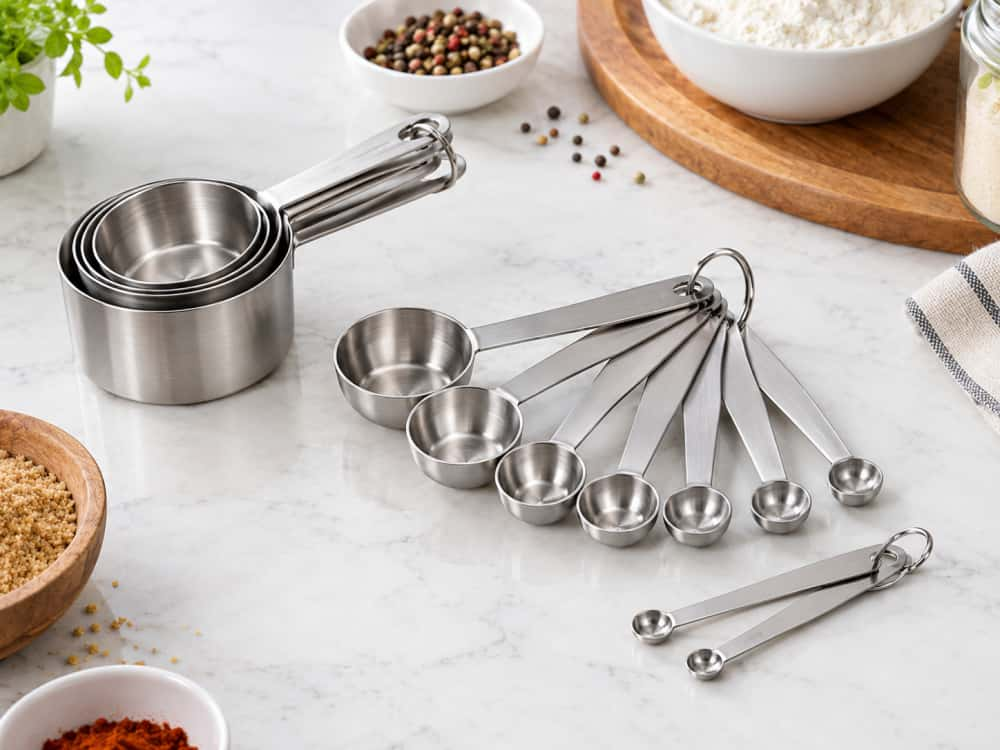


How to Use Measuring Spoons Accurately for Baking and Cooking
Kitlucy Kitchen Guide · Measuring Tools
Accurate measuring helps you follow recipes consistently, from baking cakes and cookies to seasoning everyday meals. Learn how to measure dry and liquid ingredients with measuring spoons, level ingredients correctly, convert spoon sizes, and avoid common measuring mistakes.
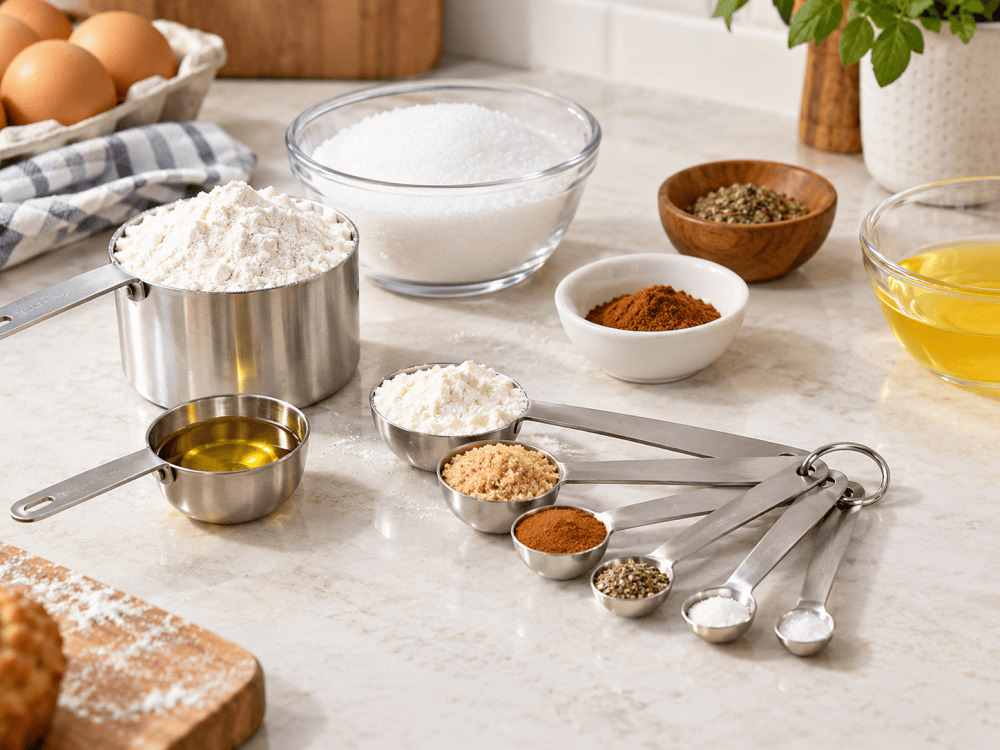
How do you use measuring spoons accurately? Choose the spoon size specified in the recipe, fill it using a consistent method, and level dry ingredients when the recipe calls for a level measure. For liquids, fill the spoon carefully without spilling. Avoid estimating fractions by eye, and remember that a teaspoon measures volume—not weight. For recipes that specify grams, use a suitable kitchen scale.
Why Is Accurate Measuring Important in Baking and Cooking?
Measuring spoons help you portion small amounts of ingredients more consistently. Their value is especially clear when a recipe depends on a balanced combination of flavors or carefully measured baking ingredients.
Salt, spices, vanilla extract, baking powder, baking soda, and other ingredients are often measured in teaspoons or fractions of a teaspoon. Adding too much or too little can affect a recipe's flavor, texture, or overall result.
Consistency between batches
Using the same spoon size and filling technique each time makes it easier to reproduce a recipe. This is useful whether you are preparing a family dinner, testing a new cookie recipe, or making the same product repeatedly.
Better control over small quantities
A dedicated measuring spoon is generally more repeatable than an ordinary eating spoon. Household cutlery varies in size and shape, so it should not be treated as a standardized measuring tool.
More reliable recipe results
Accurate measuring is particularly helpful when ingredients perform a specific function. For example, changing the amount of a leavening agent can affect how a baked product rises. In cooking, small changes in salt, spice, or concentrated flavoring can noticeably change the taste.
Understand Measuring Spoon Sizes Before You Start
Measuring spoon sets usually include several standardized capacities. Before measuring, check the marking on the spoon and confirm that it matches the recipe.
| US Measuring Spoon | Approximate Metric Volume | Common Use |
|---|---|---|
| 1 tablespoon (1 tbsp) | 14.79 mL | Oils, extracts, sauces, and larger small-volume portions |
| 1 teaspoon (1 tsp) | 4.93 mL | Seasonings, extracts, and baking ingredients |
| 1/2 teaspoon | 2.46 mL | Smaller quantities of spices and other ingredients |
| 1/4 teaspoon | 1.23 mL | Small amounts of salt, spices, and leavening ingredients |
| 1/8 teaspoon | About 0.62 mL | Very small quantities in some recipes |
| 1/16 teaspoon | About 0.31 mL | Specialty mini measurements, when included in a set |
Metric values are approximate US customary volume conversions. Not all measuring spoon sets include 1/8 or 1/16 teaspoon. Check the product markings and specifications before use.
Tablespoons and teaspoons are not interchangeable
In standard US customary kitchen measurements, 1 tablespoon equals 3 teaspoons. That means 1 tablespoon is three times the volume of 1 teaspoon. Confusing these two sizes can significantly change the quantity of an ingredient.
How to Measure Dry Ingredients with Measuring Spoons
Dry ingredients such as salt, sugar, flour, baking powder, and spices can differ in particle size, density, and tendency to clump. A consistent filling method helps reduce variation.
- Choose the correct spoon size Read the marking on the handle or spoon head. If the recipe calls for 1/2 teaspoon, do not substitute a full teaspoon.
- Prepare the ingredient If the ingredient is clumped, loosen it as appropriate before measuring. Do not crush or pack it unless the recipe specifically instructs you to do so.
- Fill the spoon consistently Scoop or transfer the ingredient into the spoon. For loose dry ingredients, avoid pressing the material down unless a packed measurement is required.
- Level the top when required Use a straight edge, such as the flat edge of a suitable utensil, to remove the excess. A level spoon provides a more repeatable volume than an uneven mound.
- Transfer the ingredient carefully Tip the measured ingredient into the mixing bowl without spilling. If you spill some, measure again rather than guessing how much remains.
Should you pack dry ingredients into a measuring spoon?
Only when the recipe specifies a packed measure. For example, a recipe may call for “packed brown sugar” when the intended amount assumes that the sugar has been pressed into the measuring utensil. Most dry ingredients should not automatically be packed into the spoon.
How should you measure flour with a measuring spoon?
For a small quantity of flour specified in teaspoons, gently fill the spoon and level the top without compressing the flour. If a recipe gives flour in grams, weighing it is generally a more reliable way to follow the stated quantity.
How should you measure salt and spices?
For recipes calling for a measured spoonful, fill the spoon consistently and level it unless the recipe specifies otherwise. Coarse salt, fine salt, ground spices, and whole spices can have different densities, so equal spoon volumes do not necessarily have equal weights.
How to Measure Liquid Ingredients with Measuring Spoons
Measuring spoons are useful for small quantities of liquids such as vanilla extract, cooking oil, vinegar, lemon juice, and other recipe ingredients.
- Place the spoon on a stable surface if practical Keeping the spoon steady can make it easier to fill without spilling.
- Pour slowly into the spoon Add the liquid until it reaches the intended capacity. Avoid pouring so quickly that the liquid overflows.
- Check the fill level For a full spoon measure, aim to fill the spoon without spilling over the edge. Take extra care with very small spoon sizes.
- Transfer the liquid into the recipe Pour the contents into the bowl or pan carefully. For sticky ingredients, allow the liquid to drain as appropriate.
- Clean the spoon before the next ingredient Residue from oil, syrup, extracts, or other ingredients can affect the next measurement or introduce unwanted flavors.
Should you use measuring spoons or a liquid measuring cup?
Measuring spoons are convenient for small quantities. A graduated liquid measuring cup is usually more practical for larger volumes. Use the tool that matches the recipe's quantity and the level of precision required.
What about honey, syrup, and other sticky ingredients?
Sticky ingredients can cling to the spoon and may not transfer as easily as water. Follow the recipe's instructions, scrape the spoon if appropriate, and consider whether the ingredient needs to be measured by weight for greater consistency.
Measuring Spoons for Baking vs. Everyday Cooking
The same measuring spoon set can be useful for both baking and cooking, but the importance of precision depends on the recipe.
When baking
Baking recipes often rely on carefully balanced proportions. Measure baking powder, baking soda, salt, extracts, and small quantities of spices as directed. If the recipe provides weights in grams, use a suitable kitchen scale for ingredients specified by weight.
When cooking
Measuring spoons are helpful for portioning salt, spices, herbs, oil, vinegar, sauces, and flavorings. In many savory recipes, seasoning can be adjusted to taste, but following the specified starting quantity makes the recipe easier to reproduce.
When scaling a recipe
If you halve or double a recipe, adjust each ingredient proportionally. For very small fractions, use the correct miniature spoon size when available rather than estimating an uneven fraction of a larger spoon.
| Situation | Recommended approach | Why it helps |
|---|---|---|
| Baking powder or baking soda | Use the specified spoon size and level the measure | Helps follow the recipe's intended proportions |
| Salt and spices | Measure first, then adjust if the recipe allows | Provides a consistent starting point for seasoning |
| Vanilla extract | Fill the specified spoon carefully | Reduces spills and unintended variation |
| Oil and vinegar | Fill the spoon without overflowing | Helps control small liquid quantities |
| Ingredients specified in grams | Use a suitable kitchen scale | Measures mass directly rather than estimating it from volume |
Measuring Spoon Conversion Chart
These common US customary conversions can help when a recipe uses a different spoon size from the one you have.
| Measurement | Equivalent |
|---|---|
| 1 tablespoon | 3 teaspoons |
| 1 teaspoon | 3 teaspoons? No — 1 teaspoon is the base unit. |
| 1/2 teaspoon | 2 × 1/4 teaspoon |
| 1/4 teaspoon | 2 × 1/8 teaspoon |
| 1/8 teaspoon | 2 × 1/16 teaspoon |
| 1 US teaspoon | Approximately 4.93 mL |
| 1 US tablespoon | Approximately 14.79 mL |
These are volume equivalents. Do not convert teaspoons to grams without considering the ingredient, because the weight of a given volume varies with its density.
Common Measuring Spoon Mistakes to Avoid
1. Using an ordinary eating spoon
Household cutlery is not standardized for recipe measurement. Use a dedicated measuring spoon set when the recipe calls for teaspoons or tablespoons.
2. Confusing tablespoons with teaspoons
In US customary measurements, one tablespoon equals three teaspoons. Always check recipe abbreviations before measuring.
3. Leaving dry ingredients heaped when a level measure is required
An uneven mound can contain more ingredient than intended. Level the spoon when the recipe calls for a level measure.
4. Packing ingredients without checking the recipe
Compressing an ingredient changes how much fits into a spoon. Pack only when the recipe specifies a packed measurement.
5. Assuming volume equals weight
A teaspoon is a unit of volume. The weight of flour, salt, sugar, and spices in the same spoon can differ substantially. Use a scale when the recipe specifies mass.
6. Measuring over the mixing bowl
When filling a spoon directly above a bowl, spills can add an unknown amount to the recipe. Measure over a separate surface when practical, then transfer the ingredient.
7. Ignoring the condition of the measuring spoon
Bent, damaged, or heavily worn spoons may be difficult to fill consistently. Clean utensils after use and replace them if damage affects their function or makes them difficult to clean.
How to Choose the Right Measuring Spoon Set
A good measuring spoon set should make common measurements easy to identify, use, clean, and store. Consider the following features when choosing a set for home cooking or a kitchenware product range.
- Clear size markings Look for easy-to-read capacity markings that help users distinguish tablespoons, teaspoons, and fractions.
- A useful range of sizes Standard sets cover everyday measurements, while some specialty sets include smaller sizes such as 1/8 or 1/16 teaspoon.
- Suitable material and construction Stainless steel and suitable food-contact plastics are common options. Evaluate the actual product specifications, finish, and intended use.
- Practical spoon shape Consider whether the spoon head fits common ingredient containers and is easy to fill, level, and clean.
- Convenient storage Nesting spoons or a secure storage ring can help keep sizes organized and reduce the chance of losing smaller pieces.
- Appropriate cleaning instructions Confirm whether the set is dishwasher-safe or requires hand washing.
For kitchenware retailers and private-label buyers
When sourcing measuring spoons, check the stated capacity of each spoon, the accuracy and durability of the markings, material specifications, finish quality, and consistency between production batches. Packaging should clearly list the sizes included in the set so customers understand what they are purchasing.
For OEM or private-label projects, reviewing production samples and agreeing on product specifications before mass production can help reduce avoidable differences between samples and finished goods.
Frequently Asked Questions
How do you use measuring spoons correctly?
Choose the spoon size specified in the recipe, fill it consistently, and level dry ingredients when a level measurement is required. For liquids, fill the spoon carefully without spilling.
Should measuring spoons be level or heaped?
Use a level spoon unless the recipe specifies a heaped measure. A consistent level measurement helps make recipe results more repeatable.
How do you measure flour with a measuring spoon?
Gently fill the spoon and level the top without compressing the flour, unless the recipe says otherwise. If the recipe specifies flour by weight, use a suitable kitchen scale.
Can I use a regular spoon instead of a measuring spoon?
It is not recommended when a recipe requires a specific measurement. Ordinary eating spoons vary in capacity and are not standardized measuring tools.
Is a teaspoon the same as 5 mL?
One US customary teaspoon is approximately 4.93 mL. It is often rounded to 5 mL for practical kitchen conversions, but the exact convention can depend on the measurement system used.
How many teaspoons are in one tablespoon?
In standard US customary kitchen measurements, one tablespoon equals three teaspoons.
Are measuring spoons for dry and liquid ingredients different?
Many standard measuring spoon sets can be used for both dry and liquid ingredients. The important point is to use the correct capacity and measure carefully to avoid spills or inconsistent filling.
Are measuring spoons more accurate than measuring cups?
Neither tool is automatically more accurate in every situation. Measuring spoons are convenient for small quantities, while measuring cups are useful for larger volumes. Accuracy depends on the tool, its condition, and how it is used.
When should I use a kitchen scale instead of measuring spoons?
Use a suitable kitchen scale when a recipe specifies grams or another unit of mass. A scale can improve consistency for ingredients whose weights vary considerably at the same volume.
Further Reading on Kitchen Measurements
For standard measurement conversions and guidance on units, consult these reference sources.
KITLUCY · MEASURING TOOLS
Looking for Measuring Spoons for Your Kitchenware Range?
Well-designed measuring spoons help home cooks and bakers follow recipes more consistently. For retailers, distributors, and private-label brands, clear size markings, practical designs, and consistent product specifications are important when developing a measuring spoon range.
Explore Kitlucy's kitchenware offerings and contact the team to discuss wholesale or product development requirements.
Related Blogs