

Magnetic vs. Traditional Measuring Spoons: Which Design Is Better?
Measuring spoons may be small kitchen tools, but their design can make a noticeable difference in everyday cooking and baking. Magnetic measuring spoons keep the set connected for convenient storage, while traditional measuring spoons often use a connecting ring or a simple nested design. Which option is better depends on how you measure ingredients, organize your kitchen, and clean your utensils.
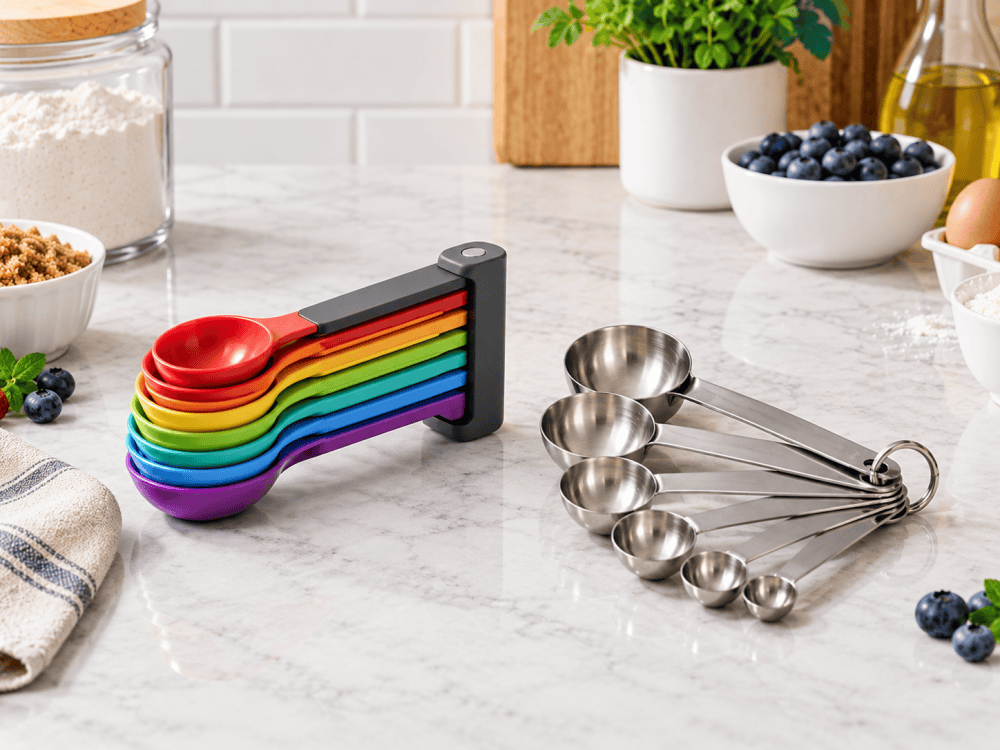
Magnetic measuring spoons are often better for organized storage and convenient access because the spoons can stay together while individual pieces can be removed. Traditional measuring spoons are a practical choice for shoppers who prefer a simple ring-connected or nested set, particularly when they want a straightforward design.
Neither design is automatically more accurate. Measurement accuracy depends more on the spoon's actual capacity, readable markings, shape, construction, and how consistently ingredients are filled and leveled.
1. What Are Magnetic Measuring Spoons?
Magnetic measuring spoons have magnets built into or attached to their handles. The magnets help keep the spoons together as a set, making them easier to organize in a drawer or remove one at a time. Some designs also allow the set to attach to a suitable metal surface, although this depends on the product's magnet placement and strength.
Many magnetic sets are made from stainless steel and include common measuring sizes such as 1/4 teaspoon, 1/2 teaspoon, 1 teaspoon, and 1 tablespoon. Some sets add smaller measurements, metric markings, narrow spoon ends for spice jars, or a separate leveling tool.
Key advantages of magnetic measuring spoons
- Organized storage: The spoons can stay connected rather than becoming scattered in a utensil drawer.
- Easy access: Individual spoons can often be removed without taking apart a ring or searching through loose pieces.
- Convenient organization: A connected set is easier to return to its usual storage place after use.
- Flexible product design: Magnets can be combined with narrow spoon heads, dual-sided bowls, etched markings, and other useful features.
However, a magnetic connection is not a substitute for good construction. If the magnets are too weak, poorly positioned, or difficult to separate, the design may be less convenient than expected.
2. What Are Traditional Measuring Spoons?
Traditional measuring spoons typically use one of three storage approaches: a connecting ring, a nesting arrangement, or separate individual spoons. Ring-connected sets keep the pieces together, while nested sets fit one spoon inside another. Some simple sets are sold as loose pieces without a permanent connection.
Traditional measuring spoons are available in stainless steel, plastic, and other materials. Their designs range from basic everyday utensils to premium sets with engraved measurement markings, long handles, and carefully shaped spoon bowls.
Key advantages of traditional measuring spoons
- Simple construction: A basic set has few additional components and is easy to understand and use.
- Wide product variety: Buyers can choose from different materials, handle styles, capacities, and price points.
- Familiar storage options: Ring-connected and nested sets are straightforward choices for many kitchens.
- Potentially easy cleaning: A simple one-piece spoon design has fewer connection points to inspect for residue.
The main limitation depends on the storage design. Ring-connected sets may require users to move several spoons together when selecting one, while loose sets can become separated. Nested spoons can also be inconvenient if their shapes make them difficult to separate.
3. Magnetic vs. Traditional Measuring Spoons: A Side-by-Side Comparison
The most useful comparison is not simply magnetic versus non-magnetic. It is how each design performs during measuring, storage, cleaning, and repeated everyday use.
| Feature | Magnetic Measuring Spoons | Traditional Measuring Spoons |
|---|---|---|
| Storage | Magnets help keep the set together and may support attachment to compatible metal surfaces. | Uses a ring, nesting arrangement, or separate pieces, depending on the design. |
| Access | Individual spoons can often be removed while the rest remain connected. | Ring-connected pieces may need to be moved together; nested spoons may need to be separated. |
| Measurement accuracy | Depends on capacity, shape, markings, and consistent filling and leveling. | Depends on the same factors; a non-magnetic design can be equally accurate. |
| Cleaning | Check around magnet housings, joints, or handle seams if present. | Simple one-piece designs are often straightforward to wash. |
| Durability | Depends on material quality, magnet attachment, corrosion resistance, and construction. | Depends on material quality, handle strength, and overall construction. |
| Cost | Can cost more when magnetic features are combined with premium materials or finishes. | Available across a broad range of budget and premium options. |
| Best suited for | Users who value connected storage and convenient access. | Users who prefer a simple, familiar design or have specific material and budget preferences. |
Bottom line: Magnetic measuring spoons have a practical advantage in organization, but the overall quality of the spoon matters more than the presence of a magnet alone.
4. Which Measuring Spoon Design Is More Accurate?
Accuracy is especially important when measuring baking ingredients, spices, salt, extracts, and other ingredients used in small quantities. However, the storage mechanism does not determine the spoon's measurement capacity.
What affects measuring spoon accuracy?
- Correct capacity: Each spoon should hold its stated volume, such as 5 mL for a US teaspoon or 15 mL for a US tablespoon.
- Clear measurement markings: Engraved or otherwise durable markings are easier to rely on than labels that may wear away.
- Consistent spoon shape: A well-formed bowl and a suitable rim make filling and leveling more repeatable.
- Leveling technique: For ingredients that should be measured level, remove excess material with a straight edge rather than packing or compressing it.
- Stable construction: The handle and bowl should remain secure during normal scooping and leveling.
For dry ingredients such as flour, cocoa powder, and baking powder, follow the recipe's measuring method. Scooping directly from a container can compact some ingredients and produce a different amount than spooning the ingredient into the measuring spoon and leveling it.
For liquids such as vanilla extract or cooking oil, fill the spoon carefully to the intended level. A clearly marked spoon with a suitable bowl shape can make this easier.
A magnetic set with well-calibrated capacities can be accurate, and a traditional set can be inaccurate if its capacities or markings are poorly made. When evaluating products, look for verified capacity specifications and consistent manufacturing rather than assuming that one storage design is more precise.
5. Which Design Is Easier to Clean?
Cleaning performance depends on the materials and construction, not just on whether a set is magnetic. Both styles can be easy to clean when they have smooth surfaces and minimal residue-trapping areas.
Magnetic measuring spoons
Stainless steel magnetic measuring spoons with smooth, one-piece bowls are generally straightforward to wash. If magnets are enclosed inside the handles, check that the handle construction is sealed and suitable for the product's stated cleaning method. Exposed joints, seams, or crevices may require extra attention when measuring honey, syrups, oils, or sticky seasonings.
Traditional measuring spoons
Traditional spoons with simple one-piece construction can be quick to rinse and dry. Ring-connected designs may need to be opened or separated during cleaning so that food residue and moisture do not remain between the pieces. Nested sets should be fully dried before being stored together.
Are measuring spoons dishwasher safe?
Some stainless steel and plastic measuring spoon sets are dishwasher safe, but this should not be assumed for every product. Follow the manufacturer's care instructions, especially when a set contains magnets, bonded components, decorative finishes, or printed markings.
For buyers comparing products, dishwasher compatibility, corrosion resistance, marking durability, and the ability to clean around joints are useful product specifications to confirm before placing an order.
6. Which Measuring Spoons Are Better for Everyday Cooking and Baking?
Choose magnetic measuring spoons if you:
- Prefer keeping all spoon sizes connected in one set.
- Frequently switch between different measuring sizes while cooking.
- Want to reduce the chance of individual spoons becoming separated in a drawer.
- Prefer a modern storage design and like the convenience of removing one spoon at a time.
Choose traditional measuring spoons if you:
- Prefer a simple ring-connected, nested, or individual-spoon design.
- Want to prioritize straightforward construction and easy maintenance.
- Have a preferred material, handle shape, or price range that matters more than magnetic storage.
- Already have a convenient way to organize your kitchen utensils.
What about frequent baking?
For frequent baking, prioritize accurate capacities, durable markings, comfortable handles, and a shape that makes leveling easy. Magnetic storage is a useful extra if you measure several ingredients in succession, but it should not replace these core functional requirements.
If you regularly measure spices or ingredients stored in narrow containers, consider a set with slim spoon ends. Some dual-sided designs offer a narrow end for small jars and a rounded end for liquids. Check the actual dimensions and bowl capacities rather than relying on product photos alone.
7. What Should Buyers Look for When Sourcing Measuring Spoons?
For retailers, distributors, kitchenware brands, and private-label buyers, choosing a measuring spoon design involves more than selecting a magnetic or traditional format. Product usability, material specifications, quality consistency, packaging, and target-market requirements all influence the final decision.
1. Material and construction
Stainless steel is a common option for buyers looking for a durable, rigid measuring spoon. Plastic designs may offer more color choices and different handle styles. Evaluate the actual material grade, surface finish, handle construction, and corrosion resistance instead of relying on a broad material description alone.
2. Measurement range and markings
Review the sizes included in the set and confirm whether they meet the needs of the intended market. Common sizes include 1/4 teaspoon, 1/2 teaspoon, 1 teaspoon, and 1 tablespoon. Additional sizes such as 1/8 teaspoon or 1/2 tablespoon may be useful for recipes requiring smaller increments.
For products sold in markets using both US customary and metric units, dual-unit markings can improve convenience. Confirm that the displayed conversions are correct and easy to read.
3. Magnet performance and attachment
For magnetic products, check whether the spoons remain connected during normal handling but can still be separated without excessive effort. Review the magnet attachment, handle seams, and overall assembly quality. If the product is intended to attach to a metal surface, confirm that the surface and magnet arrangement are compatible.
4. Cleaning and product testing
Confirm the manufacturer's care instructions and assess the product's performance after repeated washing. Depending on the intended specification, buyers may wish to evaluate marking wear, corrosion resistance, magnet retention, handle stability, and residue around joints.
5. Packaging and private-label requirements
Packaging should keep the set organized, protect the product finish, and communicate the included sizes and material accurately. Private-label buyers may also need to review logo placement, retail packaging, barcode requirements, carton quantities, and any market-specific food-contact compliance documentation relevant to the product.
Before finalizing an order, request samples and confirm the specifications that matter to your sales channel. Actual product testing is more reliable than choosing a set based on appearance alone.
8. Magnetic vs. Traditional Measuring Spoons: Final Verdict
Magnetic measuring spoons are a strong choice for people who want convenient storage and easy access to individual spoons. Traditional measuring spoons remain practical for buyers who prefer a simple design, a familiar connecting ring, or a straightforward nested set.
For either option, the most important features are accurate capacities, durable and readable markings, comfortable handling, appropriate materials, and easy cleaning. A well-designed traditional set can outperform a poorly made magnetic set, while a well-made magnetic set can offer the same measuring function with more convenient storage.
The best design is the one that matches your measuring habits and makes everyday cooking or baking easier without compromising product quality.
Frequently Asked Questions
Are magnetic measuring spoons more accurate than traditional measuring spoons?
Not necessarily. Magnetic storage helps keep the set organized, but accuracy depends on the spoon's actual capacity, shape, markings, construction, and measuring technique. Both designs can provide accurate measurements when properly manufactured.
Do magnetic measuring spoons stick to the refrigerator?
Some magnetic measuring spoon sets can attach to compatible metal surfaces, but not all designs are intended for wall or refrigerator storage. Check the product specifications and the surface compatibility before relying on this feature.
Are magnetic measuring spoons dishwasher safe?
Some are, but dishwasher safety depends on the materials, magnet construction, finishes, and manufacturer's care instructions. Always verify the instructions for the specific set.
What measuring spoon sizes should a basic set include?
A basic set commonly includes 1/4 teaspoon, 1/2 teaspoon, 1 teaspoon, and 1 tablespoon. Depending on your recipes, additional sizes such as 1/8 teaspoon, 3/4 teaspoon, or 1/2 tablespoon may be useful.
Are stainless steel measuring spoons better than plastic ones?
Stainless steel is often chosen for rigidity and durability, while plastic can offer different colors, handle designs, and price points. The better option depends on the intended use, product construction, care requirements, and buyer preferences.
What should retailers consider when buying measuring spoon sets wholesale?
Retailers should compare measurement sizes, material specifications, marking durability, ease of cleaning, storage design, packaging, quality-control procedures, and relevant compliance documentation. For magnetic sets, magnet retention and handle construction deserve additional attention.
Looking for Practical Kitchen Measuring Tools?
Choosing the right measuring spoon design starts with understanding how customers cook, bake, store, and clean their kitchen tools. Compare materials, measurement ranges, construction, and packaging requirements to identify a set that fits your product range.
Explore the Kitlucy kitchenware website to learn more about kitchen tools and product options.
Related Blogs