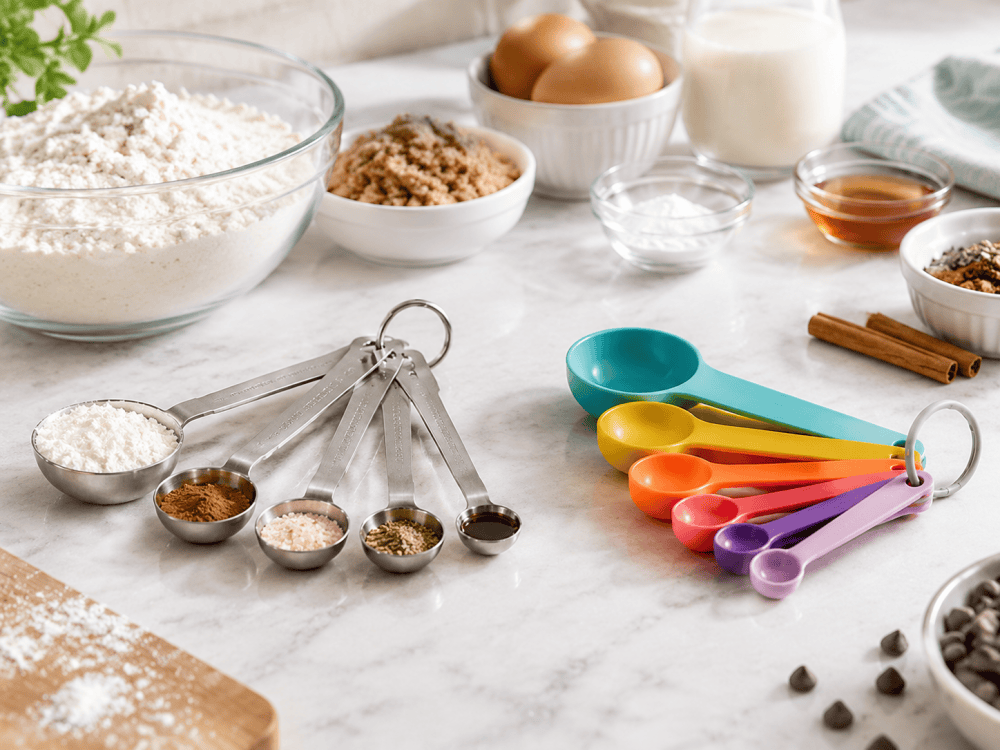


What Is the Smallest Measuring Spoon? A Guide to 1/8 and 1/16 Teaspoon
Kitlucy Kitchen Guide · Measuring Tools
Need to measure a tiny amount of salt, baking powder, spice, or vanilla? Learn how small measuring spoons work, how 1/8 teaspoon compares with 1/16 teaspoon, and which miniature spoon sizes are most useful for cooking and baking.
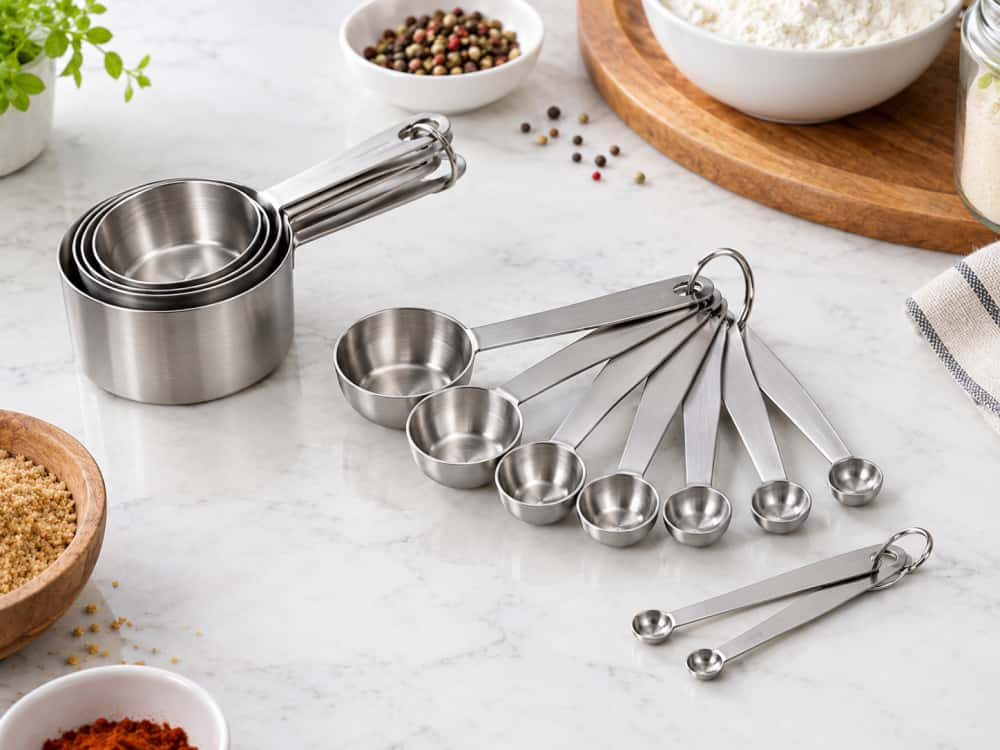
What is the smallest measuring spoon? For many everyday kitchen sets, 1/4 teaspoon is the smallest included size. Smaller specialty sets may include a 1/8 teaspoon, 1/16 teaspoon, or even smaller measures such as 1/32 teaspoon. A 1/16 teaspoon holds half as much as a 1/8 teaspoon. In US customary measurements, these are approximately 0.31 mL and 0.62 mL, respectively.
What Is the Smallest Measuring Spoon?
The answer depends on the measuring spoon set. Standard household sets often include 1/4 teaspoon as their smallest spoon, while specialty mini measuring spoon sets offer smaller capacities for recipes that require greater control over tiny quantities.
A typical measuring spoon set may include a tablespoon, teaspoon, 1/2 teaspoon, and 1/4 teaspoon. Some sets expand this range with a 1/8 teaspoon measure. Miniature sets may include 1/16 teaspoon, 1/32 teaspoon, or other small-volume measures.
If you regularly follow recipes that use small quantities of concentrated spices, leavening agents, extracts, or other ingredients, having a smaller measuring spoon can make the process more consistent than estimating by eye.
Common small measuring spoon sizes
- 1/4 teaspoon: A common small size in standard household measuring spoon sets.
- 1/8 teaspoon: Half of a 1/4 teaspoon; useful for smaller seasoning and baking quantities.
- 1/16 teaspoon: Half of a 1/8 teaspoon; useful when a recipe calls for a very small amount.
- 1/32 teaspoon: A specialty mini measure found in some miniature spoon sets.
Not every set contains all these sizes. Check the listed capacities and the markings on the spoons before purchasing.
1/8 Teaspoon vs. 1/16 Teaspoon: What Is the Difference?
The main difference is capacity. A 1/8 teaspoon holds twice the volume of a 1/16 teaspoon, making the 1/16 teaspoon the better fit when a recipe requires a smaller measured quantity.
Both measurements are useful for small-volume ingredients. A 1/8 teaspoon can be convenient for measuring small portions of spices or flavorings, while a 1/16 teaspoon can help when you need approximately half that amount.
Which size should you use?
Follow the exact measurement in the recipe whenever possible. If a recipe specifies 1/8 teaspoon, use a 1/8 teaspoon measure or combine two level 1/16 teaspoon measures. If it calls for 1/16 teaspoon, using a full 1/8 teaspoon would double the intended volume.
For very small amounts, a consistent measuring method matters. Fill and level the spoon as appropriate for the ingredient, and avoid adding an unmeasured extra portion.
Small Measuring Spoon Conversion Chart
Use this chart to compare common teaspoon fractions with approximate metric volumes.
| US Measurement | Approximate Volume | Relationship |
|---|---|---|
| 1 teaspoon (1 tsp) | 4.93 mL | Standard teaspoon reference |
| 1/2 teaspoon | 2.46 mL | Half of 1 tsp |
| 1/4 teaspoon | 1.23 mL | Half of 1/2 tsp |
| 1/8 teaspoon | About 0.62 mL | Half of 1/4 tsp |
| 1/16 teaspoon | About 0.31 mL | Half of 1/8 tsp |
| 1/32 teaspoon | About 0.15 mL | Half of 1/16 tsp |
Metric values are rounded from US customary teaspoon fractions. Some products use rounded metric capacities or different measurement conventions. Follow the markings and specifications of your particular measuring set.
How many milliliters are in 1/16 teaspoon?
One US teaspoon is approximately 4.93 mL. Dividing that volume by 16 gives approximately 0.31 mL for 1/16 teaspoon. Similarly, 1/8 teaspoon is approximately 0.62 mL.
Remember that milliliters measure volume, not mass. The weight in grams will vary depending on the ingredient. One 1/16 teaspoon of table salt will not necessarily weigh the same as 1/16 teaspoon of flour or cinnamon.
What Do Pinch, Dash, and Smidgen Mean?
Recipes sometimes use informal terms instead of exact teaspoon fractions. These words can be convenient, but their meanings are not always consistent across cookbooks, manufacturers, and cooking traditions.
| Term | Common Mini-Spoon Convention | Important Note |
|---|---|---|
| Dash | Often labeled 1/8 tsp | May vary by recipe or spoon set. |
| Pinch | Often labeled 1/16 tsp | A finger pinch is not a standardized volume. |
| Smidgen | Often labeled 1/32 tsp | Conventions differ between products. |
| Tad | Sometimes labeled 1/4 tsp | Check the definitions used by the specific set. |
These are common naming conventions, not universal definitions. Some recipes use “pinch” to mean a small amount taken between the fingers, while some specialty spoon sets assign that label to a specific capacity.
Should you use a pinch or a 1/16 teaspoon?
For casual seasoning, a pinch may be sufficient. For repeatable baking results or recipes with concentrated ingredients, a clearly marked measuring spoon provides a more consistent reference than estimating with your fingers.
When Do You Need a Mini Measuring Spoon?
Small measuring spoons are useful whenever the quantity is too small to measure conveniently with the larger spoons in a standard set.
1. Baking recipes
Some baking recipes call for small amounts of baking powder, baking soda, salt, spices, or concentrated flavorings. Measuring carefully can help you follow the intended ingredient balance.
2. Seasoning and spice blends
When preparing a small batch of a spice blend, a 1/8 or 1/16 teaspoon can help portion small quantities of strong seasonings more consistently.
3. Small-batch cooking
When scaling a recipe down, you may need a fraction of the original seasoning quantity. Mini spoons can make those smaller measurements easier to manage.
4. Repeating a recipe consistently
If you prepare the same recipe regularly, using the same marked spoon and the same filling method can reduce variation between batches.
For ingredients where the recipe specifies an exact mass, or where a small variation would be important, a suitably precise scale may be more appropriate than a volume spoon.
How to Measure 1/16 Teaspoon Without a 1/16 Teaspoon
If your measuring set does not include a 1/16 teaspoon, there are a few practical options for ordinary cooking.
Option 1: Use half of a level 1/8 teaspoon
For dry ingredients that can be divided reasonably evenly, fill a 1/8 teaspoon and level it. Transfer the ingredient to a clean, flat surface and divide it into two similar portions. Use one portion as an approximation of 1/16 teaspoon.
This method is an estimate rather than a precise measurement. Fine powders, coarse crystals, and ingredients that clump may not divide evenly by volume or weight.
Option 2: Use two 1/16 teaspoon measures for 1/8 teaspoon
If your set includes a 1/16 teaspoon but not a 1/8 teaspoon, two level measures equal 1/8 teaspoon. This is useful for recipes that call for the larger of the two quantities.
Option 3: Choose a set with the required size
If you frequently prepare recipes that call for tiny quantities, buying a mini measuring spoon set with clearly marked capacities is usually more convenient than estimating every time.
Option 4: Use a suitable scale when mass matters
A scale can be useful when a recipe specifies grams or when ingredient density makes volume measurements inconsistent. At very small quantities, the scale must have suitable resolution and accuracy for the amount being weighed.
Important: Do not use approximate kitchen spoon conversions to measure medication or other substances that require precise dosing. Use the measuring device and instructions supplied for that purpose.
Tips for Measuring Very Small Amounts Accurately
- Check the spoon marking. Confirm whether the spoon is 1/8 teaspoon, 1/16 teaspoon, or another size before filling it.
- Use a consistent filling method. For dry ingredients, follow the recipe's instructions on filling, packing, and leveling.
- Level the ingredient when appropriate. A level spoon is more repeatable than an uneven mound when the recipe expects a level measure.
- Avoid spills. Small quantities are easy to lose while transferring ingredients from the spoon to a mixing bowl.
- Keep spoons clean and dry. Residual moisture or ingredients from a previous measurement can affect the next portion.
- Use the right tool for the recipe. If a recipe gives a weight in grams, use a suitable scale rather than assuming volume and weight are interchangeable.
Why can a tiny measurement make a difference?
The effect depends on the ingredient and the recipe. A small change in the amount of a strong spice or flavoring may noticeably affect taste. In baking, changing a leavening ingredient can also affect the result. Careful measuring is particularly useful when following a tested recipe or reproducing the same batch.
How to Choose a Small Measuring Spoon Set
If you are choosing measuring spoons for home use, retail, or a kitchenware product range, look beyond the number of pieces in the set.
- Look for clearly marked capacities The measurement should be easy to identify, including on smaller spoons.
- Check which sizes are included A standard set may stop at 1/4 teaspoon. Mini sets may include 1/8, 1/16, or smaller measures.
- Consider the material Stainless steel is commonly selected for durability, while plastic options may be lightweight and economical. The best choice depends on product specifications, construction, intended use, and user preference.
- Inspect the spoon shape Narrow or elongated spoon heads may fit certain spice jars better. Consider whether the shape is easy to fill, level, and clean.
- Check storage and organization A ring, nesting design, or another storage solution can help keep small spoons together.
- Review cleaning instructions Confirm whether the product is dishwasher-safe or requires hand washing.
For kitchenware retailers and private-label buyers
When sourcing measuring spoon sets, confirm the exact capacity of every spoon, the measurement system used, marking durability, material specifications, and product dimensions. If a set uses terms such as “pinch” or “smidgen,” make sure the intended capacity is clearly defined in the product specifications.
For product development, sample inspection and consistent capacity checks are important. Packaging should also communicate which sizes are included so customers can compare sets accurately before purchase.
Frequently Asked Questions
What is the smallest measuring spoon size?
In many standard household sets, 1/4 teaspoon is the smallest included size. Specialty mini measuring spoon sets may include 1/8 teaspoon, 1/16 teaspoon, 1/32 teaspoon, or smaller capacities.
Is 1/16 teaspoon smaller than 1/8 teaspoon?
Yes. A 1/16 teaspoon holds half the volume of a 1/8 teaspoon. Two level 1/16 teaspoon measures equal one 1/8 teaspoon.
How many milliliters is 1/16 teaspoon?
One US 1/16 teaspoon is approximately 0.31 mL. This is a rounded volume conversion, not a gram measurement.
How many milliliters is 1/8 teaspoon?
One US 1/8 teaspoon is approximately 0.62 mL, or twice the volume of 1/16 teaspoon.
Is a pinch the same as 1/16 teaspoon?
Some mini measuring spoon sets label 1/16 teaspoon as a pinch. However, the term is not universally standardized, and a pinch taken between the fingers varies from person to person.
Can I use half of a 1/8 teaspoon to measure 1/16 teaspoon?
You can divide a level 1/8 teaspoon portion into two similar portions as a rough estimate for ordinary cooking. This is not as reliable as using a dedicated 1/16 teaspoon measure.
Do all measuring spoon sets include 1/8 teaspoon?
No. Many standard sets include 1 tablespoon, 1 teaspoon, 1/2 teaspoon, and 1/4 teaspoon. Smaller sizes depend on the set, so check the product listing before buying.
Is a measuring spoon more accurate than a kitchen scale?
They measure different things: a measuring spoon measures volume, while a scale measures mass. For recipes specified in grams, a suitable scale is usually the more direct choice. For recipes specified in teaspoon fractions, use a properly sized measuring spoon.
Further Reading on Kitchen Measurements
For standard US kitchen measurement equivalents, consult these reference sources. Informal terms such as “pinch,” “dash,” and “smidgen” may vary by recipe and manufacturer.
KITLUCY · MEASURING TOOLS
Looking for Measuring Spoons for Your Kitchenware Range?
Whether you are developing an everyday measuring spoon set or exploring additional sizes for baking and seasoning, clear capacity specifications and practical product design help create a better user experience.
Explore Kitlucy's kitchenware range and contact the team to discuss product selection, wholesale inquiries, or private-label requirements.
Related Blogs