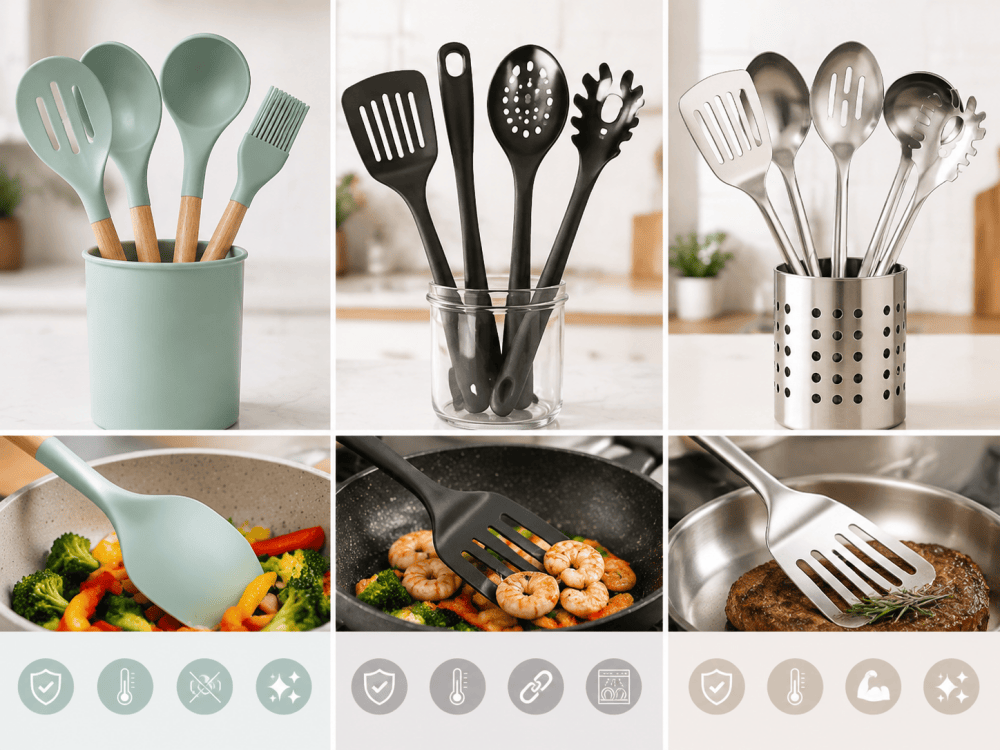
Is Silicone Safer Than Plastic for Food? A Food-Safety Comparison
Is Silicone Safer Than Plastic for Food? A Food-Safety Comparison
Is silicone safer than plastic for food? Not necessarily in every situation. Silicone and plastic are broad material categories, and food-contact safety depends on the specific material formulation, additives, manufacturing quality, intended use, temperature, food type, and applicable food-contact requirements. However, food-grade silicone can offer advantages over some plastics for kitchenware applications that involve repeated exposure to higher temperatures.
Silicone and plastic are both widely used in modern kitchenware. You can find silicone spatulas, baking molds, brushes, food storage products, tongs, and utensils alongside polypropylene (PP), nylon, ABS, and other plastic kitchen products.
This leads to a common question: is silicone safer than plastic for food?
The answer is more nuanced than simply saying that one material is safe and the other is unsafe. Silicone is not automatically safer than every plastic, and plastic is not automatically unsafe for food contact. The key question is whether the specific material and finished product are suitable for the intended food-contact conditions.
For consumers, retailers, importers, and kitchenware brands, this distinction is important when choosing materials for cooking utensils, baking tools, food containers, and other kitchen products.

Silicone vs Plastic for Food: Quick Answer
| Factor | Silicone | Plastic |
|---|---|---|
| Material category | Flexible elastomer | Large family of polymers with different properties |
| Food-contact suitability | Depends on formulation and intended use | Depends on polymer, formulation and intended use |
| Heat performance | Often well suited to repeated high-temperature kitchen applications | Varies significantly by plastic type and product design |
| Flexibility | Generally flexible and elastic | Ranges from flexible to rigid |
| Durability | Good resistance to repeated flexing in many applications | Depends strongly on polymer and design |
| Food-contact safety | Must be evaluated for its intended application | Must be evaluated for its intended application |
| Common kitchen applications | Spatulas, baking molds, brushes, scrapers and utensil heads | Containers, handles, measuring tools, kitchen gadgets and utensil components |
Important: “Silicone” and “plastic” are not single materials with one universal safety profile. A meaningful comparison should evaluate the exact material, formulation and conditions of use.
Is Silicone Safer Than Plastic?
Silicone can be a very suitable material for food-contact kitchenware, but it is not scientifically accurate to say that silicone is always safer than plastic.
Plastic includes many different polymers. Polypropylene, polyethylene, nylon, ABS and other plastics have different chemical structures, additives, temperature capabilities and food-contact applications.
Likewise, silicone products can differ in formulation, curing process, additives, pigments, fillers and manufacturing quality.
Therefore, the better question is not simply:
“Is silicone safer than plastic?”
Instead, ask:
“Which specific material is suitable for this food-contact application under the expected conditions of use?”
This approach is consistent with how food-contact materials are evaluated. The FDA explains that food-contact substances are assessed according to their intended use, including migration and toxicological information, rather than simply being classified as universally safe or unsafe materials.
Is Silicone Safer Than Plastic for Food?
For food-contact kitchenware, food-grade silicone can be an excellent option, especially when flexibility and repeated exposure to elevated temperatures are important.
However, a properly formulated food-contact plastic can also be an appropriate and safe material for food use.
For example, polypropylene is widely used in food-contact applications because it can provide a useful combination of lightweight construction, chemical resistance, durability and heat performance depending on the specific grade and product design.
This means that a high-quality food-contact PP container should not automatically be considered less safe simply because it is made from plastic.
At the same time, a silicone product should not automatically be considered safe simply because the word “silicone” appears in its product description.
Why Is Silicone Popular for Food-Contact Kitchenware?
1. Good Performance at Elevated Temperatures
One of the biggest reasons silicone is popular in cooking and baking products is its ability to perform well in many high-temperature applications.
This makes silicone useful for products such as spatulas, scrapers, pastry brushes, baking molds and oven-related kitchen tools.
However, the actual temperature limit depends on the specific silicone formulation and finished product. Buyers should always follow the manufacturer's stated conditions of use rather than assuming that every silicone product has the same temperature rating.
2. Flexibility
Silicone is naturally flexible and elastic. This allows manufacturers to create soft spatulas, flexible scrapers, collapsible products and baking molds that are difficult to produce from rigid materials.
3. Non-Stick-Friendly Surface
Silicone surfaces are commonly used in baking and cooking applications because they can help reduce sticking and make certain foods easier to release.
This is particularly useful for silicone baking molds, pastry tools and kitchen utensils.
4. Resistance to Repeated Flexing
Many silicone kitchen products can withstand repeated bending and flexing without becoming permanently deformed as quickly as some rigid materials.
This is useful for spatulas, scrapers, brushes and flexible baking molds.
Does Plastic Make Food Unsafe?
No. “Plastic” is too broad a category to make that conclusion.
Different plastics have very different properties and food-contact applications.
For example, polypropylene, commonly identified as PP or recycling code 5, is widely used for food containers, kitchen tools and other food-contact products.
Other plastics may be better suited to rigid handles, housings or specific temperature conditions.
The important question is whether the specific plastic formulation and finished article are appropriate for the intended food-contact use.
FDA guidance explains that food-contact materials must be evaluated according to their specific components and intended conditions of use.
Silicone vs PP Plastic for Food
For kitchenware sourcing, comparing silicone with a specific plastic such as polypropylene is often more useful than comparing silicone with “plastic” as a whole.
| Feature | Silicone | PP Plastic |
|---|---|---|
| Flexibility | High | Moderate; depends on design |
| Rigidity | Low to moderate | Moderate to high depending on design |
| Heat applications | Commonly used for higher-temperature kitchen tools | Suitable for many food-contact applications, but temperature limits depend on grade |
| Typical feel | Soft, flexible, rubber-like | Lightweight, harder and more rigid |
| Common applications | Spatulas, baking molds, scrapers and brushes | Containers, measuring tools, kitchen gadgets and handles |
| Manufacturing | Compression, injection or liquid silicone processes depending on product | Commonly injection molded |
Neither material wins every category. The better choice depends on what the product needs to do.
Is Silicone Better Than Plastic for Cooking Utensils?
Silicone can be a strong choice for cooking utensils when the product requires flexibility, a soft working surface and repeated exposure to elevated temperatures.
For example, silicone spatulas are useful when working with non-stick cookware because the flexible head can conform to the surface without the rigidity of some metal utensils.
Plastic utensils can also be appropriate, particularly when the product needs greater rigidity, lower material cost, lightweight construction or a specific structural design.
For B2B buyers, the choice should therefore be based on the product's function rather than the assumption that silicone is universally safer.
Is Silicone Safer Than Plastic for Baking?
Silicone is particularly popular in baking because many silicone products are designed for repeated exposure to oven temperatures within their specified operating range.
Common examples include:
- Silicone baking molds
- Silicone spatulas
- Silicone pastry brushes
- Silicone scrapers
- Silicone baking mats
- Silicone utensil handles
However, silicone is not automatically safer simply because it is used in baking.
The finished product should be designed and tested for its intended temperature, food type and contact conditions.
FDA food-contact guidance specifically recognizes that conditions such as high-temperature processing, cooking and different food types can affect how food-contact substances are evaluated.
Does Silicone Leach Chemicals Into Food?
Like other food-contact materials, silicone products should be evaluated based on the potential migration of substances from the material into food under their intended conditions of use.
It is therefore too broad to say that silicone “never leaches anything.”
Likewise, it would be inaccurate to assume that all plastics have the same migration behavior.
Food-contact safety is influenced by factors such as:
- Material formulation
- Additives and pigments
- Manufacturing process
- Food type
- Temperature
- Contact time
- Surface condition
- Intended use
The FDA evaluates migration and exposure when assessing food-contact substances for intended uses.
Does Food-Grade Silicone Mean It Is Automatically Safe?
No.
“Food-grade silicone” is useful terminology, but responsible sourcing should go beyond a product description.
For commercial kitchenware, buyers should ask the supplier for documentation relevant to the target market and intended application.
Depending on the product and market, this may include:
- Material specifications
- Food-contact compliance documentation
- Migration or overall migration testing
- Third-party laboratory reports
- Temperature or conditions-of-use information
- Product specifications
- Quality-control documentation
It is also important to understand that a compliance document applies to a specific material, formulation, product or intended use rather than automatically proving that every product made from the same general material is compliant.
What Makes a Silicone Kitchen Product Safer?
For B2B buyers, several factors matter more than simply choosing silicone over plastic.
Material Quality
The supplier should be able to clearly identify the silicone material used in the product and explain its intended food-contact application.
Manufacturing Control
Consistent mixing, molding, curing, finishing and quality inspection help reduce variation between production batches.
Suitable Conditions of Use
The product should be designed for the temperatures, food types, cleaning methods and contact conditions expected in actual use.
Testing and Documentation
For commercial projects, documentation can help buyers evaluate whether a product is suitable for the target market and application.
Finished Product Quality
Material quality alone does not tell the entire story. Pigments, coatings, inserts, adhesives, handles and other components can also matter depending on the construction of the product.
Silicone vs Plastic: Which Is Better for Different Kitchen Products?
| Kitchen Product | Potentially Suitable Material | Why |
|---|---|---|
| Spatula | Silicone or plastic | Silicone offers flexibility; suitable plastics can provide greater rigidity |
| Baking mold | Silicone | Flexibility and easy release are useful for many baking applications |
| Food container | PP and other suitable plastics | Rigidity, lightweight design and food-storage applications |
| Pastry brush | Silicone | Flexible bristles and easy cleaning |
| Measuring cup | Plastic or silicone | Choice depends on rigidity, flexibility and product design |
| Kitchen gadget | Plastic, silicone or combination | Different components may require different material properties |
Is Silicone Better Than Plastic for High-Temperature Kitchenware?
In many applications, silicone has an advantage because it can be formulated for repeated use at temperatures that would be unsuitable for some conventional plastics.
But this does not mean every silicone product can withstand unlimited heat.
Temperature performance should always be based on the specific product specification.
For example, a silicone utensil head may have a different operating range from a product that combines silicone with a PP handle, stainless steel core, adhesive or other component.
Heat resistance should therefore be evaluated at the finished-product level, not only at the raw-material level.
Silicone vs Plastic: Which Is More Durable?
Durability depends heavily on the product design and the type of plastic being compared.
Silicone can perform well when repeated bending, flexing and temperature changes are involved.
Some plastics can provide excellent rigidity, impact resistance and dimensional stability.
Therefore, there is no universal answer that silicone is more durable than plastic.
For OEM and private-label kitchenware, the correct material should be selected according to the product's mechanical requirements, temperature requirements, expected service conditions and target price.
How Should B2B Buyers Compare Silicone and Plastic Kitchenware?
If you are sourcing kitchenware for wholesale, retail or private label, do not compare materials based only on the words “silicone” and “plastic.”
Instead, compare the following specifications:
- Exact material and grade
- Food-contact suitability
- Temperature range
- Food types and conditions of use
- Migration or compliance documentation
- Product construction
- Color and pigment system
- Odor and sensory characteristics
- Mechanical performance
- Cleaning and dishwasher requirements
- MOQ
- Tooling requirements
- Packaging options
- Private-label capabilities
Can Silicone and Plastic Be Used Together in One Kitchen Product?
Yes. Many kitchenware products combine different materials to achieve a better balance of performance, cost and appearance.
For example, a cooking utensil may combine a silicone working head with a PP handle or stainless steel core.
A food-contact product can therefore contain several materials, and each relevant component should be considered for the intended application.
This is especially important for OEM and private-label projects because the finished product, rather than only the main visible material, is what the buyer ultimately needs to evaluate.
Which Is Safer: Silicone or Plastic?
There is no universal winner. Food-grade silicone can be an excellent choice for many cooking and baking applications, particularly where flexibility and repeated exposure to elevated temperatures are important. Suitable food-contact plastics can also be safe and effective for many applications. The safest choice depends on the exact material, formulation, product construction and intended conditions of use.
FAQ: Silicone vs Plastic for Food
Is silicone safer than plastic for food?
Not automatically. Silicone and plastic include many different formulations. Food-contact safety depends on the exact material, manufacturing quality, intended use, temperature, food type and applicable requirements.
Is silicone safer than plastic for cooking?
Silicone can be advantageous for certain cooking applications because of its flexibility and high-temperature performance. However, properly designed food-contact plastics can also be suitable for cooking utensils and kitchen products.
Is silicone safer than plastic for baking?
Food-grade silicone is widely used for baking molds, mats and utensils because many silicone formulations can perform well at elevated temperatures. The actual temperature rating should always be confirmed for the specific product.
Is food-grade silicone safer than plastic?
Food-grade silicone can be suitable for food contact, but “food-grade” should not be treated as an automatic guarantee that every silicone product is safer than every plastic product. The exact intended use and compliance documentation matter.
Does silicone contain BPA?
Silicone is chemically different from common BPA-based polycarbonate plastics. However, buyers should evaluate the complete formulation and finished product rather than relying on a single “BPA-free” statement as the only measure of food-contact safety.
Can silicone replace plastic in kitchenware?
Sometimes. Silicone is particularly useful for flexible, heat-resistant and soft-touch applications. Plastic may remain preferable when rigidity, dimensional stability, lightweight construction or cost efficiency is more important.
Is silicone more heat resistant than plastic?
Silicone generally performs well in many high-temperature kitchen applications, but plastics vary significantly. A specific plastic may have a different temperature capability from another plastic, so material comparisons should always use the exact grade and finished-product specification.
What should I ask a silicone kitchenware supplier?
Ask about the exact silicone material, food-contact documentation, applicable testing, temperature rating, manufacturing process, product construction, MOQ, customization, packaging and quality-control procedures.
Final Takeaway: Is Silicone Safer Than Plastic for Food?
Silicone is not automatically safer than plastic, but high-quality food-contact silicone can be an excellent material for many cooking and baking applications.
The biggest mistake is treating “silicone” and “plastic” as two simple safety categories.
Plastic includes many different polymers, while silicone products can also vary in formulation and manufacturing quality.
For food-contact kitchenware, the better approach is to evaluate the specific material and finished product according to its intended conditions of use, including temperature, food type, contact time, manufacturing quality and applicable food-contact requirements.
For B2B buyers, this approach provides a more reliable basis for selecting materials for cooking utensils, baking tools, kitchen gadgets, food-contact products and private-label kitchenware.
Looking for Silicone or Plastic Kitchenware for OEM & Private Label?
Kitlucy is a kitchenware brand under DKS-Group, with more than 27 years of manufacturing experience. We provide cooking tools, baking tools and kitchenware solutions with OEM and ODM customization.
For a silicone or plastic kitchenware project, you can discuss material selection, product design, size, color, logo, packaging and other customization requirements with the Kitlucy team.
Related Blogs