

What Are the Advantages of a Nylon Utensil Set Compared to Other Materials?
Choosing the right kitchen utensil set involves more than comparing appearances. Material affects cookware compatibility, heat resistance, durability, ease of use, and overall product cost. Among the available options, nylon kitchen utensils are a practical choice for many everyday cooking tasks, especially when lightweight handling and affordability are priorities.
But how does a nylon utensil set compare with silicone and 304 stainless steel? Which material works best for non-stick cookware, everyday home cooking, or high-temperature applications? This guide explains the key differences and helps consumers, retailers, and kitchenware buyers choose the right utensils for their needs.
Quick Answer: Nylon utensil sets are valued for their lightweight construction, practical rigidity, cookware-friendly surfaces, and cost-effective positioning. Silicone offers greater flexibility and is often preferred for scraping bowls and handling delicate non-stick cookware. Stainless steel provides excellent rigidity and durability for demanding cooking tasks. The best choice depends on the utensil design, rated operating temperature, cookware, and intended application.
1. What Is a Nylon Utensil Set?
A nylon utensil set is a collection of cooking tools made with nylon working heads, handles, or other structural components. Depending on the design, a set may include cooking spoons, slotted turners, solid turners, ladles, pasta servers, skimmers, and other everyday kitchen tools.
Nylon is a type of engineering thermoplastic. Its combination of relatively low weight, useful rigidity, and design flexibility makes it suitable for many kitchen utensil applications. Unlike metal utensils, properly designed nylon heads are generally less likely to scratch intact non-stick coatings during normal use.
However, nylon is not a single, identical material across every product. Formulation, reinforcement, manufacturing quality, utensil thickness, and the temperature rating all influence performance. Buyers should evaluate the finished product rather than relying on the word "nylon" alone.
Common Types of Nylon Kitchen Utensils
- Nylon cooking spoons: For stirring soups, sauces, vegetables, and other everyday dishes.
- Nylon turners and spatulas: For flipping eggs, pancakes, burgers, and other foods in suitable cookware.
- Nylon slotted spoons: For lifting food while allowing excess liquid to drain.
- Nylon ladles: For serving soups, stews, and sauces.
- Nylon utensil sets: For households, retail assortments, and kitchenware collections that require multiple complementary tools.
2. What Are the Main Advantages of a Nylon Utensil Set?
The strongest reason to choose a nylon utensil set is its balance of practicality, handling, cookware compatibility, and cost. It may not outperform every alternative in every category, but it offers a useful combination for everyday cooking.
Lightweight and Comfortable to Handle
Nylon utensils are generally lighter than comparable solid stainless steel tools. This can make repeated stirring, turning, and serving more comfortable, especially for users who prefer lightweight kitchen accessories.
For a multi-piece set, lower weight can also make storage, handling, and product packaging more convenient. The actual feel still depends on the handle design, wall thickness, internal structure, and overall balance of each utensil.
Suitable for Many Non-Stick Cookware Applications
One of nylon's key advantages is its suitability for many non-stick cooking applications. Compared with hard metal utensil heads, nylon working surfaces are generally less likely to scratch intact non-stick coatings when used correctly.
This makes nylon turners, spoons, and spatulas practical options for everyday frying pans and coated cookware, provided that the utensil is designed for the intended temperature and cooking task.
Useful Rigidity for Everyday Cooking
Compared with soft, flexible silicone, nylon often provides a firmer working head. This can be helpful when turning pancakes, lifting food, stirring thicker mixtures, or moving ingredients around a pan.
That balance between flexibility and stiffness depends on the product's design and dimensions. Thin nylon heads may bend more easily, while thicker or reinforced designs can offer greater resistance to flexing.
Cost-Effective for Everyday Use and Retail Sets
Nylon utensils are often suitable for products positioned around affordability and practical everyday functionality. For consumers, a multi-piece set can provide several useful tools without requiring a separate purchase for each utensil.
For retailers and wholesalers, nylon can also be considered when developing value-oriented kitchen utensil assortments. Final pricing depends on the material grade, tool count, construction, production volume, packaging, and quality requirements.
Flexible Options for Shapes and Colors
Nylon can be molded into different utensil shapes, including slotted heads, solid spoons, turners, and serving tools. Color choices and handle configurations can also be varied to support different product styles.
For kitchenware brands, these design options can help create coordinated utensil sets for specific retail channels or consumer preferences. Color consistency and the suitability of pigments for food-contact applications should be assessed during product development.
Practical for Everyday Cleaning and Storage
Many nylon utensils have relatively simple surfaces that can be cleaned with ordinary dishwashing methods. Lightweight construction and coordinated set designs can also make them easy to organize in drawers, utensil holders, or kitchen storage systems.
Cleaning requirements vary by product. Dishwasher compatibility should be confirmed from the manufacturer's instructions, and utensils should be inspected regularly for wear or heat damage.
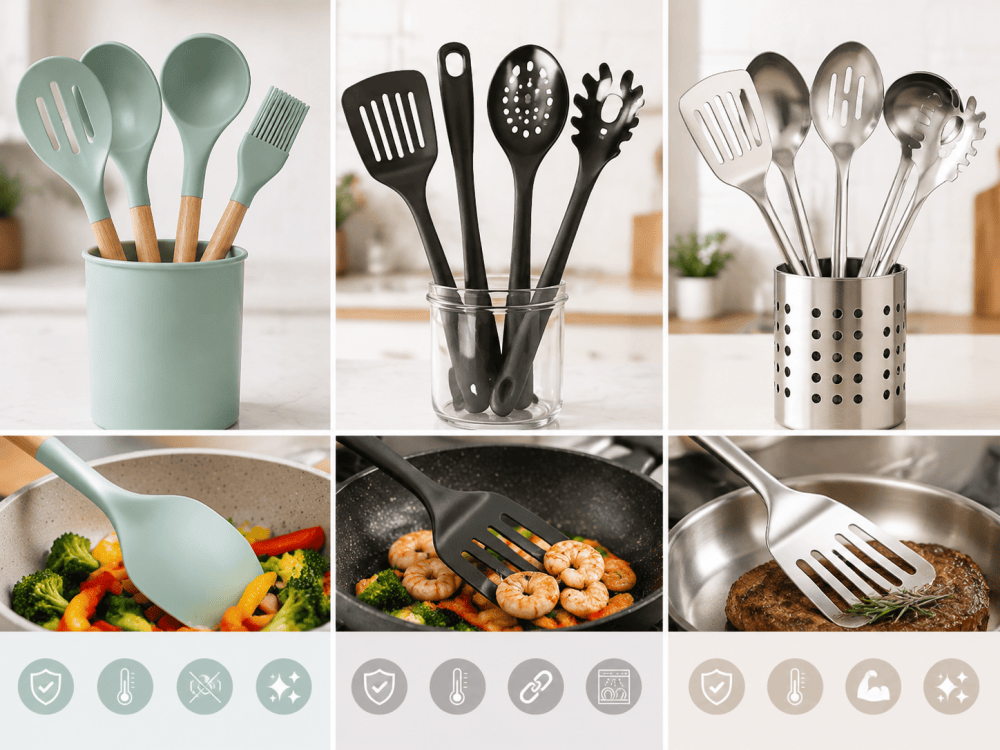
3. Nylon vs. Silicone vs. 304 Stainless Steel: Advantages and Disadvantages
There is no universally best kitchen utensil material. Nylon, silicone, and 304 stainless steel each have different strengths, so the right option depends on the cooking task and the expectations of the intended user.
| Comparison Factor | Nylon | Food-Grade Silicone | 304 Stainless Steel |
|---|---|---|---|
| Main advantages | Lightweight, relatively rigid, practical, and often cost-effective | Flexible, soft, and useful for scraping and coated cookware | Strong, rigid, durable, and corrosion-resistant when properly manufactured |
| Main limitations | Can soften, deform, or degrade if exposed beyond its rated temperature | May flex too much for tasks requiring a firm edge or rigid head | Hard working surfaces can scratch non-stick coatings |
| Weight | Generally lightweight | Generally lightweight, depending on construction | Often heavier than comparable polymer utensils |
| Working-head feel | Usually firmer than flexible silicone | Soft and flexible | Firm and rigid |
| Non-stick cookware | Generally suitable when used correctly | Generally suitable when used correctly | Use caution; metal heads can scratch coatings |
| High-temperature use | Limited by the specific grade and product rating | Limited by the specific formulation and product rating | Generally well suited to high-temperature cooking tasks |
| Common applications | Everyday stirring, turning, and serving | Scraping bowls, folding mixtures, and gentle cooking | Heavy-duty stirring, grilling tools, and demanding cooking tasks |
| Typical market positioning | Practical everyday and value-oriented sets | Versatile household and design-focused sets | Durability-focused and professional-style tools |
The comparison above describes general material characteristics, not guaranteed performance for every product. A well-designed utensil made from one material may outperform a poorly designed utensil made from another.
Nylon vs. Silicone: Which Is More Practical?
Nylon is worth considering when users prefer a firmer utensil head for turning, lifting, and stirring. Silicone is often the better choice when flexibility is important, such as scraping the sides of a mixing bowl or folding a delicate mixture.
Both materials can be suitable for non-stick cookware. The deciding factors are the utensil's shape, stiffness, temperature rating, and the task being performed.
Nylon vs. Stainless Steel: Which Should You Choose?
Nylon is often a practical choice for everyday coated cookware, where a non-metal working surface is desirable. Stainless steel is better suited to tasks that benefit from rigidity and high-temperature durability, such as certain grilling and heavy-duty cooking applications.
For a kitchen that uses non-stick cookware regularly, a nylon set can be a useful everyday option. Stainless steel tools may still be valuable for compatible cookware and specific cooking tasks.
4. Which Utensil Material Is Best for Different Cooking Scenarios?
Choosing a utensil based on the actual cooking task is more useful than assuming that one material is best for every kitchen. Consider the cookware, temperature, required stiffness, and type of food being handled.
| Cooking Scenario | Material to Consider | Why | Important Consideration |
|---|---|---|---|
| Cooking with non-stick pans | Nylon or silicone | Non-metal heads can help reduce scratching | Use within the product's temperature rating |
| Flipping eggs and pancakes | Nylon or silicone | Suitable for many coated pans | Choose a thin, appropriately shaped turner |
| Scraping mixing bowls | Silicone | Flexibility helps follow the bowl's contours | Check whether the head and handle are heat-rated for the intended use |
| Stirring everyday dishes | Nylon, silicone, or stainless steel | Each can work depending on cookware and recipe | Consider the required stiffness and surface compatibility |
| High-temperature grilling | Suitable stainless steel tools | Metal is generally better suited to direct, intense heat | Check handle materials and product specifications |
| Heavy-duty commercial tasks | Application-specific stainless steel or rated utensils | Frequent use may require greater structural durability | Assess sanitation, wear, temperature, and service-life requirements |
For Everyday Home Cooking
A nylon utensil set can cover many common tasks, including stirring vegetables, serving pasta, flipping eggs, and mixing ingredients in a pan. A coordinated set also provides multiple tools in one purchase, which can be convenient for households setting up a kitchen.
For Non-Stick Cookware
Nylon and silicone are both practical options for coated cookware. Choose nylon when a firmer head is useful, and silicone when flexibility is more important. Neither material should be used beyond its specified temperature limits.
For High-Heat Cooking and Grilling
High-heat applications require extra attention to the utensil's rated temperature and construction. Stainless steel working heads are generally better suited to direct high heat than conventional nylon utensils. Nylon should not be left resting against a hot pan or exposed to a burner or grill flame unless the specific product is expressly designed for that use.
For Professional Kitchens
Professional kitchens may need utensils that withstand frequent washing, intensive use, and demanding cooking conditions. Stainless steel can be suitable for heavy-duty tasks, while properly rated nylon or silicone tools may be useful for specific cookware and food-handling applications.
Commercial buyers should evaluate the finished product's durability, cleanability, food-contact compliance, and suitability for their operating procedures before selecting a material.
5. What Should Buyers Look for in a Nylon Utensil Set?
For retailers, importers, distributors, and kitchenware brands, choosing a nylon utensil set involves more than selecting a color or counting the pieces. Product specifications and the intended market should guide the decision.
Check the Temperature Rating
Do not assume that all nylon utensils have the same heat resistance. Different nylon formulations, product designs, and manufacturing processes can produce different performance limits.
Ask the supplier for the stated maximum operating temperature and any restrictions on contact with hot cookware. Confirm that the rating applies to the finished utensil rather than relying on a generic figure for raw material.
Evaluate Shape, Thickness, and Stiffness
The head should be suitable for its intended task. A turner needs an appropriate edge for lifting food, while a cooking spoon needs enough strength for stirring. Excessive flexibility, sharp edges, rough surfaces, or inconsistent thickness may affect the user experience.
Samples should be tested with the types of food and cookware for which the product is intended.
Review the Complete Set Configuration
A useful set should contain tools that match the target customer's cooking habits. Common configurations may include:
- Solid cooking spoon
- Slotted spoon
- Slotted turner
- Solid turner
- Ladle
- Pasta server or other specialized tool
Not every set needs all these pieces. A compact assortment may be more suitable for smaller households or value-focused retail, while a larger set can serve customers looking for a broader collection of kitchen tools.
Assess Material Quality and Manufacturing Consistency
For wholesale orders, buyers should confirm the material specification, dimensions, finish, color consistency, and construction quality. Check for visible defects, rough edges, deformation, and inconsistent molding.
Food-contact suitability should be supported by appropriate documentation and testing for the destination market. Where relevant, buyers should also clarify traceability, inspection procedures, and applicable regulatory requirements.
Consider Packaging and Retail Presentation
Packaging influences how a utensil set is stored, displayed, and transported. Hanging arrangements, paper sleeves, boxes, and other packaging formats may suit different retail channels.
For private-label projects, confirm artwork requirements, packaging dimensions, labeling obligations, order quantities, and production lead times before placing an order.
6. Why Nylon Utensil Sets Can Be Attractive for Wholesale Buyers
Nylon utensil sets can be a useful option for brands and retailers looking to develop practical, multi-piece kitchenware assortments. Their appeal comes from the combination of everyday functionality, relatively lightweight construction, and flexible product configurations.
Several factors may make them worth considering in a wholesale product range.
- Accessible product positioning: Nylon can support value-oriented assortments, depending on the specification and production volume.
- Multiple set configurations: Different tool combinations can be developed for different customer needs.
- Design flexibility: Molded shapes and color choices allow products to be coordinated across a collection.
- Broad everyday applications: Suitable nylon tools can serve common stirring, turning, and serving needs.
- Complementary product opportunities: Nylon utensils can be combined with other kitchen tools to create broader retail assortments.
These advantages do not guarantee a lower final retail price or stronger sales. Buyers should compare quotations, tooling requirements, quality standards, packaging, logistics, and market demand before making a sourcing decision.
7. Common Mistakes When Choosing Nylon Kitchen Utensils
Assuming All Nylon Utensils Are Heat-Resistant to the Same Degree
Temperature performance varies by grade and finished product. Always verify the supplier's stated limits and avoid using the utensil in applications outside its rating.
Choosing a Set Based Only on Piece Count
A set with more pieces is not necessarily more useful. Consider whether the tools meet the intended cooking needs and whether the design, dimensions, and stiffness are appropriate.
Ignoring Signs of Heat Damage
Discoloration, softening, deformation, cracking, or other unusual changes can indicate that an utensil has been damaged or used outside its intended conditions. Discontinue use when the utensil is no longer in good condition.
Using Hard Utensils on Coated Cookware Without Considering Compatibility
Metal utensil heads can scratch non-stick surfaces. For coated pans, choose a suitable nylon or silicone utensil and follow the cookware manufacturer's recommendations.
Overlooking Product Documentation
For commercial orders, avoid relying solely on general marketing claims such as "food-safe" or "high-temperature resistant." Request the relevant material specifications, test reports, and compliance documents for the actual product and destination market.
Frequently Asked Questions
Are nylon kitchen utensils better than silicone utensils?
Neither material is better for every application. Nylon is often preferred when a firmer working head is useful, while silicone is useful for flexible scraping and folding tasks. The best choice depends on the utensil design, temperature rating, and intended use.
Are nylon utensils suitable for non-stick cookware?
Many nylon utensils are suitable for non-stick cookware because their working surfaces are generally less likely to scratch intact coatings than metal heads. Use them correctly and stay within the product's rated temperature limits.
Can nylon utensils be used for high-temperature cooking?
Only when the specific product is rated for the intended temperature and application. Nylon can soften or deform if overheated, so it should not be exposed to direct flame or left against a hot pan unless the manufacturer expressly permits that use.
Are nylon utensil sets suitable for wholesale and private-label projects?
They can be suitable for value-oriented and everyday kitchenware assortments. Buyers should confirm the available set configurations, material specifications, customization options, minimum order quantity, packaging, quality controls, and compliance documentation with the supplier.
How should nylon kitchen utensils be cleaned?
Follow the manufacturer's care instructions. Many can be washed with dish soap and warm water, but dishwasher compatibility depends on the finished product. Inspect utensils regularly and replace any that show cracking, deformation, or significant wear.
What is the difference between nylon and plastic kitchen utensils?
Nylon is itself a type of plastic, specifically an engineering thermoplastic. The more useful comparison is between nylon and other plastic materials, because their stiffness, temperature resistance, durability, and suitability for food-contact applications can differ significantly.
Conclusion
A nylon utensil set offers a practical combination of lightweight handling, useful rigidity, compatibility with many non-stick cookware applications, and flexible product configurations. These characteristics make nylon worth considering for everyday home kitchens and value-oriented kitchenware assortments.
Silicone remains a strong choice for flexible utensils and scraping tasks, while 304 stainless steel is generally more appropriate for applications that demand rigidity and high-temperature durability. Rather than selecting a material based on a single feature, consider the cookware, cooking method, product rating, and expected service conditions.
For kitchenware brands and wholesale buyers, a well-designed nylon utensil set can be a useful addition to a broader product collection when its specifications, quality, and market positioning align with customer needs.
Explore Kitchen Utensil Solutions with Kitlucy
Looking to develop or expand your kitchenware collection? Explore Kitlucy's kitchenware range to discover products for everyday cooking and kitchen organization.
For product inquiries, discuss your target market, preferred utensil configuration, material requirements, and packaging needs with the Kitlucy team.
Explore KitlucyRelated Blogs