

Measuring Cups vs. Measuring Spoons: What's the Difference?
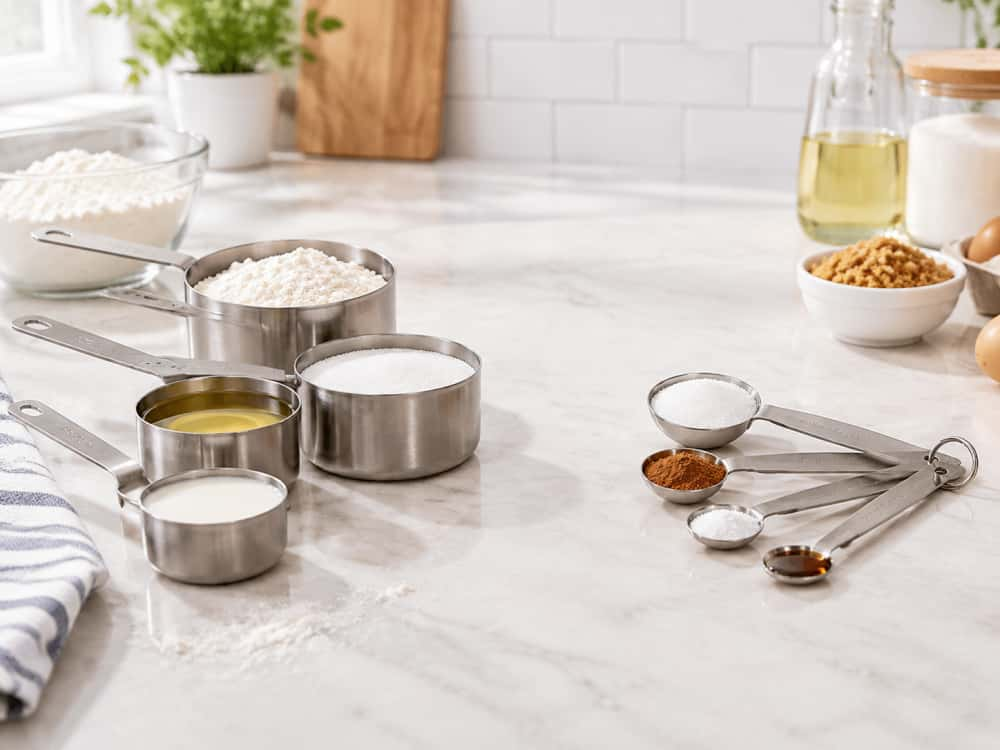
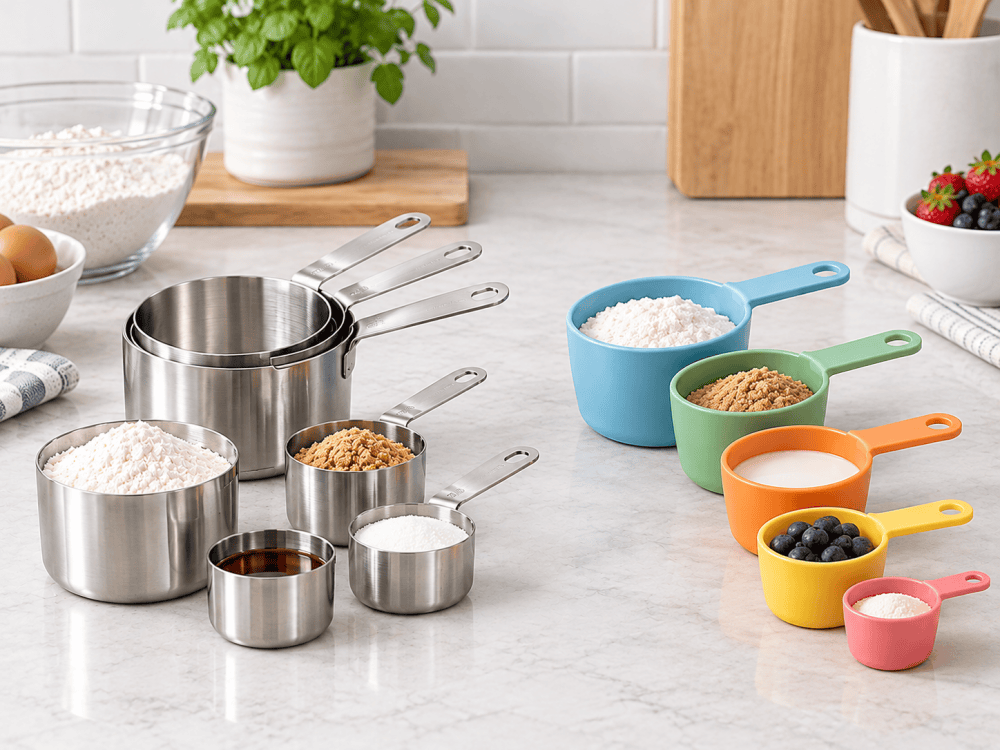
Measuring cups and measuring spoons are both essential kitchen tools, but they serve different purposes. Measuring cups are designed for larger quantities of ingredients, while measuring spoons help you measure smaller amounts with greater convenience. Understanding when to use each tool can improve recipe accuracy, reduce measuring mistakes, and make everyday cooking and baking easier.
Quick Answer: Measuring cups are generally used to measure larger volumes of ingredients, such as flour, sugar, milk, and water. Measuring spoons are designed for smaller quantities, including baking powder, salt, spices, vanilla extract, and cooking oil. Both can measure dry and liquid ingredients, provided you use the appropriate measuring technique.
1. What Is the Difference Between Measuring Cups and Measuring Spoons?
The main difference is capacity. Measuring cups are practical for ingredients used in larger amounts, whereas measuring spoons are better suited to small quantities that need to be measured carefully.
For example, a baking recipe might call for two cups of flour, half a cup of milk, one teaspoon of baking powder, and half a teaspoon of salt. You would typically use measuring cups for the flour and milk, then measuring spoons for the baking powder and salt.
| Feature | Measuring Cups | Measuring Spoons |
|---|---|---|
| Main purpose | Measuring larger quantities of ingredients | Measuring small quantities of ingredients |
| Common sizes | 1 cup, 1/2 cup, 1/3 cup, 1/4 cup | 1 tbsp, 1 tsp, 1/2 tsp, 1/4 tsp |
| Typical ingredients | Flour, sugar, rice, milk, water | Salt, spices, baking powder, extracts |
| Dry ingredients | Yes | Yes |
| Liquid ingredients | Yes, preferably with a liquid measuring cup | Yes, especially for small quantities |
| Best advantage | Efficient for larger amounts | Convenient for precise small measurements |
Neither tool is automatically more accurate than the other. Accuracy depends on the quality of the measuring tool, the measurement markings, and how the ingredient is measured.
2. What Are the Standard Measuring Cup and Measuring Spoon Sizes?
In the United States, measuring cups and measuring spoons commonly follow US customary measurements. Knowing the relationships between these units makes it easier to follow recipes and convert measurements when necessary.
Common Measuring Cup Sizes
| Measuring Cup | US Customary Equivalent | Approximate Metric Volume |
|---|---|---|
| 1 cup | 8 US fluid ounces | 236.6 mL |
| 1/2 cup | 4 US fluid ounces | 118.3 mL |
| 1/3 cup | 2 2/3 US fluid ounces | 78.9 mL |
| 1/4 cup | 2 US fluid ounces | 59.1 mL |
Common Measuring Spoon Sizes
| Measuring Spoon | Equivalent | Approximate Metric Volume |
|---|---|---|
| 1 tablespoon (tbsp) | 3 teaspoons | 14.8 mL |
| 1 teaspoon (tsp) | 1/3 tablespoon | 4.9 mL |
| 1/2 teaspoon | 1/2 tsp | 2.5 mL |
| 1/4 teaspoon | 1/4 tsp | 1.2 mL |
| 1/8 teaspoon | 1/8 tsp | 0.6 mL |
These metric values are approximate conversions from US customary units. Some kitchen tools are manufactured using rounded metric capacities, such as a 5 mL teaspoon or a 15 mL tablespoon. Always check the markings and measurement system used by your utensils and recipe.
This conversion is useful when a recipe provides a cup measurement but you only have measuring spoons available. However, measuring a large quantity spoon by spoon can be inconvenient and increases the opportunity for measurement errors.
3. Can You Use Measuring Cups and Measuring Spoons for Both Dry and Liquid Ingredients?
Yes. Both measuring cups and measuring spoons can measure dry and liquid ingredients. The important distinction is between the amount being measured and the design of the measuring tool.
Measuring Dry Ingredients
Dry measuring cups are commonly used for flour, granulated sugar, oats, rice, and similar ingredients. Their open tops make it easy to fill the cup and level off excess ingredients.
For smaller amounts of dry ingredients, measuring spoons are more convenient. They are especially useful for measuring salt, cinnamon, baking soda, baking powder, and other ingredients that are added in small quantities.
- Use the measuring cup size that most closely matches the recipe quantity.
- For flour, avoid compressing the ingredient unless the recipe specifically instructs you to do so.
- Level dry ingredients when the recipe calls for a level measurement.
- Use a smaller measuring spoon when a recipe requires only a fraction of a teaspoon.
Measuring Liquid Ingredients
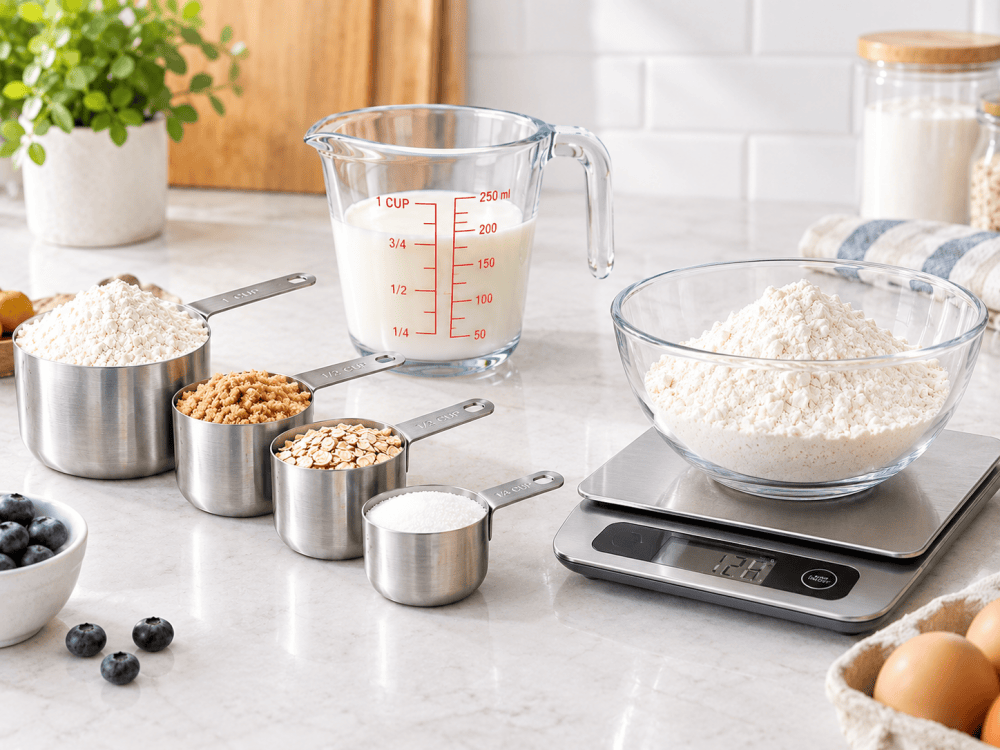
Liquid measuring cups are typically designed with a pouring spout and measurement markings that allow you to read the liquid level. Transparent cups can make it easier to see the level from the side.
Measuring spoons are useful for small amounts of liquid, such as vanilla extract, lemon juice, cooking oil, or vinegar. Fill the spoon to the intended level and avoid spilling before adding the ingredient to your recipe.
4. When Should You Use Measuring Cups Instead of Measuring Spoons?
Choosing the right tool depends mainly on the quantity of the ingredient and the type of recipe you are preparing.
Use Measuring Cups for Larger Quantities
Measuring cups are generally the better choice when a recipe calls for ingredients in quantities such as one cup of flour, half a cup of milk, or two-thirds of a cup of sugar.
They are particularly useful for:
- Baking: Measuring flour, sugar, oats, and other bulk ingredients.
- Cooking: Measuring rice, broth, water, grains, and other recipe components.
- Meal preparation: Portioning ingredients when preparing several servings.
Use Measuring Spoons for Small Quantities
Measuring spoons are the practical choice when a recipe calls for a teaspoon or tablespoon of an ingredient. They help you measure small amounts without estimating or using an oversized utensil.
They are especially useful for:
- Seasoning: Measuring salt, pepper, spices, and dried herbs.
- Baking: Measuring baking powder, baking soda, and vanilla extract.
- Sauces and dressings: Measuring small amounts of oil, vinegar, lemon juice, and other flavorings.
- Recipe adjustments: Adding small amounts of an ingredient in controlled increments.
For most kitchens, the two tools work best as a set. Measuring cups handle larger quantities, while measuring spoons fill the gap for smaller measurements.
5. How to Measure Ingredients More Accurately
Even a well-designed measuring tool can produce inconsistent results if it is used incorrectly. A few simple habits can improve measurement consistency in everyday cooking and baking.
1. Choose the Correct Capacity
Use the smallest suitable measuring unit that matches the recipe. For example, measure one teaspoon of baking powder with a teaspoon measure rather than trying to estimate a small amount in a larger cup.
2. Level Dry Ingredients When Required
For a level measurement, fill the cup or spoon and remove excess ingredients with a straight edge. Avoid packing flour or other dry ingredients unless the recipe specifically calls for a packed measurement, as with some brown sugar recipes.
3. Read Liquid Measurements Carefully
When using a liquid measuring cup with graduated markings, place it on a level surface and check the liquid level at eye height. This helps reduce errors caused by viewing the markings from above or below.
4. Avoid Mixing Up Volume and Weight
Measuring cups and measuring spoons are volume-based tools. Ingredients have different densities, so the same volume can have very different weights. For recipes that require high precision, particularly baking formulas expressed in grams, a kitchen scale may be the better choice.
5. Clean Tools Between Ingredients
Clean and dry measuring spoons between ingredients when necessary, especially when moving from wet ingredients to dry ingredients or between strongly flavored spices. This helps prevent residue from affecting the next measurement.
6. What Should You Look for When Choosing Measuring Cups and Measuring Spoons?
When selecting measuring tools for a home kitchen, a baking setup, or a kitchenware product range, consider more than just the number of pieces in a set. Capacity, material, readability, and storage design all affect everyday usability.
Material
Stainless steel measuring spoons are often chosen for their durability, resistance to rust when properly manufactured and maintained, and suitability for repeated kitchen use. Plastic measuring spoons are generally lightweight and can offer a wider range of colors and design options. For measuring cups, stainless steel, plastic, and glass each offer different benefits depending on the intended application.
Measurement Markings
Clear, legible markings make it easier to identify the correct size. Engraved or otherwise durable markings can be useful for products intended for frequent use, while printed markings should be assessed for their resistance to normal washing and wear.
Set Configuration
A practical measuring spoon set should include the sizes most commonly used in the target market. Many US-oriented sets include a tablespoon, teaspoon, half teaspoon, and quarter teaspoon. Some sets also include smaller fractional sizes for recipes requiring finer measurements.
Measuring cup sets often include one-cup, half-cup, one-third-cup, and quarter-cup sizes. The ideal assortment depends on the recipes and users the set is designed to serve.
Storage and Cleaning
Nested designs and removable rings can help keep measuring spoons together and make storage more convenient. For measuring cups, stackability and handle design can affect how easily a set fits into a kitchen drawer or cabinet. Dishwasher compatibility should always be checked against the manufacturer's care instructions rather than assumed from the material alone.
7. Do You Need Both Measuring Cups and Measuring Spoons?
For most home cooks and bakers, having both is worthwhile. Each tool serves a different purpose, and relying on only one type can make some recipes unnecessarily difficult to measure.
Measuring cups are more convenient for larger quantities of flour, sugar, liquids, grains, and similar ingredients. Measuring spoons are better suited to small quantities of seasonings, extracts, leavening agents, and liquids used in sauces or dressings.
If you bake regularly, a set of measuring cups and a set of measuring spoons provide a useful foundation. If you mainly prepare simple meals, a basic set of each is usually sufficient. A kitchen scale can complement both tools when a recipe specifies ingredient weights.
Conclusion
Measuring cups and measuring spoons are complementary kitchen tools, not interchangeable replacements for every situation. Cups are designed to make larger-volume measurements convenient, while spoons are ideal for measuring smaller quantities with control.
For reliable results, choose the right capacity, follow the recipe's measurement system, and use an appropriate technique for dry and liquid ingredients. A well-chosen combination of measuring cups and measuring spoons can make cooking and baking more organized, consistent, and efficient.
Frequently Asked Questions
1. Is a measuring cup the same as a measuring spoon?
No. Both measure volume, but they have different capacities. Measuring cups are generally used for larger quantities, while measuring spoons are designed for smaller amounts.
2. How many tablespoons are in one US cup?
One US customary cup equals 16 US tablespoons, or 48 US teaspoons. These conversions are based on US customary units.
3. Can I use a regular eating spoon instead of a measuring spoon?
It is not recommended when recipe accuracy matters. Everyday eating spoons can vary in size and are not calibrated to standard measuring spoon capacities.
4. Should I use a measuring cup or a measuring spoon for liquids?
Use a liquid measuring cup for larger quantities and a measuring spoon for small amounts. Both can measure liquid volume when the appropriate capacity and technique are used.
5. Are measuring cups and measuring spoons interchangeable with a kitchen scale?
No. Cups and spoons measure volume, while a kitchen scale measures weight or mass. Converting between them requires knowing the ingredient's density or using a reliable ingredient-specific conversion.
Explore Kitchen Measuring Tools with Kitlucy
The right measuring tools can make everyday cooking and baking more convenient and consistent. Whether you are looking for measuring cups, measuring spoons, or complementary kitchen accessories, choosing practical designs and suitable product configurations makes a difference.
Explore Kitlucy's kitchenware collection to discover products for your kitchenware assortment and product development needs.
Explore KitlucyRelated Blogs