

Measuring Cup Sizes Explained: Cups, Ounces, and Milliliters
Measuring cup sizes can be confusing when recipes use cups, fluid ounces, or milliliters. A recipe from the United States may call for 1/2 cup of milk, while another recipe lists 120 mL. Both measurements describe a similar volume, but the exact conversion depends on the measurement system being used.
Understanding measuring cup sizes makes it easier to follow recipes, choose kitchen measuring tools, and convert ingredient quantities accurately. It is especially useful for baking, where consistent measurements can make a noticeable difference in the final result.
In this guide, we explain common measuring cup sizes, show how cups convert to US fluid ounces and milliliters, and clarify the difference between liquid volume and ingredient weight.
In the US customary system, 1 cup equals 8 US fluid ounces, or approximately 236.6 mL. In many US nutrition-label contexts, 1 cup is expressed as 240 mL, while a metric cup used in some countries equals 250 mL. Always check which measurement system a recipe uses.
What Are the Standard Measuring Cup Sizes?
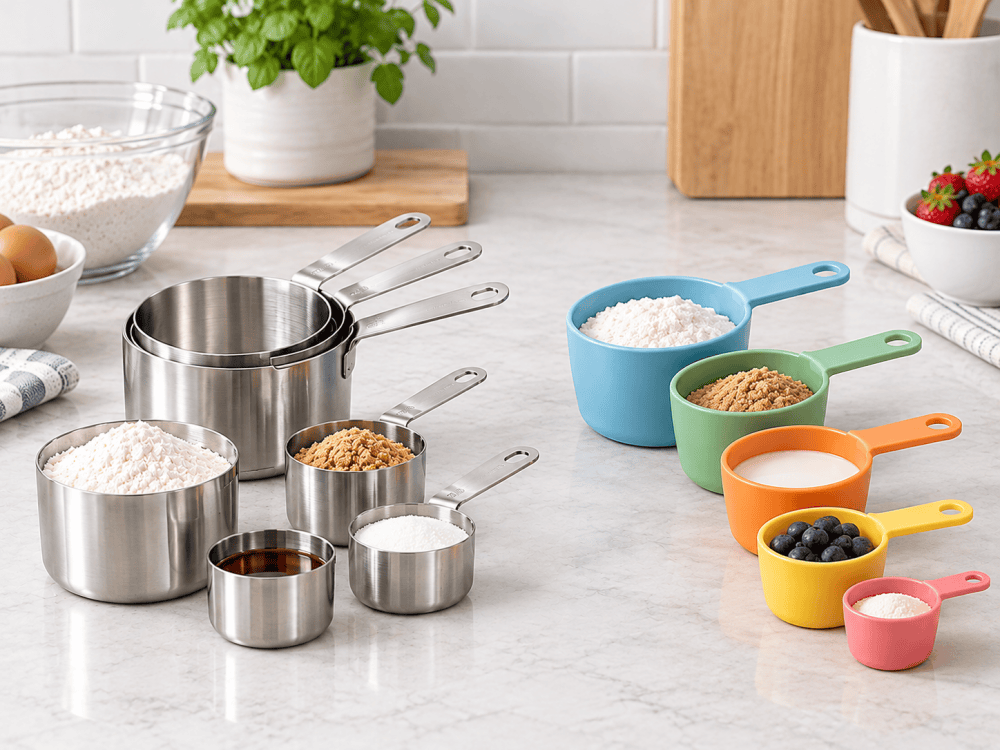
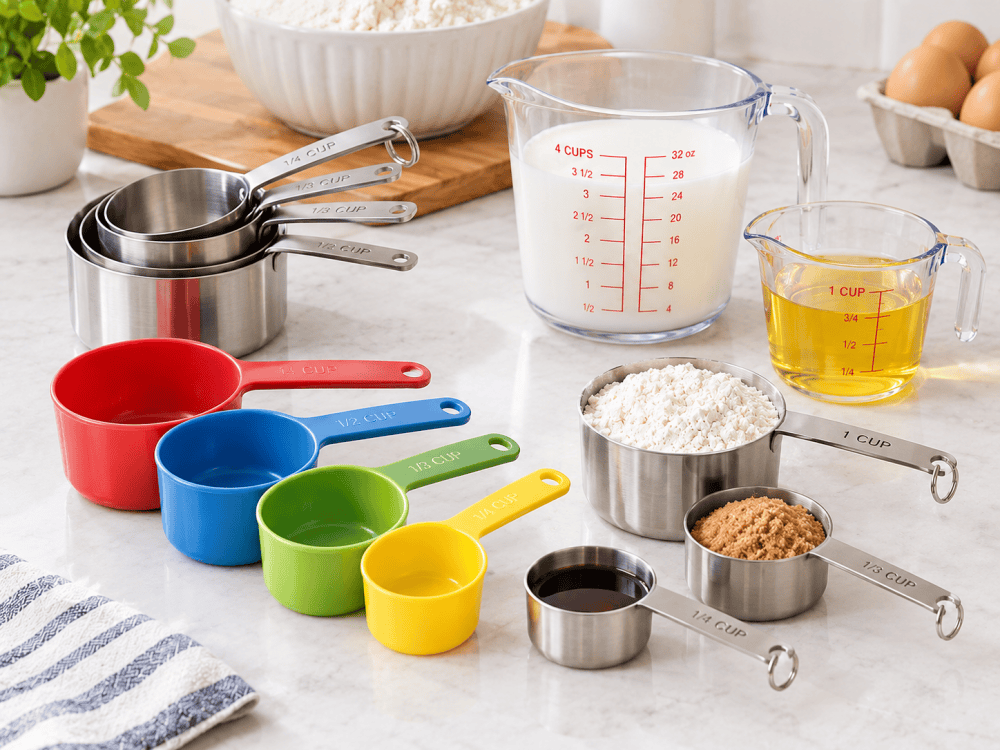
Measuring cups are available in several capacities to accommodate different ingredient quantities. In US kitchens, dry measuring cup sets commonly include 1/4 cup, 1/3 cup, 1/2 cup, and 1 cup. Some sets also include 2/3 cup, 3/4 cup, or other sizes.
Liquid measuring cups are often designed with graduated markings so users can measure several quantities in the same container. Common capacities include 1 cup, 2 cups, 4 cups, and larger measuring jugs.
The most useful size depends on the amount being measured, the type of ingredient, and whether the recipe uses volume or weight.
| Measuring Cup Size | US Fluid Ounces | Approximate US Cup Volume in mL |
|---|---|---|
| 1/4 cup | 2 fl oz | 59 mL |
| 1/3 cup | 2.67 fl oz | 79 mL |
| 1/2 cup | 4 fl oz | 118 mL |
| 2/3 cup | 5.33 fl oz | 158 mL |
| 3/4 cup | 6 fl oz | 177 mL |
| 1 cup | 8 fl oz | 237 mL |
| 1 1/2 cups | 12 fl oz | 355 mL |
| 2 cups | 16 fl oz | 473 mL |
| 4 cups | 32 fl oz | 946 mL |
Values use the US customary cup (approximately 236.588 mL) and US fluid ounces. Values are rounded for convenient kitchen reference.
How Many Ounces Are in a Cup?
For US customary volume measurements, 1 cup equals 8 US fluid ounces. This is a volume conversion, which is useful when measuring water, milk, oil, broth, and other liquids.
However, the word "ounce" can refer to either fluid ounces or ounces by weight. These are different measurements and should not be used interchangeably.
US Fluid Ounces vs. Ounces by Weight
- Fluid ounce (fl oz): Measures volume, or how much space a liquid occupies.
- Ounce (oz): Commonly refers to weight or mass in recipes and ingredient packaging.
- Milliliter (mL): A metric unit of volume.
- Gram (g): A metric unit of mass.
One cup of water has a volume of about 8 US fluid ounces. That does not mean one cup of every ingredient weighs 8 ounces. A cup of flour, sugar, oil, and honey can have different weights because their densities differ.
How Many Milliliters Are in a Cup?
The answer depends on the cup definition used by the recipe. For US customary volume measurements, 1 cup is approximately 236.6 mL. Some US nutrition-label references use 240 mL for a cup, while a metric cup used in countries such as Australia is 250 mL.
These differences may seem small, but they can affect a recipe when several cups of ingredients are measured. If you are following an international recipe, check its country of origin and the measurement standard it uses.
| Measurement | US Customary Cup | 240 mL Reference | Metric Cup |
|---|---|---|---|
| 1/4 cup | 59 mL | 60 mL | 62.5 mL |
| 1/3 cup | 79 mL | 80 mL | 83.3 mL |
| 1/2 cup | 118 mL | 120 mL | 125 mL |
| 3/4 cup | 177 mL | 180 mL | 187.5 mL |
| 1 cup | 237 mL | 240 mL | 250 mL |
| 2 cups | 473 mL | 480 mL | 500 mL |
| 4 cups | 946 mL | 960 mL | 1,000 mL |
The 240 mL column is a rounded household-measure reference used in US nutrition-label guidance, not a separate definition of the US customary cup. Metric cup sizes vary by country and recipe convention.
How to Convert Cups to Ounces and Milliliters
Once you know which measurement system is being used, converting cup measurements is straightforward.
Cups to US Fluid Ounces
Multiply the number of US customary cups by 8 to calculate US fluid ounces.
US fluid ounces = US cups × 8
Example:
2 cups × 8 = 16 US fluid ounces
Cups to Milliliters
For a US customary recipe, multiply the number of cups by approximately 236.588 to calculate milliliters.
Milliliters = US cups × 236.588
Example:
1.5 cups × 236.588 ≈ 355 mL
Milliliters to Cups
To convert milliliters back to US customary cups, divide the volume in milliliters by approximately 236.588.
US cups = milliliters ÷ 236.588
Example:
500 mL ÷ 236.588 ≈ 2.11 US cups
For everyday cooking, rounded values are often sufficient. For recipes that require greater consistency, use the conversion standard specified in the original recipe.
Dry Measuring Cups vs. Liquid Measuring Cups
Although both types measure volume, dry and liquid measuring cups are designed for different measuring techniques.
Dry Measuring Cups
Dry measuring cups are commonly sold as individual cups with fixed capacities. They are useful for flour, sugar, oats, rice, and other dry ingredients. The cup is filled according to the recipe's instructions, and excess ingredients may be leveled with a straight edge.
For ingredients such as flour, the method used to fill the cup can affect the amount collected. If precise baking results are important, weighing the ingredient may be more consistent.
Liquid Measuring Cups
Liquid measuring cups often have transparent walls, graduated markings, and a pouring spout. These features make it easier to measure water, milk, oil, and other liquids without filling separate cups for each quantity.
For a clear liquid, place the cup on a level surface and read the liquid level at eye height. This helps reduce errors caused by viewing the markings from above or below.
Learn more in our related guide to dry vs. liquid measuring cups.
Measuring Cups vs. Kitchen Scales
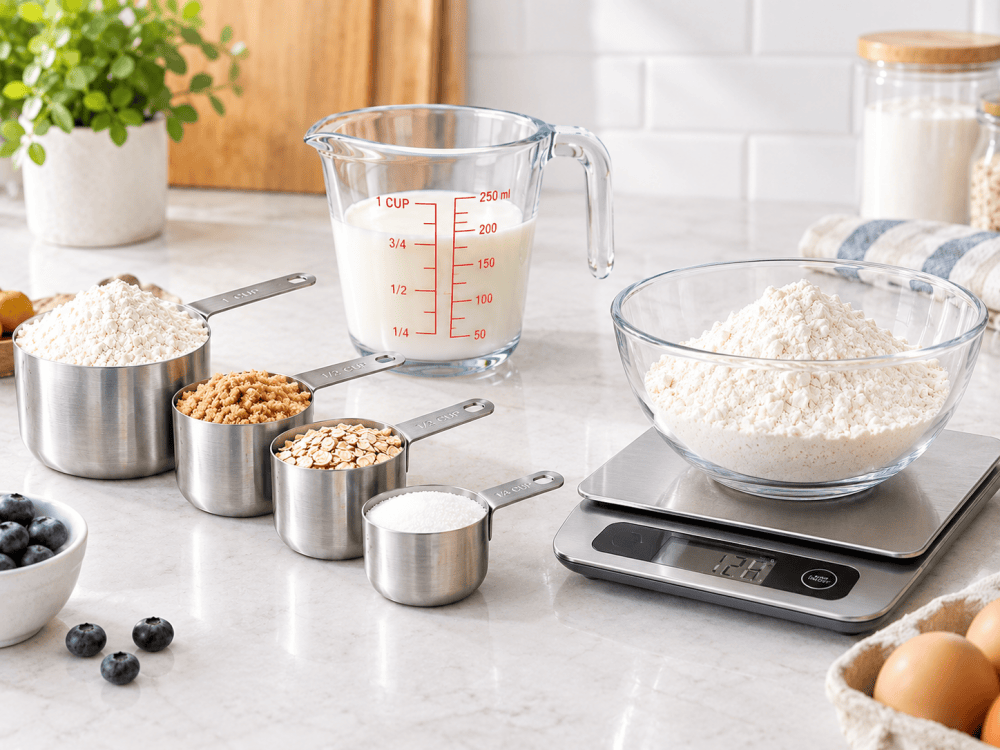
Measuring cups are convenient for recipes that specify volume, but a kitchen scale measures mass. The two tools serve different purposes, and neither measurement should be substituted for the other without an appropriate conversion.
| Tool | What It Measures | Best Use |
|---|---|---|
| Dry measuring cup | Volume | Measuring ingredients specified in cups |
| Liquid measuring cup | Volume | Measuring and pouring liquids |
| Digital kitchen scale | Mass or weight | Recipes that specify grams or ounces by weight |
For flour, cocoa powder, and other ingredients whose measured weight can vary with packing and handling, a scale can improve repeatability when the recipe provides a weight. If a recipe specifies 200 grams, do not assume that 200 grams equals 200 milliliters or one cup.
For a more detailed comparison, see measuring cups vs. kitchen scales if this article is available on your site.
How to Choose the Right Measuring Cup Sizes
The right measuring cup set should suit the recipes you make, the quantities you use most often, and your available storage space.
For Everyday Home Cooking
- Choose a set with common fractions such as 1/4, 1/3, 1/2, and 1 cup.
- Look for clear, durable capacity markings.
- Consider a transparent liquid measuring cup for water, milk, and oil.
- Choose nesting designs if drawer space is limited.
For Baking
- Check whether recipes use US customary cups, metric cups, milliliters, or grams.
- Use dry measuring cups for ingredients specified by volume as dry measures.
- Use a graduated liquid measuring cup for liquids.
- Consider a kitchen scale when the recipe specifies ingredient weights.
For Brands, Wholesalers, and Retailers
For kitchenware buyers, measuring cup selection involves more than choosing a capacity. Product specifications should reflect the target market, intended use, and expected customer needs.
- Measurement system: Specify US customary, metric, or dual-unit markings as required.
- Capacity range: Select cup sizes that match common recipes and the target market.
- Marking durability: Review whether markings are molded, engraved, stamped, or printed.
- Material and construction: Consider stainless steel, plastic, handle design, rim finish, and expected usage.
- Usability: Evaluate readability, nesting, pouring features, and storage requirements.
- Quality control: Define capacity verification and inspection requirements for consistent production.
- Packaging and customization: Consider set configuration, retail packaging, and private-label needs.
For international distribution, clearly identifying the measurement standard helps customers use the product with recipes from their intended market. Dual-unit markings can be useful when the conversions are accurate, legible, and appropriate for the product design.
Common Measuring Cup Mistakes to Avoid
- Confusing fluid ounces with ounces by weight: Fluid ounces measure volume, while ounces on a kitchen scale usually indicate weight.
- Assuming every cup equals 250 mL: US customary and metric cups are different sizes.
- Using the wrong cup for the recipe: Check whether the recipe expects a dry measuring cup, a graduated liquid cup, or a weight measurement.
- Reading liquid markings from an angle: Place the cup on a level surface and view the liquid level at eye height.
- Packing dry ingredients inconsistently: Follow the recipe's measuring instructions, particularly for flour and other dry baking ingredients.
- Ignoring the recipe's country of origin: A cup measurement can mean different volumes in different measurement systems.
Frequently Asked Questions
How many ounces are in 1 cup?
One US customary cup equals 8 US fluid ounces. This is a volume conversion and does not mean that every ingredient in a cup weighs 8 ounces.
How many milliliters are in 1 cup?
One US customary cup is approximately 236.6 mL. Some US nutrition-label references use 240 mL, while a metric cup used in some countries equals 250 mL.
How many milliliters are in 1/2 cup?
One-half of a US customary cup is approximately 118 mL. In a 240 mL cup convention, half a cup is 120 mL.
How many milliliters are in 1/4 cup?
One-quarter of a US customary cup is approximately 59 mL. It is often rounded to 60 mL for everyday cooking.
Is 8 ounces always equal to 1 cup?
Eight US fluid ounces equal one US customary cup by volume. Eight ounces by weight are a mass measurement, so they are not automatically equivalent to one cup of an ingredient.
Are dry and liquid measuring cups the same size?
Both measure volume, but their designs and measuring methods differ. Dry measuring cups are often filled and leveled, while liquid measuring cups commonly use graduated markings and a pouring spout.
Can I use milliliters instead of cups in a recipe?
Yes, provided you use the correct cup standard and conversion. Check whether the original recipe uses US customary cups, metric cups, or another measurement convention before converting.
Are measuring cups accurate enough for baking?
Measuring cups can work well when the correct measuring method is followed. For ingredients whose volume varies with packing, a kitchen scale can provide more repeatable results when the recipe specifies weight.
Conclusion
Understanding measuring cup sizes makes cooking and baking easier, especially when recipes use cups, fluid ounces, and milliliters interchangeably. For US customary measurements, one cup equals 8 US fluid ounces or approximately 236.6 mL. However, other cup conventions exist, so checking the measurement system is essential.
Choose dry measuring cups for ingredients specified by dry volume, graduated liquid measuring cups for liquids, and a kitchen scale when a recipe calls for weight. For kitchenware brands and retailers, clearly marked capacities, appropriate measurement standards, durable markings, and consistent quality control are important considerations.
Looking for Custom Measuring Cup Solutions?
Kitlucy supports kitchenware customization projects for brands, wholesalers, and retailers. Discuss your preferred capacities, measurement markings, materials, set configurations, and private-label requirements with our team.
Related Blogs