

Solid vs. Slotted Stainless Steel Spatulas: Which One Should You Choose?
Solid vs. Slotted Stainless Steel Spatulas: Which One Should You Choose?
A stainless steel spatula is a versatile kitchen tool for flipping, lifting, turning, and serving food. However, not all spatulas have the same blade design. Some feature a completely solid surface, while others have slots or openings that allow oil and liquid to drain away. So, what is the difference between solid and slotted stainless steel spatulas, and which one is better for everyday cooking?
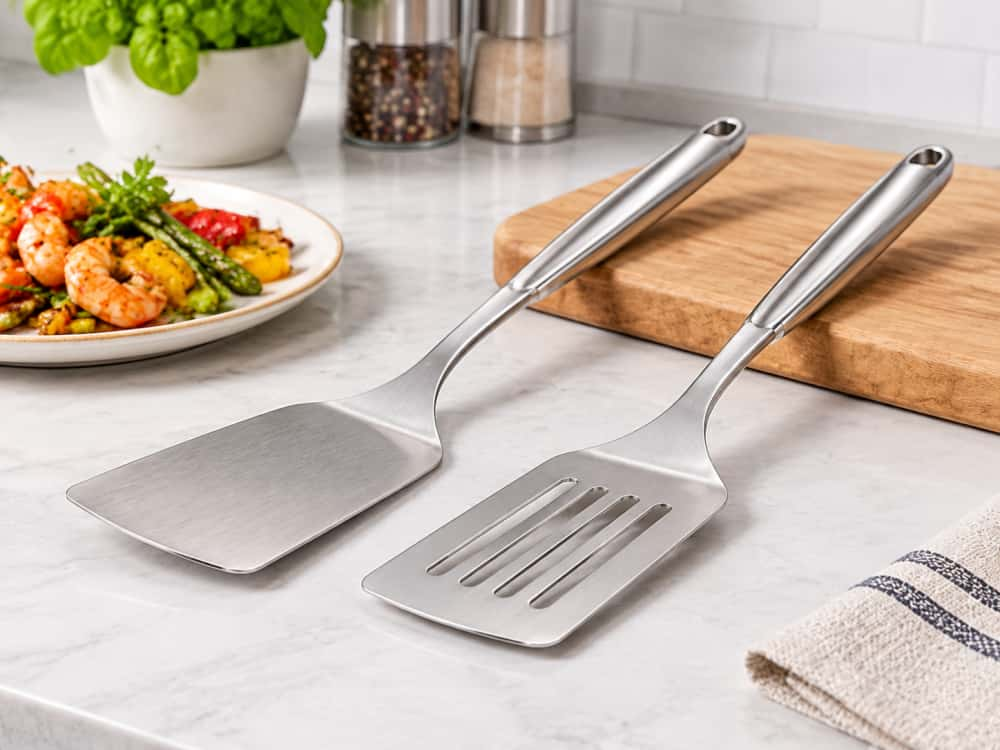
Neither design is universally better. The right choice depends on the food, cooking method, and the amount of support or drainage needed.
1. What Is a Solid Stainless Steel Spatula?
A solid stainless steel spatula has a flat or slightly curved blade without drainage openings. Its continuous surface helps support food across a wider area, making it useful when lifting, turning, or transferring ingredients from a pan to a plate.
Solid spatulas are available in different blade shapes and sizes. Some have broad, rectangular heads for flipping larger foods, while others feature narrower or slightly tapered edges for getting underneath ingredients.
Common Uses of Solid Stainless Steel Spatulas
- Eggs and omelets: The continuous blade helps support soft foods during lifting and turning.
- Pancakes and crepes: A broad surface can support the food and reduce the risk of tearing during transfer.
- Fish fillets: A suitably thin and flexible solid blade can help lift delicate fillets while supporting more of their surface.
- Grilled sandwiches: The solid blade helps lift sandwiches and other foods that need stable support.
- General pan cooking: It can be used to turn vegetables, meat portions, and other ingredients when drainage is not a priority.
Advantages of Solid Stainless Steel Spatulas
- Continuous food support: The solid blade provides a more complete contact surface when lifting food.
- Suitable for delicate ingredients: It can help support foods that might sag or break through the openings of a slotted blade.
- Easy to wipe clean: With no slots or internal openings, there are fewer areas where food particles can become trapped.
- Versatile design: A well-shaped solid spatula can handle a wide range of everyday cooking tasks.
Potential Limitations
The main limitation is that a solid blade does not allow oil or liquid to drain through it. When lifting fried foods or ingredients from a pan containing excess cooking oil, some liquid may remain on the blade and move with the food.
A wide solid blade may also feel less convenient when working with foods that need to be drained before serving. Blade thickness and edge shape matter too: a thick or blunt blade may be difficult to slide under delicate foods.
2. What Is a Slotted Stainless Steel Spatula?
A slotted stainless steel spatula features one or more openings cut into its blade. These slots allow excess oil, water, and cooking juices to pass through while the spatula supports the food.
The number, size, and arrangement of the slots vary by design. Some spatulas have several narrow openings, while others use a few larger slots. The blade may also be solid around the edges to help maintain structural strength.
Common Uses of Slotted Stainless Steel Spatulas
- Fried foods: Slots help excess oil drain away when lifting fried ingredients from a pan.
- Burgers: A slotted turner can help lift burger patties while allowing some cooking juices and grease to pass through.
- Grilled vegetables: It can be useful for turning and transferring vegetables without carrying as much liquid.
- Fish and seafood: A slotted fish turner with a wide, thin blade can support fillets while allowing liquid to drain.
- Pan-fried foods: It is practical when food needs to be lifted from oil or cooking liquid before serving.
Advantages of Slotted Stainless Steel Spatulas
- Better drainage: Openings allow excess oil and liquid to escape from the blade.
- Less liquid transferred: Food can be lifted without carrying as much oil or cooking juice.
- Useful for frying: The design is convenient for handling foods cooked in shallow oil or grease.
- Multiple blade designs: Slotted spatulas can be made with narrow, wide, or angled heads for different cooking applications.
Potential Limitations
Slots reduce the amount of continuous blade surface available to support food. Very soft or fragile ingredients may sag through larger openings or become difficult to lift if the blade is not designed for that task.
Food particles can also collect around the edges of slots. Although many stainless steel spatulas are easy to clean, the openings may require a little more attention than a completely solid blade.
3. Solid vs. Slotted Stainless Steel Spatulas: Key Differences
The main difference is the blade structure. A solid spatula prioritizes continuous support, while a slotted spatula combines food support with drainage. The following comparison summarizes their practical differences.
| Comparison | Solid Stainless Steel Spatula | Slotted Stainless Steel Spatula |
|---|---|---|
| Blade design | Continuous surface without openings | Blade contains slots or openings |
| Main function | Lifting, turning, and supporting food | Lifting food while allowing liquid to drain |
| Oil drainage | Limited | Better drainage through the slots |
| Food support | More continuous support | Support depends on slot size, spacing, and blade shape |
| Suitable foods | Eggs, pancakes, crepes, sandwiches, and delicate foods | Fried foods, burgers, grilled vegetables, and oily foods |
| Cleaning | Generally easy to wipe clean | Slots may need additional cleaning attention |
| Best feature | Continuous contact and support | Drainage and reduced liquid transfer |
4. Which Spatula Is Better for Different Foods?
Choosing between a solid and slotted stainless steel spatula becomes easier when you consider what you cook most often. Different foods have different handling requirements.
Eggs and Omelets: Solid Spatula
Eggs and omelets are relatively soft and can break apart when lifted. A solid spatula provides a continuous surface that helps support the food during turning and transfer.
A thin, slightly flexible edge is especially useful because it can slide underneath cooked eggs without requiring excessive force.
Pancakes and Crepes: Solid Spatula
Pancakes and crepes benefit from a broad, continuous blade. A solid spatula can support more of the food's surface, making it easier to flip or move it without bending or tearing.
Fried Foods: Slotted Spatula
When lifting fried foods from a pan, excess oil can collect underneath the food. A slotted spatula allows some of this oil to drain through the blade before the food reaches the serving plate.
For deep-fried foods, a dedicated skimmer or wire draining tool may be more suitable, depending on the food size and cooking setup.
Burgers and Meat Patties: Slotted or Solid
Both designs can work well for burgers. A slotted turner is useful when you want to let grease and cooking juices drain away. A solid spatula provides more continuous support, which can be helpful when transferring a large or fragile patty.
For thicker patties or heavier portions, blade width, thickness, rigidity, and handle construction are just as important as whether the blade has slots.
Fish Fillets: Choose Based on Blade Design
Fish is delicate, so the best spatula is usually one with a wide, thin, carefully shaped blade. A solid fish turner can provide more continuous support, while a slotted fish turner can help drain cooking liquid.
Do not assume that every slotted spatula is suitable for fish. Large openings, a thick leading edge, or a narrow blade may make delicate fillets harder to handle.
Vegetables: Both Can Work
For sautéed vegetables, a solid spatula works well when you need to turn or move ingredients around the pan. A slotted design is useful when transferring cooked vegetables that contain excess water or oil.
| Food or Cooking Task | Recommended Design | Reason |
|---|---|---|
| Fried eggs and omelets | Solid | Provides continuous support |
| Pancakes and crepes | Solid | Helps support the full food surface |
| Fried potatoes | Slotted | Allows excess oil to drain |
| Burger patties | Either | Depends on drainage and support needs |
| Delicate fish fillets | Usually solid or fine-slotted | Requires a wide blade with suitable support |
| Sautéed vegetables | Either | Depends on moisture and cooking method |
5. What Should You Look for When Choosing a Stainless Steel Spatula?
Blade design is only one part of a spatula's performance. Material, thickness, edge shape, handle construction, and overall balance all affect how comfortable and practical the tool is to use.
1. Stainless Steel Grade
Stainless steel is widely used for kitchen utensils because of its strength, durability, and corrosion resistance. Common grades include 304 and 430 stainless steel.
- 304 stainless steel: An austenitic grade commonly selected for kitchen products because of its good corrosion resistance in many everyday environments.
- 430 stainless steel: A ferritic grade used in various kitchen applications. Its corrosion resistance and mechanical properties differ from those of 304.
The best material depends on the product's design, expected use, manufacturing process, and cost requirements. A stainless steel grade alone does not guarantee the performance of the finished spatula. Surface condition, fabrication quality, cleaning conditions, and product testing also matter.
2. Blade Thickness and Flexibility
A spatula blade needs enough strength to lift food without bending excessively, but it should also have an appropriate level of flexibility for its intended use.
A thicker blade may provide greater rigidity for heavier foods. A thinner blade with a carefully finished edge may slide more easily under delicate ingredients. The ideal specification depends on the spatula's size and application.
3. Blade Shape and Edge Design
Look at the shape of the blade rather than focusing only on whether it is solid or slotted.
- Wide rectangular blades: Useful for pancakes, burgers, and larger food portions.
- Angled blades: Can make it easier to slide underneath food in a frying pan.
- Rounded corners: May help the spatula move around the curved edges of cookware.
- Thin leading edges: Help the tool slide beneath food more easily when properly finished.
4. Handle Material and Construction
Stainless steel spatulas may have all-metal handles or handles made with other materials, such as wood, plastic, or silicone.
- All-stainless steel handles: Offer a consistent metal construction and are often selected for durability and a professional appearance. They can become hot depending on their design and exposure to heat.
- Plastic handles: Can provide a lightweight and comfortable grip. Their heat resistance depends on the plastic material and construction.
- Silicone or soft-grip handles: May improve grip comfort, but their heat resistance and dishwasher suitability should be verified for the finished product.
- Wooden handles: Offer a traditional appearance but generally require more careful cleaning and drying.
5. Cleaning and Maintenance
Most stainless steel spatulas are relatively easy to maintain. However, cleaning requirements depend on the complete product, including the handle, joints, surface finish, and any decorative or protective components.
For routine care:
- Wash the spatula with dish soap and warm water after use.
- Use a non-abrasive sponge to remove food residue.
- Pay attention to slots, joints, and handle connections.
- Rinse thoroughly and dry before storage.
- Follow the manufacturer's instructions when using a dishwasher.
6. Solid or Slotted: Which Design Is Better for Kitchenware Brands?
For kitchenware brands, wholesalers, retailers, and importers, the decision is not necessarily about choosing one design over the other. Solid and slotted stainless steel spatulas serve different cooking needs, so offering both can create a more complete product range.
Build a Practical Product Assortment
A basic stainless steel turner collection can include several designs:
- Solid turner: A general-purpose option for everyday frying, flipping, and serving.
- Slotted turner: Designed for lifting food while allowing excess oil or liquid to drain.
- Wide solid turner: Suitable for larger foods such as pancakes and sandwiches.
- Slotted fish turner: A specialized design with a broad, thin blade for handling fish and other delicate foods.
- Compact turner: A smaller option for individual portions, smaller pans, and compact kitchens.
Important Product Development Considerations
When developing a stainless steel spatula for wholesale or private-label sales, buyers should evaluate more than the product's appearance.
- Material specification: Confirm the stainless steel grade and material thickness used in the blade and handle.
- Blade performance: Check rigidity, flexibility, edge finishing, and resistance to deformation under intended use.
- Slot design: Evaluate slot size, spacing, drainage performance, and ease of cleaning.
- Handle connection: Inspect welds, joints, rivets, or other connection methods for strength and consistency.
- Surface finish: Check for sharp edges, burrs, uneven polishing, and visible manufacturing defects.
- Packaging: Consider retail packaging, barcode labels, product information, and private-label branding requirements.
- Quality control: Establish inspection criteria for dimensions, appearance, construction, and functional performance.
These details help buyers evaluate whether a spatula is suitable for their target market, retail positioning, and expected price range.
7. Should You Buy a Solid or Slotted Stainless Steel Spatula?
If you only want one spatula for general home cooking, consider the foods you prepare most often.
- Choose a solid stainless steel spatula if you frequently cook eggs, pancakes, crepes, or foods that need continuous support.
- Choose a slotted stainless steel spatula if you often fry foods or want excess oil and liquid to drain away when lifting ingredients.
- Choose a set containing both designs if you want greater flexibility for different recipes and cooking methods.
For commercial kitchens or households that cook a wide variety of foods, having both designs available is often the most practical solution. The two tools complement each other rather than compete directly.
Frequently Asked Questions
1. What is the main difference between a solid and slotted spatula?
A solid spatula has a continuous blade that provides more complete support when lifting food. A slotted spatula has openings that allow excess oil and liquid to drain through the blade. Their main difference is the balance between food support and drainage.
2. Is a slotted spatula better for frying?
In many cases, yes. A slotted spatula allows excess oil to drain when lifting fried food from a pan. However, the best tool depends on the food's size, texture, and how much support it needs.
3. Can I use a solid stainless steel spatula for fish?
Yes. A solid fish turner with a wide, thin, and appropriately flexible blade can provide continuous support for delicate fillets. A fine-slotted design can also work if its openings do not compromise support.
4. Are slotted stainless steel spatulas harder to clean?
Not necessarily, but food particles can collect around the edges of the openings. Rinse the blade thoroughly and use a suitable brush or sponge if residue remains. Cleaning requirements also depend on the handle and overall construction.
5. Are stainless steel spatulas safe for nonstick pans?
Metal spatulas can scratch or damage nonstick coatings, particularly if they have sharp edges or are used with excessive force. Silicone or nylon spatulas are generally a better choice for delicate coated cookware.
6. Is 304 stainless steel better for spatulas?
304 stainless steel generally offers better corrosion resistance than 430 in many common kitchen environments. However, the best material depends on the intended application, product construction, manufacturing quality, and cost requirements. The complete product should be evaluated rather than relying on the grade alone.
7. Should a kitchen utensil set include both solid and slotted spatulas?
Including both designs can make a kitchen utensil set more versatile. A solid spatula handles foods that need continuous support, while a slotted spatula is useful for lifting and draining. The final assortment should match the target customers and intended retail price.
Looking for Stainless Steel Spatulas for Your Kitchenware Business?
Choosing the right spatula design is an important part of developing a practical kitchen utensil collection. Whether you need solid turners, slotted spatulas, fish turners, or a complete stainless steel utensil set, product specifications and manufacturing quality should match your market requirements.
Kitlucy supports kitchenware buyers with product sourcing and OEM/ODM customization solutions. We can help you explore different utensil designs, materials, handle options, finishes, and packaging for your product range.
Explore Kitchen Utensil Sets | Learn About Customization | Contact Our Team
Related Blogs