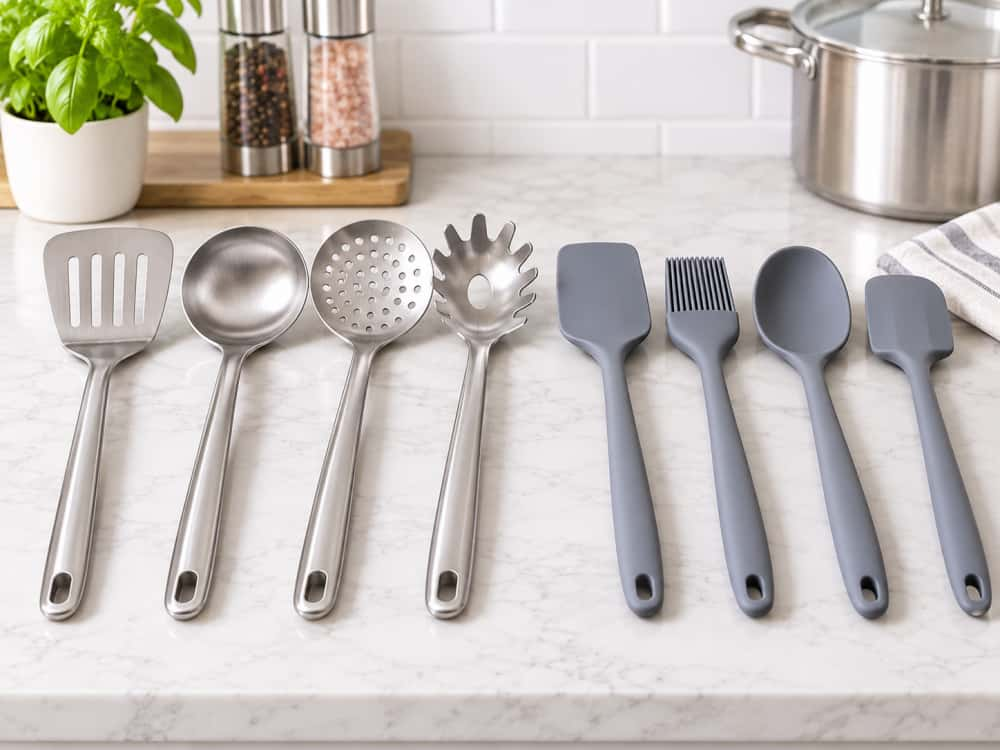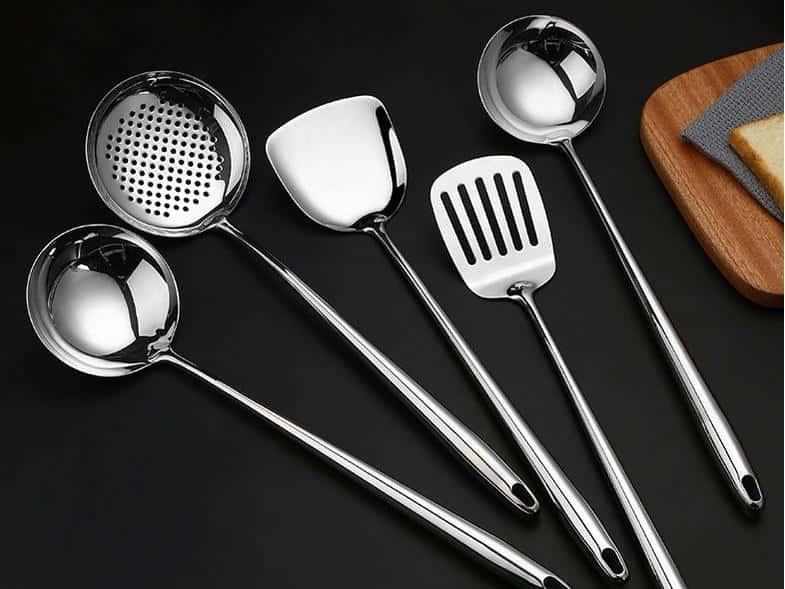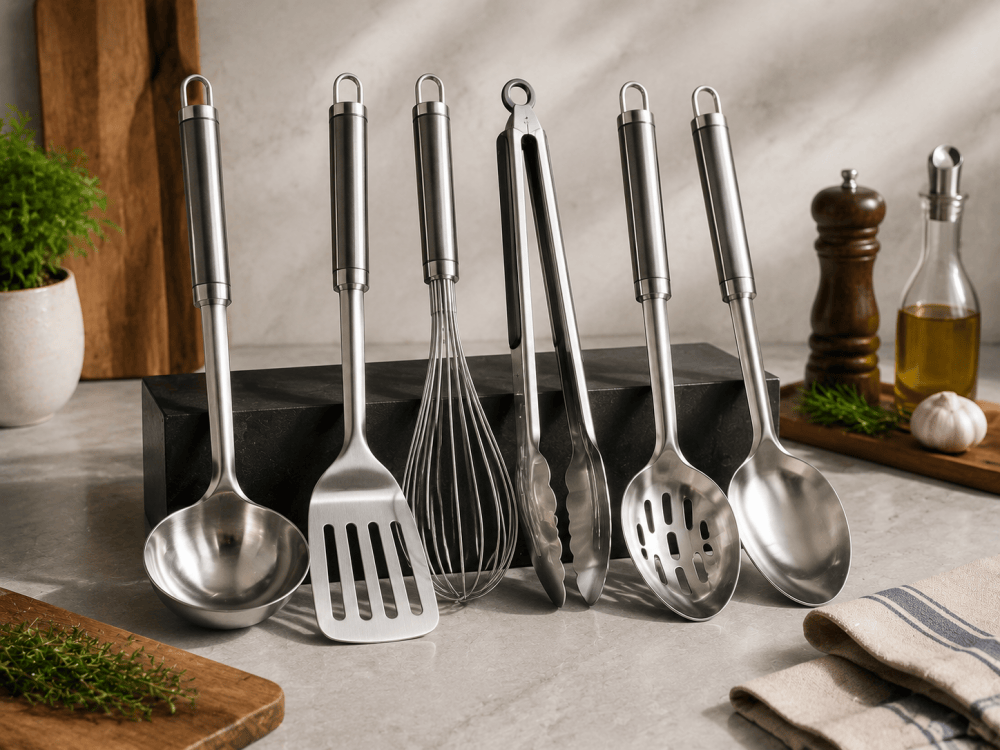


Types of Stainless Steel Kitchen Utensils and Their Uses
Stainless steel kitchen utensils are widely used in home kitchens, restaurants, catering operations, and commercial food preparation. From stirring soup and flipping food to whisking eggs and serving pasta, different utensils are designed to handle different cooking tasks.
However, a stainless steel kitchen utensil set is more than a collection of metal spoons and spatulas. The shape of the working head, handle length, thickness, construction, and overall design all affect how a utensil performs. Choosing the right tool can make cooking more efficient and help reduce unnecessary wear during everyday use.
In this guide, we explore the most common types of stainless steel kitchen utensils, explain what each one is used for, and highlight the product features worth considering when selecting individual tools or sourcing a complete kitchen utensil collection.
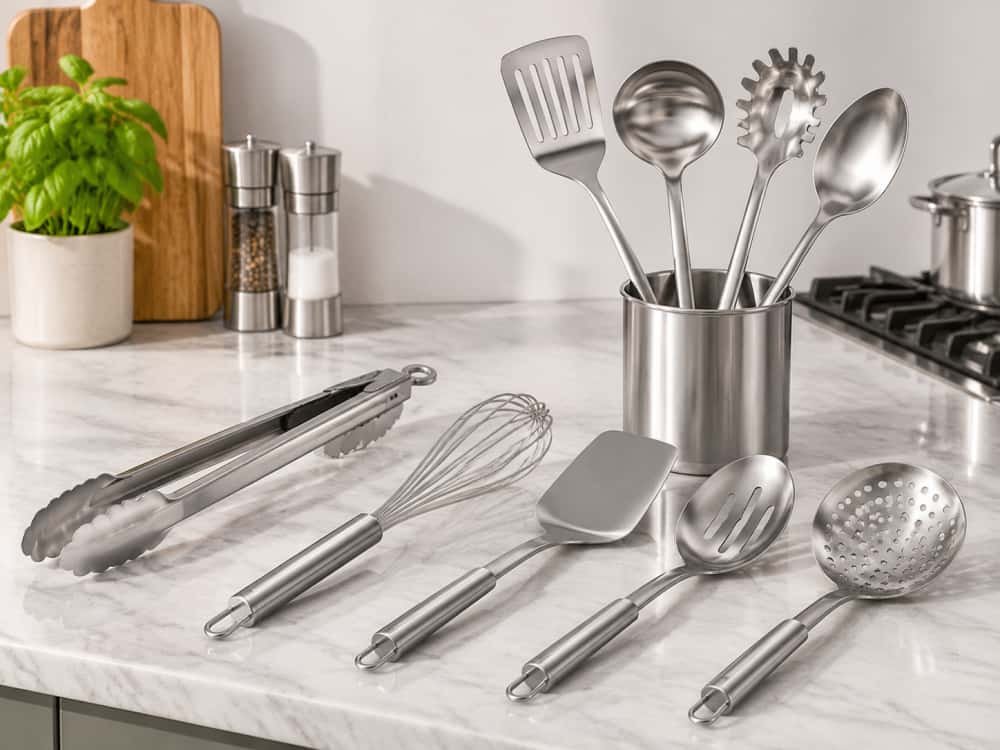
Common types include solid cooking spoons, slotted spoons, soup ladles, solid turners, slotted turners, kitchen tongs, whisks, skimmers, pasta servers, potato mashers, and carving forks. Each has a specific working shape designed for stirring, lifting, draining, flipping, mixing, or serving food.
1. Types of Stainless Steel Kitchen Utensils and Their Uses
The easiest way to understand stainless steel kitchen utensils is to group them by their primary function. Some are designed for stirring and mixing, while others are better suited to lifting food, draining liquids, turning ingredients, or serving prepared dishes.
1.1 Solid Cooking Spoon
A solid cooking spoon is one of the most basic and frequently used stainless steel kitchen tools. It usually features a rounded or oval-shaped bowl connected to a long handle.
Main uses:
- Stirring soups, sauces, and stews.
- Mixing ingredients in pots and deep pans.
- Moving vegetables, meat, and other ingredients during cooking.
- Serving small portions of cooked food.
The depth and width of the spoon bowl determine how much food it can hold. A deeper bowl is useful for scooping liquids, while a shallower design offers more control when stirring or transferring solid ingredients.
For product selection, consider the bowl capacity, handle length, edge finish, and balance. A comfortable handle and smooth transitions between the bowl and handle can improve everyday usability.
1.2 Slotted Spoon
A slotted spoon looks similar to a solid cooking spoon, but its bowl contains elongated openings or slots. These openings allow excess liquid to drain away while the food remains in the spoon.
Main uses:
- Lifting vegetables from boiling water.
- Removing dumplings, pasta, and poached foods from liquid.
- Stirring and lifting ingredients in soups or stews.
- Transferring food while leaving excess cooking liquid behind.
The number, width, and arrangement of slots affect drainage and food retention. Narrow slots may hold smaller pieces of food more effectively, while wider openings can allow liquid to drain more quickly.
A slotted spoon is particularly useful when a recipe requires ingredients to be removed from a cooking liquid without transferring too much liquid to the serving dish.
1.3 Soup Ladle
A stainless steel soup ladle has a deep, rounded bowl and a relatively long handle. Its design allows users to collect and transfer larger amounts of liquid from deep pots.
Main uses:
- Serving soups, broths, and stews.
- Portioning sauces and gravies.
- Transferring cooking liquids between containers.
- Serving punch or other beverages from suitable containers.
Ladles are available in different bowl capacities. Smaller ladles are useful for sauces and controlled portions, while larger models are more suitable for soup pots and family-style serving.
When choosing a ladle, look at its bowl depth, pouring edge, handle length, and capacity. A well-shaped pouring edge can help reduce dripping when transferring liquids.
1.4 Solid Turner
A solid turner, sometimes called a solid spatula or solid food turner, has a broad, flat working head. It is designed to slide beneath food and lift or turn it during cooking.
Main uses:
- Turning pancakes and grilled sandwiches.
- Lifting cooked vegetables and meat portions.
- Moving food from a pan to a serving plate.
- Handling ingredients that need support across a wider surface.
The shape of the head can vary from rectangular to slightly rounded or tapered. A thin front edge can slide beneath food more easily, while a wider head provides additional support for larger portions.
Solid stainless steel turners are generally better suited to cookware surfaces that can tolerate metal utensils. For nonstick or coated cookware, a silicone or nylon turner is often a more appropriate choice.
1.5 Slotted Turner
A slotted turner has a flat, broad head with several long openings. It combines the lifting function of a turner with the drainage function of a slotted spoon.
Main uses:
- Flipping burgers and other pan-fried foods.
- Turning fish fillets and vegetables.
- Lifting fried foods while allowing excess oil to drain.
- Removing food from a pan without carrying as much liquid or grease.
The front edge, head width, slot design, and overall stiffness are important product details. A thin, slightly angled edge can make it easier to slide beneath food, while a sufficiently rigid head helps support heavier portions.
For delicate fish or foods that break easily, a wider turner with a thinner edge may offer better support than a narrow, rigid design.
1.6 Kitchen Tongs
Stainless steel kitchen tongs consist of two connected arms that open and close to grip food. Many models use a spring mechanism to provide tension, while others have a simpler hinged construction.
Main uses:
- Turning meat, chicken, and vegetables during cooking.
- Handling food on grills and barbecue equipment.
- Tossing pasta and salads.
- Transferring hot food from pans or serving dishes.
Tongs may have scalloped, flat, or other shaped gripping ends. Scalloped tips are common because they help hold a variety of food shapes. Some designs also include a locking mechanism for convenient storage.
Important buying considerations include spring tension, opening range, tip alignment, handle comfort, and the reliability of the locking mechanism. The length should also match the intended cooking environment.
1.7 Stainless Steel Whisk
A stainless steel whisk is made with multiple metal wires attached to a handle. The wires move through ingredients to combine them, break up lumps, and incorporate air.
Main uses:
- Beating eggs and mixing egg-based ingredients.
- Combining flour, sugar, and other dry or wet ingredients.
- Mixing sauces, dressings, and batters.
- Incorporating air into cream and other suitable mixtures.
Different whisk shapes are designed for different tasks:
- Balloon whisk: A rounded shape with multiple wire loops, commonly used for beating eggs and incorporating air.
- French whisk: A narrower, more elongated design for mixing sauces and ingredients in deeper containers.
- Flat whisk: A flatter wire arrangement that can be useful for stirring sauces in shallow pans.
When evaluating a whisk, check wire thickness, wire attachment, handle construction, and the overall balance. The wires should be securely connected and evenly arranged.
1.8 Skimmer and Spider Strainer
Skimmers are designed to lift food or remove unwanted material from liquids while allowing the liquid to drain away. Stainless steel versions are common in cooking and deep-frying environments.
Main uses:
- Removing fried food from hot oil.
- Lifting dumplings and vegetables from boiling water.
- Removing foam or impurities from stocks and broths.
- Transferring food from liquid to a draining container.
There are several common designs:
- Perforated skimmer: A flat or shallow round head with multiple holes for draining liquids.
- Wire spider skimmer: A basket-shaped wire head designed to lift larger quantities of food from hot liquid or oil.
- Fine-mesh skimmer: A mesh head that can capture smaller particles and foam.
For deep pots and frying applications, handle length and head construction are especially important. A sturdy connection between the handle and working head helps the tool remain stable when lifting food.
1.9 Pasta Server
A pasta server, also known as a spaghetti server, typically has a round or slightly curved head with projecting teeth around the edge. Some models also include a central opening or drainage features.
Main uses:
- Lifting spaghetti and other long pasta from cooking water.
- Serving pasta while helping strands stay together.
- Transferring pasta from a pot to a serving bowl.
- Portioning certain noodle dishes.
The teeth help gather long pasta strands, while the spaces between them allow excess water to drain. Tooth shape, spacing, head size, and handle length all influence usability.
A pasta server is a useful addition to kitchen utensil sets designed for households that frequently prepare pasta and noodle dishes.
1.10 Potato Masher
A stainless steel potato masher usually consists of a handle connected to a flat or curved mashing plate. The working head may contain holes, a wire grid, or a series of curved metal bars.
Main uses:
- Mashing cooked potatoes.
- Breaking down soft cooked vegetables.
- Preparing certain fruit mixtures and soft ingredients.
- Creating a coarser texture for selected recipes.
A perforated plate can produce a relatively consistent texture, while a wire-style head may provide a different mashing experience. The handle should offer a secure grip, and the connection to the mashing head should be strong enough to withstand repeated pressure.
1.11 Carving Fork
A carving fork has a long handle and two or more pointed prongs. It is designed to hold larger pieces of food securely during cutting and handling.
Main uses:
- Holding roasts in place while carving.
- Stabilizing cooked meat during slicing.
- Turning larger pieces of meat during preparation.
- Transferring certain large cooked foods.
Prong length, spacing, thickness, and handle design affect how securely the fork holds food. For carving applications, the handle should provide a stable and comfortable grip.
1.12 Serving Spoon and Serving Fork
Serving spoons and forks are designed primarily for transferring prepared food from a serving dish to individual plates. They are often included in stainless steel tableware and kitchen utensil collections.
Main uses:
- Serving vegetables, rice, and side dishes.
- Portioning pasta, salads, and prepared foods.
- Serving dishes at family meals, buffets, and catered events.
Serving spoons may have solid, slotted, or perforated bowls depending on the type of food being served. Serving forks generally have longer, wider prongs than ordinary dining forks to make transferring food easier.
2. Stainless Steel Kitchen Utensils: Comparison of Types and Uses
If you are selecting individual utensils or comparing different kitchen utensil sets, the following table provides a quick overview of their main functions.
| Utensil Type | Main Function | Common Applications |
|---|---|---|
| Solid Cooking Spoon | Stirring and mixing | Soups, sauces, stews |
| Slotted Spoon | Lifting and draining | Vegetables, pasta, dumplings |
| Soup Ladle | Scooping and serving liquids | Soups, broths, sauces |
| Solid Turner | Lifting and flipping food | Pancakes, sandwiches, vegetables |
| Slotted Turner | Flipping and draining | Burgers, fish, fried foods |
| Kitchen Tongs | Gripping and turning | Meat, vegetables, pasta, grilling |
| Whisk | Beating and blending | Eggs, sauces, batters |
| Skimmer | Removing food from liquids | Frying, boiling, stock preparation |
| Pasta Server | Lifting and serving pasta | Spaghetti, noodles |
| Potato Masher | Mashing soft ingredients | Potatoes, cooked vegetables |
| Carving Fork | Holding and stabilizing food | Roasts, cooked meat |
| Serving Spoon | Portioning prepared food | Vegetables, rice, side dishes |
3. How to Choose the Right Stainless Steel Kitchen Utensils
Not every kitchen needs every type of utensil. The right selection depends on cooking habits, cookware, food preparation requirements, and the available storage space.
3.1 Start With Your Cooking Habits
Consider which tasks you perform most frequently. A household that regularly prepares soups, stews, and sauces may need a solid spoon, slotted spoon, and ladle. People who cook meat and vegetables in pans may use turners and tongs more often.
For households that frequently bake or prepare sauces, a whisk and other mixing tools may be more useful. Pasta servers and skimmers are practical additions for specific cooking styles.
3.2 Check the Stainless Steel Grade
The term stainless steel covers different steel grades with different compositions and corrosion-resistance characteristics. Common grades used in kitchenware include 304 and 430 stainless steel, although the appropriate choice depends on the product design and intended application.
- 304 stainless steel: An austenitic grade commonly selected for its good corrosion resistance and broad kitchenware applications.
- 430 stainless steel: A ferritic grade that can be used in selected kitchenware applications where its properties and cost are suitable.
- Other stainless steel grades: May be used depending on the required performance, manufacturing process, and product specification.
Do not assume that every stainless steel utensil has the same material quality. Buyers should confirm the actual grade, component material, and applicable food-contact requirements with the manufacturer.
For a more detailed material comparison, read our guide to 304 vs. 430 Stainless Steel Kitchen Utensils if this page is available on your website.
3.3 Consider Handle Design and Construction
The handle influences comfort, balance, grip, and product durability. Common options include all-stainless-steel handles, hollow stainless steel handles, and stainless steel handles combined with other materials.
When comparing products, check:
- Whether the handle length suits the intended pot, pan, or cooking task.
- Whether the grip feels comfortable and balanced.
- Whether the handle has smooth edges and a well-finished surface.
- Whether the connection between the handle and working head is secure.
- Whether the construction is suitable for the expected cleaning and use conditions.
A one-piece construction can reduce the number of joints, while multi-component designs may offer additional grip or appearance options. Neither design is automatically better in every application; construction quality and intended use matter.
3.4 Match the Utensil to Your Cookware
Stainless steel utensils are rigid and durable, but their metal working edges can scratch some nonstick and coated cookware surfaces.
For stainless steel cookware and other compatible uncoated cooking surfaces, stainless steel tools can be useful for stirring, turning, and lifting food. For nonstick pans or delicate coatings, silicone or nylon utensils are generally a safer choice for protecting the surface.
Always follow the cookware manufacturer's recommendations. A mixed-material utensil set can be a practical option for kitchens that use different types of cookware.
3.5 Choose a Practical Set Configuration
A larger utensil set is not necessarily a better set. The ideal combination should cover the most common cooking tasks without including too many tools that are rarely used.
A basic collection may include:
- Solid cooking spoon
- Slotted spoon
- Soup ladle
- Turner
- Kitchen tongs
- Whisk
More comprehensive collections may add a skimmer, pasta server, potato masher, serving spoon, and other specialty tools. Buyers should consider the target market, retail price range, packaging size, and expected product positioning when developing a set.
4. What Should B2B Buyers Check When Sourcing Stainless Steel Kitchen Utensils?
For importers, wholesalers, retailers, and private-label brands, choosing stainless steel kitchen utensils involves more than selecting attractive product shapes. Product specifications, manufacturing consistency, quality control, and packaging all influence the final buying decision.
4.1 Confirm Material Specifications
Ask the manufacturer to identify the stainless steel grade used in each component. If a utensil combines stainless steel with silicone, nylon, PP, or another material, confirm the material specification for each part rather than relying on a general product description.
For products intended for food contact, request relevant compliance documentation and test reports for the finished article and its intended market. A material name or grade alone does not establish that the complete product complies with every applicable food-contact requirement.
4.2 Evaluate Product Construction
Pay attention to the details that affect everyday performance:
- Working-head thickness and stiffness.
- Handle strength and overall balance.
- Welded, riveted, or other connection structures.
- Surface polishing and edge finishing.
- Spring performance and locking function for tongs.
- Wire attachment and stability for whisks.
These details can help buyers distinguish between products that look similar in a catalog but may perform differently in actual use.
4.3 Check Surface Finish and Appearance
Stainless steel kitchen utensils may feature mirror polish, satin finish, brushed finish, or other surface treatments. The finish affects product appearance, perceived quality, and the visibility of fingerprints or minor surface marks.
For private-label collections, buyers should also consider whether the finish is consistent across all items in the set. Differences in color tone, polishing quality, and handle details can make a collection look less cohesive.
4.4 Review Quality Control and Packaging
Before placing a bulk order, establish clear inspection requirements with the supplier. Depending on the product type, these may include:
- Material and dimension verification.
- Visual inspection for scratches, burrs, dents, and polishing defects.
- Handle and joint strength checks.
- Functional testing of moving parts and locking mechanisms.
- Cleaning and packaging condition checks.
- Carton protection and shipping suitability.
Packaging should match the sales channel. Retail-ready sets may require color boxes, product inserts, or hanging displays, while bulk wholesale orders may prioritize efficient carton packing and transport protection.
4.5 Consider OEM and ODM Customization
For brands and distributors developing their own kitchen utensil collections, OEM and ODM services can provide more flexibility in product selection and presentation.
Depending on the manufacturer's capabilities, customization may include:
- Selection of utensil types and set combinations.
- Handle shape, length, and material options.
- Stainless steel grade and surface finish specifications.
- Logo application and private-label branding.
- Retail packaging and product presentation.
- Customized product dimensions and design details.
A clear product specification sheet helps align the buyer and manufacturer before sampling and mass production. It should identify the materials, dimensions, finish, construction, packaging, and inspection requirements for each item.
5. How to Maintain Stainless Steel Kitchen Utensils
Proper cleaning and storage can help keep stainless steel utensils in good condition. Although stainless steel offers good corrosion resistance, it is not completely immune to staining, discoloration, or corrosion under unsuitable conditions.
- Clean after use: Wash utensils with warm water and mild dish soap to remove food residue.
- Rinse thoroughly: Remove soap and food particles, especially around joints and connections.
- Dry when needed: Drying utensils after washing can help reduce water spots and prolonged moisture exposure.
- Avoid harsh chemicals: Avoid prolonged contact with chlorine bleach and other unsuitable cleaning chemicals.
- Store properly: Keep utensils dry and organized to reduce unnecessary scratching and contact damage.
- Check product instructions: Dishwasher suitability depends on the complete product construction, including handles, coatings, and joined components.
For mixed-material utensils, always check the manufacturer's cleaning instructions. A stainless steel working head does not automatically mean every part of the utensil is suitable for the same cleaning conditions.
6. Frequently Asked Questions About Stainless Steel Kitchen Utensils
What are the most common stainless steel kitchen utensils?
The most common types include solid cooking spoons, slotted spoons, soup ladles, turners, kitchen tongs, whisks, skimmers, pasta servers, and serving spoons. These tools cover many everyday cooking, mixing, lifting, and serving tasks.
What is the difference between a slotted spoon and a skimmer?
A slotted spoon usually has a spoon-shaped bowl with openings and is designed for lifting and draining individual portions of food. A skimmer generally has a broader perforated, mesh, or wire-basket head and is commonly used to remove food or foam from liquids.
Can stainless steel utensils be used with nonstick cookware?
Metal utensils can scratch or damage some nonstick and coated surfaces. Silicone or nylon utensils are generally a better option for protecting these coatings. Always follow the cookware manufacturer's instructions.
Are all stainless steel kitchen utensils dishwasher safe?
No. Many stainless steel utensils are dishwasher safe, but suitability depends on the complete product design and materials. Handles, coatings, adhesives, and other components may have different cleaning requirements. Check the manufacturer's care instructions.
Is 304 stainless steel better than 430 stainless steel for kitchen utensils?
304 stainless steel generally offers better corrosion resistance than 430 stainless steel, but the best choice depends on the utensil's design, application, required performance, and cost target. Buyers should confirm the actual material specification rather than assuming all stainless steel products use the same grade.
What should a stainless steel kitchen utensil set include?
A practical basic set may include a solid spoon, slotted spoon, ladle, turner, tongs, and whisk. Larger collections may add a skimmer, pasta server, potato masher, and serving utensils. The best configuration depends on cooking habits and the target market.
What should importers look for in a stainless steel kitchen utensil manufacturer?
Importers should evaluate material specifications, manufacturing quality, product consistency, surface finishing, food-contact documentation, customization capabilities, packaging options, and quality-control procedures. Sample evaluation is also important before confirming a bulk order.
Looking for a Stainless Steel Kitchen Utensil Supplier?
Whether you are developing a new kitchen utensil collection, sourcing products for wholesale distribution, or building a private-label brand, selecting the right product specifications and manufacturing partner is an important first step.
Kitlucy supports kitchenware product development and customization for business buyers. From utensil selection and material options to product combinations and retail packaging, we can help you explore solutions for your market.
Contact KitlucyRelated Blogs