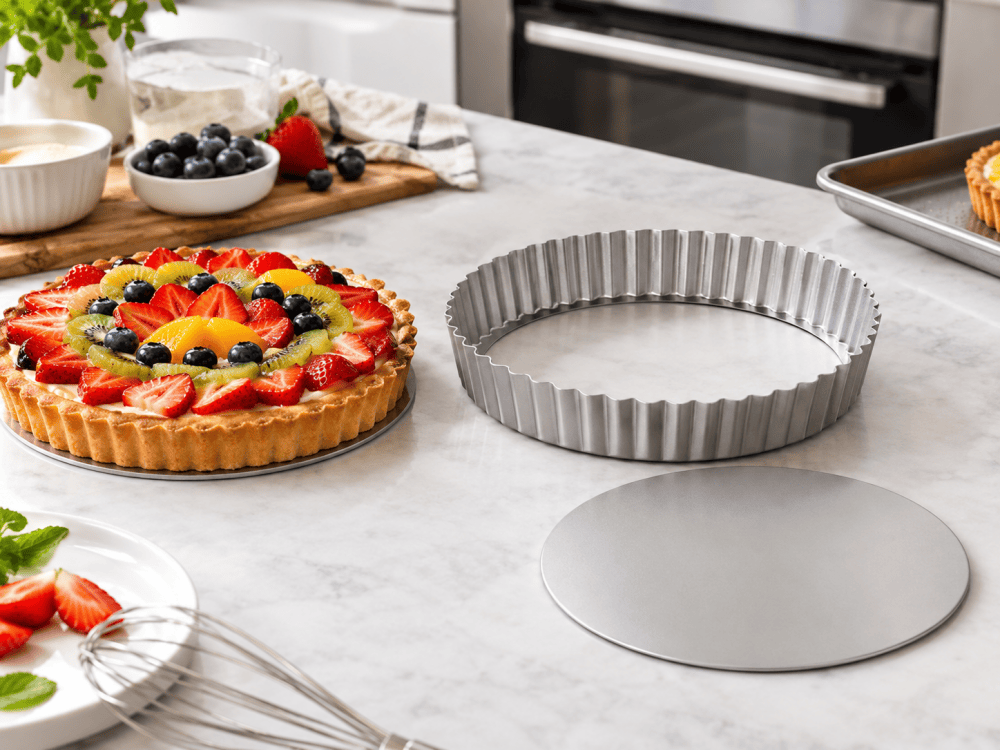
Tart Pan Sizes: What Size Tart Pan Should You Use?
Tart Pan Sizes: What Size Tart Pan Should You Use?
What size tart pan should you use? For most home baking, an 8- to 10-inch tart pan is a practical choice for standard-sized tarts. Smaller 4- to 6-inch pans work well for individual or mini tarts, while 11- to 12-inch pans are useful for larger tarts and group servings. The right tart pan size depends on the recipe, number of servings, tart thickness, pan shape, and whether you are baking for home use or commercial production.
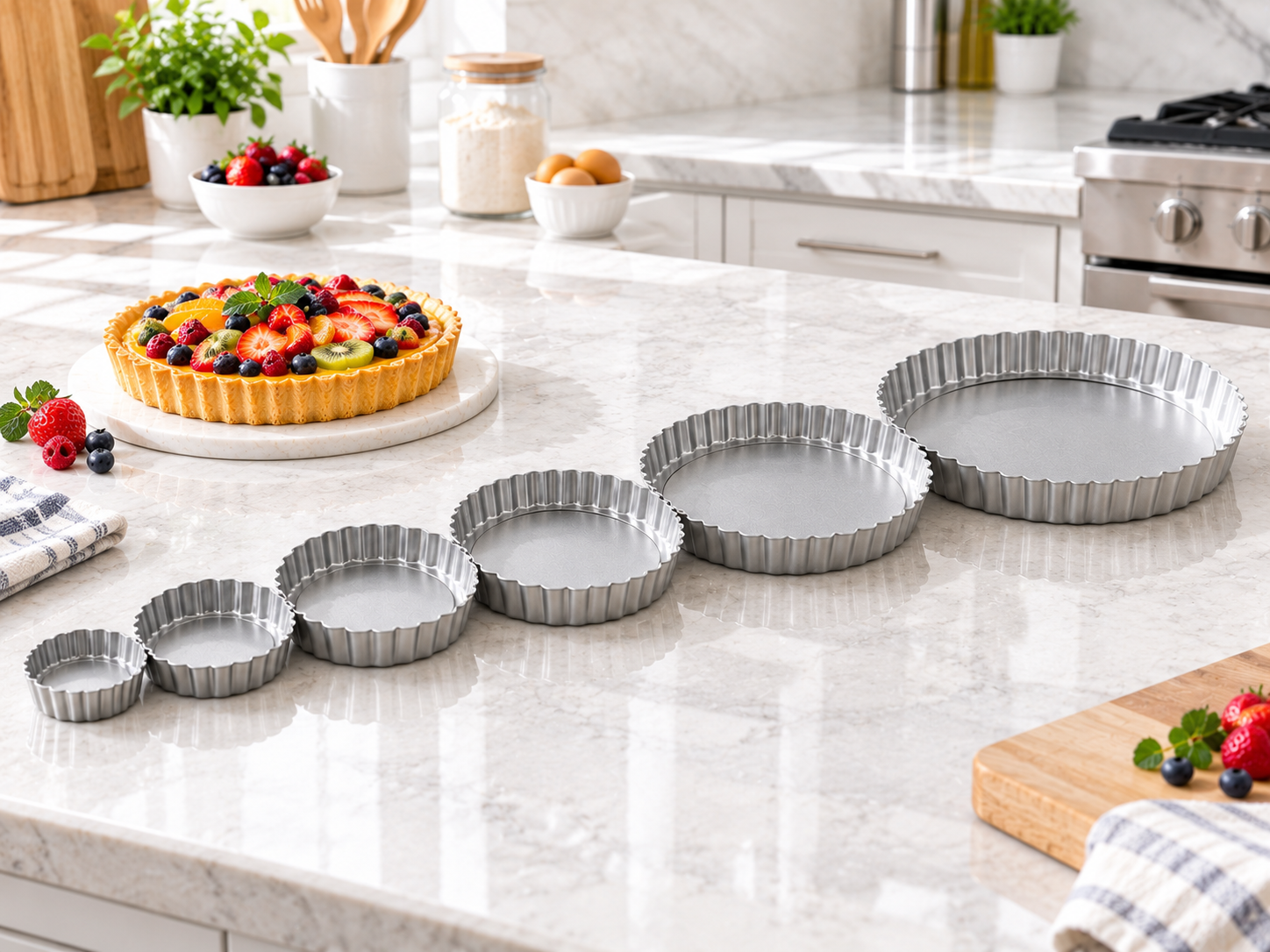
Choosing the right tart pan size can affect more than the amount of batter or filling you need. Pan diameter, depth, shape, and removable-bottom design can influence baking time, crust thickness, filling depth, presentation, and portion size.
For consumers, the most common question is simple: what size tart pan should I buy? For retailers and B2B buyers, the question is broader: which tart pan sizes should be included in a product range?
This guide explains common tart pan sizes, typical applications, approximate serving ranges, size selection, and important considerations for wholesale and OEM tart pan sourcing.
What Are the Most Common Tart Pan Sizes?
Tart pans are available in many diameters and shapes, so there is no single universal standard size. However, several sizes are commonly used for home baking, foodservice, and retail bakeware.
| Tart Pan Size | Typical Use | Approximate Serving Range |
|---|---|---|
| 4–5 inches | Mini or individual tarts | 1 serving |
| 6 inches | Small individual or sharing tart | 1–2 servings |
| 7 inches | Small family tart | 2–4 servings |
| 8 inches | Small standard tart | 4–6 servings |
| 9 inches | Common home-baking size | 6–8 servings |
| 10 inches | Large home or family tart | 8–10 servings |
| 11–12 inches | Large tart or entertaining | 10+ servings |
Important: Serving numbers are approximate rather than fixed standards. A tart's actual yield depends on its depth, recipe, slice size, filling, and the type of tart being made.
What Size Tart Pan Is Best for Most Recipes?
For many home bakers, an 8-, 9-, or 10-inch tart pan provides a practical balance between capacity, presentation, and ease of handling.
A 9-inch tart pan is particularly useful when a recipe is written specifically for a standard-sized tart. It provides enough surface area for fruit, custard, chocolate, lemon, or other fillings without becoming difficult to handle.
However, the best size is ultimately determined by the recipe. If a recipe was developed for a 9-inch pan, changing to a significantly smaller or larger pan changes the filling depth and can affect baking time.
Why Does Pan Size Matter?
- A larger pan creates a wider and usually shallower tart.
- A smaller pan creates a smaller tart and may increase filling depth if the recipe quantity is not reduced.
- Changing the pan size can change baking time.
- The crust-to-filling ratio can change.
- The final number of servings can change.
For best results, match the pan size to the recipe whenever possible.
What Size Tart Pan Is Best for 1–2 People?
For one or two people, a 4- to 6-inch tart pan can be a convenient option.
These smaller pans are useful for individual desserts, small fruit tarts, mini chocolate tarts, personal quiches, and other small-format baked products.
Mini tart pans can also be attractive for retail bakeware collections because consumers may use them for portion-controlled desserts or individual serving presentations.
4–5 Inch Tart Pans
These are generally suitable for individual portions. They can be useful when the goal is to create several small tarts rather than one large tart.
6 Inch Tart Pans
A 6-inch tart pan offers slightly more capacity while remaining relatively compact. It can work well for one large individual tart or a small tart intended for sharing.
What Size Tart Pan Is Best for 4–6 People?
For a small family or group, an 8- or 9-inch tart pan is often a practical choice.
An 8-inch tart can provide a compact presentation while a 9-inch tart generally offers more surface area for larger portions.
For fruit tarts and custard tarts, the 9-inch format is also useful because it provides enough space to arrange toppings while maintaining a manageable tart thickness.
| Size | Typical Application |
|---|---|
| 8 inch | Small family tart, compact dessert |
| 9 inch | Standard home tart, fruit tart, custard tart |
| 10 inch | Larger family tart or entertaining |
What Size Tart Pan Is Best for 8–10 People?
For a larger group, a 10- to 12-inch tart pan can provide more surface area and more servings.
A larger pan is particularly useful for entertaining, larger family gatherings, commercial food preparation, and recipes designed for larger batches.
However, simply choosing a larger pan does not always mean the same recipe can be poured into it without adjustment. The recipe quantity may need to be increased to maintain an appropriate filling depth.
What Is the Standard Tart Pan Size?
There is no single universal standard tart pan size.
In consumer bakeware, 8-, 9-, and 10-inch tart pans are common sizes, but manufacturers also produce mini pans, larger pans, rectangular pans, square pans, and custom sizes.
When a recipe refers to a tart pan size, the stated diameter should be treated as part of the recipe specification rather than assuming that every tart pan uses the same dimensions.
For B2B buyers: When sourcing tart pans, always confirm the exact diameter, overall dimensions, depth, bottom diameter, rim design, and usable interior dimensions. Two pans with the same nominal diameter may have different usable capacities.
How Deep Should a Tart Pan Be?
Tart pans are generally shallower than many pie pans, but depth varies by design and intended application.
A shallow profile is useful because many traditional tarts are designed around a relatively thin crust and a controlled layer of filling. However, deeper tart and quiche pans are also available for recipes that require additional filling capacity.
Shallow Tart Pans
Shallow tart pans are suitable for many fruit tarts, chocolate tarts, lemon tarts, and classic pastry-based desserts.
Deeper Tart and Quiche Pans
Deeper designs provide additional filling capacity and may be more suitable for quiche, custard-based recipes, or products that require a thicker filling layer.
Therefore, diameter alone does not completely describe a tart pan's capacity. Diameter + depth + shape provide a more useful description.
Does Tart Pan Shape Affect the Size?
Yes. Tart pans can have the same general dimensions but different capacities depending on their shape.
| Tart Pan Shape | Typical Advantage | Common Applications |
|---|---|---|
| Round | Classic presentation and easy recipe matching | Fruit tarts, chocolate tarts, custard tarts |
| Rectangular | More surface area and modern presentation | Fruit tarts, pastry desserts, commercial baking |
| Square | Easy portion cutting | Bars, desserts, specialty tarts |
| Mini | Individual portions | Mini tarts, individual desserts |
| Fluted | Decorative crust edge | Traditional tart presentation |
For this reason, a 9-inch round tart pan and a rectangular tart pan cannot always be treated as equivalent simply because both are marketed as “standard” sizes.
How Do You Choose the Right Tart Pan Size?
When choosing a tart pan, consider the following factors.
1. Check the Recipe
If the recipe specifies a pan diameter, start with that size. This is usually the most reliable way to maintain the intended filling depth and baking characteristics.
2. Consider the Number of Servings
Choose a smaller pan for individual portions and a larger pan for family or group servings.
3. Consider the Tart Type
A thin fruit tart may work well in a shallow pan, while a quiche or deeper custard-based product may require more filling capacity.
4. Consider the Shape
Round tart pans are common for traditional recipes, while rectangular and square designs can offer different presentation and portioning options.
5. Consider the Pan Depth
Do not evaluate tart pan size based only on diameter. Depth can significantly affect the usable capacity of the pan.
6. Consider the Removable Bottom
A removable-bottom tart pan can make it easier to release a finished tart while preserving the crust and presentation.
For more information, see our guide to tart pans with removable bottoms.
Tart Pan Size Conversion: Can You Use a Different Size?
Yes, but changing tart pan size may require adjusting the recipe.
If you use a smaller pan while keeping the original recipe quantity, the filling may become deeper. If you use a larger pan without increasing the recipe quantity, the filling may become thinner.
Both changes can affect baking time and the final texture.
| Change | Possible Result |
|---|---|
| Smaller pan + same recipe quantity | Deeper filling, potentially longer baking time |
| Larger pan + same recipe quantity | Thinner filling, potentially shorter baking time |
| Same diameter + different depth | Different capacity and filling thickness |
| Different shape + same nominal size | Different surface area and capacity |
Practical rule: When changing tart pan size, compare the pan's actual capacity rather than relying only on the diameter printed on the packaging.
9-Inch vs 10-Inch Tart Pan: What's the Difference?
The difference between a 9-inch and 10-inch tart pan may appear small, but the larger diameter provides noticeably more surface area.
This can make a 10-inch pan suitable for larger tarts or more servings, while a 9-inch pan may be easier to handle and more appropriate for recipes developed around a standard home-baking format.
| Feature | 9-Inch Tart Pan | 10-Inch Tart Pan |
|---|---|---|
| Size | Medium | Larger |
| Typical use | Home baking | Family baking and entertaining |
| Serving potential | About 6–8 | About 8–10 |
| Recipe compatibility | Common recipe format | May require quantity adjustment |
Neither size is universally better. The correct choice depends on the recipe, desired serving size, and filling depth.
What Tart Pan Sizes Are Best for Wholesale?
For B2B buyers, choosing tart pan sizes is different from choosing one pan for a home kitchen.
A retail or private-label collection should cover multiple consumer needs without creating unnecessary SKU complexity.
A practical assortment may include:
- 4–6 inch: mini and individual tart applications
- 8 inch: smaller standard tart
- 9 inch: common home-baking size
- 10 inch: larger family or entertaining size
- 11–12 inch: larger-format applications
- Rectangular or square: differentiated retail designs
The final assortment should be based on target-market demand, recipe compatibility, packaging dimensions, shipping costs, and the intended retail positioning.
How Should B2B Buyers Specify Tart Pan Dimensions?
When requesting a quote from a tart pan supplier, providing only “9-inch tart pan” may not be enough.
A more complete specification can include:
| Specification | What to Confirm |
|---|---|
| Diameter | Nominal and actual diameter |
| Depth | Overall sidewall depth and usable depth |
| Shape | Round, square, rectangular, mini, custom |
| Bottom | Fixed or removable |
| Sidewall | Straight, fluted, smooth or custom |
| Material | Aluminum, steel, coated metal or other material |
| Surface | Natural, anodized, nonstick or other finish |
| Thickness | Material thickness according to product specification |
| Packaging | Individual, bulk, retail or private-label packaging |
Can Tart Pan Sizes Be Customized for OEM and Private Label?
Yes. Tart pans can be developed in different sizes and shapes for OEM, ODM, and private-label kitchenware programs, depending on the supplier's tooling and manufacturing capabilities.
Customization may include:
- Diameter and overall dimensions
- Pan depth
- Round, square or rectangular shapes
- Fluted or smooth sidewalls
- Removable or fixed bottoms
- Material and material thickness
- Surface treatment
- Color or coating
- Logo and branding
- Retail packaging
- Product sets with multiple sizes
For B2B buyers, offering a coordinated size range can be useful because consumers may purchase different tart pans for different recipes and serving occasions.
How Many Tart Pan Sizes Should a Retail Collection Include?
There is no universal number of SKUs that works for every retailer. The right assortment depends on the target customer, shelf space, price positioning, and market demand.
A basic collection could focus on three core sizes, such as 8, 9, and 10 inches, while a broader collection could add mini sizes, larger formats, and rectangular designs.
| Collection Type | Possible Assortment |
|---|---|
| Basic | 8, 9, 10 inch |
| Family-focused | 8, 9, 10, 11 inch |
| Multi-purpose | 4–6 inch mini + 8–10 inch standard |
| Premium | Multiple sizes + different shapes + surface options |
| Professional | Custom sizes based on recipes and production requirements |
Aluminum Tart Pan Sizes vs Silicone Tart Mold Sizes
When comparing aluminum tart pans with silicone tart molds, size specifications should be interpreted carefully.
An aluminum tart pan is a rigid structure, so its stated diameter and depth generally describe a stable physical form. Silicone molds are flexible and may have different usable capacities depending on the mold design and cavity structure.
For buyers comparing products, it is better to compare actual cavity dimensions and capacity rather than relying only on nominal size labels.
If you are comparing materials, see our guide to aluminum tart pans.
Common Mistakes When Choosing a Tart Pan Size
Choosing Only by Diameter
A 9-inch label does not tell you everything about the pan. Depth, shape, bottom design, and usable interior dimensions also matter.
Ignoring Recipe Specifications
A recipe developed for one pan size may not produce the same result in a significantly different pan without adjusting the ingredient quantity or baking time.
Assuming All 9-Inch Pans Have the Same Capacity
Different manufacturers may use different depths, side profiles, and bottom dimensions even when the nominal diameter is similar.
Ignoring Packaging Dimensions for Wholesale
For B2B purchasing, product size also affects carton dimensions, shipping costs, warehouse space, and retail packaging.
Frequently Asked Questions About Tart Pan Sizes
What is the most common tart pan size?
There is no universal standard, but 8-, 9-, and 10-inch tart pans are common choices for home baking. The appropriate size depends on the recipe and desired serving quantity.
What size tart pan is best for a standard tart?
A 9-inch tart pan is a practical choice for many standard home-baking applications, but the recipe should determine the final size whenever possible.
Is a 9-inch tart pan the same as a 9-inch pie pan?
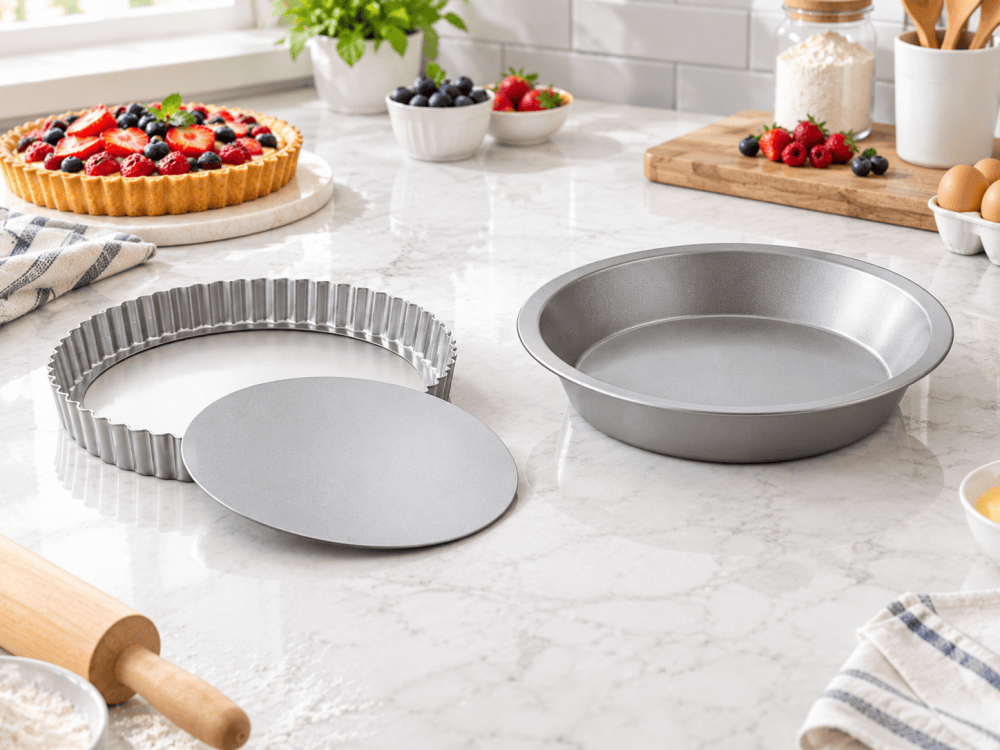
No. The nominal diameter may be similar, but tart pans are generally shallower and often have straight or fluted sides and a removable bottom, while pie pans are typically deeper with sloped sides and a fixed bottom.
What size tart pan is best for two people?
A 4- to 6-inch tart pan can work well for individual or small shared portions.
What size tart pan is best for six people?
An 8- or 9-inch tart pan may be suitable for approximately six servings, depending on tart depth and portion size.
What size tart pan is best for ten people?
A 10- to 12-inch tart pan may provide enough surface area for a larger tart, but the recipe quantity should be adjusted to match the pan's capacity.
Are 8-inch and 9-inch tart pans interchangeable?
They can sometimes be substituted, but the difference in surface area and capacity may affect filling depth and baking time. Adjust the recipe when necessary.
Does a deeper tart pan hold more filling?
Generally, yes. A deeper pan can provide more usable capacity, but actual capacity also depends on the diameter and shape.
Can tart pan sizes be customized?
Yes. OEM and private-label tart pans can potentially be developed in customized diameters, depths, shapes, materials, surface treatments, and packaging depending on the supplier's manufacturing capabilities.
Final Takeaway: What Size Tart Pan Should You Use?
The right tart pan size depends on the recipe, serving quantity, tart type, depth, and pan shape.
As a general guide, 4–6 inch pans are useful for individual or mini tarts, 8–10 inch pans are practical for many home-baking applications, and 11–12 inch pans can be suitable for larger-format tarts and group servings.
However, there is no single universal “standard” tart pan size. For the most consistent baking results, match the pan to the recipe and consider both diameter and depth.
For retailers, importers, and private-label brands, tart pan sizing should also be evaluated together with material, surface treatment, removable-bottom design, packaging, MOQ, and target-market requirements.
Looking for Custom Tart Pans for Your Brand?
Kitlucy provides kitchenware and bakeware OEM/ODM solutions for B2B buyers. Tart pan projects can be developed around different sizes, shapes, materials, surface treatments, packaging, and private-label requirements.
Contact Kitlucy to discuss your tart pan size, product specifications, packaging, and customization requirements.
Related Blogs