Tart Pan vs Tart Mold vs Tart Ring: What's the Difference?
Tart Pan vs Tart Mold vs Tart Ring: What's the Difference?
What is the difference between a tart pan, tart mold, and tart ring? A tart pan is a structured baking pan that normally has a bottom and sidewalls, and many designs use a removable bottom for easier release. A tart mold is a broader term for a mold used to shape and bake tart-style desserts, often emphasizing the shape, pattern, or cavity design. A tart ring is usually a bottomless ring that defines the shape of the tart while the pastry is baked on a separate baking surface. The best option depends on the recipe, baking method, release requirements, and production needs.
Tart pan, tart mold, and tart ring are sometimes used interchangeably in product listings, but they do not always describe the same type of baking tool.
For home bakers, the difference mainly affects how a tart is shaped, baked, and removed from the tool. For retailers, importers, and kitchenware brands, the distinction also matters when specifying product dimensions, materials, packaging, and intended applications.
This guide compares tart pans, tart molds, and tart rings by structure, bottom design, materials, baking applications, release method, and B2B sourcing considerations.

Tart Pan vs Tart Mold vs Tart Ring: Quick Answer
| Feature | Tart Pan | Tart Mold | Tart Ring |
|---|---|---|---|
| Basic structure | Pan with sidewalls and a bottom | Mold used to form a tart shape | Bottomless ring |
| Bottom | Usually fixed or removable | May be fixed, removable, flexible, or cavity-based | Usually no bottom |
| Main purpose | Shape and bake the tart | Shape and bake or form the tart | Define the tart shape during baking |
| Release method | Lift or remove tart from pan | Depends on mold design | Lift ring away from tart |
| Typical materials | Aluminum, steel, coated metal | Metal, silicone, other heat-resistant materials | Stainless steel, aluminum, perforated metal |
| Common design | Round or rectangular | Many shapes and cavity designs | Round or specialty shapes |
| Best for | Home baking and general tart production | Specialty shapes and different tart formats | Professional pastry shaping and baking |
Important: Product terminology is not completely standardized across manufacturers and retailers. Some suppliers may use “tart mold” as a general product category that includes tart pans and tart rings. Always check the actual product structure and specifications rather than relying only on the product name.
What Is a Tart Pan?
A tart pan is a baking pan designed specifically for making tarts. It normally has a base and sidewalls that hold the pastry crust and filling during baking.
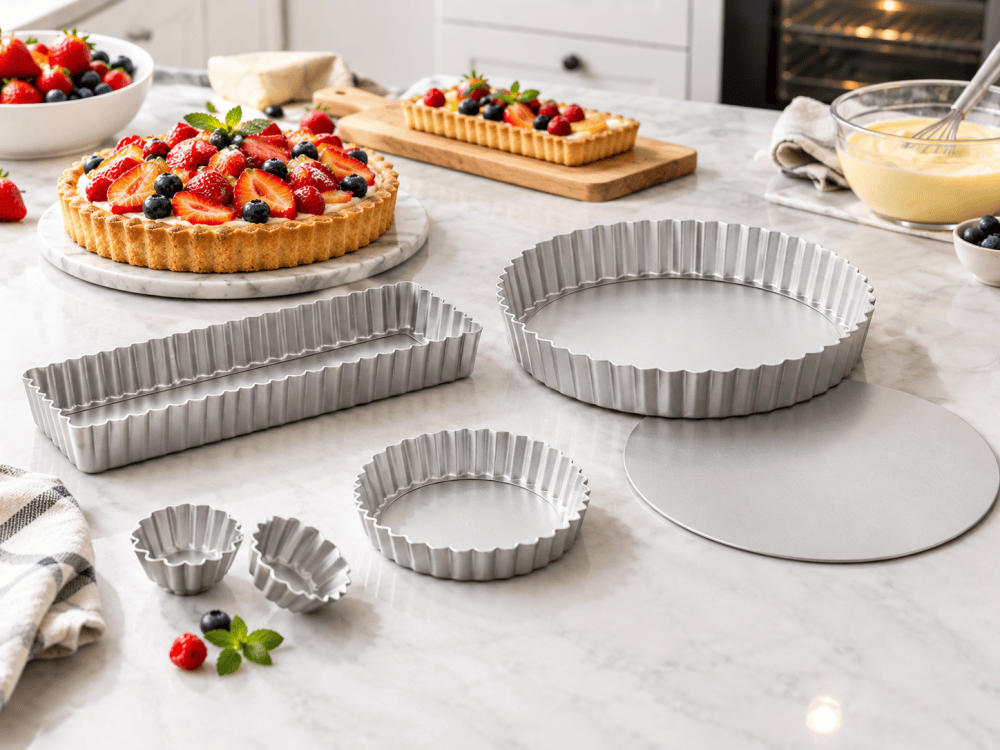
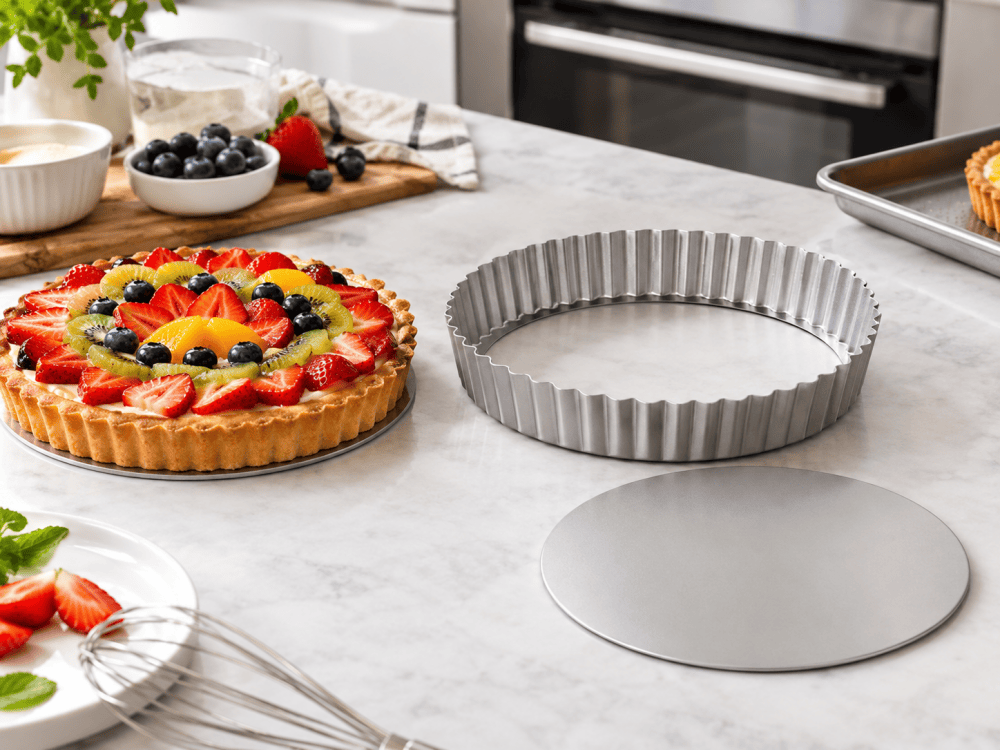
Many traditional tart pans have fluted sides to create a decorative crust edge. Some designs also have a removable bottom, allowing the outer ring to be lifted away after baking.
Tart pans are commonly available in round, rectangular, square, mini, and specialty formats.
Key Features of a Tart Pan
- Has a defined pan structure.
- Usually includes a bottom.
- May have a fixed or removable bottom.
- Often has straight or fluted sidewalls.
- Commonly made from aluminum or steel.
- Available in different sizes and shapes.
- Designed for baking and releasing a finished tart.
If you want to understand tart pan construction in more detail, see our guide to What Is a Tart Pan? Types, Uses & How to Choose.
What Is a Tart Mold?
Tart mold is a broader term that generally describes a mold used to shape a tart or tart-style dessert.
Unlike the term “tart pan,” which usually suggests a structured baking pan, “tart mold” can refer to several different product designs.
A tart mold may have individual cavities, a flexible silicone structure, a decorative shape, or a rigid metal form. The exact design depends on the product and its intended application.
Common Types of Tart Molds
- Round tart molds
- Mini tart molds
- Silicone tart molds
- Decorative tart molds
- Individual cavity molds
- Specialty-shaped tart molds
- Professional pastry molds
Because “tart mold” is a broad category, buyers should look at the actual product dimensions, cavity structure, material, and release mechanism before comparing it with a tart pan.
What Is a Tart Ring?
A tart ring is typically a ring-shaped tool without a bottom.
Instead of containing the tart on its own like a conventional pan, the ring defines the outside shape of the pastry while the tart is supported by a separate baking surface, such as a baking sheet or suitable baking mat.
Tart rings are particularly common in professional pastry applications where precise shape, consistent dimensions, and efficient production are important.
Key Features of a Tart Ring
- Usually has no bottom.
- Defines the outside shape of the tart.
- Usually placed directly on a baking surface.
- Can be round, rectangular, square, or specialty-shaped.
- Often made from metal.
- Commonly used for professional pastry production.
- Can support consistent portion and shape control.
Simple way to remember it: A tart pan contains the tart. A tart mold shapes the tart. A tart ring defines the tart's outer shape without providing a conventional bottom.
Tart Pan vs Tart Ring: What's the Difference?
The most important difference between a tart pan and a tart ring is the bottom structure.
A tart pan normally has a bottom that supports the pastry and filling. A tart ring normally does not have a bottom and instead sits on another baking surface.
| Feature | Tart Pan | Tart Ring |
|---|---|---|
| Bottom | Usually included | Usually absent |
| Supports filling | Yes | Only when used with a separate baking surface or prepared base |
| Release | Remove tart from pan | Lift ring away from tart |
| Typical use | Home and general tart baking | Professional pastry production |
| Storage | Pan remains a complete unit | Simple ring structure can be easy to stack |
Which Is Easier for Home Bakers?
For many home bakers, a tart pan can be easier because the bottom supports the pastry and filling during handling.
A tart ring can provide excellent shape control, but it requires a suitable baking surface and a baking method appropriate for the ring design.
Tart Pan vs Tart Mold: What's the Difference?
The difference is less precise because “tart mold” can be used as a broader category.
A tart pan generally refers to a specific type of baking vessel with a base and sidewalls. A tart mold may refer to a wider range of tools used to create a tart shape.
For example, a silicone mold with several individual tart cavities can be described as a tart mold, while a rigid round pan with a removable bottom is more naturally described as a tart pan.
| Feature | Tart Pan | Tart Mold |
|---|---|---|
| Terminology | More specific | Broader |
| Structure | Usually a rigid pan | Can be rigid or flexible |
| Bottom | Usually has a bottom | Depends on design |
| Shape variety | Moderate | Often very broad |
| Material variety | Often metal | Metal, silicone and other materials |
| Main emphasis | Baking and tart structure | Shape, cavity, design and release |
Tart Mold vs Tart Ring: What's the Difference?
A tart mold can have a bottom and may contain one or multiple cavities, while a tart ring generally consists of an open ring without a bottom.
This makes the two tools useful for different production methods.
Tart Mold
A mold is generally designed to create a specific shape or cavity. It may be useful for mini tarts, decorative desserts, individual portions, or specialty pastry products.
Tart Ring
A ring primarily defines the perimeter of the tart. The pastry is supported by another surface, making the ring particularly useful when consistent dimensions and professional presentation are important.
Can You Use a Tart Ring Instead of a Tart Pan?
In some recipes, yes, but the baking setup is different.
A tart ring does not normally provide the same bottom support as a tart pan. The pastry is typically placed inside the ring on a separate baking surface.
Before substituting a ring for a pan, consider:
- How the pastry will be supported.
- Whether the filling is liquid or relatively firm.
- Whether the recipe requires a removable bottom.
- Whether the ring is designed for baking.
- Whether the baking surface provides adequate support.
A tart pan is generally more straightforward when a recipe specifically calls for a pan with a bottom.
Can You Use a Tart Pan Instead of a Tart Ring?
Sometimes, but the final result may differ.
A tart pan can provide additional support and make the baking process easier, but it may not produce exactly the same crust shape or release characteristics as a professional tart ring.
If the recipe is designed around a ring, the pastry thickness, edge shape, and baking behavior may be different when transferred to a conventional pan.
Tart Pan vs Tart Mold vs Tart Ring: Which Is Best?
There is no single best option for every application.
| Application | Recommended Option | Why |
|---|---|---|
| Home fruit tart | Tart pan | Easy to assemble, bake and release |
| Classic round tart | Tart pan | Provides a stable base and defined sides |
| Mini individual tarts | Tart mold or mini tart pan | Efficient portion control |
| Decorative specialty tart | Tart mold | More shape and cavity options |
| Professional pastry production | Tart ring | Precise shape and efficient production |
| Consistent commercial sizing | Tart ring or rigid tart pan | Good dimensional control |
| Flexible release | Silicone tart mold | Flexible material can assist demolding |
Materials: Tart Pan vs Tart Mold vs Tart Ring
Material is another important difference between these products.
Aluminum
Aluminum is widely used for bakeware because it is lightweight, conducts heat efficiently, and can be formed into different pan and ring designs.
Aluminum tart pans can be natural, anodized, or combined with a suitable surface treatment depending on the product.
See our detailed guide: Aluminum Tart Pan: Benefits, Types & How to Choose.
Steel
Steel and aluminized steel are also used in tart pans and molds. They can provide a rigid structure and support different surface treatments.
Stainless Steel
Stainless steel is commonly used for professional pastry rings because it provides a rigid, reusable structure and can be manufactured in consistent dimensions.
Silicone
Silicone is commonly used for flexible molds, particularly when easy release and specialty shapes are important.
However, not every silicone product is automatically suitable for every food-contact or temperature application. Buyers should evaluate the specific material formulation, intended use, and relevant compliance documentation.
Tart Pan vs Tart Mold vs Tart Ring for Different Baking Applications
| Baking Application | Tart Pan | Tart Mold | Tart Ring |
|---|---|---|---|
| Fruit tart | Excellent | Good | Good |
| Chocolate tart | Excellent | Good | Good |
| Lemon tart | Excellent | Good | Good |
| Mini tart | Good | Excellent | Good |
| Decorative tart | Good | Excellent | Good |
| Professional pastry production | Good | Good | Excellent |
| Multi-cavity production | Limited | Excellent | Limited |
What Should B2B Buyers Look for When Sourcing Tart Pans, Molds and Rings?
For importers, distributors, retailers, and private-label brands, the product name is only the starting point.
A complete product specification should identify the actual structure and intended use.
1. Product Structure
Confirm whether the product has a fixed bottom, removable bottom, multiple cavities, or no bottom.
2. Dimensions
Specify diameter, length, width, depth, wall thickness, cavity dimensions, and usable capacity where relevant.
3. Material
Confirm the exact material rather than relying only on terms such as “metal,” “aluminum,” or “food grade.”
4. Surface Treatment
For coated products, confirm the type of coating or surface treatment, intended use, and relevant documentation.
5. Temperature Requirements
Confirm the intended baking temperature range based on the actual product construction and material specification.
6. Release Design
For tart pans and molds, evaluate whether the product uses a removable bottom, flexible material, nonstick surface, or another release mechanism.
7. Packaging
For wholesale and retail products, packaging dimensions can affect shipping costs, carton efficiency, shelf presentation, and storage.
8. Quality Control
Check dimensional consistency, surface quality, edge finishing, coating consistency, deformation resistance, and packaging quality.
Can Tart Pans, Tart Molds and Tart Rings Be Customized?
Yes. Depending on the supplier's manufacturing capabilities, B2B tart-baking products can be developed for OEM, ODM, and private-label programs.
Potential customization options include:
- Diameter and overall dimensions
- Depth
- Round, square, rectangular, or custom shapes
- Fluted or smooth sidewalls
- Fixed or removable bottoms
- Single or multiple cavities
- Material selection
- Surface treatment
- Logo and branding
- Retail packaging
- Product sets containing multiple sizes
For example, a private-label bakeware collection could combine a 9-inch tart pan, mini tart molds, and professional-style tart rings to cover different consumer and foodservice applications.
How to Choose Between a Tart Pan, Tart Mold and Tart Ring
The easiest way to choose is to start with the intended baking method rather than the product name.
- Need a complete baking vessel with a bottom? Choose a tart pan.
- Need specialty shapes or multiple cavities? Consider a tart mold.
- Need a bottomless shaping tool? Consider a tart ring.
- Need easy removal from a rigid pan? Consider a tart pan with a removable bottom.
- Need flexible demolding? Consider an appropriate silicone tart mold.
- Need consistent professional pastry dimensions? A tart ring may be more suitable.
The correct choice depends on the recipe, baking process, desired presentation, and production requirements.
Frequently Asked Questions
Is a tart pan the same as a tart mold?
Not necessarily. A tart pan is usually a structured baking pan with a bottom and sidewalls, while tart mold is a broader term that can describe different tools used to shape and bake tart-style products.
Is a tart ring the same as a tart pan?
No. A tart ring is generally bottomless and is placed on a separate baking surface, while a tart pan normally includes a bottom that supports the pastry.
What is the main difference between a tart pan and a tart ring?
The main difference is the bottom. A tart pan normally has a bottom, while a tart ring usually does not.
What is a tart mold used for?
A tart mold is used to shape and often bake tart-style desserts. It may be designed for standard tarts, mini tarts, decorative shapes, or multiple individual cavities.
Are tart rings better for professional baking?
Tart rings can be useful for professional pastry production because they provide consistent dimensions and allow efficient shaping on a separate baking surface. Whether they are better depends on the recipe and production process.
Can I use a tart ring for a liquid filling?
It depends on the recipe and setup. Because a tart ring generally has no bottom, the pastry and baking surface must provide adequate support and containment before adding the filling.
What material is best for a tart pan?
There is no universal best material. Aluminum, steel, stainless steel, and silicone each have different properties. The appropriate choice depends on thermal performance, rigidity, release requirements, durability, surface treatment, and intended application.
Can tart pans and tart molds be made for private label?
Yes. Depending on the supplier, tart pans and molds can be customized in size, shape, material, surface treatment, branding, packaging, and product-set configuration for OEM, ODM, and private-label programs.
Final Takeaway: Tart Pan vs Tart Mold vs Tart Ring
The simplest distinction is:
| Product | Simple Definition |
|---|---|
| Tart Pan | A baking pan with sidewalls and usually a bottom, often with a removable bottom. |
| Tart Mold | A broader category of molds used to shape and potentially bake tart-style products. |
| Tart Ring | A generally bottomless ring used to define the shape of a tart on a separate baking surface. |
For most home bakers looking for a straightforward tart-baking solution, a tart pan is usually the easiest option. For specialty shapes or multiple individual portions, a tart mold may offer more flexibility. For professional pastry production and precise shaping, a tart ring can be a useful choice.
For B2B buyers, the most important step is to look beyond the product name and confirm the actual structure, dimensions, material, surface treatment, bottom design, intended temperature range, packaging, and customization options.
Looking for Custom Tart Pans, Tart Molds or Tart Rings?
Kitlucy provides kitchenware and bakeware OEM/ODM solutions for B2B buyers. Tart-baking products can be developed around different sizes, shapes, materials, surface treatments, packaging, and private-label requirements.
Contact Kitlucy to discuss your tart pan, tart mold, or tart ring project and product specifications.
Related Blogs