

304 vs. 316 Stainless Steel Cutting Boards: Which Should You Choose?
When comparing stainless steel cutting boards, the material grade is one of the first things worth checking. Two common options are 304 and 316 stainless steel. Both are austenitic stainless steels used in food-related applications, but they differ in chemical composition, corrosion resistance, and material cost.
So, is a 316 stainless steel cutting board really better than a 304 stainless steel cutting board? Does the higher grade make a noticeable difference in everyday food preparation? And which material makes more sense for kitchenware brands, wholesalers, and product buyers?
The answer depends on the intended application. Grade 316 offers better resistance to chloride-related corrosion, while grade 304 already provides reliable corrosion resistance for many ordinary kitchen environments. Understanding this distinction helps buyers avoid paying for material properties they may not actually need.
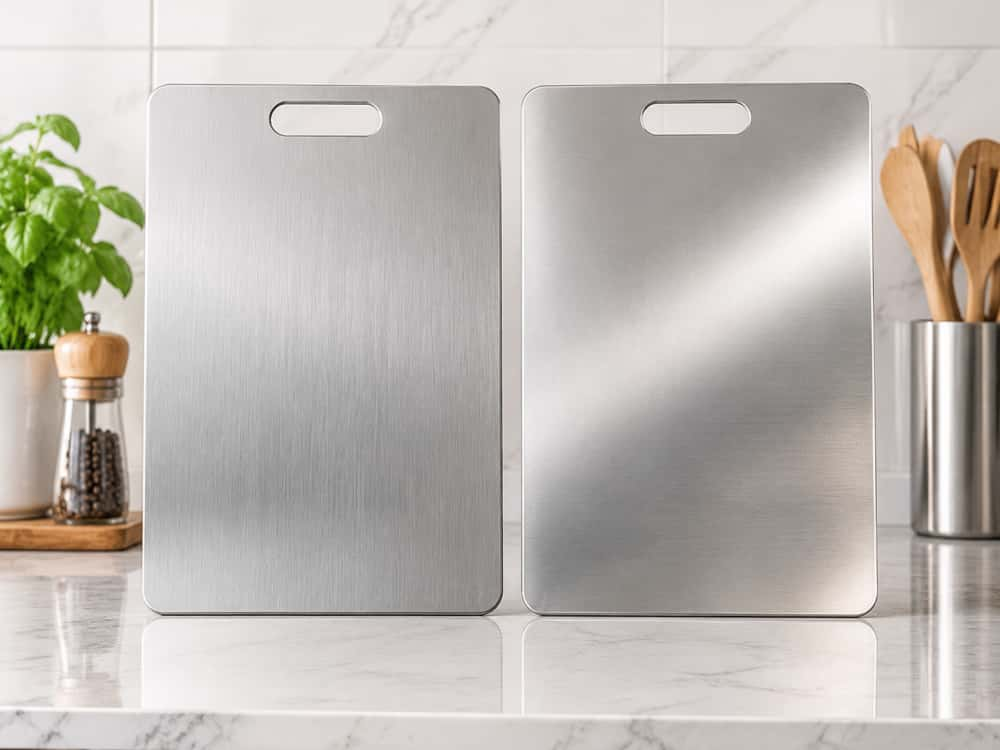
304 stainless steel is generally a practical choice for standard kitchen cutting boards because it offers good corrosion resistance, wide availability, and a relatively economical material cost.
316 stainless steel contains molybdenum, which improves resistance to chloride-related pitting and crevice corrosion. It is worth considering for products exposed to salty ingredients, coastal environments, or more demanding cleaning conditions.
However, 316 is not automatically more hygienic, more scratch-resistant, or more knife-friendly than 304. Both are rigid metal surfaces, so the overall product design and intended use remain important.
1. What Are 304 and 316 Stainless Steel?
304 and 316 belong to the austenitic stainless steel family. They contain chromium and nickel, which help provide corrosion resistance, toughness, and good formability.
The most important difference is that 316 also contains molybdenum. This additional alloying element improves its resistance to certain corrosive environments, particularly those involving chloride ions.
304 Stainless Steel: A Common Choice for Kitchenware
304 stainless steel is one of the most widely used stainless steel grades in food processing equipment, cookware, kitchen accessories, and food-contact applications.
It is often described as 18/8 stainless steel because its typical composition includes approximately 18% chromium and 8% nickel. Actual composition must be checked against the applicable material specification and supplier documentation.
Its main characteristics include:
- Good corrosion resistance: Suitable for many ordinary indoor kitchen and food-preparation environments.
- Good formability: Can be processed into different shapes and product structures.
- Good weldability: Suitable for many fabricated kitchenware components.
- Wide availability: Commonly supplied in sheet and plate forms.
- Cost efficiency: Usually more economical than 316 for comparable material forms and specifications.
For a standard stainless steel cutting board designed for everyday food preparation, 304 is often a sensible starting point.
316 Stainless Steel: Improved Resistance to Chlorides
316 stainless steel has a chemical composition similar to 304, but it contains approximately 2–3% molybdenum. This addition improves its resistance to pitting and crevice corrosion, especially in chloride-containing environments.
Its main characteristics include:
- Improved chloride resistance: Better suited to environments where salt exposure is a concern.
- Good corrosion resistance: Performs well in a range of demanding food-processing conditions.
- Good formability: Can be fabricated into different kitchenware shapes and structures.
- Higher material cost: Generally more expensive than 304.
- Specialized applications: Often selected where additional corrosion resistance justifies the extra cost.
For cutting boards used in seafood preparation, salty food handling, or demanding commercial environments, 316 may offer an additional material advantage.
2. 304 vs. 316 Stainless Steel: Key Differences
The following table summarizes the main differences buyers should understand before selecting a material for a stainless steel cutting board.
| Comparison | 304 Stainless Steel | 316 Stainless Steel |
|---|---|---|
| Steel family | Austenitic stainless steel | Austenitic stainless steel |
| Chromium content | Typically around 18–20% | Typically around 16–18% |
| Nickel content | Typically around 8–10.5% | Typically around 10–14% |
| Molybdenum content | No intentional molybdenum addition in standard 304 | Typically around 2–3% |
| General corrosion resistance | Good | Very good |
| Chloride resistance | More susceptible to chloride-related pitting | Improved resistance to chloride-related pitting |
| Food-contact applications | Widely used | Also used, particularly in more demanding environments |
| Formability | Good | Good |
| Material cost | Generally lower | Generally higher |
| Typical cutting board positioning | Standard and value-oriented products | Premium or specialized products |
Important: The percentages above are approximate typical ranges, not a substitute for a material standard. Exact chemical composition varies according to the applicable specification and product form. Always verify the grade through a material certificate.
3. Corrosion Resistance: Why Does 316 Perform Better?
Corrosion resistance is the most meaningful technical difference between 304 and 316 stainless steel.
Both grades rely on a thin, protective chromium-rich passive layer on their surfaces. This layer helps prevent the underlying metal from reacting with its environment. However, chloride ions can damage this protective layer under certain conditions and cause localized corrosion.
How Salt Affects Stainless Steel
Salt contains chloride ions. When salt or salty liquid remains on a metal surface, especially in areas where moisture collects or evaporation concentrates the salt, the risk of localized corrosion can increase.
This is relevant to cutting boards used for:
- Preparing seafood and shellfish.
- Handling salted meat and cured food products.
- Preparing foods with salty marinades.
- Frequent contact with salt-containing liquids.
- Commercial food-preparation environments with demanding cleaning routines.
304 stainless steel performs well in many everyday kitchen environments, but it is more vulnerable to chloride-related pitting than 316. The molybdenum in 316 helps improve resistance to this type of corrosion.
Does 316 Mean the Cutting Board Cannot Rust?
No. This is an important distinction for both consumers and product buyers.
316 stainless steel is more resistant to certain corrosive conditions, but it is not completely corrosion-proof. Prolonged exposure to concentrated salt, unsuitable cleaning chemicals, trapped moisture, or poorly designed joints can still create corrosion risks.
The surface condition also matters. Scratches, contamination from carbon steel tools, poor weld finishing, and deposits around edges or joints can affect long-term performance.
For either grade, proper cleaning, drying, fabrication, and surface finishing remain essential.
4. Are 304 and 316 Stainless Steel Both Food Safe?
Both 304 and 316 stainless steel are widely used in food-related applications. Neither grade should be treated as automatically unsuitable for food contact simply because it is not 316.
304 is a common material for food-processing equipment, containers, kitchen utensils, and other food-contact products. 316 is also used in food and beverage applications, particularly where additional corrosion resistance is required.
For a cutting board, however, food-contact suitability is not determined by the steel grade alone.
What Else Affects Food-Contact Suitability?
- Material traceability: The manufacturer should be able to identify the actual stainless steel grade and provide relevant material documentation.
- Surface finish: A smooth, properly finished surface is easier to clean than one with rough areas, deep scratches, or manufacturing defects.
- Weld and edge quality: Poorly finished joints, gaps, and sharp edges can create cleaning and handling problems.
- Product construction: Hollow structures, seams, attachments, and anti-slip components should be designed to avoid unnecessary dirt and moisture traps.
- Regulatory requirements: The finished product should be evaluated against the food-contact requirements of its target market.
A cutting board made from verified 304 stainless steel with good surface finishing and sound construction may be a more suitable product than a poorly manufactured board advertised as 316.
Buyers should therefore request material information and assess the finished product rather than relying on a simple marketing description such as "food-grade stainless steel."
5. Is 316 Stainless Steel Better for Cutting Boards?
It depends on what "better" means.
If the priority is resistance to chloride-related corrosion, 316 has an advantage. If the priority is everyday performance at a reasonable cost, 304 may be sufficient.
There are also several cutting-board characteristics that the difference between 304 and 316 does not automatically resolve.
Knife Sharpness
Both 304 and 316 are rigid metal surfaces. Unlike wood, rubber, or many plastic cutting surfaces, they provide very little cushioning when a knife edge makes contact with the board.
As a result, neither grade should be considered inherently knife-friendly. Repeated cutting on a hard metal surface may contribute to faster edge wear or damage compared with a suitable softer cutting surface.
The difference between 304 and 316 is primarily related to corrosion resistance, not a guaranteed difference in how well each material preserves knife sharpness.
Scratch Resistance
316 is not automatically more scratch-resistant than 304. Both grades can develop surface scratches through contact with knives, cookware, abrasive cleaning tools, and other hard objects.
Actual scratch performance depends on the product's material condition, surface finish, thickness, and manufacturing process.
Cleaning and Maintenance
Both materials can be cleaned using suitable kitchen cleaning methods. A smooth, well-finished surface helps remove food residues and makes routine cleaning easier.
However, choosing 316 does not eliminate the need for proper cleaning. Salt residues, food particles, and moisture should still be removed after use.
6. 304 vs. 316: Which One Is Better for Different Applications?
The right grade depends on how the cutting board will be used, how frequently it will be cleaned, and the environment in which it will operate.
| Application | Suggested Grade | Reason |
|---|---|---|
| Everyday home food preparation | 304 | Good corrosion resistance for many standard kitchen conditions. |
| General kitchenware retail products | 304 | Offers a practical balance between performance and material cost. |
| Seafood preparation | 316 worth considering | Better resistance to chloride exposure from salty ingredients. |
| Salt-heavy food preparation | 316 worth considering | Additional resistance to chloride-related pitting. |
| Commercial food preparation | Depends on conditions | Cleaning chemicals, exposure, frequency of use, and maintenance all matter. |
| Premium kitchenware product lines | 304 or 316 | Material selection should match the product positioning and actual performance requirements. |
| Coastal or humid storage environments | 316 may be advantageous | Offers additional resistance in chloride-exposed environments, although maintenance is still necessary. |
For many household cutting boards, 304 is likely to be sufficient. For specialized products intended for frequent contact with salty ingredients or more demanding environments, 316 deserves consideration.
There is little value in specifying a more expensive grade if the product's intended use does not require its additional corrosion resistance.
7. What About 304L and 316L Stainless Steel?
When researching stainless steel materials, buyers may also encounter 304L and 316L. These are low-carbon variations of 304 and 316.
The letter "L" stands for low carbon. The reduced carbon content helps reduce the risk of sensitization during welding, which can improve resistance to certain forms of weld-related corrosion.
| Grade | Main Characteristic | Potential Application |
|---|---|---|
| 304 | Standard 304 composition | General kitchenware and fabricated products |
| 304L | Lower carbon content than standard 304 | Fabricated products involving welding |
| 316 | Contains molybdenum for improved chloride resistance | Products exposed to more corrosive environments |
| 316L | Lower carbon version of 316 | Welded products requiring improved resistance to weld-related corrosion |
For a stainless steel cutting board with welded components, 304L or 316L may be worth discussing with the manufacturer. The choice should be based on the actual fabrication process, material specification, and service environment rather than assuming that every product needs an L-grade material.
8. How to Choose a Stainless Steel Cutting Board Manufacturer
For importers, wholesalers, retailers, and private-label kitchenware brands, selecting the right material is only one part of supplier evaluation.
A reliable manufacturer should be able to explain the material specification, production process, surface treatment, and quality-control procedures behind the finished product.
1. Verify the Stainless Steel Grade
Do not rely only on a product description stating "304 stainless steel" or "316 stainless steel."
Ask the supplier for relevant documentation, such as:
- Material test certificates or mill test certificates, where applicable.
- Material grade and applicable standard.
- Information about the steel supplier and material traceability.
- Confirmation of whether the product uses solid stainless steel or a different construction.
For larger or higher-risk orders, buyers may also consider independent material verification. A handheld XRF analyzer can help identify alloying elements such as molybdenum, although it does not measure carbon accurately enough to distinguish every low-carbon grade. The verification method should match the material claim being checked.
2. Check Surface Finish and Edge Processing
The surface finish directly affects the appearance, cleanability, and perceived quality of a stainless steel cutting board.
When evaluating samples, pay attention to:
- Surface consistency and visible scratches.
- Polishing quality and finishing marks.
- Whether corners and edges are smooth and safe to handle.
- Whether there are gaps, burrs, or unfinished joints.
- Whether the surface is easy to clean after contact with food residues.
3. Evaluate Thickness and Structural Design
Material grade alone does not determine the overall durability of a cutting board.
Thickness, flatness, structural support, and edge design can all influence the finished product's performance. A board that is too thin may flex or feel unstable, while an unnecessarily heavy design may increase shipping costs and reduce convenience.
Buyers should evaluate thickness according to the intended product size, construction, and market positioning.
4. Inspect Anti-Slip and Functional Features
A stainless steel cutting board should be stable during normal food preparation. Depending on the design, manufacturers may offer:
- Non-slip silicone or rubber feet.
- Integrated anti-slip edges.
- Juice grooves or liquid collection features.
- Rounded corners and reinforced edges.
- Different sizes and thickness options.
If the board uses rubber, silicone, or other attached components, buyers should also evaluate their material specifications, attachment quality, and suitability for the intended food-contact application.
5. Review Quality Control and Testing
A professional supplier should have a clear quality-control process covering incoming materials, production, finishing, and final inspection.
Depending on the product design, buyers can request checks for:
- Material grade and thickness consistency.
- Surface defects, scratches, and finish uniformity.
- Flatness and dimensional accuracy.
- Edge safety and workmanship.
- Stability of anti-slip components.
- Cleaning performance and corrosion resistance under relevant test conditions.
The testing method should reflect the actual intended use. A generic corrosion test or a material certificate alone cannot guarantee the performance of every finished cutting board.
9. Custom 304 and 316 Stainless Steel Cutting Boards for OEM/ODM Projects
For kitchenware brands and distributors, choosing between 304 and 316 can also influence product positioning, manufacturing costs, and target retail prices.
A custom stainless steel cutting board project may involve more than selecting a metal grade. Buyers may need to define the product's dimensions, thickness, surface finish, edge design, packaging, and branding requirements.
Common OEM/ODM customization options include:
- Material selection: 304 or 316 stainless steel according to the intended application.
- Dimensions: Custom lengths, widths, and thicknesses for different retail markets.
- Surface treatment: Different polishing and finishing options.
- Structural design: Flat boards, reinforced structures, and selected functional features.
- Additional components: Silicone feet, protective edges, or other design elements.
- Private-label branding: Customized packaging and brand presentation.
Before starting mass production, it is advisable to confirm the material specification, approve a production sample, and agree on measurable quality standards. This helps ensure that the final product matches the buyer's expectations.
10. Frequently Asked Questions
Is 316 stainless steel better than 304 for cutting boards?
316 offers better resistance to chloride-related corrosion because it contains molybdenum. However, 304 is already suitable for many everyday kitchen applications. The better choice depends on the product's intended environment and budget.
Is 304 stainless steel safe for food contact?
304 stainless steel is widely used in food-contact applications. Its suitability for a finished cutting board also depends on material verification, surface condition, manufacturing quality, and the food-contact requirements of the target market.
Does 316 stainless steel rust?
Yes, under certain conditions. Although 316 has better resistance to chloride-related corrosion than 304, it is not completely rust-proof. Concentrated salt, unsuitable cleaning chemicals, poor surface finishing, and trapped moisture can still cause corrosion.
Is 316 stainless steel more expensive than 304?
Generally, yes. The addition of molybdenum and differences in alloy composition make 316 more expensive in many market conditions. Actual prices depend on raw material costs, thickness, product dimensions, processing, and order quantity.
Can I use a 304 stainless steel cutting board for seafood?
A properly manufactured 304 stainless steel board can be used for food preparation, including seafood. However, frequent or prolonged exposure to salty residues can increase corrosion risk. Clean and dry the board promptly, and consider 316 if the intended application involves more demanding chloride exposure.
Does 316 stainless steel keep knives sharper than 304?
There is no reliable basis for treating 316 as a knife-friendly alternative to 304. Both are hard, rigid metal surfaces and may contribute to faster knife-edge wear than suitable wood or plastic cutting surfaces.
What is the difference between 304 and 304L, or 316 and 316L?
The "L" indicates a lower-carbon version of the corresponding grade. Lower carbon content helps reduce the risk of sensitization during welding, making these variants useful for certain fabricated products.
How can I confirm whether a cutting board is really made of 304 or 316 stainless steel?
Ask the manufacturer for material documentation and traceability information. For additional verification, an appropriate independent alloy-identification test can help confirm the grade. Visual appearance alone cannot reliably distinguish 304 from 316.
Conclusion: Choose the Stainless Steel Grade Based on the Application
The difference between 304 and 316 stainless steel cutting boards comes down primarily to corrosion resistance and cost.
304 is a practical material for many standard kitchen cutting boards. It offers good corrosion resistance, wide availability, and a reasonable balance between material cost and performance.
316 is worth considering when a product is expected to face more frequent exposure to salt, chloride-containing ingredients, or demanding cleaning conditions. Its additional corrosion resistance can justify the higher material cost in those applications.
For buyers developing a stainless steel cutting board product line, the best decision is not simply to choose the highest grade. It is to match the material, surface finish, structural design, and quality-control requirements to the product's intended market.
Looking for a Stainless Steel Cutting Board Manufacturing Partner?
Kitlucy works with kitchenware buyers and brands looking for practical product solutions and customization options. Whether you are developing a standard stainless steel cutting board or exploring a premium product line, choosing the right material and product structure is an important part of the process.
Contact our team to discuss your product requirements, OEM/ODM possibilities, and customized kitchenware projects.
Contact KitlucyRelated Blogs