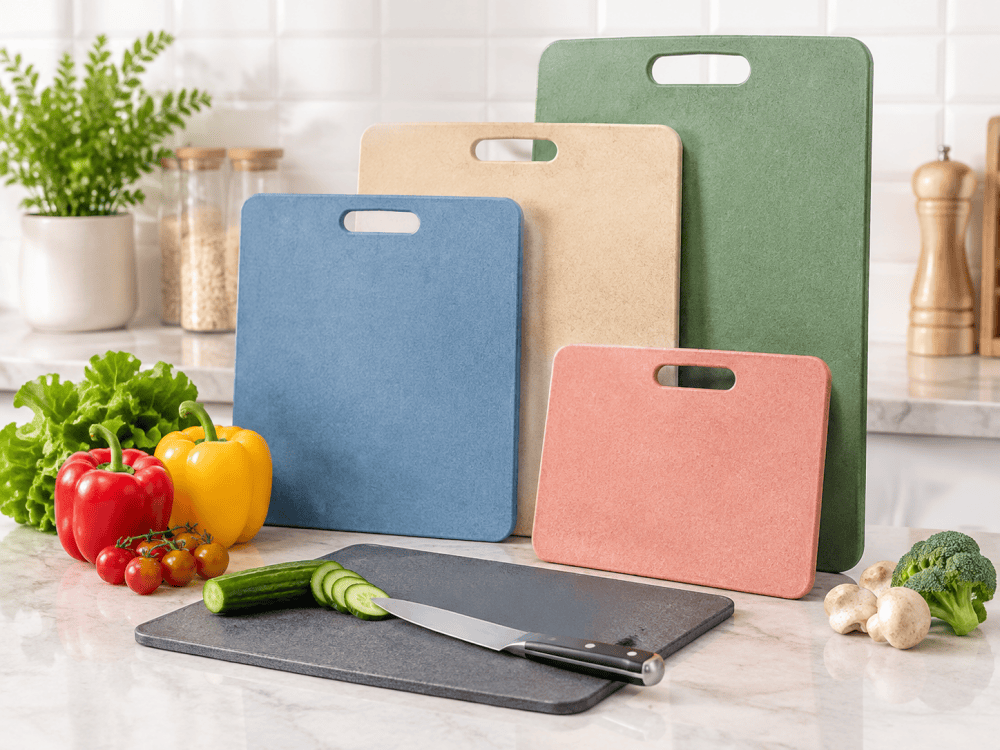


Are Wood Fiber Cutting Boards Safe for Food Preparation? A Complete Guide
Wood fiber cutting boards have become a popular alternative to traditional wooden and plastic boards. Their smooth surfaces, compact construction, and modern appearance make them attractive for everyday kitchens and commercial kitchenware collections. But are wood fiber cutting boards actually safe for preparing food?
Yes. Wood fiber cutting boards can be safe for food preparation when they are manufactured with suitable food-contact materials, properly processed, and used according to the manufacturer's instructions. However, safety depends on the complete product—not simply the fact that it contains wood fibers.
Buyers should pay attention to the fiber material, resin or binder system, surface treatment, manufacturing quality, and relevant food-contact documentation. Proper cleaning and regular inspection are equally important for maintaining food hygiene.
1. What Are Wood Fiber Cutting Boards Made Of?
Wood fiber cutting boards are generally composite products rather than solid pieces of natural wood. They are commonly made by combining wood-based fibers or paper-derived fibers with a binding material, followed by a controlled manufacturing process.
Some products use multiple layers of fiber-based material that are bonded with thermosetting resin under heat and pressure. This process can produce a dense, rigid board with a relatively smooth surface.
However, not all wood fiber cutting boards use the same formula or production method. The exact composition can vary between manufacturers and product ranges.
Common Components of Wood Fiber Cutting Boards
- Wood or paper-based fibers: Provide the structural base of the composite material.
- Resin or binder: Bonds the fibers together and helps create a solid board.
- Surface treatment: May be used to achieve a particular finish, color, or surface characteristic.
- Additional components: Some designs include silicone feet, non-slip edges, hanging holes, or other accessories.
These components should be evaluated as part of the finished product. A material that performs well on its own does not automatically make every finished cutting board suitable for food contact.
2. Are Wood Fiber Cutting Boards Food Safe?
Wood fiber cutting boards can be suitable for food preparation, but the answer depends on their material formulation and manufacturing quality.
Since these boards are composite products, it is important to consider more than the wood fibers. The resin or binder, any surface coating, added colorants, and other components may also come into contact with food.
Why Does the Resin or Binder Matter?
In many composite boards, resin helps hold the fibers together and contributes to the finished product's structural properties. The type of resin and its suitability for the intended food-contact conditions are therefore important considerations.
Buyers should not assume that every resin is automatically food safe. Instead, they should request information about the material formulation and supporting food-contact evaluation for the finished product.
Relevant questions include:
- What type of fiber material is used?
- What resin or binder system is used in production?
- Is the finished product intended for direct food contact?
- Has the complete product been evaluated under relevant food-contact conditions?
- Are there any restrictions on food types, temperature, or cleaning methods?
Does a Smooth Surface Mean a Cutting Board Is Food Safe?
Not necessarily. A smooth, dense surface can be useful for everyday food preparation and cleaning, but appearance alone cannot demonstrate chemical safety or regulatory compliance.
A board may look well finished while still requiring further evaluation of its resin system, coatings, colorants, or other components. Food-contact suitability should be supported by appropriate technical documentation rather than visual inspection alone.
3. What Makes Wood Fiber Cutting Boards Suitable for Food Preparation?
Several product characteristics influence whether a wood fiber cutting board is appropriate for everyday food preparation. These characteristics should be considered together rather than treated as individual guarantees of safety.
1. Suitable Food-Contact Materials
All materials that may contact food should be selected for the intended application. This includes the main composite material as well as coatings, pigments, adhesives, and attached components where relevant.
Manufacturers should understand the composition of the materials they use and maintain supporting documentation for the finished product.
2. Consistent Manufacturing Quality
Proper manufacturing helps create a stable, uniform product. Inconsistent bonding, incomplete processing, surface defects, or poorly finished edges can affect product quality and may create problems during use and cleaning.
Quality inspections should pay attention to:
- Surface uniformity and finish.
- Edge quality and overall workmanship.
- Bonding consistency and visible separation.
- Cracks, chips, or other manufacturing defects.
- Stability of attached components, if present.
3. A Surface That Can Be Cleaned Properly
A cutting board should have a surface that can be cleaned effectively after normal food preparation. Food particles, oils, and liquids should not be allowed to accumulate in damaged areas or difficult-to-clean gaps.
Knife marks are a normal result of cutting. However, deep grooves, cracks, and surface deterioration can make cleaning more difficult. A board with significant damage should be replaced.
4. Clear Use and Care Instructions
A good product should come with practical instructions explaining how to clean, dry, store, and maintain it. These instructions should also identify any limitations concerning dishwashers, high temperatures, or particular cleaning products.
Buyers should avoid making assumptions based on the general term "wood fiber." Different constructions can have different care requirements.
4. Wood Fiber vs. Traditional Wood vs. Plastic Cutting Boards
Wood fiber, traditional wood, and plastic cutting boards each have different material characteristics. The right choice depends on the intended application, cleaning requirements, maintenance expectations, and product specifications.
| Comparison | Wood Fiber Composite | Traditional Wood | Plastic |
|---|---|---|---|
| Material structure | Compressed fiber-based composite with a binder | Solid or laminated natural wood | Commonly PE, HDPE, or PP |
| Surface characteristics | Typically smooth and dense | Depends on wood species and construction | Depends on plastic type and surface finish |
| Moisture behavior | Depends on composite formulation and construction | Natural wood can absorb moisture | Generally low water absorption |
| Maintenance | Follow manufacturer instructions | Requires careful drying and may need suitable oil treatment | Usually straightforward to wash |
| Dishwasher suitability | Product-specific; verify manufacturer instructions | Generally not recommended for wood boards | Depends on plastic type, thickness, and design |
| Food-contact suitability | Depends on the complete composite formulation and evaluation | Depends on wood, construction, finish, and intended use | Depends on the plastic formulation and intended use |
| Common applications | Home kitchens and selected commercial applications | Home kitchens, serving, and food preparation | Home kitchens and commercial food preparation |
There is no single material that is automatically the safest choice in every situation. Product construction, food-contact suitability, cleaning procedures, and condition during use all matter.
5. Are Wood Fiber Cutting Boards Hygienic?
Hygiene is one of the most important considerations when choosing a cutting board. Any cutting surface can become contaminated during food preparation if it is not cleaned correctly.
Wood fiber composite boards are often designed with dense, smooth surfaces. These characteristics may make routine cleaning more convenient, but they do not mean the board is self-sanitizing or resistant to every type of contamination.
Can Bacteria Grow on Wood Fiber Cutting Boards?
Bacteria can remain on cutting board surfaces when food residues and moisture are not removed properly. Scratches, deep knife grooves, cracks, and damaged areas can make cleaning more difficult.
The key hygiene practices are:
- Wash the board after every use.
- Remove food residues before storing it.
- Use separate boards for raw meat and ready-to-eat foods when possible.
- Clean and sanitize the board appropriately after handling raw meat, poultry, or seafood.
- Allow the board to dry completely before storage.
- Replace boards that develop deep grooves, cracks, or other damage that prevents effective cleaning.
A smooth surface should not be confused with an antimicrobial surface. Unless a specific antimicrobial claim has been properly tested and substantiated, a wood fiber cutting board should not be described as antibacterial or self-sanitizing.
6. How to Clean and Maintain Wood Fiber Cutting Boards Safely
Proper cleaning is essential for keeping a cutting board suitable for repeated food preparation. Always follow the care instructions supplied with the specific product.
Step 1: Remove Food Residues
Remove leftover food particles from the board immediately after use. Do not leave meat juices, oils, or food residues on the surface for extended periods.
Step 2: Wash with Soap and Water
Wash the board using warm water, mild dish soap, and a soft sponge or cleaning brush. Pay attention to the entire surface, including edges and corners.
Step 3: Rinse Thoroughly
Rinse away soap and loosened food residues. Avoid leaving cleaning products on the surface.
Step 4: Dry Completely
Dry the board with a clean towel or allow it to air dry. Make sure both sides are dry before storing it.
Step 5: Store Properly
Store the board in a clean, dry location. If the design allows, vertical storage can help air circulate around the surface.
Can You Use a Dishwasher?
Some wood fiber composite cutting boards are designed to be dishwasher safe, but this should never be assumed for every product. Dishwasher suitability depends on the composite formulation, manufacturing process, thickness, and any additional components.
Check the manufacturer's instructions for the permitted dishwasher conditions. For more detailed guidance, read our related article: Are Wood Fiber Cutting Boards Dishwasher Safe?
7. What Food-Contact Standards Should Buyers Consider?
For importers, wholesalers, retailers, and private-label kitchenware brands, food-contact compliance is an important part of wood fiber cutting board sourcing.
Requirements depend on the destination market and the specific materials used in the finished product. Buyers should identify the applicable rules before confirming product specifications or making compliance claims.
United States: FDA Food-Contact Requirements
In the United States, the FDA regulates substances that come into contact with food. Food-contact substances can include materials used in food preparation surfaces, cookware, equipment, adhesives, colorants, and other components.
A manufacturer or importer should evaluate the materials used in the product and determine whether the applicable FDA requirements are met for the intended conditions of use.
It is important to understand that the phrase "FDA compliant" is not the same as saying that the FDA has issued a universal certification for a cutting board. Buyers should request relevant material information and supporting documentation rather than relying only on a supplier's marketing statement.
European Union: Food Contact Materials Regulation
For products placed on the EU market, Regulation (EC) No 1935/2004 establishes the general framework for food contact materials. Materials must not transfer constituents to food in quantities that could endanger human health or cause unacceptable changes to food composition, taste, or odor.
Food contact materials must also be manufactured in accordance with applicable Good Manufacturing Practice requirements under Regulation (EC) No 2023/2006. Additional material-specific or national rules may also apply.
Because wood fiber composite boards can contain different fibers, binders, and surface treatments, buyers should confirm which requirements and testing approaches are relevant to the actual product construction.
What Documents Should Importers Request?
Depending on the target market and product construction, buyers may request:
- Material specifications identifying the fiber, resin, and other relevant components.
- Food-contact test reports for the finished product or relevant materials.
- Supporting declarations or compliance statements where applicable.
- Information about test conditions and intended use.
- Production quality-control and traceability records.
8. What Should Buyers Check Before Sourcing Wood Fiber Cutting Boards?
For B2B buyers, product sourcing should go beyond appearance and unit price. A cutting board may look attractive in a product catalog, but material consistency, food-contact suitability, production quality, and care requirements all influence its suitability for a retail or wholesale program.
1. Material Composition
Ask the supplier to identify the fiber material, resin or binder system, surface treatment, and any additional components. Request technical specifications that clearly describe the product construction.
2. Food-Contact Documentation
Confirm that the finished product is suitable for its intended food-contact application in the destination market. Review available test reports and supporting documentation before making compliance claims.
3. Surface and Edge Quality
Inspect the board for uneven surfaces, sharp edges, cracks, chips, delamination, or other defects. A consistent finish is important for product quality and routine cleaning.
4. Cleaning and Temperature Requirements
Confirm whether the product is suitable for hand washing, dishwasher cleaning, and the intended temperature conditions. Do not assume that all wood fiber boards have identical heat resistance or dishwasher performance.
5. Product Testing and Quality Control
A sourcing evaluation may include:
- Visual inspection and dimensional checks.
- Surface finish and edge inspection.
- Bonding and delamination checks.
- Cleaning and repeated-use evaluation.
- Dishwasher-cycle testing when dishwasher suitability is claimed.
- Verification of attached components, such as silicone feet or non-slip edges.
6. OEM and Private Label Capabilities
If you are developing a private-label cutting board range, discuss available sizes, colors, thicknesses, shapes, packaging, logo application, and product specifications with the manufacturer.
Make sure that any changes to the material formulation, surface treatment, or product construction are reviewed for their potential impact on food-contact suitability and performance.
9. Frequently Asked Questions
Are wood fiber cutting boards toxic?
Not necessarily. Wood fiber cutting boards can be suitable for food preparation when their fibers, resin or binder, coatings, and other components are appropriate for the intended food-contact use. Buyers should verify the product's material information and relevant supporting documentation.
Do wood fiber cutting boards contain chemicals?
Many composite wood fiber boards use a resin or binder to hold the fibers together. The specific formulation varies by manufacturer. The presence of a binder does not automatically mean a product is unsafe, but its suitability for food contact should be properly evaluated.
Are wood fiber cutting boards antibacterial?
No general antibacterial property should be assumed. A dense or smooth surface does not automatically make a cutting board antibacterial. Clean and maintain the board after every use, and only rely on antimicrobial claims when they are supported by appropriate testing.
Can I cut raw meat on a wood fiber cutting board?
Whether a particular board is suitable for raw meat preparation depends on its intended use and care instructions. If you use it for raw meat, poultry, or seafood, wash and sanitize it appropriately before using it for other foods. Using separate boards for raw animal products and ready-to-eat foods is a practical way to reduce cross-contamination.
Are wood fiber cutting boards better than plastic cutting boards?
Neither material is automatically better in every situation. Wood fiber composite boards may offer a dense, rigid construction and a different appearance from plastic boards. Plastic boards are available in materials such as PE and HDPE and are widely used in food preparation. Compare the actual product specifications, food-contact documentation, cleaning requirements, and intended application before choosing.
How long do wood fiber cutting boards last?
Service life depends on material construction, frequency of use, knife contact, cleaning methods, and maintenance. Replace a board if it develops cracks, deep grooves, delamination, or damage that makes effective cleaning difficult.
Are all wood fiber cutting boards FDA compliant?
No. Food-contact suitability must be evaluated based on the actual material composition and intended conditions of use. A supplier should provide relevant documentation to support any FDA-related compliance claim. There is no universal FDA certificate that automatically covers every wood fiber cutting board.
10. Final Thoughts: Choosing a Safe Wood Fiber Cutting Board
Wood fiber cutting boards can be a practical option for food preparation, but their suitability depends on more than their appearance or material name. The complete product—including its fiber material, resin or binder, surface treatment, and additional components—should be considered.
For everyday users, the most important habits are choosing a product intended for food contact, cleaning it thoroughly after use, preventing cross-contamination, and replacing it when the surface becomes excessively worn or damaged.
For importers and private-label brands, the key is to work with a manufacturer that can explain the material composition, provide relevant technical documentation, maintain consistent production quality, and support product customization.
Looking for a Wood Fiber Cutting Board Manufacturer?
If you are sourcing cutting boards for retail, wholesale, or private-label kitchenware collections, choosing the right product specifications and manufacturing partner is an important first step.
Kitlucy works with kitchenware buyers on product selection and OEM/ODM customization. Contact our team to discuss your cutting board requirements, product designs, materials, and packaging needs.
Contact KitlucyReferences and Further Reading
Related Blogs