

Are Stainless Steel Cutting Boards Bad for Knives? What You Need to Know
Stainless steel cutting boards have attracted attention for their sleek appearance, nonporous surface, and easy-clean design. But there is one important question many home cooks and professional chefs ask before buying one: Are stainless steel cutting boards bad for knives?
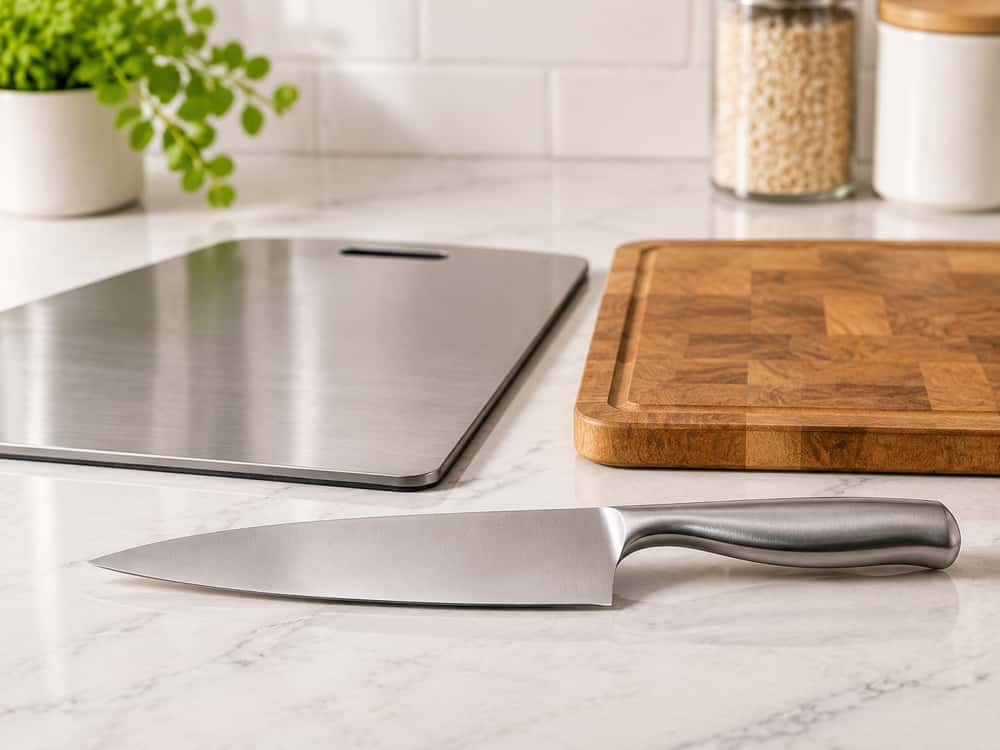
Quick Answer: Yes, stainless steel cutting boards can dull knives faster than wood or suitable plastic cutting boards.
The main issue is not simply that stainless steel is harder than knife steel. It is that metal provides a rigid, unyielding cutting surface with very little cushioning. Repeated contact can place extra stress on the knife's fine cutting edge, reducing sharpness over time.
Stainless steel can still be useful for certain food-preparation tasks, but it is generally not the best everyday cutting surface if preserving knife sharpness is a priority.
In this guide, we will explain why stainless steel can affect knife edges, which knives are more vulnerable, how it compares with other cutting board materials, and what buyers should consider when choosing a cutting board for everyday or commercial use.
1. Why Can Stainless Steel Cutting Boards Dull Knives?
To understand the problem, it helps to look at what happens when a knife makes contact with a cutting surface.
A kitchen knife does not cut with the entire blade. It cuts with an extremely fine edge, often referred to as the cutting apex. This narrow edge needs to remain properly aligned to slice food efficiently.
When a knife repeatedly strikes a rigid surface, the edge can experience impact stress. Depending on the blade steel, edge geometry, cutting force, and surface, the edge may gradually deform, roll, wear, or even chip.
The Importance of Surface Give
Wood, plastic, and rubber cutting boards have different levels of flexibility and surface give. They provide some cushioning when a knife reaches the end of a cut.
Stainless steel, by comparison, is rigid. It does not compress or yield in the same way. This means more of the impact is transferred back to the knife edge rather than being absorbed by the cutting surface.
Even if the stainless steel board itself is not harder than the knife blade, its rigid surface can still be tough on a very fine cutting edge. Material hardness is only one part of the explanation; the way the surface responds to impact also matters.
Important distinction: A cutting board does not need to be harder than a knife to contribute to edge wear. A rigid surface that offers little cushioning can still place repeated stress on the blade's cutting apex.
What Happens to the Knife Edge?
Repeated contact with a hard cutting surface can affect a knife in several ways:
- Edge deformation: The very fine edge may bend or roll slightly, making the knife feel less sharp.
- Edge wear: Repeated contact can gradually wear away the cutting edge.
- Micro-chipping: A thin or brittle edge may develop tiny chips under unfavorable impact conditions.
- Reduced cutting performance: A less effective edge may struggle with foods that require clean, precise slicing.
These effects do not happen at the same rate with every knife. A sturdy knife used occasionally with light pressure may experience a different result from a thin, finely sharpened knife used for frequent chopping.
2. What Does Testing Say About Metal Cutting Boards?
Independent product testing provides useful evidence beyond marketing claims.
In a 2026 review, America's Test Kitchen evaluated several metal cutting boards, including products sold as stainless steel and titanium. Testers used fresh knives for different food-preparation tasks, checked sharpness before and after use, and compared the results with a wooden cutting board.
Their testing found that the knives used on metal boards became noticeably duller after the preparation tasks. The knife used on the tested wooden board retained its sharpness much better. The reviewers ultimately did not recommend metal boards as everyday cutting surfaces.
Prudent Reviews also published comparative testing of stainless steel, titanium, wood, plastic, bamboo, composite, and rubber cutting boards. Its evaluation considered knife sharpness, cutting noise, and the overall cutting experience. Stainless steel and titanium performed poorly for knife-edge preservation compared with several softer materials.
What should readers take away? These tests support the conclusion that metal cutting surfaces can be harder on knife edges. However, the exact amount of wear should not be treated as universal. Results depend on the specific board, knife, testing method, and cutting technique.
For everyday cooking, the practical lesson is straightforward: if you want to maintain a sharp knife for longer, choose a more forgiving cutting surface.
3. Which Knives Are Most Affected by Stainless Steel Boards?
Not all kitchen knives respond to hard cutting surfaces in exactly the same way. Blade thickness, steel composition, heat treatment, hardness, and sharpening angle all influence edge durability.
Japanese Kitchen Knives
Many Japanese-style kitchen knives are designed with relatively thin blades and fine cutting edges. Some use harder steels and narrower edge angles to achieve precise slicing performance.
These characteristics can make them more sensitive to poor cutting surfaces and excessive impact. A rigid stainless steel board is therefore not a good everyday choice for high-performance Japanese knives, particularly when performing repeated chopping or rocking cuts.
German-Style Chef's Knives
Many German-style chef's knives have thicker blade profiles and are designed for versatile everyday use. Some are more tolerant of demanding kitchen tasks than very thin, delicate blades.
However, this does not mean they are immune to edge wear. Repeatedly cutting on stainless steel can still reduce sharpness and increase the need for maintenance.
High-Carbon Steel Knives
High-carbon steel knives can offer excellent sharpness and cutting performance, but their edge behavior depends heavily on the specific steel, heat treatment, and blade geometry.
A thin, hard edge may be vulnerable to chipping when used with excessive force on a rigid surface. Other high-carbon blades may be tougher and more resistant to damage. The steel category alone is not enough to predict performance.
| Knife Type | Potential Concern | Recommended Cutting Surface |
|---|---|---|
| Japanese-style knives | Fine edges may be more sensitive to impact and chipping. | Wood, rubber, or suitable plastic |
| German-style chef's knives | Repeated contact can still accelerate edge wear. | Wood, rubber, or suitable plastic |
| High-carbon steel knives | Edge durability varies with steel, heat treatment, and geometry. | A forgiving cutting surface suited to the blade |
| Everyday utility knives | Frequent use on rigid surfaces may increase maintenance needs. | Wood or suitable plastic |
For most quality kitchen knives, a wood, rubber, or suitable plastic cutting board is a better everyday partner than a stainless steel board.
4. Stainless Steel vs. Wood vs. Plastic Cutting Boards
Each cutting board material has different characteristics. The right choice depends on what matters most: knife care, cleaning, durability, handling, or the type of food being prepared.
| Feature | Stainless Steel | Wood | Plastic |
|---|---|---|---|
| Knife friendliness | Generally poor | Generally very good | Generally good |
| Surface flexibility | Very rigid | Some natural give | Varies by polymer and thickness |
| Moisture absorption | Nonporous | Can absorb moisture | Generally nonporous |
| Cleaning | Usually easy to wipe and sanitize | Requires appropriate care | Generally easy to wash |
| Resistance to deep knife grooves | High, although scratches can occur | Can develop cut marks | Can develop grooves over time |
| Cutting noise | Usually louder | Generally quieter | Generally quieter |
| Maintenance | Usually low | May require drying and oiling | Inspect and replace when excessively worn |
Stainless Steel Cutting Boards
Stainless steel offers a smooth, nonporous surface that does not absorb food liquids in the way some porous materials can. It is resistant to rust when an appropriate grade and finish are used and can be convenient for certain food-handling and preparation tasks.
However, it is not especially knife-friendly. Its rigid surface can also produce more noise during chopping, and some designs may slide on a countertop without effective anti-slip features.
Wooden Cutting Boards
Wood is widely used for everyday knife work because it offers a more forgiving cutting surface. Many cooks prefer wood for slicing vegetables, preparing meat, and maintaining the edge of quality kitchen knives.
Wood does require proper maintenance. It should be cleaned promptly, dried thoroughly, and cared for according to its construction and finish. Some boards also need periodic food-safe oiling.
Plastic Cutting Boards
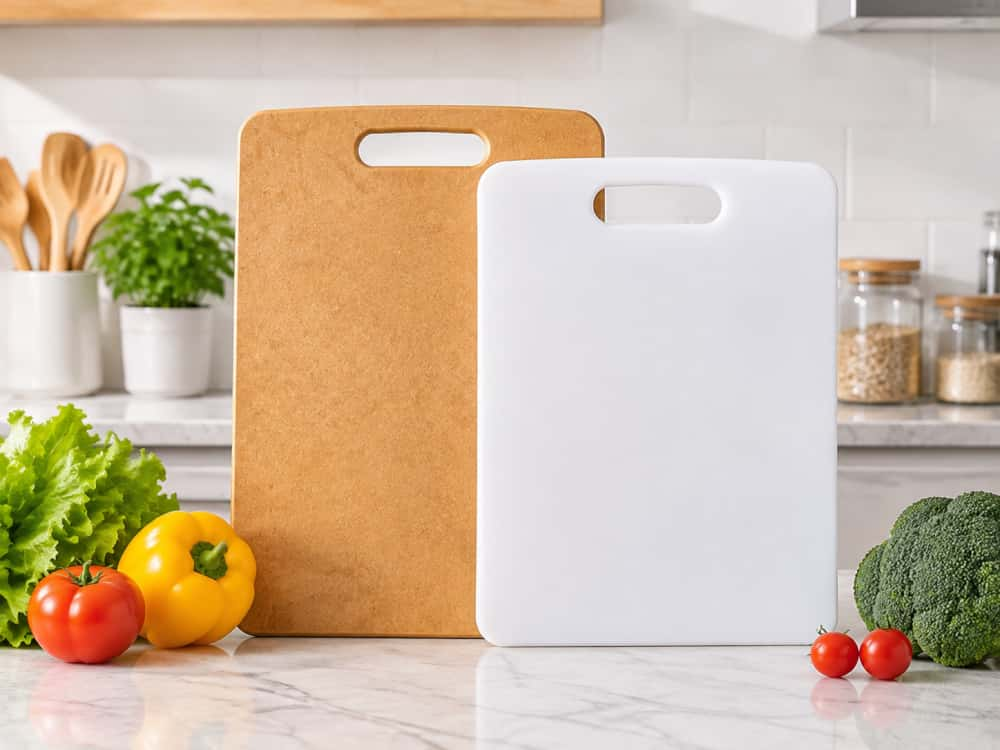
Plastic cutting boards, particularly those made from suitable food-contact polymers such as polyethylene or polypropylene, offer a practical balance between affordability, cleaning convenience, and knife friendliness.
They are common in home and commercial kitchens. However, repeated cutting can create grooves and scratches. Boards should be inspected regularly and replaced when they become excessively worn or difficult to clean effectively.
For more information about different board materials, explore our cutting board collection.
5. Can You Use a Stainless Steel Cutting Board Without Damaging Your Knives?
If you already own a stainless steel cutting board, you do not necessarily need to stop using it. The key is to understand its limitations and avoid using it for every cutting task.
Use It for Tasks That Require Less Knife Contact
A stainless steel board may be useful for ingredient staging, handling certain foods, or placing prepared ingredients. It can also serve as a work surface for tasks that do not involve repeated chopping with a sharp knife.
For frequent slicing, dicing, and chopping, a more forgiving board is usually the better option.
Avoid Heavy Chopping and Excessive Force
Do not strike the board with unnecessary force. Heavy chopping increases impact on the knife edge and can make an already rigid surface even less suitable for delicate blades.
Use controlled cutting movements and avoid treating a stainless steel board like a traditional wooden butcher block.
Do Not Scrape Food with the Sharp Edge
After cutting vegetables or other ingredients, many people use the knife blade to push food across the board. Repeatedly dragging the sharp edge sideways can contribute to edge wear.
Instead, turn the knife over and use its spine, or use a bench scraper to transfer ingredients.
Choose the Right Knife for the Task
If a stainless steel surface must be used, avoid making it the regular cutting surface for expensive, thin, or finely sharpened knives. A less delicate utility knife may be more appropriate for occasional light tasks, although it will still experience wear.
Maintain Your Knives Properly
Regular knife care helps maintain cutting performance. Honing can realign a slightly rolled edge, while sharpening removes material to create a fresh cutting edge when the blade has become worn.
These maintenance practices can help restore performance, but they do not eliminate the additional edge stress associated with rigid cutting surfaces.
6. Are Stainless Steel Cutting Boards Better for Hygiene?
One reason stainless steel cutting boards attract attention is their nonporous surface. Unlike materials that can absorb moisture, a properly finished stainless steel surface does not readily absorb food liquids.
It can be straightforward to wash and sanitize, and it does not develop deep knife grooves in the same way as softer plastic boards. These characteristics can be useful in some food-preparation environments.
However, a nonporous surface does not automatically kill bacteria or guarantee better food safety. Microorganisms can still remain on a surface if it is not cleaned and sanitized correctly.
Food safety depends on the complete cleaning process, correct sanitizing procedures, separation of raw and ready-to-eat foods, and proper handling practices.
For food-contact applications: Buyers should evaluate the stainless steel grade, surface finish, product construction, applicable food-contact requirements, and cleaning instructions. Avoid treating the term "stainless steel" alone as proof of food safety or regulatory compliance.
7. What Should Buyers Look for in a Stainless Steel Cutting Board?
For importers, wholesalers, retailers, and private-label brands, choosing a stainless steel cutting board involves more than comparing appearance or material claims.
Product design affects user experience, durability, safety, and long-term customer satisfaction. The following factors deserve attention during supplier evaluation and product development.
1. Stainless Steel Grade
Ask the manufacturer to specify the stainless steel grade rather than relying on a general description such as "premium stainless steel."
Common grades such as 304 and 316 have different corrosion-resistance characteristics. The appropriate choice depends on the intended environment, exposure to salts or acidic ingredients, product design, and target price point.
Request material documentation when the grade is important to your product specification.
2. Surface Finish and Edge Treatment
The surface should be consistent, smooth, and free from sharp burrs or manufacturing defects. Rounded corners and properly finished edges help improve handling safety.
Buyers should also understand that a polished surface does not make stainless steel more forgiving to knife edges. Surface appearance and knife friendliness are separate considerations.
3. Thickness and Structural Stability
Board thickness influences rigidity, weight, and handling. A very thin board may feel less stable or be more prone to bending, while a thicker design may be heavier and more expensive to ship.
The ideal specification depends on the intended product size, construction, countertop use, and target market.
4. Anti-Slip Design
A cutting board that moves during food preparation can create a safety concern. Buyers should evaluate whether the product includes silicone feet, an anti-slip backing, grip edges, or another effective stabilization feature.
Do not assume that a metal board will remain stable simply because it is heavy. Test it on common countertop materials under realistic conditions.
5. Functional Design and User Experience
Additional features can improve product usability, depending on the intended market:
- Rounded corners and smooth edges for safer handling.
- Handles or grip areas for easier lifting and storage.
- Anti-slip components for better countertop stability.
- Appropriate board dimensions for different kitchen tasks.
- Easy-to-clean construction with minimal dirt-trapping gaps.
- Suitable packaging to protect the surface during transportation.
For OEM and ODM projects, these details can help a brand create a product that meets the needs of a particular retail channel or customer group.
8. Should You Buy a Stainless Steel Cutting Board?
The answer depends on how you plan to use it.
A Stainless Steel Board May Suit You If:
- You prioritize a nonporous surface and easy surface cleaning.
- You need a board for ingredient staging or limited-contact preparation tasks.
- You want a metal surface that resists moisture absorption.
- You understand that it is not the best surface for preserving knife sharpness.
You May Prefer Wood, Rubber, or Plastic If:
- You frequently chop, slice, and dice ingredients.
- You own expensive or finely sharpened kitchen knives.
- You want a quieter and more comfortable cutting experience.
- You need an everyday cutting board for general food preparation.
For many kitchens, the most practical approach is to use different boards for different tasks. A wood or suitable plastic board can handle everyday knife work, while a stainless steel surface can serve more specialized preparation or staging needs.
9. Frequently Asked Questions
Do stainless steel cutting boards dull knives?
Yes. Stainless steel cutting boards can dull knives faster than wood or suitable plastic boards. Their rigid surfaces provide little cushioning when a knife edge makes contact, which can increase edge wear over repeated use.
Can a stainless steel cutting board chip a knife?
It is possible under unfavorable conditions, particularly when a thin or brittle edge is used with excessive force. The risk depends on the knife's steel, heat treatment, edge geometry, and cutting technique. Edge wear or loss of sharpness is a more general concern.
Is stainless steel worse than glass for knives?
Both are rigid cutting surfaces that are generally poor choices for preserving knife sharpness. Their exact effects depend on the surface and knife, but neither is recommended as a regular cutting board material for quality kitchen knives.
Are stainless steel cutting boards suitable for Japanese knives?
They are generally not recommended for regular use with Japanese knives, especially models with thin, finely sharpened edges. Wood, rubber, or suitable plastic boards are usually better options for protecting their cutting performance.
Are stainless steel cutting boards better than plastic boards?
Not in every respect. Stainless steel resists deep knife grooves and does not absorb moisture, while plastic is generally more forgiving to knife edges and often lighter to handle. The better option depends on whether cleaning convenience, knife care, durability, or cost is the main priority.
Can I use a stainless steel cutting board every day?
You can, but it may not be the best choice for everyday chopping and slicing if you want to preserve knife sharpness. Consider using it for selected preparation tasks and keeping a wood, rubber, or suitable plastic board for regular knife work.
Does stainless steel cutting board thickness affect knife sharpness?
Thickness mainly affects structural rigidity, weight, and stability. It does not turn a rigid metal surface into a knife-friendly cutting surface. A thicker board may feel more substantial, but it should not be assumed to protect knife edges like wood or rubber.
Final Thoughts
Stainless steel cutting boards have practical advantages, including a nonporous surface, moisture resistance, and convenient cleaning. However, their rigid construction makes them less suitable for regular knife work.
If maintaining knife sharpness is important, wood, rubber, or suitable plastic cutting boards are generally better everyday choices. Stainless steel can still have a place in the kitchen, but buyers should understand its limitations before choosing it as their primary cutting surface.
Ultimately, the best cutting board is not simply the one made from the most durable material. It is the one that balances food-preparation needs, knife care, cleaning requirements, safety, and long-term usability.
Looking for a Reliable Cutting Board Manufacturing Partner?
Choosing the right cutting board material and product design is essential for building a competitive kitchenware range. Whether you are developing a new product, expanding an existing collection, or sourcing customized cutting boards for your brand, our team can help you explore suitable materials, sizes, structures, and OEM/ODM options.
Contact us to discuss your product requirements and develop cutting board solutions for your target market.
Contact Our Team Explore CustomizationReferences and Further Reading
- America's Test Kitchen – Independent testing and evaluation of metal cutting boards, published in 2026.
- Prudent Reviews – Titanium and Stainless Steel Cutting Boards: Pros, Cons & Test Results.
- U.S. Department of Veterans Affairs – Knife Safety: Choosing a suitable cutting surface and maintaining knives.
Related Blogs