

Stainless Steel vs. Titanium Cutting Boards: Which Is Better for Your Kitchen?
Metal cutting boards have become increasingly popular among consumers looking for alternatives to traditional wood and plastic boards. Stainless steel and titanium are two materials attracting particular attention because of their nonporous surfaces, modern appearance, and resistance to moisture.
But when comparing stainless steel vs. titanium cutting boards, which material actually performs better? Is titanium worth the higher price? Does stainless steel offer better value? And most importantly, which one is better for everyday food preparation?
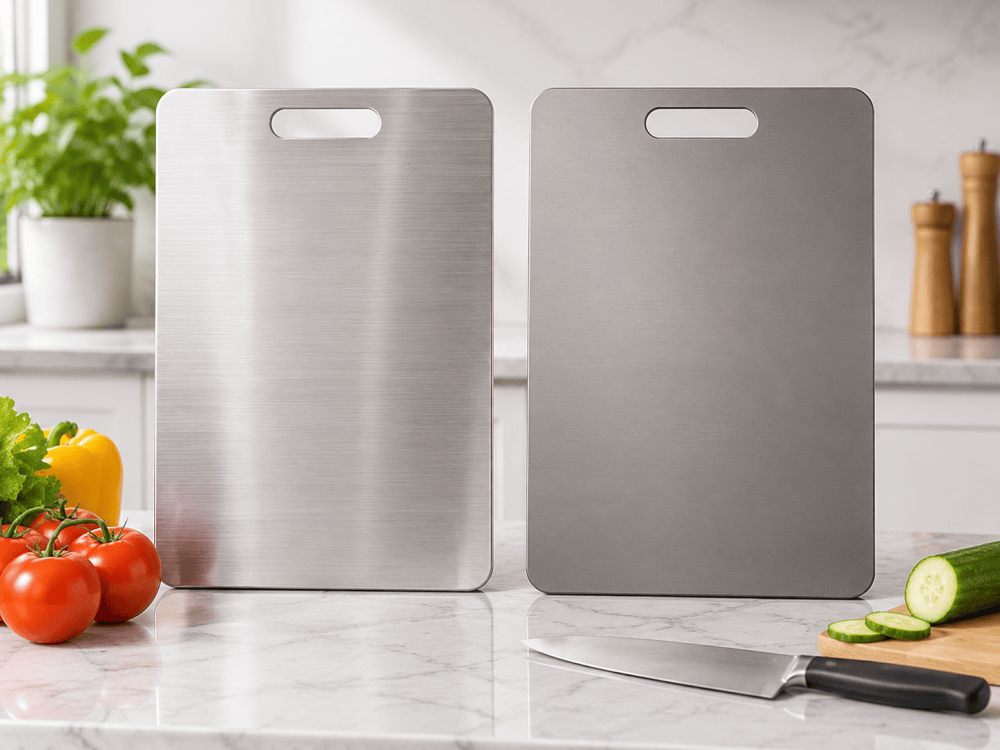
Quick Answer: Titanium is generally lighter and offers excellent corrosion resistance, while stainless steel is usually more affordable and widely available.
However, neither material is ideal for protecting knife sharpness. Both are rigid metal surfaces, and independent testing has found that knives can become dull faster on metal boards than on more forgiving materials such as wood or rubber.
If weight and corrosion resistance are your priorities, genuine titanium may be worth considering. If upfront cost and practical durability matter more, stainless steel may offer better value. For everyday chopping with quality knives, wood, rubber, or suitable plastic is generally a better choice.
In this guide, we compare the two materials in terms of construction, knife performance, durability, cleaning, weight, cost, and product sourcing. We will also explain what buyers should check before purchasing a product marketed as a titanium cutting board.
1. What Is a Stainless Steel Cutting Board?
A stainless steel cutting board is a food-preparation surface made from stainless steel sheet or plate. It may feature a brushed, polished, or textured finish, with different thicknesses and structural designs depending on the intended application.
Stainless steel is widely used in food-processing equipment, commercial kitchen surfaces, sinks, and food-contact components because of its corrosion resistance, durability, and ease of cleaning.
Common Stainless Steel Grades
Different stainless steel grades have different chemical compositions and performance characteristics. Two grades that buyers may encounter include:
- 304 stainless steel: A widely used austenitic stainless steel with good general corrosion resistance. It is commonly selected for kitchen equipment and food-contact applications.
- 316 stainless steel: Contains molybdenum, which improves resistance to certain forms of corrosion, especially in chloride-containing environments. It is often chosen for more demanding applications.
For many general kitchen applications, 304 stainless steel can be a practical material choice. Whether 316 is necessary depends on the intended environment, exposure conditions, product specifications, and cost requirements.
Advantages of Stainless Steel Cutting Boards
- Generally more affordable than solid titanium alternatives.
- Nonporous surface that does not readily absorb food liquids or odors.
- Good corrosion resistance when the appropriate grade and finish are used.
- Available in a wide range of thicknesses, dimensions, and designs.
- Relatively easy to clean and maintain.
Potential Disadvantages
- Heavier than a comparable titanium board of similar dimensions and construction.
- Rigid surface can contribute to faster knife-edge wear.
- May produce noticeable metallic noise during chopping.
- Can slide on countertops if the design lacks effective anti-slip features.
- May develop scratches, fingerprints, or surface marks during use.
2. What Is a Titanium Cutting Board?
A titanium cutting board is a metal food-preparation surface made from titanium or a titanium-based construction. It is often marketed as a lightweight, durable, and corrosion-resistant alternative to stainless steel.
Titanium is used in industries such as aerospace, chemical processing, and medical equipment because of its excellent strength-to-weight ratio and corrosion resistance. These properties also make it an interesting material for premium kitchen products.
Pure Titanium vs. Titanium-Coated Boards
One important detail is that not every product marketed as a titanium cutting board is made entirely from titanium.
There are two different constructions buyers may encounter:
- Solid titanium board: The board is made from titanium throughout its material thickness. Its exact properties depend on the titanium grade and manufacturing specification.
- Titanium-coated board: A base material, such as stainless steel or aluminum, has a titanium coating or surface treatment. The underlying material remains the main structural component.
These products should not be treated as equivalent. A coating may provide a particular surface appearance or functional property, but it does not make the entire board a solid titanium product.
Buyer tip: Before purchasing a titanium cutting board, ask the supplier to identify the exact material, grade, construction, and coating details. Request supporting material documentation when solid titanium is an important product claim.
Advantages of Titanium Cutting Boards
- Lower density than stainless steel, making comparable solid boards lighter.
- Excellent resistance to corrosion in many food-preparation environments.
- Nonporous surface that does not readily absorb moisture or odors.
- Does not require the oiling and drying routine associated with many wooden boards.
- Can support premium product positioning in certain retail markets.
Potential Disadvantages
- Usually more expensive than comparable stainless steel products.
- Still a hard, rigid surface that is not especially knife-friendly.
- Can develop visible scratches during normal use.
- Product authenticity and material claims may be difficult to verify without documentation.
- Limited product differentiation if the design and user experience do not justify the higher price.
3. Stainless Steel vs. Titanium Cutting Boards: Key Differences
Both materials offer the benefits of a nonporous metal surface, but their physical properties and commercial positioning are different.
| Comparison | Stainless Steel | Titanium |
|---|---|---|
| Material density | Higher | Lower |
| Weight at comparable dimensions | Generally heavier | Generally lighter |
| Corrosion resistance | Good to excellent, depending on grade and conditions | Excellent in many environments |
| Knife friendliness | Generally poor compared with wood or rubber | Generally poor compared with wood or rubber |
| Surface porosity | Nonporous | Nonporous |
| Cleaning | Generally easy | Generally easy |
| Surface scratching | Can develop scratches | Can develop scratches |
| Material cost | Generally lower | Generally higher |
| Product positioning | Practical and mid-range options | Premium and lightweight options |
The table shows the general differences between the materials. Actual product performance depends on the alloy or grade, board thickness, surface finish, manufacturing quality, and design.
4. Which Is Better for Knife Sharpness?
For many buyers, this is the most important comparison. A cutting board should provide a stable surface without unnecessarily wearing down the knife edge.
Unfortunately, neither stainless steel nor titanium has a clear advantage when it comes to protecting kitchen knives. Both are rigid metal surfaces, and neither provides the same cushioning effect as wood, rubber, or suitable plastic.
What Independent Testing Found
In September 2026, Prudent Reviews published a comparative test of titanium and stainless steel cutting boards alongside wood, plastic, bamboo, composite, and rubber boards.
The reviewer measured knife sharpness before and after repeated chopping and rocking cuts using a BESS edge tester. In that particular test, the titanium board produced a larger increase in the sharpness reading than the stainless steel board. The stainless steel board also caused substantial edge wear compared with several non-metal alternatives.
America's Test Kitchen also tested products sold as titanium and stainless steel cutting boards. Its August 2026 report noted that two of the three boards marketed as titanium in its test were actually stainless steel. The metal boards caused significant sharpness loss during food-preparation tasks.
These tests are useful evidence, but they should not be interpreted as proof that every titanium board will dull every knife more quickly than every stainless steel board. Product construction, blade geometry, cutting force, and test conditions all matter.
Practical conclusion: Do not choose titanium simply because it is a different metal from stainless steel. If knife-edge preservation is the priority, a suitable wood, rubber, or plastic cutting board is generally the better option.
Why Are Metal Boards Hard on Knife Edges?
A knife cuts with a very fine edge. When that edge repeatedly strikes a rigid surface, it can experience stress that causes deformation, wear, or micro-chipping.
Wood and rubber provide more surface give, helping reduce the impact associated with repeated cutting. Metal boards do not offer the same level of cushioning.
For cooks who regularly use Japanese knives, thin chef's knives, or finely sharpened blades, this difference is particularly important.
5. Which Material Is More Durable and Corrosion-Resistant?
Both stainless steel and titanium can provide long service life when the material and product design are appropriate. However, they achieve corrosion resistance in different ways.
Stainless Steel: Durable but Grade-Dependent
Stainless steel resists corrosion through a passive chromium-rich surface layer. The effectiveness of this protection depends on the alloy composition, surface condition, and exposure environment.
For example, 304 stainless steel offers good general corrosion resistance, while 316 stainless steel provides additional resistance to certain chloride-related corrosion conditions.
However, stainless steel should not be treated as completely rust-proof. Poor maintenance, surface contamination, unsuitable chemicals, and prolonged exposure to aggressive environments can still cause discoloration, pitting, or corrosion.
Titanium: Excellent Corrosion Resistance
Titanium forms a stable protective oxide layer that helps it resist corrosion in many environments. This is one reason it is used in demanding industrial and medical applications.
For a cutting board, this property can be attractive to buyers who want a durable metal surface with minimal corrosion-related maintenance.
However, excellent corrosion resistance does not automatically make titanium the better kitchen product. Buyers should also consider price, thickness, structural stability, surface finish, and the actual conditions in which the board will be used.
6. Which Cutting Board Is Easier to Clean?
Both stainless steel and titanium have nonporous surfaces. Neither material readily absorbs food liquids in the way some porous materials can, and both can generally be cleaned with ordinary kitchen cleaning methods.
Cleaning Stainless Steel Boards
- Wash with warm water and a suitable dish detergent.
- Use a soft sponge or non-abrasive cleaning tool for routine cleaning.
- Rinse away food residue and cleaning products thoroughly.
- Dry the board when appropriate to reduce water spots and surface marks.
- Follow the manufacturer's instructions for dishwasher use.
Cleaning Titanium Boards
- Wash with warm water and mild dish detergent.
- Remove food residue promptly, especially after preparing strongly colored or acidic ingredients.
- Avoid abrasive cleaning methods if the surface finish needs to be preserved.
- Check whether the product is dishwasher-safe according to its construction and manufacturer's instructions.
One important point: a nonporous surface does not automatically make a cutting board antibacterial or self-sanitizing. Food particles and microorganisms can still remain on a board if it is not cleaned and sanitized properly.
Food safety also depends on separating raw and ready-to-eat foods, using appropriate cleaning procedures, and following local food-handling recommendations.
7. Is Titanium Worth the Higher Price?
Titanium is generally more expensive than stainless steel as a raw material. Its lower density means a comparable solid board can weigh less, but the final product price also depends on material grade, thickness, manufacturing processes, finishing, and packaging.
Whether the extra cost is justified depends on what the buyer values.
When Stainless Steel Offers Better Value
Stainless steel may be the more practical choice when:
- The target retail price is a major consideration.
- The product needs to balance durability and affordability.
- The buyer wants a familiar metal material for a kitchenware range.
- Weight is not a major concern for the intended product size.
- The product is designed for general food preparation rather than a premium niche.
When Titanium May Justify Its Premium Positioning
Titanium may be worth considering when:
- Low weight is an important selling point.
- Excellent corrosion resistance is a priority.
- The product targets premium kitchenware consumers.
- The brand can clearly communicate and verify the material specification.
- The retail price can support the higher material and production costs.
However, a premium material alone does not guarantee a better user experience. Stability, handling, edge design, cleaning, and suitability for the intended cutting tasks still matter.
8. How to Identify a Genuine Titanium Cutting Board
Material transparency is particularly important when sourcing titanium cutting boards. Products with similar appearances may have very different constructions and costs.
Before placing an order, buyers should check the following information.
1. Confirm the Exact Material
Ask whether the product is made from solid titanium, a titanium alloy, or another metal with a titanium coating. The product description should not use these terms interchangeably.
2. Request Material Documentation
Ask for material specifications and supporting documentation that identify the grade and composition. If the supplier claims the product is made from commercially pure titanium, the documentation should support that claim.
3. Check Thickness and Weight
Request the actual board dimensions, material thickness, and finished product weight. These details help buyers compare products more accurately and assess shipping costs.
4. Evaluate Surface Finish and Edges
Check for consistent finishing, smooth corners, and the absence of sharp burrs. A premium metal board should be comfortable to handle and should not have unfinished edges.
5. Test the Complete Product
Do not evaluate the board based only on its material certificate. Test the finished product for countertop stability, handling, cleaning, surface scratches, and overall usability.
Important: A magnet test or weight comparison may provide clues about a metal product, but neither is sufficient to verify its exact composition. Proper material documentation or suitable material analysis is more reliable.
9. Stainless Steel vs. Titanium: Which Should You Choose?
There is no single winner for every kitchen. The better choice depends on the product's intended use, target price, customer expectations, and performance requirements.
| Your Priority | Better Option to Consider | Why |
|---|---|---|
| Lower purchase cost | Stainless steel | Generally more economical than solid titanium. |
| Lower product weight | Titanium | Lower material density can reduce finished board weight. |
| Corrosion resistance | Titanium | Excellent resistance in many environments. |
| General metal-board applications | Either, depending on specifications | Both offer nonporous metal surfaces. |
| Knife-edge preservation | Neither | Wood, rubber, or suitable plastic is generally better. |
| Premium lightweight positioning | Titanium | Can support a premium product proposition when material claims are verified. |
| Cost-conscious product range | Stainless steel | Offers more flexibility for price-sensitive product development. |
For most everyday home kitchens, a wood or suitable plastic cutting board remains a more practical choice for regular chopping and slicing. Metal boards are better evaluated as specialized products with specific advantages, rather than universal replacements for traditional cutting boards.
10. Frequently Asked Questions
Is titanium better than stainless steel for cutting boards?
Titanium is generally lighter and offers excellent corrosion resistance, while stainless steel is usually more affordable and widely available. Neither is clearly better in every category. The right choice depends on the intended use, budget, and product construction.
Do titanium cutting boards dull knives?
Yes. Titanium cutting boards are rigid metal surfaces and can contribute to knife-edge wear. Independent testing has reported significant sharpness loss when knives were used on titanium boards. Wood, rubber, and suitable plastic surfaces are generally more forgiving.
Are titanium cutting boards lighter than stainless steel?
Generally, yes. Titanium has a lower density than common stainless steel grades. For boards with comparable dimensions and solid construction, titanium can be significantly lighter. Actual product weight still depends on thickness, shape, and design.
Are titanium cutting boards rust-proof?
Titanium has excellent corrosion resistance and does not rust in the same way ordinary iron-containing materials do. However, product quality and surface condition still matter. Buyers should verify the actual material rather than relying only on marketing descriptions.
Are stainless steel cutting boards safe for food?
Appropriately specified stainless steel can be used for food-contact applications. Buyers should verify the grade, surface finish, construction, and applicable food-contact requirements. Proper cleaning and food-handling practices are still necessary.
What is the difference between solid titanium and titanium-coated cutting boards?
A solid titanium board uses titanium throughout its material thickness. A titanium-coated board has a different base material with a titanium surface layer. Their cost, construction, durability, and material claims are not equivalent.
Can titanium and stainless steel cutting boards go in the dishwasher?
Many metal boards are designed for dishwasher cleaning, but this should not be assumed for every product. Check the manufacturer's instructions, especially when the board includes coatings, bonded components, silicone feet, or other attached parts.
Which material is better for commercial kitchens?
Neither material is automatically the best option for every commercial kitchen. Buyers should consider cleaning procedures, knife use, product stability, food-contact specifications, durability, and total cost. Wood, rubber, and suitable plastic may be more practical for frequent chopping tasks.
Final Thoughts
Stainless steel and titanium cutting boards share several advantages: both offer nonporous metal surfaces, resistance to moisture absorption, and convenient cleaning. However, they differ in weight, corrosion resistance, material cost, and product positioning.
Titanium is an attractive option for premium, lightweight products, while stainless steel remains a practical choice for buyers who want a more economical metal cutting surface.
But neither material should be considered the ideal everyday cutting surface for preserving knife sharpness. If knife care is a priority, wood, rubber, or suitable plastic boards are generally better choices.
For consumers and product buyers alike, the best decision comes from looking beyond material claims and evaluating the complete product: construction, finish, stability, cleaning requirements, and the actual food-preparation tasks it is designed to handle.
Looking for Cutting Board Solutions for Your Kitchenware Range?
Choosing the right material is only one part of developing a competitive cutting board product. Dimensions, surface finish, thickness, edge treatment, packaging, and target-market requirements all influence the final product.
Whether you are sourcing standard cutting boards or developing customized kitchenware products, our team can help you explore suitable materials, product specifications, and OEM/ODM possibilities for your market.
Contact Our Team Explore CustomizationReferences and Further Reading
- Prudent Reviews – Titanium and Stainless Steel Cutting Boards: Pros, Cons & Test Results. Updated September 29, 2026.
- America's Test Kitchen – Should You Get a Metal Cutting Board? Metal cutting board testing, August 2026.
- University of California, Davis – Food Safety – Sanitary Design and Construction of Food Equipment.
Related Blogs