


Wood Fiber Cutting Board: Pros and Cons
Wood fiber cutting boards have become an interesting alternative to traditional wood and plastic cutting boards. Their engineered structure, firm surface, and modern appearance appeal to many home cooks and kitchenware buyers. But are they actually a good choice? Before buying one, it is important to understand both the advantages and limitations of this material.
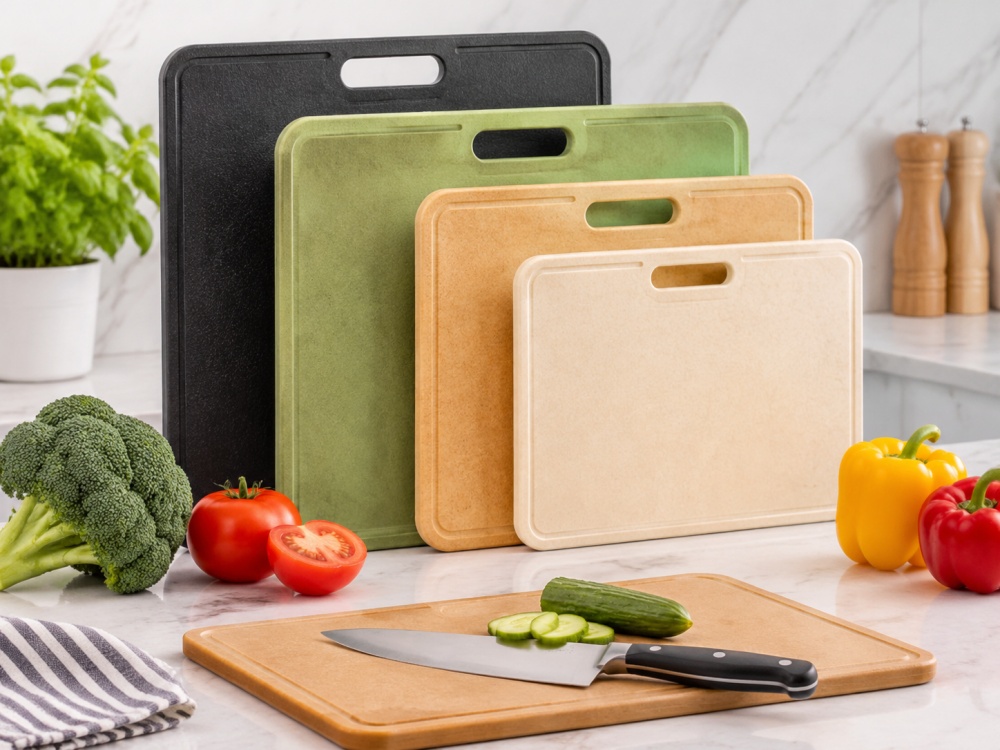
Wood fiber cutting boards can be a practical choice for users who want a firm, relatively uniform cutting surface and a slim, modern design. They can offer consistent dimensions and convenient storage. However, they may feel harder than some traditional wood boards, and their heat resistance, dishwasher compatibility, water resistance, and knife-friendliness depend on the specific material formulation and manufacturing quality. They are not automatically the best option for every kitchen.
- What Makes Wood Fiber Cutting Boards Different?
- Advantages of Wood Fiber Cutting Boards
- Disadvantages of Wood Fiber Cutting Boards
- Are Wood Fiber Cutting Boards Knife-Friendly?
- Are They Heat-Resistant?
- Are They Easy to Clean?
- Wood Fiber vs. Wood vs. Plastic
- What to Check Before Buying
- Frequently Asked Questions
1. What Makes Wood Fiber Cutting Boards Different?
A wood fiber cutting board is an engineered cutting surface made by combining processed wood fibers with a binding system and forming the mixture into a solid panel under controlled conditions.
Unlike a traditional wooden cutting board, which is generally made from solid pieces of timber, a wood fiber board uses processed fibers as its main structural component. This gives manufacturers more control over the finished panel's dimensions, thickness, and surface consistency.
Wood fiber cutting boards are also different from ordinary plastic boards. Although both can have a relatively uniform appearance, their material composition and manufacturing processes are not the same.
The term "wood fiber cutting board" does not describe one universal formula. Different products may use different fiber sources, binders, production conditions, and surface finishes. These differences can affect how a board performs in everyday use.
If you want to understand the material and manufacturing process in more detail, read our guide: What Is a Wood Fiber Cutting Board? Materials, Benefits, and Uses.
2. Advantages of Wood Fiber Cutting Boards
1. A Firm and Uniform Cutting Surface
One of the main characteristics of wood fiber cutting boards is their relatively consistent surface. The engineered structure helps manufacturers produce panels with uniform thickness and a predictable finish.
For everyday food preparation, a flat and firm surface can provide a stable working area for slicing vegetables, cutting fruit, and preparing other ingredients.
2. Slim and Space-Saving Design
Many wood fiber cutting boards are designed with a relatively slim profile. Compared with some thick wooden chopping blocks, they may take up less storage space and can be easier to place in kitchen drawers, cabinets, or board racks.
This is especially useful in smaller kitchens where storage space is limited.
3. Modern and Minimalist Appearance
Wood fiber cutting boards often have a clean, understated appearance. Their surfaces can look more uniform than natural wood grain, making them suitable for modern kitchen styles.
Depending on the manufacturer, they may be available in different colors, shapes, sizes, and edge designs. This flexibility can help brands develop coordinated kitchenware collections.
4. Consistent Dimensions for Product Collections
The engineered manufacturing process can help manufacturers maintain repeatable dimensions and product designs. This can be useful for retailers, distributors, and private-label brands that need consistent specifications across multiple SKUs.
For wholesale buyers, dimensional consistency, surface quality, and batch-to-batch performance are important factors to evaluate when selecting a supplier.
5. Suitable for Different Everyday Kitchen Tasks
Depending on the product's design and specifications, wood fiber cutting boards can be used for common food preparation tasks such as:
- Slicing fruits and vegetables.
- Chopping herbs and preparing ingredients.
- Cutting bread and sandwiches.
- Preparing cheese and other ready-to-eat foods.
- General food preparation on a kitchen countertop.
Some designs may also be suitable for serving bread, cheese, or snacks. Always check that the product finish is intended for direct food contact and serving use.
6. Potential for Flexible Product Customization
Wood fiber boards can offer opportunities for product customization, depending on the manufacturer's equipment and production capabilities. Possible options may include different dimensions, shapes, thicknesses, colors, edge details, and packaging.
This makes the category worth exploring for kitchenware brands that want to develop a distinctive product range rather than sell only standard cutting board designs.
3. Disadvantages of Wood Fiber Cutting Boards
Despite their practical features, wood fiber cutting boards also have limitations. Understanding these disadvantages is important before choosing one for everyday cooking or commercial product development.
1. The Surface May Feel Harder Than Traditional Wood
Wood fiber boards generally have a firm, compressed structure. Depending on the formulation and surface finish, the cutting surface may feel harder than some traditional wood boards.
This matters to users who prefer a softer cutting experience or place a high priority on preserving the sharpness of their knives.
2. Knife Marks Can Develop Over Time
Repeated cutting can leave visible marks on the surface. The amount of wear depends on the board's material, surface hardness, knife type, cutting pressure, and frequency of use.
Deep grooves may become more difficult to clean thoroughly. Inspect the board regularly and replace it if damage affects safe and hygienic food preparation.
3. Heat Resistance Is Not the Same for Every Product
Some wood fiber cutting boards are marketed for relatively high-temperature applications, but this does not mean every product can withstand the same level of heat.
The heat resistance of a board depends on its fiber composition, binding system, thickness, and manufacturing process. High temperatures may affect certain products through deformation, discoloration, or surface damage.
Do not use a wood fiber cutting board as a trivet or place hot cookware directly on it unless the manufacturer specifically confirms that the product is suitable for that purpose.
4. Dishwasher Compatibility Must Be Verified
Dishwasher suitability is a common question, but it should not be assumed based on the material name alone.
Dishwashers expose products to hot water, detergents, and repeated temperature changes. Depending on the board's construction, these conditions may affect its dimensions, surface, or bonding system.
Some products may be designed for dishwasher cleaning, while others require hand washing. Always follow the product-specific care instructions.
5. Material and Quality Can Vary Between Manufacturers
The term "wood fiber" does not guarantee a consistent material formulation across different brands. The type of wood fibers, binder, density, and production controls can vary.
As a result, two boards that look similar may perform differently in terms of durability, water resistance, heat tolerance, and surface wear.
For this reason, buyers should evaluate actual product specifications and test results rather than choosing solely by appearance or price.
Advantages
- Firm and relatively uniform surface
- Often available in slim designs
- Clean, modern appearance
- Consistent dimensions can support repeat orders
- Suitable for various everyday preparation tasks
- Potential for different shapes, sizes, and finishes
Disadvantages
- May feel harder than some wood boards
- Knife marks can develop with repeated use
- Heat resistance varies by product
- Dishwasher compatibility must be confirmed
- Material composition differs between manufacturers
- Quality cannot be judged by appearance alone
4. Are Wood Fiber Cutting Boards Knife-Friendly?
Knife-friendliness is one of the most important considerations when choosing a cutting board. A cutting surface that is too hard may contribute to faster knife edge wear, while a surface that is too soft may develop deep cuts more easily.
Wood fiber cutting boards have a firm engineered structure, so their effect on knife edges depends on the specific material and surface hardness. It is not accurate to claim that every wood fiber board is either completely knife-friendly or damaging to knives.
If preserving knife sharpness is a priority, consider the following:
- Check whether the manufacturer provides surface hardness or knife-use test information.
- Evaluate the board with the type of knives you normally use.
- Avoid excessive cutting pressure and unnecessary scraping with the blade edge.
- Keep knives properly sharpened and use an appropriate cutting technique.
For buyers developing a kitchenware collection, knife-friendliness is worth evaluating through practical testing rather than relying only on marketing claims.
5. Are Wood Fiber Cutting Boards Heat-Resistant?
Heat resistance can be an advantage of certain engineered wood fiber products, but it is not a universal property of all wood fiber cutting boards.
The temperature a board can tolerate depends on its specific formulation and construction. A product's stated heat limit should be supported by manufacturer specifications or relevant testing.
It is also important to distinguish between short-term heat exposure and repeated exposure to high temperatures. A board that tolerates a brief temperature change may not necessarily be suitable for prolonged contact with hot cookware.
Before purchasing, check:
- The manufacturer's stated maximum temperature, if available.
- Whether the board is intended for cutting only or also for use as a trivet.
- Whether repeated heating affects the board's shape or surface.
- Whether the product has been tested under conditions relevant to its intended use.
6. Are Wood Fiber Cutting Boards Easy to Clean?
Cleaning performance depends on the board's surface finish, material composition, and the condition of the cutting surface.
A smooth, well-finished board can be straightforward to wash after normal food preparation. However, deep knife grooves, cracks, or surface damage may make cleaning more difficult.
Recommended Cleaning Practices
- Remove food residue promptly after use.
- Wash according to the manufacturer's instructions.
- Use a suitable dishwashing detergent and a non-abrasive sponge when hand washing is recommended.
- Dry the board thoroughly before storage.
- Avoid prolonged exposure to moisture.
- Do not use dishwasher or high-temperature cleaning methods unless approved for the product.
For raw meat, poultry, and seafood preparation, follow food-safety guidance and clean the board thoroughly after use. Using separate boards for raw animal products and ready-to-eat foods can help reduce cross-contamination.
For a more detailed maintenance guide, read: How to Clean and Maintain a Wood Fiber Cutting Board.
7. Wood Fiber vs. Wood vs. Plastic Cutting Boards
Wood fiber, traditional wood, and plastic cutting boards each offer different benefits. The best choice depends on how the board will be used, how much maintenance the user is willing to perform, and which product characteristics matter most.
| Comparison Factor | Wood Fiber | Traditional Wood | Plastic |
|---|---|---|---|
| Material | Processed wood fibers with a binding system | Solid wood or joined wood pieces | Plastic polymers |
| Surface feel | Generally firm; varies by formulation | Varies by wood species and grain construction | Varies by polymer and surface finish |
| Appearance | Usually uniform and engineered | Natural grain and color variation | Wide range of colors and styles |
| Storage | Many models have a slim profile | Thicker models can require more space | Depends on board thickness and design |
| Maintenance | Follow product-specific instructions | Often needs careful drying and maintenance | Often easy to wash; dishwasher use depends on product |
| Customization | Depends on manufacturing capabilities | Depends on wood type and craftsmanship | Depends on molding and finishing capabilities |
| Best suited for | Users seeking an engineered wood-based surface | Users who prefer natural wood and traditional designs | Users seeking versatile, practical, often budget-friendly options |
There is no single material that is best for everyone. Traditional wood may appeal to cooks who value natural grain and a familiar cutting feel. Plastic is widely used for its variety of designs and accessible price points. Wood fiber boards offer an engineered alternative with a relatively uniform appearance and potentially space-saving design.
For a more detailed material comparison, see Wood Fiber vs. Wood Cutting Boards: What's the Difference? and Wood Fiber vs. Plastic Cutting Boards: Which Is Better?.
8. What to Check Before Buying a Wood Fiber Cutting Board
If you are considering a wood fiber cutting board, do not focus only on its appearance or advertised benefits. The following factors can help you evaluate whether a product is suitable for your needs.
Material Composition
Ask what type of wood fibers and binding materials are used. For products intended for food preparation, request relevant food-contact compliance information and supporting test reports.
Surface Quality
Check whether the surface is smooth, even, and free from visible cracks, rough patches, or manufacturing defects. Surface quality affects both appearance and everyday usability.
Thickness and Weight
Consider how the board will be stored and handled. A slim board may be convenient for compact kitchens, while a thicker board may provide a different level of rigidity and weight.
Size and Shape
Choose a size that matches your food preparation habits and countertop space. Common design considerations include rectangular or rounded shapes, reversible surfaces, hanging holes, and juice grooves.
Cleaning and Temperature Specifications
Confirm whether the product is dishwasher-safe and whether it has a stated temperature limit. These claims should be supported by product documentation or testing.
Long-Term Durability
Ask about resistance to surface wear, repeated cleaning, moisture exposure, and dimensional changes. For wholesale orders, sample evaluation and batch quality checks are especially important.
9. Who Should Choose a Wood Fiber Cutting Board?
A wood fiber cutting board may be a good option for people who prefer a firm, uniform cutting surface and a relatively slim design. It can also be attractive to kitchenware brands looking to expand their product collections with an engineered wood-based material.
It may be worth considering if you:
- Prefer a modern and minimalist kitchen appearance.
- Want a cutting board with a relatively slim profile.
- Need consistent product dimensions for a coordinated kitchenware range.
- Are exploring alternatives to traditional solid wood or plastic boards.
- Have confirmed that the product's material and care requirements suit your intended use.
However, if you strongly prefer a softer cutting surface, prioritize a specific natural wood appearance, or need a board with verified dishwasher compatibility, compare the relevant product specifications before making a decision.
10. Frequently Asked Questions
Are wood fiber cutting boards worth buying?
They can be worth considering if you want a firm, relatively uniform cutting surface and a slim, modern design. Whether a particular board is worth buying depends on its material quality, price, durability, and care requirements.
What is the biggest advantage of a wood fiber cutting board?
Its engineered structure can provide a relatively consistent surface and repeatable dimensions. Many designs also have a slim profile that is convenient for storage.
What is the biggest disadvantage of a wood fiber cutting board?
Its firm surface may not suit users who prefer softer cutting boards. In addition, heat resistance, dishwasher compatibility, and long-term durability vary between products and must be checked individually.
Do wood fiber cutting boards scratch easily?
Repeated knife use can leave marks on the surface. How visible or deep those marks become depends on the material formulation, surface finish, cutting technique, and frequency of use.
Are wood fiber cutting boards better than plastic boards?
Not necessarily. Wood fiber boards offer an engineered wood-based alternative, while plastic boards provide a wide range of designs and price points. The better choice depends on the user's priorities, product specifications, and maintenance preferences.
Can wood fiber cutting boards be used every day?
Yes, a wood fiber board designed for food preparation can be used for everyday kitchen tasks. Follow the manufacturer's instructions for cleaning, drying, and storage.
Are all wood fiber cutting boards dishwasher-safe?
No. Dishwasher compatibility depends on the board's composition and construction. Always check the specific product's care instructions.
How do I know if a wood fiber cutting board is food-safe?
Check the material specifications and request relevant food-contact compliance documentation for the exact product. Do not assume that every board marketed as wood fiber automatically meets the same requirements.
Final Thoughts
Wood fiber cutting boards offer a practical alternative to traditional wood and plastic boards, particularly for users who value a firm, uniform surface and a clean, modern design.
Their advantages include the potential for consistent dimensions, slim profiles, and flexible product designs. On the other hand, a firm surface may not appeal to every user, and important properties such as heat resistance, dishwasher compatibility, and durability vary depending on the material formulation and manufacturing process.
The best way to choose a wood fiber cutting board is to look beyond marketing claims. Understand the material, inspect the surface, check the care instructions, and evaluate the product according to how it will actually be used.
Explore Cutting Board Options for Your Kitchenware Collection
Looking to expand your kitchenware range with practical cutting board designs? Explore different materials, sizes, and product styles to find options that match your market and customer needs.
Kitlucy provides kitchenware product options for buyers, retailers, and private-label projects.
Explore KitlucyRelated Blogs


