


What Is a Wood Fiber Cutting Board? Materials, Benefits, and Uses
What Is a Wood Fiber Cutting Board? Materials, Benefits, and Uses
A wood fiber cutting board offers an alternative to traditional wooden and plastic cutting boards. Made from compressed wood fibers and a binding system, this type of board combines a wood-based appearance with a dense, engineered structure. It is often chosen for its relatively slim profile, firm cutting surface, and practical everyday use.
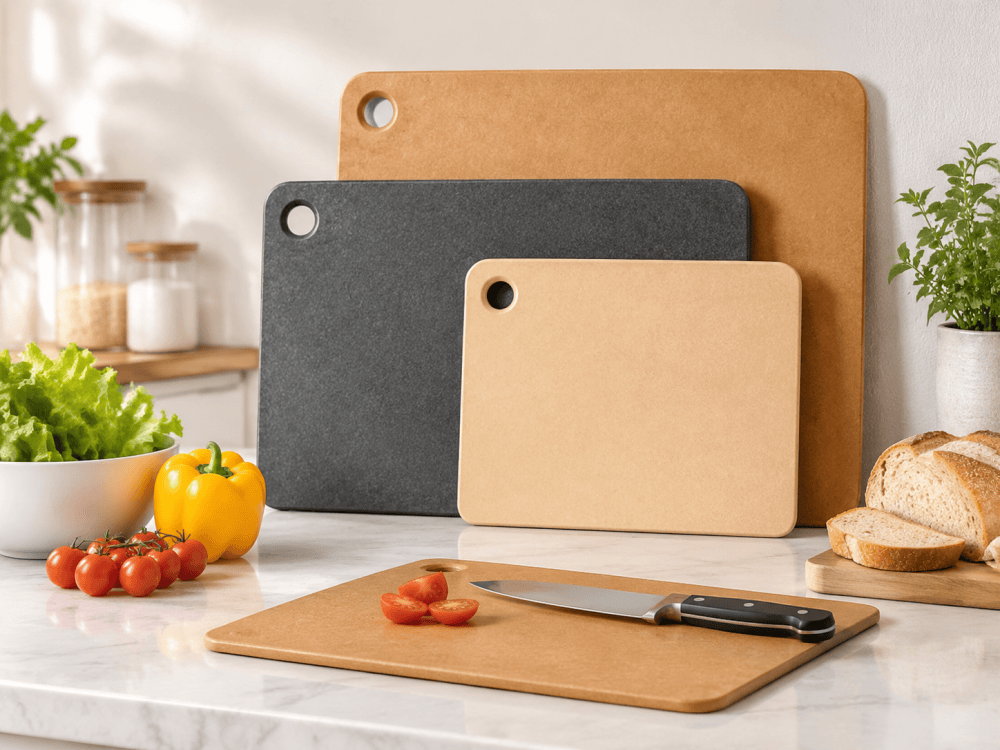
A wood fiber cutting board is an engineered cutting surface made by combining wood fibers with a binding material and compressing the mixture under controlled heat and pressure. Unlike a solid wood board, it is manufactured from processed fibers rather than a single piece of timber. Its actual durability, heat resistance, water resistance, and cleaning requirements depend on the materials and manufacturing process used.
- What Is a Wood Fiber Cutting Board?
- What Are Wood Fiber Cutting Boards Made Of?
- How Are Wood Fiber Cutting Boards Made?
- Key Benefits of Wood Fiber Cutting Boards
- Limitations to Consider
- Wood Fiber vs. Wood vs. Plastic Cutting Boards
- Common Uses in the Kitchen
- How to Choose a Wood Fiber Cutting Board
- Basic Cleaning and Maintenance
- Frequently Asked Questions
1. What Is a Wood Fiber Cutting Board?
A wood fiber cutting board is a type of composite kitchen cutting board manufactured from processed wood fibers. These fibers are combined with a suitable binding system and formed into a solid panel through heat and pressure.
The result is a dense, relatively uniform material that looks different from conventional solid wood. Rather than showing the natural grain structure of a single piece of timber, a wood fiber board has a more consistent surface and engineered composition.
Wood fiber cutting boards are sometimes grouped with composite cutting boards, but the term "composite" is broader. Composite boards can be made from different combinations of materials, while wood fiber boards specifically use wood-based fibers as a major component.
How Is It Different from a Traditional Wood Cutting Board?
A traditional wood cutting board is usually made by joining solid pieces of wood together. Depending on its construction, it may be an edge-grain or end-grain board. Its appearance, weight, and performance are influenced by the wood species and construction method.
A wood fiber cutting board, on the other hand, is made from processed fibers that are consolidated into a panel. This allows manufacturers to produce a more consistent thickness and surface, as well as a wider range of shapes and designs.
The two products are both wood-based, but they should not be treated as identical materials. Their performance depends on different manufacturing methods and product specifications.
2. What Are Wood Fiber Cutting Boards Made Of?
The exact composition of a wood fiber cutting board varies by manufacturer. In general, its construction involves wood fibers and a binding system, with possible additional processing or surface treatments.
Wood Fibers
Wood fibers are the main structural component. They are obtained through the processing of wood-based raw materials and prepared for consolidation into a dense panel.
Fiber preparation and distribution can affect the consistency, density, and appearance of the finished board. The type and quality of the raw material are therefore important considerations when evaluating a product.
Binding Materials
A binding material helps hold the fibers together and gives the finished board its structural integrity. Different manufacturers may use different resin or binder systems.
For food-contact applications, buyers should pay attention to the specific materials used and request relevant food-contact compliance documentation. The phrase "wood fiber" alone does not establish whether a particular product meets food-contact requirements.
Surface Finishing
The surface is an important part of the finished product. Depending on the manufacturing process, it may receive additional finishing to improve its smoothness, appearance, or usability.
When evaluating a wood fiber cutting board, look for a smooth, even surface without visible cracks, rough edges, or obvious manufacturing defects.
3. How Are Wood Fiber Cutting Boards Made?
Although manufacturing details vary, the general production process involves preparing wood fibers, combining them with a binding system, forming a panel, and finishing the final product.
- Raw material preparation: Wood-based raw materials are processed into fibers suitable for panel production.
- Fiber preparation: The fibers are prepared and distributed to achieve a suitable mixture and consistency.
- Mixing and binding: The fibers are combined with a binding material according to the manufacturer's formulation.
- Heat and pressure forming: The mixture is consolidated into a dense panel under controlled production conditions.
- Cutting and shaping: The panel is cut into the required dimensions and product shapes.
- Surface and edge finishing: The board is finished, inspected, and prepared for packaging.
Manufacturing conditions can influence the density, surface quality, dimensional stability, and overall performance of the finished board. For wholesale and private-label orders, it is useful to evaluate samples before confirming a bulk production specification.
4. Key Benefits of Wood Fiber Cutting Boards
Wood fiber cutting boards offer several practical characteristics that make them an option for modern kitchens. However, the benefits of an individual product should always be evaluated against its material specifications and test results.
1. A Firm and Consistent Cutting Surface
The compressed structure creates a relatively firm and uniform cutting surface. Compared with some natural wood boards, the surface may have fewer variations caused by natural grain patterns.
This consistency can be useful for everyday food preparation, particularly when users prefer a flat and stable board.
2. A Slim and Practical Design
Many wood fiber cutting boards feature a relatively slim profile. This can make them easier to store in kitchen cabinets, drawers, or dedicated board organizers.
For kitchens with limited storage space, a slim board can be a practical alternative to thicker, heavier wooden chopping blocks.
3. A Clean and Modern Appearance
Wood fiber boards often have a simple, understated appearance. Their relatively uniform surfaces can suit contemporary kitchen styles and a range of kitchen accessories.
Manufacturers may offer different shapes, colors, thicknesses, and edge designs, depending on the material and production capabilities.
4. Potential for Consistent Product Design
Because wood fiber boards are produced through an engineered manufacturing process, manufacturers can work toward consistent dimensions and repeatable designs.
This is useful for retailers and kitchenware brands that need coordinated product ranges, consistent specifications, and repeat orders.
5. Multiple Kitchen Applications
Wood fiber cutting boards can be designed for different food preparation tasks, including slicing vegetables, cutting fruit, preparing bread, and general kitchen work.
The appropriate applications depend on the board's surface properties, thickness, dimensions, and manufacturer instructions.
5. Limitations to Consider Before Buying
Wood fiber cutting boards are not automatically better than every wood or plastic alternative. Understanding their limitations helps consumers and buyers choose a suitable product.
Material Composition Varies
Not every wood fiber board uses the same wood fibers, binder, or manufacturing conditions. Products can therefore differ in water resistance, heat tolerance, surface durability, and food-contact suitability.
Surface Marks Can Develop
Like other cutting surfaces, wood fiber boards can develop knife marks through repeated use. The degree of visible wear depends on the material formulation, surface finish, knife type, and cutting habits.
Heat Resistance Has Limits
Some wood fiber boards are marketed for higher-temperature applications, but this should not be assumed for every product. Heat resistance depends on the complete material construction and product specifications.
A cutting board should not be used as a hot pan trivet unless the manufacturer explicitly states that it is suitable for that purpose.
Cleaning Instructions May Differ
Some products may be designed to tolerate dishwasher cleaning, while others may require hand washing. High temperatures, prolonged moisture exposure, and unsuitable cleaning methods can affect certain materials.
Always follow the care instructions provided for the specific board rather than assuming that all wood fiber cutting boards can be cleaned in the same way.
6. Wood Fiber vs. Wood vs. Plastic Cutting Boards
When choosing a cutting board, consumers often compare wood fiber with traditional wood and plastic. Each material has different characteristics, and the best choice depends on cooking habits, maintenance preferences, budget, and product quality.
| Feature | Wood Fiber | Traditional Wood | Plastic |
|---|---|---|---|
| Material structure | Compressed wood fibers and a binding system | Solid wood pieces or joined wood construction | Usually molded from plastic polymers |
| Appearance | Generally uniform and engineered | Natural wood grain and variation | Available in many colors and finishes |
| Thickness options | Often available in slim designs | Ranges from thin boards to thick blocks | Ranges from flexible mats to rigid boards |
| Surface feel | Generally firm | Varies by wood species and grain construction | Varies by polymer and surface finish |
| Maintenance | Follow product-specific care instructions | Often requires careful drying and periodic maintenance | Usually straightforward to wash |
| Customization | Depends on production process and manufacturer | Depends on wood species and craftsmanship | Depends on molding and finishing capabilities |
There is no single winner for every kitchen. Traditional wood boards appeal to users who value natural grain and classic craftsmanship. Plastic boards are popular for their accessible pricing and wide range of colors and shapes. Wood fiber boards offer another option for users who prefer an engineered wood-based surface with a relatively slim design.
For a more detailed comparison, see our related guide: Wood Fiber vs. Wood Cutting Boards: What's the Difference?
7. Common Uses of Wood Fiber Cutting Boards
Wood fiber cutting boards can be used for a variety of everyday food preparation tasks, provided the product is designed for the intended application.
Vegetable and Fruit Preparation
A wood fiber board can provide a firm surface for slicing vegetables, cutting fruit, chopping herbs, and preparing ingredients before cooking.
Bread and Bakery Preparation
A board with suitable dimensions can be used for slicing bread, portioning baked goods, and preparing sandwiches. A larger surface is useful when handling loaves or multiple ingredients.
Everyday Meal Preparation
For routine kitchen tasks, a medium-sized cutting board can provide a convenient surface for preparing ingredients such as onions, peppers, cheese, and other foods.
Serving and Presentation
Some wood fiber boards also have a design suitable for presenting bread, cheese, fruit, or snacks. However, serving suitability depends on the product's finish and food-contact specifications.
8. How to Choose a Wood Fiber Cutting Board
Not all wood fiber cutting boards are made to the same specifications. Before purchasing, consider the following factors to find a product that matches your kitchen needs.
1. Check the Material Specifications
Start by understanding what the board is made of. Ask about the wood fiber source, binding system, and any surface treatments. For food-contact products, request relevant compliance documentation and test reports.
2. Choose the Right Size
The size of the board should match the available countertop space and the type of food preparation. Smaller boards are convenient for fruit and quick tasks, while larger boards provide more room for vegetables, bread, and meal preparation.
3. Consider Thickness and Weight
A thinner board may be easier to store, while a thicker design may provide a different level of rigidity and handling. Buyers should consider both dimensions and actual product weight rather than evaluating thickness alone.
4. Inspect the Surface and Edges
Look for a smooth surface, consistent thickness, cleanly finished edges, and no visible cracks or delamination. A stable board should sit properly on the countertop during normal use.
5. Understand Cleaning and Heat Resistance
Check whether the board is suitable for dishwasher cleaning and whether it has a stated heat-resistance limit. These details should be confirmed through manufacturer specifications or relevant testing, not assumed from the material name.
6. Look at Practical Design Features
Depending on your preferences, useful features may include:
- Juice grooves for collecting liquids.
- Reversible surfaces for different preparation tasks.
- Rounded corners for easier handling.
- Hanging holes for convenient storage.
- Non-slip details for improved countertop stability.
- Different sizes and shapes for different kitchen applications.
9. Basic Cleaning and Maintenance
Proper cleaning and storage help maintain the condition of a wood fiber cutting board. Because products can differ in material composition, the manufacturer's instructions should always take priority.
Clean After Each Use
Remove food residue promptly and wash the surface according to the manufacturer's recommendations. Avoid leaving food particles or moisture on the board for extended periods.
Dry Before Storage
After cleaning, dry the board thoroughly before storing it. Keeping it in a well-ventilated location can help reduce prolonged moisture exposure.
Avoid Unapproved Cleaning Methods
Do not use abrasive cleaners, harsh chemicals, or high-temperature cleaning methods unless they are permitted by the product instructions.
Inspect the Board Regularly
Check for deep cuts, cracks, rough areas, warping, or separation in the material. If the board becomes difficult to clean or develops damage that affects food preparation, replace it.
For more detailed guidance, read our related article: How to Clean and Maintain a Wood Fiber Cutting Board.
10. Frequently Asked Questions
1. Is a wood fiber cutting board real wood?
It is made from wood-based fibers, but it is not the same as a solid wood cutting board. The fibers are processed and combined with a binding system to create an engineered composite material.
2. Are wood fiber cutting boards safe for food preparation?
They can be suitable for food preparation when manufactured with appropriate materials and verified for the intended food-contact application. Check the specific product's material specifications and compliance documentation rather than relying on the term "wood fiber" alone.
3. Do wood fiber cutting boards dull knives?
Knife wear depends on the hardness and surface characteristics of the board, as well as the knife steel and cutting technique. Wood fiber boards are generally firm surfaces, so buyers who prioritize knife edge retention should evaluate the specific product and test it with their intended knives.
4. Can wood fiber cutting boards go in the dishwasher?
It depends on the product's material formulation and heat resistance. Some products may be designed for dishwasher cleaning, while others may require hand washing. Always follow the manufacturer's care instructions.
5. Are wood fiber cutting boards heat-resistant?
Heat resistance varies by product. Some engineered wood fiber boards may tolerate higher temperatures than conventional wood products, but this should not be assumed for every board. Check the stated temperature limit before using one near hot cookware.
6. Can wood fiber cutting boards be used for raw meat?
Use them for raw meat only when the product is suitable for that application and can be cleaned according to appropriate food-safety practices. Separate boards for raw meat and ready-to-eat foods are a practical way to reduce cross-contamination risks.
7. What is the difference between a wood fiber and a composite cutting board?
Composite cutting board is a broad category covering boards made from combinations of materials. A wood fiber cutting board is a more specific type of composite board in which processed wood fibers form a major part of the structure.
8. How long does a wood fiber cutting board last?
Its service life depends on material quality, construction, frequency of use, cleaning methods, and maintenance. There is no universal lifespan that applies to every wood fiber cutting board.
Final Thoughts
A wood fiber cutting board is an engineered alternative to traditional wood and plastic cutting boards. Its compressed wood fiber structure, relatively uniform surface, and potential for practical, slim designs make it worth considering for modern kitchens.
However, the material name alone does not determine product quality. The fiber source, binding system, manufacturing process, surface finish, and verified food-contact performance all matter when evaluating a board.
Whether you are choosing a cutting board for everyday cooking or sourcing products for a kitchenware brand, understanding these factors will help you make a more informed decision.
Looking for Cutting Boards for Your Kitchenware Collection?
Choosing the right cutting board involves more than selecting a material. Size, thickness, surface finish, product design, and quality consistency all influence the final product.
Explore Kitlucy's kitchenware range to learn more about cutting board options for retail, wholesale, and product development projects.
Explore KitlucyRelated Blogs


