Color Coded Cutting Boards: What Each Color Means and How to Prevent Cross-Contamination
Color Coded Cutting Boards: What Each Color Means and How to Prevent Cross-Contamination
Color coded cutting boards are widely used in commercial kitchens, restaurants, food service operations, and home kitchens to help organize food preparation and reduce the risk of cross-contamination.
Instead of using the same cutting board for every ingredient, different board colors are assigned to specific food categories. This creates a simple visual system that helps food handlers remember which board should be used for raw meat, poultry, seafood, vegetables, dairy, and other food groups.
For example, a kitchen may use one board for raw meat and another board for fresh vegetables. This separation can help reduce the risk of transferring harmful bacteria from raw foods to foods that may be eaten without further cooking. USDA food safety guidance also recommends using separate cutting boards for fresh produce and for raw meat, poultry, or seafood whenever possible.
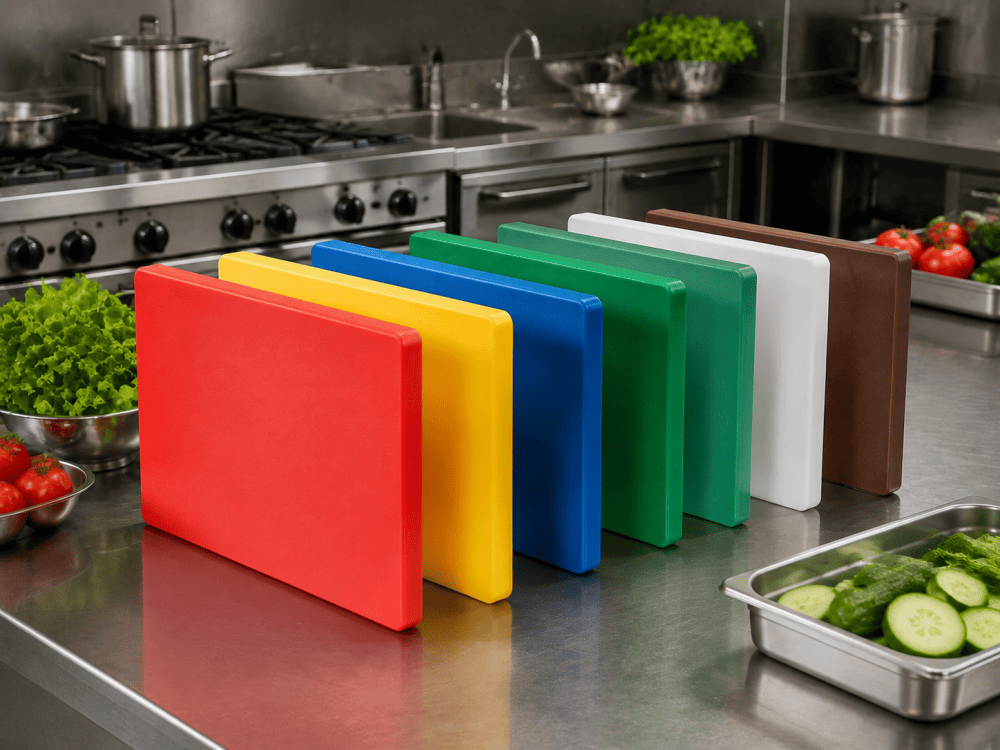
Color coded cutting boards are cutting boards in different colors that are assigned to specific food categories. The purpose is to make food preparation easier to organize and help reduce the risk of cross-contamination between raw and ready-to-eat foods.
What Are Color Coded Cutting Boards?
Color coded cutting boards are a set of cutting boards that use different colors to identify their intended food preparation purpose.
A typical commercial kitchen may use a system such as:
- Red for raw meat
- Yellow for raw poultry
- Blue for raw seafood
- Green for fruits and vegetables
- White for bakery or dairy products
- Brown for cooked meat
However, it is important to understand that there is no single mandatory U.S. color code assigned by USDA regulations for all cutting boards. Color coding is generally used as an operational food safety practice, and businesses may establish their own system as long as it is clearly implemented and followed consistently. :contentReference[oaicite:1]{index=1}
The most important point is not simply the color itself. The color system must be clear enough that kitchen staff know which board is assigned to which food category.
Why Are Color Coded Cutting Boards Important?
The main purpose of using different colored cutting boards is to make food separation easier during preparation.
Cross-contamination can occur when harmful bacteria from one food, cutting board, knife, utensil, or surface are transferred to another food. This is especially important when raw meat, poultry, eggs, or seafood come into contact with foods that are already cooked or ready to eat. :contentReference[oaicite:2]{index=2}
By assigning cutting boards to different food categories, commercial kitchens can create a clearer and more organized workflow.
1. Easier Food Separation
A color-coded system provides an immediate visual reminder of which cutting board should be used.
Instead of relying only on labels or staff memory, the color itself helps employees quickly identify the intended board.
2. Helps Reduce Cross-Contamination Risks
Using separate cutting boards for different types of food can help prevent raw food juices and bacteria from transferring to ready-to-eat ingredients.
USDA guidance recommends using one cutting board for fresh produce and another for raw meat, poultry, and seafood when possible. :contentReference[oaicite:3]{index=3}
3. Supports Staff Training
In busy commercial kitchens, employees may need to prepare multiple types of food at the same time.
A simple color system can make training easier and reduce confusion between workstations.
4. Improves Kitchen Organization
Color coding can also help create more consistent food preparation procedures.
For example, when employees see a green board at a vegetable preparation station, they immediately understand its intended use.
Color Coded Cutting Boards: What Does Each Color Mean?
The most commonly used cutting board color system assigns different colors to different food categories.
| Cutting Board Color | Common Food Category | Typical Use |
|---|---|---|
| Red | Raw Meat | Beef, pork, lamb and other raw meat |
| Yellow | Raw Poultry | Chicken, turkey and other poultry |
| Blue | Raw Seafood | Fish, shellfish and seafood |
| Green | Fruits and Vegetables | Fresh produce and salad ingredients |
| White | Bakery and Dairy | Bread, cheese and dairy products |
| Brown | Cooked Meat | Cooked and ready-to-serve meat products |
This six-color system is widely used as an industry practice, but kitchens should always follow their own documented food safety procedures and applicable local requirements. The specific colors are less important than using a clear, consistent system that employees understand. :contentReference[oaicite:4]{index=4}
Red Cutting Board: Raw Meat
A red cutting board is commonly assigned to raw meat preparation.
This can include:
- Raw beef
- Raw pork
- Raw lamb
- Uncooked steaks
- Other raw red meat products
Using a dedicated red cutting board helps keep raw meat preparation separate from foods such as vegetables, bread, or cooked ingredients.
After preparing raw meat, the board should be properly cleaned before being returned to use. Cleaning and sanitizing procedures should follow the kitchen's established food safety requirements.
Yellow Cutting Board: Raw Poultry
Yellow cutting boards are commonly used for raw poultry.
Typical ingredients include:
- Chicken
- Turkey
- Duck
- Other raw poultry products
Raw poultry should be kept separate from ready-to-eat foods and other ingredients that will not be cooked further. Using a dedicated yellow cutting board can help make this separation easier for kitchen staff to follow. :contentReference[oaicite:5]{index=5}
Blue Cutting Board: Raw Seafood
Blue cutting boards are commonly used for fish and seafood preparation.
They may be assigned to:
- Fresh fish
- Shellfish
- Shrimp
- Other seafood ingredients
Using a dedicated board for seafood can help reduce the risk of transferring raw seafood juices, bacteria, or strong odors to other food categories.
Green Cutting Board: Fruits and Vegetables
A green cutting board is commonly used for fresh fruits and vegetables.
This category may include:
- Leafy vegetables
- Fresh fruits
- Salad ingredients
- Herbs
- Ready-to-eat produce
Because many fruits and vegetables may be eaten without additional cooking, it is particularly important to keep them separate from raw meat, poultry, and seafood during food preparation.
FoodSafety.gov specifically recommends using separate cutting boards for fresh produce and for raw meat, poultry, seafood, and eggs. :contentReference[oaicite:6]{index=6}
White Cutting Board: Bakery and Dairy Products
White cutting boards are often assigned to bakery and dairy products.
Common examples include:
- Bread
- Pastries
- Cheese
- Other dairy products
In some kitchen systems, white may also be used for other ready-to-eat foods. For this reason, staff should always follow the specific color assignment used by their own food service operation.
Brown Cutting Board: Cooked Meat
Brown cutting boards are commonly used for cooked meat and prepared food products.
Typical uses include:
- Cooked beef
- Roasted meat
- Grilled meat
- Cooked poultry
- Prepared meat products
Separating cooked meat from raw meat is important because cooked or ready-to-eat foods should not come into contact with surfaces that may still carry contamination from raw ingredients. :contentReference[oaicite:7]{index=7}
Color coded cutting boards are a visual food preparation system, not a substitute for proper cleaning and sanitizing. A board must still be cleaned after use, and color coding should be combined with correct food handling procedures.
Are Color Coded Cutting Boards Required?
Color coded cutting boards are widely used in commercial kitchens, but the use of a specific six-color system is generally not a universal legal requirement.
Food safety regulations and operational requirements can vary depending on the country, state, local jurisdiction, and type of food service business.
Instead of requiring one specific cutting board color system, food safety programs focus on preventing cross-contamination, maintaining clean food-contact surfaces, and following proper sanitation procedures.
HACCP is a preventive food safety system designed to reduce food safety risks through appropriate food handling, monitoring, and record keeping. A color-coded cutting board system can be used as part of a broader operational procedure, but color coding itself should not be confused with the entire HACCP system. :contentReference[oaicite:8]{index=8}
Color Coded Cutting Boards in Commercial Kitchens
Color coded cutting boards are especially useful in busy food service environments where multiple employees may be preparing different ingredients at the same time.
They are commonly used in:
- Restaurants
- Hotels
- School kitchens
- Hospitals
- Catering facilities
- Central kitchens
- Food processing environments
- Supermarket food preparation areas
In these environments, visual organization can help employees follow established preparation procedures more consistently.
For example, a food preparation area may assign green boards to vegetables, red boards to raw meat, and blue boards to seafood. The boards can then be stored separately or placed at designated preparation stations.
How Color Coded Cutting Boards Help Prevent Cross-Contamination
One of the main benefits of color coded cutting boards is that they create a clear visual separation between different food preparation tasks.
For example, if raw chicken is prepared on a yellow board and fresh vegetables are prepared on a green board, kitchen staff can immediately recognize that these ingredients should not share the same food-contact surface during preparation.
This simple system can support safer food handling in several ways.
1. Creates Clear Separation Between Food Categories
Different food groups can carry different food safety risks. Raw meat, poultry, seafood, fresh produce, and ready-to-eat foods should be handled according to appropriate food safety procedures.
Using dedicated board colors helps employees separate these preparation tasks more easily.
2. Reduces Confusion in Busy Kitchens
In a commercial kitchen, employees often work quickly and may move between multiple preparation stations during a shift.
A color-coded system provides an immediate visual reference. Instead of reading labels or checking written instructions every time, employees can identify the correct cutting board by color.
3. Supports More Consistent Food Preparation Procedures
Consistency is important in professional food service operations. When every employee follows the same color system, kitchen procedures can become easier to standardize.
This can be particularly useful for:
- New employee training
- Multi-shift kitchens
- Large restaurant operations
- Central food preparation facilities
- School and institutional kitchens
4. Makes Food Safety Practices More Visible
Color coding turns food separation into a visible part of the kitchen workflow.
For example, employees may immediately notice if a raw poultry preparation station is using a board assigned to vegetables. This makes it easier to identify and correct potential workflow mistakes.
Color coding works most effectively when the same system is used consistently throughout the kitchen. Cutting boards, knives, utensils, storage areas, and preparation stations can also be organized according to the same food category system where appropriate.
Color Coded Cutting Boards and HACCP Food Safety Systems
Many commercial kitchens use color coding as part of their wider food safety procedures.
HACCP, which stands for Hazard Analysis and Critical Control Points, is a preventive food safety management approach designed to identify, evaluate, and control potential food safety hazards.
A color-coded cutting board system can support a broader HACCP-based workflow by making food categories easier to separate during preparation.
However, it is important to understand that color coding alone does not make a kitchen HACCP compliant.
A complete food safety system may also include:
- Proper employee training
- Cleaning and sanitizing procedures
- Temperature control
- Food storage procedures
- Separation of raw and ready-to-eat foods
- Equipment maintenance
- Documented operational procedures
For this reason, HACCP color coded cutting boards should be viewed as a practical visual tool that supports a larger food safety management system.
What Materials Are Used for Color Coded Cutting Boards?
Color coded cutting boards can be manufactured from several different materials. However, plastic materials are the most common choice for commercial color-coded systems because they are easy to clean, lightweight, and available in a wide range of colors.
The most common materials include:
- HDPE
- PP
- Other food-grade plastic materials
HDPE Color Coded Cutting Boards
HDPE, or High-Density Polyethylene, is one of the most commonly used materials for commercial plastic cutting boards.
HDPE cutting boards are popular because they offer a combination of durability, moisture resistance, and easy maintenance.
Common characteristics include:
- Low moisture absorption
- Good durability
- Lightweight handling
- Easy cleaning
- Availability in multiple colors
- Suitable for high-use food preparation environments
HDPE is commonly used for large commercial cutting boards and thicker chopping blocks where durability and stability are important.
PP Color Coded Cutting Boards
PP, or Polypropylene, is another widely used material for plastic cutting boards.
PP cutting boards can be designed for household kitchens, retail sets, food preparation applications, and customized kitchenware collections.
Common advantages of PP include:
- Lightweight construction
- Good moisture resistance
- Easy cleaning
- Flexible color customization
- Good suitability for multi-board sets
PP is particularly suitable for brands and retailers that want to create colorful cutting board collections with different sizes, shapes, and functional features.
HDPE vs PP Color Coded Cutting Boards
| Feature | HDPE | PP |
|---|---|---|
| Durability | High | High |
| Moisture Resistance | Excellent | Excellent |
| Weight | Lightweight | Lightweight |
| Color Customization | Good | Excellent |
| Commercial Applications | Very Common | Common |
| Retail Cutting Board Sets | Common | Very Common |
| Available Thickness Range | Wide | Wide |
The best material depends on the intended market, product positioning, thickness, design requirements, and expected frequency of use.
Commercial Color Coded Cutting Board Sizes
Color coded cutting boards are available in a wide range of sizes. The right size depends on the type of food preparation and the available workspace.
Smaller boards are useful for compact preparation areas, while larger boards provide more cutting space for high-volume food preparation.
| Board Size | Typical Application |
|---|---|
| Small | Compact kitchens and small food preparation tasks |
| Medium | General household and commercial food preparation |
| Large | Restaurants and high-volume food preparation |
| Extra Large | Commercial kitchens and specialized preparation stations |
For commercial use, buyers should also consider available counter space, storage systems, and the size of the food products being prepared.
How Thick Should a Commercial Cutting Board Be?
Thickness is another important factor when selecting commercial color coded cutting boards.
A thicker cutting board generally provides:
- Better stability
- Longer service life
- Higher resistance to warping
- A more solid cutting surface
However, thicker boards are also heavier and may require more storage space.
Thinner boards are easier to handle and store, making them suitable for lightweight retail sets and household kitchens.
For commercial applications, buyers should balance durability with daily handling requirements.
Color Coded Cutting Board Sets
Many retailers offer color coded cutting boards as complete sets rather than selling each board separately.
A typical color coded cutting board set may include multiple boards in different colors, allowing consumers or commercial kitchens to assign each board to a specific food category.
Common configurations include:
- 2-piece cutting board sets
- 3-piece cutting board sets
- 4-piece color coded sets
- 6-piece commercial color coded cutting board sets
Benefits of Selling Cutting Boards as a Set
For retailers and kitchenware brands, multi-board sets offer several advantages.
- Higher perceived product value
- Clear food safety positioning
- Easy product differentiation
- Suitable for gift and retail packaging
- Opportunity for branded color combinations
For consumers, buying a complete set makes it easier to implement a food separation system at home.
Additional Features for Color Coded Cutting Boards
Modern color coded cutting boards can include additional functional features to improve safety and convenience.
Non-Slip Edges
Non-slip feet, rubber edges, or TPR details can help improve stability during cutting.
This can be particularly useful in commercial kitchens where boards are used frequently throughout the day.
Juice Grooves
A juice groove around the edge of the cutting surface can help collect liquids from meat, fruit, and other ingredients.
This feature is commonly used on larger boards designed for carving and food preparation.
Easy-Grip Handles
Integrated handles can make cutting boards easier to lift, carry, and store.
For multi-board sets, handle designs can also help separate the boards when they are stacked together.
Hanging Holes
Some cutting boards include a hanging hole for vertical storage.
This can be useful for commercial kitchens, compact home kitchens, and retail product designs focused on easy storage.
Non-Porous Cutting Surfaces
Food-grade plastic cutting boards are often designed with low-absorption surfaces that simplify cleaning and maintenance.
However, cutting boards should still be inspected regularly for deep knife grooves, cracks, or excessive wear.
Are Color Coded Cutting Boards Better Than Regular Cutting Boards?
Color coded cutting boards are not necessarily better because of the color itself. Their main advantage is the food organization system that the different colors create.
A regular cutting board can still be safe when used, cleaned, and maintained correctly.
However, color coding can offer additional benefits when multiple food categories are being prepared.
| Feature | Regular Cutting Board | Color Coded Cutting Board System |
|---|---|---|
| Food Category Identification | Limited | Easy visual identification |
| Commercial Kitchen Organization | Depends on labels and procedures | More visually organized |
| Employee Training | Requires more verbal instructions | Simple visual reference |
| Multi-Food Preparation | May require additional labeling | Clear separation system |
| Retail Product Differentiation | Standard | Strong food safety selling point |
How to Choose the Best Color Coded Cutting Boards
When choosing color coded cutting boards, buyers should consider more than just the number of colors included in the set.
Important factors include:
- Material quality
- Food-contact compliance requirements
- Board thickness
- Non-slip performance
- Color consistency
- Knife friendliness
- Cleaning requirements
- Size and storage design
For Commercial Kitchens
Commercial buyers should focus on durability, easy identification, and compatibility with their established food safety procedures.
Useful considerations include:
- Heavy-duty construction
- Clearly distinguishable colors
- Consistent dimensions
- Easy storage
- Suitable thickness for frequent use
- Easy cleaning and sanitizing
For Retail and Household Markets
Retail products may focus more on lightweight construction, attractive colors, packaging, and multifunctional designs.
A household color coded cutting board set may also include:
- Compact storage holders
- Modern color palettes
- Knife sets
- Non-slip bases
- Integrated handles
How to Clean and Maintain Color Coded Cutting Boards
Color coded cutting boards should be cleaned and maintained regularly to help keep the color-coding system effective and the cutting surfaces in good condition.
After each use, food residue should be removed promptly and the board should be washed according to the material and manufacturer's care instructions.
Daily Cleaning Steps
- Remove visible food residue after use
- Wash the cutting board with hot water and suitable detergent
- Pay attention to handles, edges, and deep knife marks
- Rinse thoroughly
- Allow the board to dry completely before storage
In commercial kitchens, cleaning and sanitizing procedures should follow the operation's food safety requirements and local regulations.
When Should Color Coded Cutting Boards Be Replaced?
Even high-quality commercial plastic cutting boards eventually wear down after repeated knife use and cleaning.
A cutting board should be inspected regularly and may need to be replaced when it develops:
- Deep knife grooves
- Cracks or splits
- Warping that affects stability
- Persistent stains or odors
- Excessive surface wear
Color coding helps organize food preparation, but each board still needs proper cleaning and inspection. A board should not continue to be used simply because it is assigned to a specific food category if the surface has become excessively damaged.
How to Organize Color Coded Cutting Boards in a Commercial Kitchen
For the best results, color coded cutting boards should be incorporated into the overall kitchen workflow rather than simply stored as a mixed set of different colors.
A clear organization system can include:
- Dedicated storage racks
- Color-matched preparation areas
- Clear employee training materials
- Visible food category charts
- Separate cleaning procedures where required
Use a Consistent Color System
The same color should represent the same food category throughout the operation whenever possible.
For example, if a yellow cutting board is assigned to raw poultry, that meaning should remain consistent across all preparation areas.
Label Storage Areas
Storage racks or board holders can be labeled to help employees return each board to the correct location after cleaning.
This can be especially useful when multiple employees share the same preparation area.
Train New Employees
New staff members should understand what each color represents before beginning food preparation work.
Simple visual charts can help employees quickly learn the color-coded system.
Color Coded Cutting Boards for Restaurants
Restaurants are one of the largest application markets for color coded cutting boards.
Busy restaurant kitchens often prepare multiple types of ingredients during the same shift, including raw meat, poultry, seafood, vegetables, fruit, and ready-to-eat foods.
A color-coded cutting board system can help restaurant teams organize these tasks more clearly.
Benefits for Restaurant Kitchens
- Easy food category identification
- Clear preparation workflow
- Useful visual support for employee training
- Available in multiple sizes
- Suitable for replacement board programs
Restaurants may choose individual boards, complete color coded cutting board sets, or customized commercial cutting board systems based on their preparation requirements.
Color Coded Cutting Boards for Food Processing Facilities
Food processing facilities may require more specialized cutting board solutions than standard household kitchens.
Important requirements can include:
- Larger board dimensions
- Heavy-duty thickness
- Custom colors
- Specific material requirements
- Custom cutting and shaping
- Large-volume purchasing
For industrial applications, HDPE sheets and other food-grade plastic materials may be manufactured into customized cutting boards based on the dimensions and workflow requirements of the facility.
Color Coded Cutting Boards for Schools and Institutions
Schools, hospitals, catering facilities, and other institutional kitchens may also use color coded cutting boards as part of their food preparation organization.
These environments often involve:
- Large food preparation volumes
- Multiple kitchen employees
- Standardized procedures
- Regular staff training
Color coding can provide an easy visual reference across large kitchen teams.
Color Coded Cutting Boards for Home Kitchens
Color coded cutting boards are no longer limited to restaurants and commercial kitchens.
Many consumers now use multi-color cutting board sets at home to separate ingredients during daily cooking.
For example, a household may use:
- One board for raw meat
- One board for vegetables
- One board for fruit
- One board for cooked or ready-to-eat foods
Household cutting board sets often use more decorative or modern colors than traditional commercial systems.
This gives kitchenware brands an opportunity to combine food safety functionality with attractive product design.
Color Coded Cutting Boards for Retailers and Brands
For kitchenware retailers, wholesalers, and private-label brands, color coded cutting boards can offer a clear product positioning strategy.
Instead of selling a basic cutting board, brands can market a complete food preparation solution.
Possible Retail Product Configurations
- 2-piece cutting board sets
- 3-piece color coded cutting board sets
- 4-piece food separation systems
- Cutting board and knife sets
- Boards with storage holders
- Large commercial board sets
Private Label Customization Options
Depending on the manufacturer, color coded cutting boards may offer customization options such as:
- Custom board colors
- Custom sizes
- Custom thickness
- Custom logo printing or embossing
- Custom packaging
- Custom color combinations
- Non-slip edges and feet
- Juice grooves and handles
This flexibility makes color coded cutting boards suitable for supermarket brands, kitchenware retailers, hospitality suppliers, and professional food service distributors.
Common Mistakes When Using Color Coded Cutting Boards
Although color coding is simple, its effectiveness can be reduced if the system is not used consistently.
Using Different Meanings for the Same Color
If one area uses a red board for raw meat while another area uses red for a different food category, employees may become confused.
Kitchen operations should establish and maintain a consistent system.
Failing to Clean Boards Properly
A color-coded system does not replace proper cleaning and sanitizing procedures.
Every cutting board must still be cleaned according to the appropriate food safety procedures after use.
Using Excessively Worn Boards
Deep knife grooves and damaged surfaces can make cutting boards more difficult to clean and maintain.
Boards should be inspected regularly and replaced when necessary.
Assuming Colors Are Universal
One important consideration is that color meanings may vary between countries, organizations, and individual food service operations.
Always establish the color system being used and train employees accordingly.
Color Coded Cutting Boards vs Color Coded Knives
Many commercial kitchens use both color coded cutting boards and color coded knives.
Using matching colors can make the preparation system easier to understand.
| Equipment | Main Purpose |
|---|---|
| Color Coded Cutting Boards | Separate food preparation surfaces |
| Color Coded Knives | Help identify knives for different food categories |
| Color Coded Utensils | Support organized food handling |
| Color Coded Storage Areas | Improve workflow organization |
For brands and commercial suppliers, developing a complete color-coded food preparation system can create stronger product consistency across multiple kitchen tools.
How Manufacturers Produce Color Coded Plastic Cutting Boards
Plastic cutting boards can be manufactured using food-grade materials such as HDPE and PP.
Depending on the product design and production process, manufacturing may involve:
- Raw material preparation
- Color masterbatch selection
- Molding or sheet production
- Cutting and shaping
- Surface finishing
- Adding non-slip components
- Logo customization
- Quality inspection
- Packaging
Color Consistency
For commercial color coded cutting board sets, consistent colors are important because the colors serve a functional purpose.
Manufacturers should maintain consistent color matching across production batches where required.
Food-Grade Material Selection
Material selection should match the product's intended food-contact application and target market requirements.
Retailers and brands should discuss applicable food-contact requirements with their manufacturer based on the countries where the products will be sold.
Frequently Asked Questions About Color Coded Cutting Boards
What are color coded cutting boards used for?
Color coded cutting boards are used to visually separate different food preparation tasks. Different board colors can be assigned to different food categories to help organize kitchen workflows and reduce the risk of cross-contact.
What are the standard colors for cutting boards?
Common commercial systems often use colors such as red, yellow, blue, green, white, and brown. However, the exact food category assigned to each color may vary depending on the organization and food safety system being used.
Why are commercial cutting boards color coded?
Commercial cutting boards are color coded to make food category separation easier to identify visually, particularly in busy kitchens with multiple employees and preparation stations.
Are color coded cutting boards required in restaurants?
Requirements can vary depending on local regulations and individual food safety programs. Some kitchens use color coding as part of their internal food preparation procedures.
What material is best for color coded cutting boards?
HDPE and PP are commonly used materials for plastic color coded cutting boards because they are durable, moisture-resistant, lightweight, and available in different colors.
Can color coded cutting boards go in the dishwasher?
Dishwasher suitability depends on the material, thickness, size, and manufacturer's instructions. Buyers should always check the specific product care recommendations.
How often should commercial cutting boards be replaced?
There is no single replacement schedule for every board. Commercial cutting boards should be replaced when excessive wear, deep grooves, cracks, warping, or other damage affects their performance or cleanability.
Conclusion: Are Color Coded Cutting Boards Worth Using?
Color coded cutting boards provide a simple and practical way to organize food preparation.
By assigning different colors to different food categories, kitchens can create a clearer visual workflow for handling raw meat, poultry, seafood, vegetables, fruit, and ready-to-eat foods.
For commercial kitchens, restaurants, catering companies, schools, and food processing facilities, a consistent color-coded system can support employee training and organized food preparation.
For household kitchens, color coded cutting board sets offer a convenient way to separate ingredients while adding more organization and color to the kitchen.
The most important factor is consistency. A color coded cutting board system should be clearly defined, properly maintained, and combined with appropriate cleaning and food safety procedures.
Looking for Color Coded Cutting Board Solutions?
Kitlucy provides customizable cutting board solutions for kitchenware brands, retailers, wholesalers, and commercial buyers.
From PP and HDPE cutting boards to color-coded sets, custom sizes, private label products, and OEM kitchenware solutions, we support flexible product development for different markets.
Related Blogs