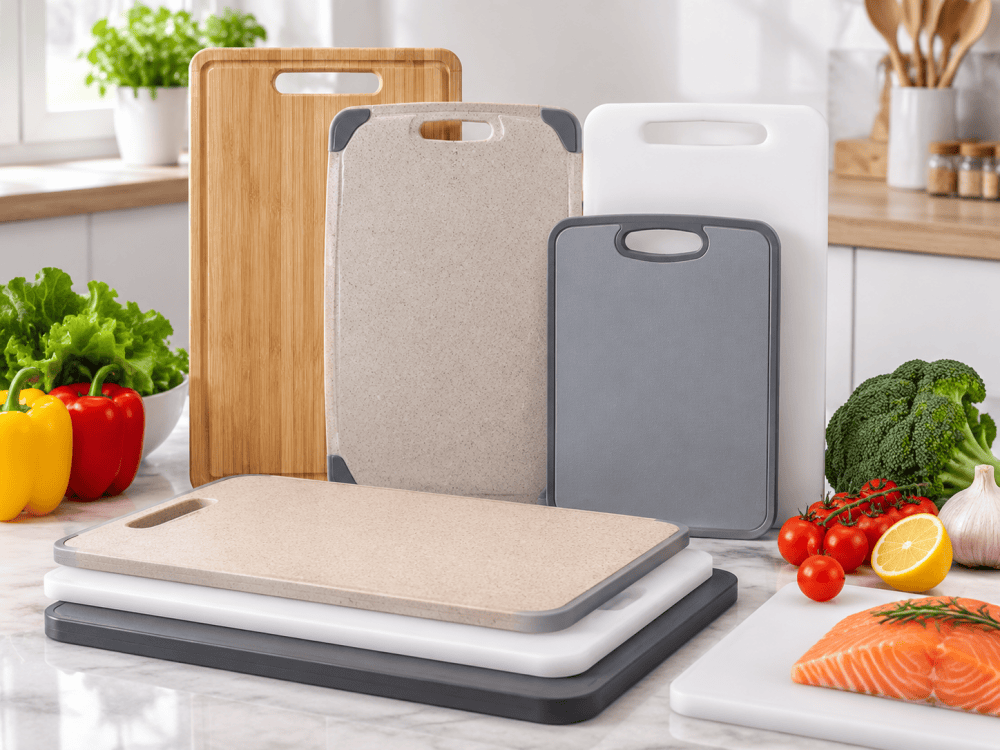
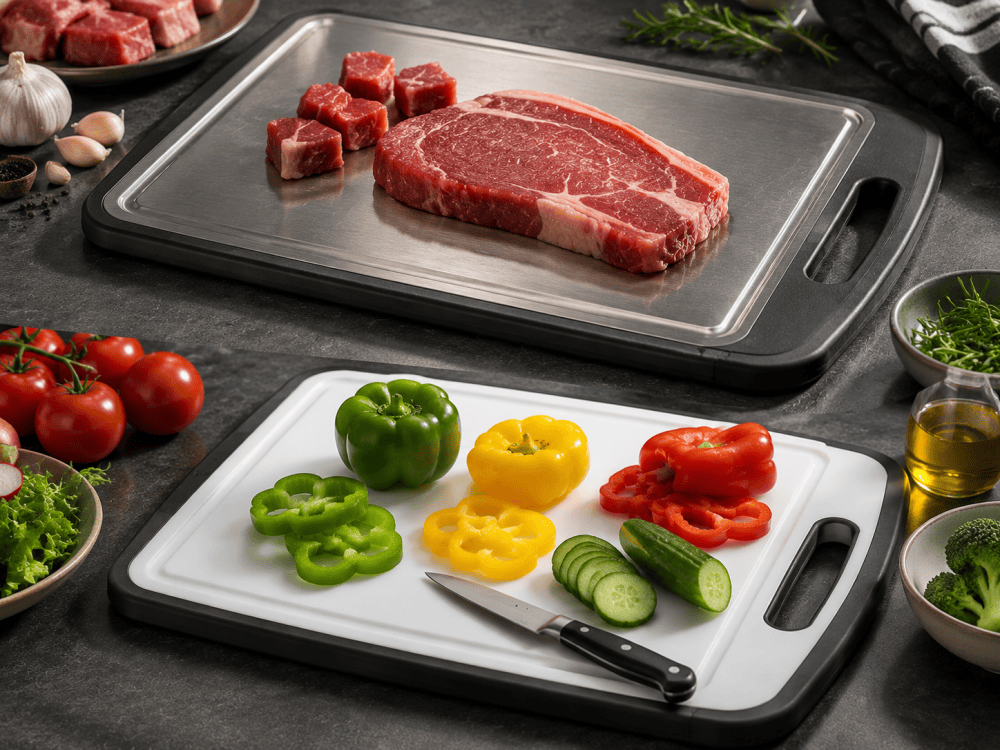
Commercial Plastic Standard Cutting Board: Sizes, Materials, Safety & Buying Guide
Commercial Plastic Standard Cutting Board: Sizes, Materials, Safety & Buying Guide
A commercial plastic standard cutting board is designed for restaurants, hotels, catering businesses, food preparation facilities, supermarkets, butcher shops, and other professional food-service environments.
Compared with ordinary household cutting boards, commercial plastic cutting boards are generally designed around higher demands for durability, sanitation, repeated cleaning, food preparation efficiency, and operational safety.
For businesses purchasing cutting boards in bulk, choosing the right material, size, thickness, color, and certification can have a significant impact on daily kitchen operations.
This guide explains what makes a commercial plastic cutting board different, why HDPE is widely used, what standard sizes are available, how HACCP color coding works, and what buyers should consider before placing a wholesale or OEM order.
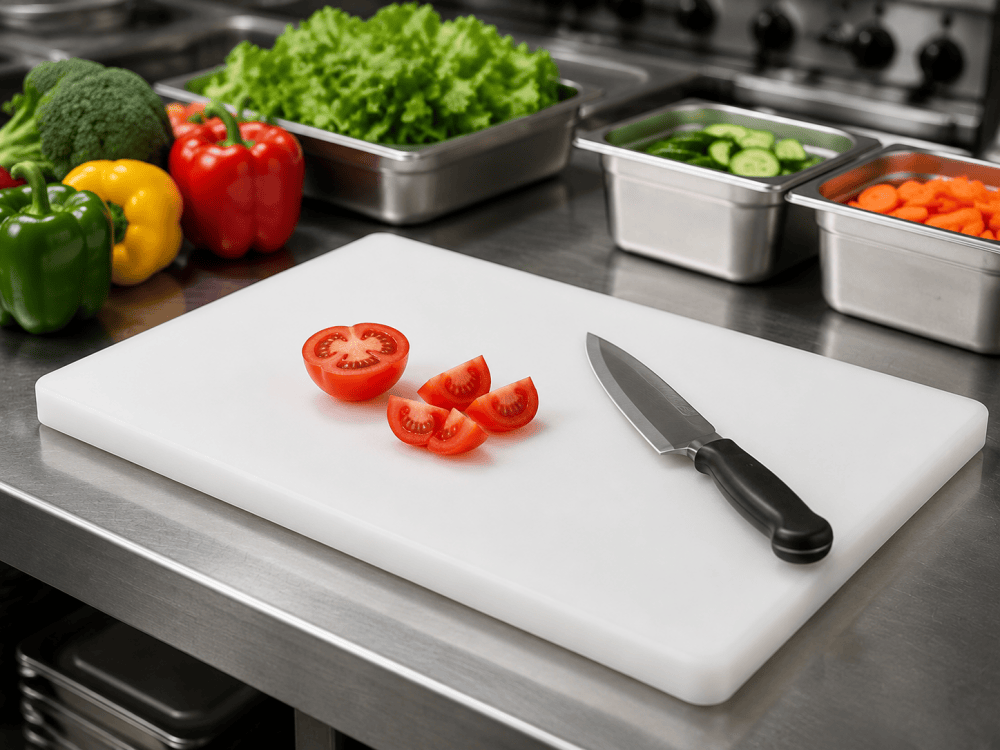
A commercial plastic standard cutting board is typically made from food-grade HDPE or another suitable food-contact plastic and is designed for repeated food preparation in professional kitchens. Compared with ordinary household boards, commercial models typically place greater emphasis on durability, sanitation, standardized sizing, color coding, and ease of cleaning.
What Is a Commercial Plastic Standard Cutting Board?
A commercial plastic standard cutting board is a professional-grade cutting surface manufactured for frequent food preparation and cleaning in commercial or institutional kitchens.
The term "standard" generally refers to commercially established dimensions and thickness options rather than one universal cutting board size.
For example, commercial suppliers commonly offer sizes such as:
- 12 × 18 inches
- 15 × 20 inches
- 18 × 24 inches
- 20 × 15 inches
- 24 × 18 inches
- Other metric and customized dimensions
Commercial suppliers also offer different thicknesses depending on the intended application. Common options include approximately 1/2 inch, 3/4 inch, and 1 inch, while specialized food-processing boards may be available in substantially thicker configurations.
There is therefore no single universal "standard cutting board size." Instead, commercial standard sizes are typically based on common kitchen workstations, storage requirements, equipment dimensions, and food-preparation tasks.
When comparing commercial cutting boards, do not evaluate size alone. Material, thickness, food-contact compliance, surface design, color coding, cleaning requirements, and intended application should all be considered together.
Why Are Plastic Cutting Boards Popular in Commercial Kitchens?
Plastic cutting boards are widely used in professional kitchens because they offer a practical combination of moisture resistance, durability, easy cleaning, and relatively low maintenance.
For high-volume food preparation environments, these characteristics can be more important than appearance or decorative design.
1. Moisture Resistance
Many commercial plastic cutting boards are made from non-porous or low-absorption materials. Unlike natural wood, plastic does not depend on wood fibers for its structure and is not affected by moisture in the same way.
This makes plastic particularly convenient for environments where boards are washed and sanitized repeatedly throughout the day.
2. Easy Cleaning
A smooth plastic cutting surface can be cleaned efficiently after preparing food.
This is particularly useful in restaurants and food-service operations where cutting boards may need to be washed between different preparation tasks.
3. Durable Construction
Commercial-grade plastic boards are designed for frequent chopping, slicing, and food preparation. HDPE is commonly selected because of its combination of durability, wear resistance, and suitability for food-contact applications.
4. Color-Coded Food Preparation
Commercial plastic cutting boards are often available in different colors to support food-preparation organization and cross-contamination control systems.
Common color-coding systems may include separate boards for raw meat, poultry, seafood, fruits and vegetables, and other food categories.
5. Standardized Sizing
Standard commercial sizes make it easier for restaurants and food-service businesses to purchase replacement boards, organize storage areas, and maintain consistent kitchen workflows.
What Material Is Used for Commercial Plastic Cutting Boards?
The material is one of the most important factors when selecting a commercial plastic cutting board.
Several plastics can be used for cutting boards, but HDPE is particularly common in professional food-preparation applications.
HDPE: High-Density Polyethylene
HDPE stands for High-Density Polyethylene. It is a widely used thermoplastic material for commercial food-preparation surfaces.
Commercial HDPE cutting boards are valued for characteristics such as:
- High durability
- Low moisture absorption
- Good chemical resistance
- Easy cleaning
- Relatively low weight compared with thick hardwood boards
- Suitable cutting performance for many kitchen knives
Commercial suppliers commonly offer HDPE boards in multiple sizes, thicknesses, and HACCP-oriented colors. :contentReference[oaicite:1]{index=1}
PP: Polypropylene
Polypropylene, or PP, is another plastic material used in food-contact kitchen products.
PP can provide good chemical resistance and a relatively lightweight construction, making it suitable for certain household and commercial applications.
However, buyers should evaluate the actual material specification and performance requirements rather than assuming that all plastic cutting boards perform identically.
UHMWPE and Other Specialized Plastics
Some commercial and industrial food-processing applications use higher-performance polyethylene materials such as UHMWPE.
These materials can be considered when wear resistance, impact resistance, or demanding processing conditions are important.
For most general restaurant applications, however, a properly specified food-grade HDPE board can provide a practical balance between performance and cost.
Commercial Plastic Cutting Board vs. Household Plastic Cutting Board
Not every plastic cutting board is designed for professional food service.
A household cutting board may prioritize appearance, compact storage, flexibility, or retail price. A commercial board generally needs to handle much more frequent use and cleaning.
| Feature | Commercial Plastic Cutting Board | Household Plastic Cutting Board |
|---|---|---|
| Intended Use | Restaurants and food service | Home kitchens |
| Material | Often HDPE or other commercial-grade plastic | PE, PP, HDPE and other plastics |
| Size | Standard commercial and custom sizes | Usually compact retail sizes |
| Thickness | Multiple heavy-duty options | Usually thinner |
| Color Coding | Commonly available | Optional |
| Certification | May include NSF/FDA-related compliance depending on product and market | Depends on manufacturer and market |
| Cleaning | Designed for frequent cleaning | Designed for normal household cleaning |
What Are Standard Commercial Cutting Board Sizes?
One of the most important questions for restaurant and food-service buyers is: what size commercial cutting board should I buy?
Commercial plastic cutting boards are available in a wide range of dimensions. Common market offerings include 18 × 12 inches, 20 × 15 inches, and 24 × 18 inches, while metric options and larger food-processing boards are also available. :contentReference[oaicite:2]{index=2}
| Common Size | Approx. Metric Size | Typical Application |
|---|---|---|
| 12 × 18 in | 305 × 457 mm | General food preparation |
| 15 × 20 in | 381 × 508 mm | Restaurant preparation stations |
| 18 × 24 in | 457 × 610 mm | Large commercial workstations |
| 20 × 15 in | 508 × 381 mm | General commercial preparation |
| 24 × 18 in | 610 × 457 mm | High-volume food preparation |
These dimensions are examples of commonly available commercial sizes rather than a universal industry standard. Suppliers may also provide custom dimensions for specific workstations and processing equipment.
How to Choose the Right Commercial Cutting Board Size
The largest cutting board is not necessarily the best choice.
Commercial buyers should select dimensions based on available counter space, the amount of food being prepared, storage capacity, and the type of ingredients handled.
Small Commercial Workstations
Smaller boards can be practical when counter space is limited or when the kitchen needs separate boards for multiple food categories.
Medium Preparation Areas
Medium-sized boards such as 15 × 20 inches or similar dimensions can provide a useful balance between workspace and storage.
Large Food Preparation Stations
Larger boards such as 18 × 24 inches can provide additional working area for high-volume preparation, large ingredients, meat processing, or bakery operations.
However, larger boards are also heavier and require more storage space, so buyers should consider the complete workflow before selecting an oversized board.
What Thickness Should a Commercial Plastic Cutting Board Be?
Thickness is another important consideration when choosing a commercial plastic cutting board. A thicker board generally provides greater rigidity and stability, while a thinner board is easier to handle, store, and transport.
Commercial cutting boards are available in different thicknesses depending on the intended application. Common options include approximately 1/2 inch, 3/4 inch, and 1 inch, while heavy-duty food-processing applications may require thicker boards.
| Approx. Thickness | Typical Use | Main Advantage |
|---|---|---|
| 1/2 inch | General restaurant preparation | Lightweight and easy to handle |
| 3/4 inch | Frequent commercial use | Good balance of stability and weight |
| 1 inch | Heavy-duty preparation | High stability and durability |
| 1 inch+ | Specialized food processing | Heavy-duty construction |
For most restaurants, thickness should be selected together with board dimensions. A large board does not necessarily need to be extremely thick if weight, storage, and handling are major considerations.
When comparing two commercial cutting boards with the same length and width, check the thickness and actual material specification before comparing price. A thicker board can require significantly more raw material and may provide greater stability during heavy food preparation.
Are Commercial Plastic Cutting Boards Food Safe?
Food safety is one of the most important considerations when purchasing a food grade plastic cutting board for professional kitchens.
A commercial cutting board should be manufactured from materials suitable for the intended food-contact application and target market. Buyers should also consider the complete product, including the plastic resin, additives, pigments, surface treatment, and manufacturing process.
HDPE and PP are commonly used in food-contact applications, but the term "food grade" should not be treated as a substitute for documented compliance.
What Should Commercial Buyers Check?
- Material specification
- Food-contact compliance documentation
- Applicable market regulations
- Manufacturing quality control
- Surface condition and finish
- Traceability of raw materials where required
For importers and distributors, the exact documentation required can vary depending on the destination market and the intended application.
FDA Compliance for Commercial Plastic Cutting Boards
Many buyers searching for a commercial plastic cutting board specifically look for FDA-compliant materials when sourcing products for the United States market.
It is important to distinguish between a material being suitable for a particular food-contact application and a finished product being marketed as "FDA certified." Compliance depends on the applicable requirements, material formulation, intended conditions of use, and supporting documentation.
For B2B procurement, buyers should ask suppliers for the relevant food-contact documentation instead of relying only on marketing descriptions.
If a cutting board is intended for the U.S. market, request documentation that supports the material's suitability for the intended food-contact application. For other markets, confirm the specific regulatory and testing requirements before production.
What Is an NSF Cutting Board?
NSF is an important consideration for many commercial food-service buyers, particularly in North America.
However, buyers should understand that not every plastic cutting board used in a restaurant is automatically NSF certified. Certification applies to specific products and manufacturers under applicable certification programs.
When a buyer specifically requires an NSF cutting board, the product should be verified through appropriate certification documentation rather than simply assuming that an HDPE board is NSF certified.
Why Does NSF Matter for Commercial Kitchens?
Commercial kitchens operate under stricter sanitation and food-handling requirements than ordinary household environments.
Third-party certification can help professional buyers evaluate whether a specific product meets the requirements relevant to its intended use.
For distributors and wholesalers, clearly documented certification can also make it easier to meet the purchasing requirements of restaurants, institutions, food-service operators, and other professional customers.
HACCP and Color-Coded Commercial Cutting Boards
Color coding is one of the most recognizable features of professional plastic cutting boards.
Restaurants and food-service businesses may use different colored boards to separate food categories and reduce the risk of cross-contamination during preparation.
Common color-coding systems may include:
| Color | Common Food Category |
|---|---|
| Red | Raw meat |
| Yellow | Raw poultry |
| Blue | Fish and seafood |
| Green | Fruit and vegetables |
| Brown | Cooked or prepared foods |
| White | Bakery or dairy products |
Color systems can vary between businesses and regions. Therefore, color should be treated as an organizational tool rather than a universal food-safety rule.
For commercial buyers, offering multiple colors can make a cutting board range more useful for restaurants implementing their own food-preparation procedures.
Commercial Plastic Cutting Board Cleaning and Sanitation
One major advantage of plastic cutting boards is their relatively straightforward cleaning and maintenance.
However, "easy to clean" does not mean that a cutting board does not require proper sanitation procedures.
Step 1: Remove Food Residue
Remove visible food particles from the cutting board as soon as possible after use.
Step 2: Wash the Surface
Wash the board using an appropriate detergent and warm water. Pay particular attention to knife grooves, edges, and corners where food residue may accumulate.
Step 3: Rinse Thoroughly
Rinse away detergent and remaining food residue before sanitizing according to the kitchen's established procedures.
Step 4: Sanitize When Required
Commercial food-service operations should follow their applicable sanitation procedures and use cleaning and sanitizing chemicals according to manufacturer instructions.
Step 5: Allow the Board to Dry
Proper drying helps reduce unnecessary moisture accumulation and makes boards easier to store hygienically.
The cleaning method should always be compatible with the specific cutting board material and the manufacturer's instructions. Do not assume that every plastic board has identical dishwasher, chemical, or temperature resistance.
Can Commercial Plastic Cutting Boards Go in a Dishwasher?
Whether a commercial plastic cutting board is dishwasher safe depends on its material, thickness, dimensions, construction, and manufacturer specifications.
Some commercial plastic boards are designed for repeated machine washing, while other products may have specific temperature or cleaning limitations.
Before placing a cutting board in a commercial dishwasher, buyers should verify:
- Material compatibility
- Recommended washing temperature
- Manufacturer cleaning instructions
- Board dimensions and dishwasher capacity
- Potential warping or deformation risks
For large-format boards, physical size can also affect whether they are practical for machine cleaning.
When Should a Commercial Plastic Cutting Board Be Replaced?
Even a durable commercial plastic cutting board will eventually show wear after repeated cutting and cleaning.
Replacement decisions should be based on the actual condition of the board rather than a fixed number of days or months.
Deep Knife Grooves
Repeated cutting creates grooves in plastic surfaces. Minor knife marks are normal, but excessively deep grooves can make cleaning and sanitation more difficult.
Cracks and Splits
Cracked boards should be evaluated carefully because damaged areas can affect structural integrity and cleanability.
Severe Warping
A significantly warped board may become unstable during cutting and may no longer sit securely on the preparation surface.
Persistent Odors or Staining
Strong persistent odors or staining may indicate that the board requires closer inspection or replacement, particularly when normal cleaning procedures are no longer effective.
A cutting board should remain stable, cleanable, and suitable for its intended food-preparation application. Replace boards when wear or damage prevents them from meeting those requirements.
Commercial Plastic Cutting Board vs. Wood Cutting Board
Both plastic and wood cutting boards are used in professional and household kitchens, but they offer different performance characteristics.
| Feature | Commercial Plastic | Wood |
|---|---|---|
| Moisture Resistance | High | Medium |
| Cleaning | Generally Easy | Requires More Care |
| Maintenance | Low | Medium |
| Knife Friendliness | Good | Good to Excellent |
| Color Coding | Easy | Less Common |
| Commercial Standard Sizes | Widely Available | Available |
| Customization | High | High |
| Typical Positioning | Commercial / Practical | Natural / Premium |
For restaurants that prioritize easy cleaning, standardized sizing, and color-coded food preparation, plastic can be a practical choice.
For premium kitchenware brands and consumers who value natural materials and appearance, hardwood cutting boards can provide a different product experience.
Commercial Plastic Cutting Board vs. Bamboo
Bamboo cutting boards are popular in consumer kitchenware because of their renewable-resource positioning and natural appearance.
However, bamboo boards and commercial plastic boards are designed around different product priorities.
| Feature | Plastic | Bamboo |
|---|---|---|
| Moisture Resistance | High | Medium |
| Maintenance | Low | Medium |
| Color Coding | Easy | Limited |
| Commercial Use | Very Common | More Limited |
| Natural Appearance | Low | High |
| Eco Positioning | Depends on material | Strong |
For high-volume commercial food preparation, plastic remains attractive because of its standardized manufacturing, moisture resistance, and practical sanitation workflow.
How to Choose the Right Commercial Plastic Standard Cutting Board
Choosing the right commercial plastic standard cutting board depends on more than size alone. Foodservice operators, distributors, and kitchenware buyers should consider material, thickness, color, cleaning requirements, and the type of food being prepared.
1. Choose the Right Plastic Material
For commercial food preparation, HDPE and PP are two of the most commonly considered plastic materials. HDPE is widely valued for its durability, moisture resistance, and relatively knife-friendly cutting surface.
PP can also be suitable for commercial and household applications where a lightweight and durable cutting board is required.
When sourcing commercial plastic cutting boards, ask the manufacturer to specify the exact plastic material, food-contact compliance, thickness, and intended application rather than relying only on general terms such as “food-grade plastic.”
2. Select the Appropriate Board Thickness
Thickness affects stability, weight, durability, and handling. A thicker commercial plastic standard cutting board generally provides better stability during repetitive food preparation, while thinner boards are easier to handle and store.
For professional kitchens, the ideal thickness should be selected according to the cutting frequency, work surface, storage requirements, and expected service life.
3. Consider Color-Coded Cutting Board Systems
Color coding is an important consideration for commercial food preparation. Different colors can be assigned to different food categories to help kitchen staff organize preparation tasks and reduce the risk of cross-contamination.
A commercial plastic standard cutting board can therefore be offered in multiple colors for applications such as:
- Raw meat preparation
- Raw poultry preparation
- Seafood preparation
- Fruit and vegetable preparation
- Ready-to-eat food preparation
For restaurant chains and foodservice distributors, standardized colors can also make kitchen procedures easier to communicate across multiple locations.
4. Look for Non-Slip and Practical Designs
Commercial cutting boards are frequently used during repetitive food preparation, so stability is an important part of product design.
Depending on the target market, buyers may consider features such as:
- Non-slip edges or feet
- Juice grooves
- Easy-grip handles
- Rounded corners
- Reversible surfaces
- Hanging holes for storage
These features can improve usability without changing the fundamental function of the cutting board.
Commercial Plastic Standard Cutting Board Maintenance
Even a durable commercial plastic cutting board requires proper cleaning and maintenance. Food particles can accumulate in knife grooves if a board is not cleaned thoroughly after use.
Clean the Board After Each Use
Wash the cutting board after food preparation using an appropriate cleaning method for the material and commercial kitchen environment. Pay particular attention to deep grooves, corners, and edges.
Separate Boards by Food Type
Using separate or color-coded boards for different food categories can help organize food preparation and reduce cross-contamination risks.
Inspect the Surface Regularly
Commercial cutting boards are exposed to repeated knife impact. Over time, deep cuts, cracks, warping, or excessive surface wear may affect usability.
When a board becomes heavily damaged and difficult to clean effectively, replacement should be considered.
Commercial Plastic Cutting Board vs Wood Cutting Board
| Feature | Commercial Plastic Cutting Board | Wood Cutting Board |
|---|---|---|
| Moisture Resistance | High | Medium |
| Cleaning | Generally Easy | Requires More Care |
| Commercial Use | Very Common | Application Dependent |
| Knife Friendliness | Good | Very Good |
| Color Coding | Easy | Limited |
| Customization | High | Medium |
| Cost Efficiency | High | Medium to High |
Plastic cutting boards are often attractive for commercial environments because they are lightweight, moisture-resistant, easy to clean, and available in standardized colors and sizes.
Wood cutting boards can provide a more natural appearance and pleasant cutting feel, making them attractive for premium kitchens and consumer-oriented products.
Commercial Plastic Standard Cutting Board for Wholesale Buyers
For wholesalers, distributors, and private-label kitchenware brands, commercial plastic cutting boards can be developed in a wide range of specifications to meet different market requirements.
Before placing a bulk order, buyers should evaluate:
- Plastic material and grade
- Board dimensions
- Thickness options
- Color requirements
- Surface texture
- Packaging specifications
- Food-contact compliance
- MOQ and production capacity
- Private-label and OEM capabilities
Why Standardization Matters for Commercial Buyers
Restaurants, catering companies, hotel groups, and foodservice distributors often need consistent products across multiple locations.
A standardized commercial plastic cutting board specification can simplify purchasing, inventory management, staff training, and product replacement.
For example, a buyer may establish a standard specification covering:
- Material: food-grade HDPE or PP
- Fixed board dimensions
- Specified thickness
- Color-coded options
- Standard packaging
- Consistent quality requirements
This approach can make large-scale procurement more efficient and reduce variation between different production batches.
Frequently Asked Questions
What is a commercial plastic cutting board?
A commercial plastic cutting board is a cutting surface designed for frequent food preparation in restaurants, foodservice operations, catering businesses, hotels, and other professional kitchen environments. Common materials include food-grade HDPE and PP.
What is the best material for a commercial plastic cutting board?
HDPE is one of the most widely used materials for commercial plastic cutting boards because it offers a balance of durability, moisture resistance, cleanability, and knife friendliness. PP can also be suitable for certain applications.
What size is a standard commercial cutting board?
There is no single universal size for every commercial kitchen. Standard dimensions vary according to the application, workstation, storage system, and food preparation requirements. Buyers should select dimensions based on the intended use rather than relying on one universal measurement.
Are commercial plastic cutting boards food safe?
Food-grade plastic cutting boards can be suitable for food preparation when they are manufactured from appropriate food-contact materials and meet the applicable requirements for the target market. Buyers should request relevant compliance documentation from the manufacturer.
Are plastic cutting boards good for commercial kitchens?
Yes. Commercial plastic cutting boards are widely used because they are moisture-resistant, relatively lightweight, easy to clean, and available in different sizes and colors for organized food preparation.
How often should a commercial plastic cutting board be replaced?
Replacement depends on usage frequency and surface condition. A board should be inspected regularly and replaced when deep grooves, cracks, warping, or excessive wear make it difficult to clean or maintain properly.
Can commercial plastic cutting boards be customized?
Yes. Depending on the manufacturer, commercial plastic cutting boards can be customized in dimensions, thickness, colors, shapes, packaging, branding, and other design specifications for wholesale and private-label programs.
Conclusion: Is a Commercial Plastic Standard Cutting Board Right for Your Business?
A commercial plastic standard cutting board can be a practical solution for restaurants, foodservice operators, hotels, catering businesses, wholesalers, and kitchenware brands looking for durable and easy-to-maintain food preparation products.
HDPE and PP are among the most common materials to consider, while factors such as thickness, size, color coding, surface design, and food-contact compliance can significantly affect the final product.
For commercial buyers, the best cutting board is not necessarily the thickest or most expensive option. The right choice should match the intended food preparation application, cleaning process, kitchen workflow, and purchasing requirements.
For wholesale and private-label projects, working directly with an experienced cutting board manufacturer can also help buyers develop standardized specifications, optimize production costs, and maintain consistent product quality across different orders.
Looking for Commercial Plastic Cutting Board Solutions?
Kitlucy provides professional plastic cutting board solutions for wholesalers, retailers, foodservice distributors, and private-label kitchenware brands. We support different materials, sizes, colors, designs, packaging, and OEM requirements for global markets.
Related Blogs