Edge Grain vs End Grain Cutting Board: Which Is Better?
Edge Grain vs End Grain Cutting Board: Which Is Better?
When choosing a wooden cutting board, shoppers often compare different wood species, thicknesses, and sizes. However, one of the most important differences is often overlooked: the direction of the wood grain.
Two of the most common constructions are edge grain and end grain. Although both can produce durable and attractive cutting boards, their grain orientation affects how the board performs under repeated knife use.
This leads to a common question: edge grain vs end grain cutting board — which one is better?
The answer depends on what you value most. Edge grain boards are generally simpler, more affordable, and easier to manufacture, while end grain boards are often thicker, more resilient to repeated knife impacts, and positioned as premium cutting boards.
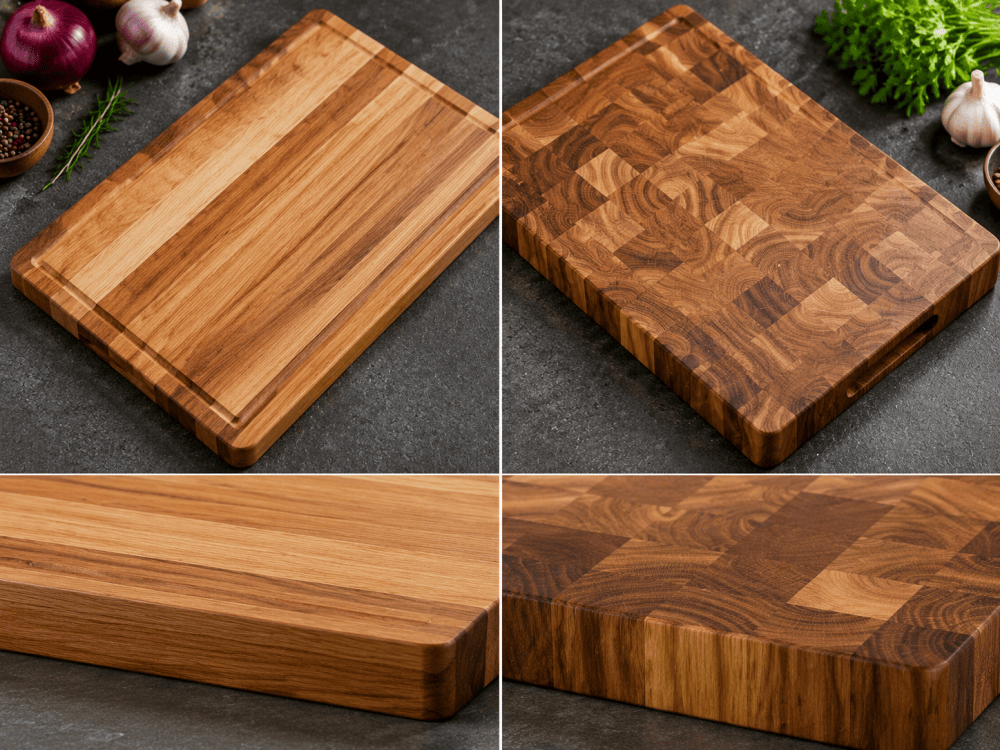
An edge grain cutting board is made with the long edges of wood strips facing upward, while an end grain cutting board is constructed with the cut ends of wood fibers facing the cutting surface. End grain generally provides better resistance to knife marks and is often preferred for premium, heavy-duty applications, while edge grain offers a practical balance of durability, price, and everyday usability.
What Is an Edge Grain Cutting Board?
An edge grain cutting board is constructed by arranging wood pieces so that the long, narrow edges of the wood face upward toward the cutting surface.
Instead of cutting directly across the ends of the wood fibers, the knife contacts the side of the grain. This creates a relatively stable and durable cutting surface while allowing manufacturers to produce boards efficiently from properly selected wood pieces.
How Edge Grain Construction Works
In an edge grain board, multiple strips of wood are typically glued together side by side. The grain runs predominantly along the length of each strip, with the edge of the wood forming the upper cutting surface.
This construction is different from an ordinary flat-sawn wooden board and from an end grain board, where the ends of the wood fibers are oriented toward the cutting surface.
The grain direction is important because knife impact interacts differently with wood fibers depending on how those fibers are positioned.
Characteristics of Edge Grain Cutting Boards
- Long grain direction is visible across the board
- Generally stable and durable for everyday cutting
- Usually less expensive than comparable end grain boards
- Available in many wood species, sizes, and thicknesses
- Suitable for everyday home kitchen preparation
- Can offer an attractive natural wood appearance
For many households, an edge grain board provides a good balance between performance and cost without requiring the higher investment associated with premium end grain construction.
What Is an End Grain Cutting Board?
An end grain cutting board is constructed so that the ends of the wood fibers face upward and form the primary cutting surface.
This is why end grain boards often have a distinctive checkerboard or block-like appearance. Individual pieces of wood are arranged so that their end surfaces become the working surface of the board.
When a knife contacts an end grain surface, the blade interacts with the ends of the wood fibers rather than cutting across the long sides of the fibers.
How End Grain Construction Works
Manufacturing an end grain board generally involves cutting wood into blocks or strips, rotating them so that the end grain faces upward, and then bonding the pieces together into a solid cutting surface.
This construction requires more processing and careful assembly than many edge grain designs. As a result, end grain cutting boards are commonly positioned at a higher price point.
Characteristics of End Grain Cutting Boards
- Wood fiber ends face the cutting surface
- Distinctive block or checkerboard appearance
- Designed to handle repeated knife impact
- Often thicker and heavier than standard boards
- Commonly positioned as premium kitchenware
- Usually requires a higher manufacturing cost
Edge Grain vs End Grain: What Is the Main Difference?
The most important difference between these two constructions is the orientation of the wood fibers on the cutting surface.
| Feature | Edge Grain | End Grain |
|---|---|---|
| Cutting Surface | Long side of wood grain | Ends of wood fibers |
| Appearance | Linear wood grain | Block or checkerboard pattern |
| Knife Impact | Good | Excellent |
| Resistance to Knife Marks | Good | Very Good |
| Typical Weight | Medium | Heavy |
| Manufacturing Complexity | Lower | Higher |
| Typical Price | Moderate | Premium |
| Typical Positioning | Everyday Kitchenware | Premium / Heavy-Duty Kitchenware |
Edge Grain vs End Grain Cutting Board: Why Does Grain Direction Matter?
Wood is a natural material made up of interconnected fibers. The direction in which those fibers are positioned influences how the material responds to cutting, pressure, moisture, and repeated impact.
When a knife is used repeatedly on a cutting board, the blade creates small cuts in the surface. The way the wood fibers respond to those cuts can affect the board's appearance, durability, and long-term maintenance requirements.
Edge Grain and Knife Interaction
With an edge grain cutting board, the knife contacts the long sides of the wood fibers. Repeated cutting can therefore leave visible knife marks over time.
However, a well-made edge grain board can still provide a durable and practical cutting surface for everyday food preparation.
End Grain and Knife Interaction
With an end grain cutting board, the blade contacts the ends of the wood fibers. The fibers can separate slightly around the knife edge rather than being cut across their entire length.
This is one reason end grain construction is often associated with reduced visible knife damage and improved resistance to repeated cutting.
Grain orientation is only one factor affecting cutting board performance. Wood species, board thickness, moisture content, construction quality, surface finish, and maintenance can also significantly influence durability and knife performance.
Are Edge Grain Cutting Boards Good?
Yes. An edge grain cutting board can be an excellent choice for everyday kitchen use, particularly when buyers want a durable wooden board without the higher price and weight of a thick end grain model.
Edge grain boards can be suitable for:
- Daily vegetable preparation
- Fruit and bread preparation
- General home cooking
- Meal preparation
- Kitchenware gift sets
- Mid-range retail collections
The main advantage is balance. An edge grain board can deliver many of the benefits associated with wooden cutting boards while remaining relatively accessible in terms of price and production.
Are End Grain Cutting Boards Better?
Not necessarily for every user. End grain boards can offer advantages in heavy-duty cutting and premium kitchen applications, but these advantages come with trade-offs.
End grain boards are typically:
- More expensive
- Heavier
- Thicker
- More complex to manufacture
- More demanding to move and store
For a professional cook or serious home chef who spends significant time preparing food and wants a premium cutting surface, these characteristics may justify the additional cost.
Edge Grain vs End Grain: Which Should You Choose?
There is no universal winner in the edge vs end grain cutting board comparison.
The better choice depends on the user's budget, cooking habits, available storage space, desired appearance, and expectations for cutting performance.
| If You Prioritize... | Recommended Construction |
|---|---|
| Affordable wooden cutting board | Edge Grain |
| Everyday home cooking | Edge Grain |
| Premium appearance | End Grain |
| Heavy-duty cutting | End Grain |
| Lower weight | Edge Grain |
| Premium gift market | End Grain |
Edge Grain vs End Grain Cutting Board: Detailed Performance Comparison
When comparing an edge grain cutting board with an end grain board, appearance is only the beginning. The more important differences appear during daily use.
For homeowners, chefs, retailers, and kitchenware buyers, the key factors usually include durability, knife friendliness, resistance to knife marks, moisture stability, maintenance, weight, and overall cost.
1. Durability and Long-Term Performance
How Durable Is an Edge Grain Cutting Board?
Edge grain boards can provide excellent durability when manufactured from a suitable hardwood and properly sealed and maintained.
Because the wood strips are arranged in a relatively simple structure, edge grain boards can maintain good dimensional stability during everyday use. However, repeated cutting can gradually create visible knife marks across the surface.
For normal household food preparation, this is usually not a major problem. A quality edge grain board can remain functional for many years with proper care.
How Durable Is an End Grain Cutting Board?
End grain construction is generally designed to handle repeated knife impact more effectively.
The vertical orientation of the wood fibers allows the cutting surface to absorb and distribute some of the force generated during chopping. This is particularly useful for users who frequently perform repetitive cutting tasks.
For this reason, end grain cutting boards are commonly positioned as premium, heavy-duty products.
Both constructions can be highly durable. Edge grain is a practical choice for everyday cooking, while end grain is often preferred when the board will receive frequent and intensive knife use.
2. Which Cutting Board Is Better for Knives?
Knife friendliness is one of the most important considerations in an end grain vs edge grain cutting board comparison.
A good cutting board should provide enough resistance for stable cutting without creating unnecessary stress on the knife edge.
Edge Grain and Knife Friendliness
Edge grain wood is generally considered a knife-friendly cutting surface, especially when made from suitable hardwoods and finished correctly.
However, because the knife cuts across the sides of the wood fibers, repeated cutting can gradually create more visible marks than on an end grain surface.
This does not mean an edge grain board is unsuitable for quality knives. It simply means that the cutting surface interacts differently with the blade.
End Grain and Knife Friendliness
End grain construction is often preferred by serious cooks because the wood fibers are oriented vertically toward the cutting surface.
This structure can provide a more forgiving cutting surface and may help reduce the visual impact of repeated knife cuts.
For expensive chef's knives, Japanese knives, and other frequently used high-quality blades, many users prefer end grain boards for this reason.
3. Which Board Shows Fewer Knife Marks?
Knife marks are inevitable on a wooden cutting board. The question is how quickly they become visible and how the board responds to repeated use.
In general, an end grain board can hide or accommodate knife marks better because of its fiber orientation.
An edge grain cutting board can also withstand repeated cutting, but the long grain surface may show scratches and knife marks more visibly over time.
| Surface Characteristic | Edge Grain | End Grain |
|---|---|---|
| Visible Knife Marks | Moderate | Lower Visibility |
| Repeated Chopping | Good | Excellent |
| Surface Recovery | Good with refinishing | Very Good with proper maintenance |
| Heavy-Duty Use | Good | Excellent |
4. Moisture Resistance and Stability
Wooden cutting boards naturally respond to changes in moisture. The amount of movement depends on the wood species, construction, thickness, grain orientation, and maintenance.
Neither edge grain nor end grain should be treated as completely waterproof. Both require appropriate care to minimize swelling, shrinking, cracking, and warping.
Edge Grain Moisture Performance
Edge grain construction can offer good dimensional stability when the board is properly manufactured and the wood has been adequately dried before assembly.
However, exposing the board to excessive water or allowing it to remain wet for extended periods can cause problems.
End Grain Moisture Performance
End grain boards can absorb moisture through the exposed fiber ends, which makes proper sealing and maintenance particularly important.
A high-quality end grain board should therefore be properly conditioned and regularly maintained to minimize moisture-related movement.
Regardless of grain construction, avoid soaking a wooden cutting board, leaving it in standing water, or placing it in a dishwasher unless the manufacturer specifically states that the product is dishwasher safe.
5. Edge Grain vs End Grain: Weight and Handling
Another practical difference is weight.
End grain cutting boards are commonly manufactured thicker to provide sufficient structural strength and a substantial cutting surface. This makes them stable on a countertop but also significantly heavier.
Edge grain boards can often be produced in thinner and lighter formats, making them easier to move, store, and handle.
| Handling Factor | Edge Grain | End Grain |
|---|---|---|
| Typical Thickness | Thin to Medium | Medium to Thick |
| Weight | Generally Lighter | Generally Heavier |
| Countertop Stability | Good | Excellent |
| Ease of Storage | Excellent | Moderate |
For smaller kitchens, apartments, and consumers who frequently move their cutting boards, a lighter edge grain model can be more convenient.
For users who prefer a stable, substantial cutting surface that stays firmly in place during heavy chopping, an end grain board may be more suitable.
6. Maintenance: Edge Grain vs End Grain
Both types of wooden cutting boards require maintenance. The construction does not eliminate the need for cleaning, drying, and periodic conditioning.
How to Maintain an Edge Grain Cutting Board
- Wash the surface promptly after use
- Do not leave the board submerged in water
- Dry both sides thoroughly
- Apply food-safe board oil when the surface becomes dry
- Use a food-safe conditioner when necessary
- Sand the surface if deep knife marks accumulate
How to Maintain an End Grain Cutting Board
- Clean the surface after every use
- Avoid prolonged exposure to water
- Allow the board to dry completely
- Regularly apply food-safe mineral oil or suitable board conditioner
- Keep both sides properly maintained
- Refinish the surface when significant knife marks develop
End grain boards can require more attention because their exposed fiber ends can interact more readily with moisture. However, proper maintenance can significantly extend the usable life of either construction.
7. Which One Is More Expensive?
Price is another major difference between edge grain and end grain cutting boards.
An edge grain board is generally simpler to assemble. Manufacturers can efficiently use long wood strips, resulting in lower material and processing costs.
End grain boards require additional cutting, alignment, bonding, sanding, and finishing. The manufacturing process is more labor-intensive, and thicker construction also increases material consumption.
| Cost Factor | Edge Grain | End Grain |
|---|---|---|
| Material Usage | Moderate | Higher |
| Manufacturing Complexity | Lower | Higher |
| Labor Requirement | Lower | Higher |
| Retail Price | Budget to Mid-Range | Mid-Range to Premium |
| Typical Market Position | Mass Market | Premium Market |
For retailers and kitchenware brands, this difference can be important when creating different price tiers within a cutting board collection.
8. Edge Grain vs End Grain for Different Wood Species
Grain construction should not be considered separately from wood species. The same construction can perform differently depending on the hardness, density, stability, and working characteristics of the wood.
Maple
Maple is commonly used for both edge grain and end grain cutting boards. It provides a relatively hard and durable surface while maintaining good suitability for knife use.
Walnut
Walnut is popular in premium cutting boards because of its darker color and attractive natural grain. Walnut can be used in both edge grain and end grain construction.
Acacia
Acacia is widely used in commercial kitchenware because of its attractive appearance, durability, and relatively accessible cost.
Beech
Beech is another practical option for wooden cutting boards and can work well for products positioned toward the mid-range kitchenware market.
When selecting a board, buyers should therefore evaluate both wood species and grain construction rather than assuming that one factor determines overall performance.
9. Edge vs End Grain Cutting Board for Home Kitchens
For most home cooks, the decision does not need to be complicated.
An edge grain board is often sufficient for routine tasks such as:
- Chopping vegetables
- Slicing fruit
- Preparing herbs
- Cutting bread
- General meal preparation
If the user frequently performs heavy chopping, owns expensive knives, or wants a premium centerpiece for the kitchen, an end grain board may provide additional benefits.
10. Edge Grain vs End Grain for Professional Kitchens
Professional kitchens place greater demands on cutting boards because they may be used continuously throughout the day.
Chefs often prioritize:
- Stable cutting surfaces
- Durability under repeated use
- Knife-friendly performance
- Easy maintenance
- Consistent dimensions
- Long service life
For heavy chopping and premium culinary applications, end grain construction can be an attractive choice.
However, commercial buyers should also consider sanitation requirements, board dimensions, weight, cleaning procedures, replacement cost, and the specific food preparation environment before selecting a construction type.
11. Edge Grain vs End Grain Cutting Board: Pros and Cons
| Construction | Pros | Cons |
|---|---|---|
| Edge Grain | Affordable, relatively lightweight, durable, easier to manufacture, versatile for everyday use | Knife marks may be more visible, less premium positioning, generally less forgiving for intensive chopping |
| End Grain | Excellent durability, premium appearance, good resistance to visible knife marks, stable for heavy chopping | More expensive, heavier, thicker, more complex to manufacture, requires careful maintenance |
12. Which Is Better: Edge Grain or End Grain?
There is no single answer to the question “edge grain vs end grain cutting board — which is better?”
For an everyday household cutting board, edge grain can provide more than enough performance while keeping the product affordable and manageable.
For premium kitchenware, serious home cooks, professional chefs, and users who perform frequent chopping, end grain construction may offer a stronger combination of durability, stability, and cutting performance.
Choose edge grain when affordability, lighter weight, and everyday practicality are the priorities. Choose end grain when premium construction, heavy-duty use, and long-term cutting performance are more important.
How to Choose Between an Edge Grain and End Grain Cutting Board
Choosing between an edge grain cutting board and an end grain model should start with how the board will actually be used.
Instead of choosing based only on appearance, consider the following factors:
- How frequently the board will be used
- What types of food will be prepared
- How often heavy chopping is required
- What type of knives will be used
- Available storage space
- Maintenance requirements
- Target price range
Choose Edge Grain If You Want Practical Everyday Performance
An edge grain cutting board can be a strong choice when the goal is to offer a practical wooden cutting board for everyday kitchen use.
It is particularly suitable for buyers who want:
- A relatively lightweight wooden board
- A more accessible retail price
- A traditional wood grain appearance
- Good durability for everyday cooking
- A board that is easier to handle and store
For many household users, the additional benefits of an end grain construction may not justify the higher price and weight.
Choose End Grain If You Want Premium Performance
An end grain cutting board may be more appropriate when cutting performance, heavy-duty use, and premium positioning are the main priorities.
It can be particularly attractive to:
- Professional chefs
- Serious home cooks
- Knife enthusiasts
- Premium kitchenware customers
- Consumers looking for long-term investment products
The distinctive end grain pattern can also give the product a premium visual identity that works well in high-end kitchenware collections.
What Wood Is Best for Edge Grain and End Grain Cutting Boards?
Construction type is important, but wood species also plays a major role in the performance and appearance of a cutting board.
When comparing an end grain cutting board vs edge grain model, buyers should consider the hardness, stability, grain structure, color, availability, and cost of the selected wood.
Maple Cutting Boards
Maple is a popular choice for wooden cutting boards because it offers a good combination of hardness, durability, and relatively fine grain structure.
Maple works well in both edge grain and end grain construction and is often associated with traditional premium cutting board designs.
Walnut Cutting Boards
Walnut is valued for its deep brown color and natural appearance. It is frequently used in premium kitchenware collections where visual appeal is an important selling point.
A walnut edge grain cutting board can offer a balance between premium appearance and practical pricing, while a walnut end grain board can target a higher-end segment.
Acacia Cutting Boards
Acacia is widely used in kitchenware because it combines attractive natural grain patterns with good durability and broad commercial availability.
Acacia cutting boards can be positioned across different price levels depending on their construction, thickness, finish, and design.
Beech Cutting Boards
Beech is another practical wood species for cutting boards. Its relatively uniform appearance makes it suitable for products designed for mass-market and mid-range kitchenware collections.
Do not assume that end grain automatically means better quality. Wood species, moisture control, adhesive quality, thickness, sanding, finishing, and manufacturing standards all influence the final performance of a cutting board.
Edge Grain vs End Grain Cutting Board for Retailers
For retailers and kitchenware brands, the decision between edge grain and end grain is also a product positioning decision.
The two constructions can serve different customer segments rather than competing for exactly the same buyer.
| Product Strategy | Edge Grain | End Grain |
|---|---|---|
| Target Price | Budget to Mid-Range | Mid-Range to Premium |
| Target Customer | General Home Users | Premium / Enthusiast Users |
| Product Weight | Easier to Manage | Heavier |
| Packaging Cost | Generally Lower | Generally Higher |
| Retail Positioning | Practical / Everyday | Premium / Professional |
| Gift Market | Good | Excellent |
Why Retailers May Offer Both Edge Grain and End Grain Boards
A kitchenware brand does not necessarily need to choose only one construction.
Offering both types can create a clearer product ladder and allow customers to select a cutting board based on their budget and cooking habits.
For example, a product range could include:
- Entry-level edge grain cutting boards
- Mid-range hardwood edge grain boards
- Premium walnut or maple edge grain boards
- Premium end grain cutting boards
- Large end grain chopping blocks for professional users
This approach can help retailers cover multiple price points without changing the overall category positioning.
Edge Grain vs End Grain for Custom and OEM Cutting Boards
For kitchenware brands sourcing custom wooden cutting boards, construction type should be discussed early in the product development process.
OEM buyers should consider:
- Wood species
- Board dimensions
- Thickness
- Grain construction
- Surface finish
- Handle or hanging-hole design
- Packaging requirements
- Target retail price
- Expected order quantity
Edge grain construction may be more suitable for products where cost efficiency and scalable production are important.
End grain construction can be more suitable for premium private-label collections where craftsmanship, appearance, and product differentiation justify a higher selling price.
Common Mistakes When Buying a Wooden Cutting Board
1. Choosing Only by Appearance
A beautiful grain pattern does not necessarily mean the cutting board has better performance. Buyers should also evaluate construction, thickness, wood quality, and finishing.
2. Assuming Thicker Always Means Better
A thicker board can provide greater stability, but it also increases weight, material consumption, shipping cost, and storage requirements.
3. Ignoring Maintenance Requirements
Even a premium end grain cutting board can develop cracks or warping if it is repeatedly exposed to excessive moisture or improper cleaning.
4. Choosing the Most Expensive Option Automatically
An expensive end grain board is not necessarily the best choice for every kitchen. For basic daily food preparation, a well-made edge grain board can provide excellent value.
How to Care for Edge Grain and End Grain Cutting Boards
Proper maintenance can significantly extend the service life of either type of wooden cutting board.
Cleaning
Wash the cutting surface with warm water and a mild dish detergent after normal use. Avoid leaving the board submerged in water for long periods.
Drying
Dry the board thoroughly after washing. Whenever possible, allow air to circulate around both sides rather than leaving the board flat on a wet countertop.
Oil Conditioning
When the wood begins to look dry or feels rough, apply a suitable food-safe cutting board oil. Regular conditioning helps reduce excessive moisture exchange and keeps the surface in better condition.
Surface Refinishing
Deep knife marks can sometimes be removed through professional or careful sanding and refinishing. This can extend the usable life of a quality wooden cutting board.
Wooden cutting boards should generally not be placed in a dishwasher unless the manufacturer specifically confirms that the product is designed for dishwasher use.
Frequently Asked Questions About Edge Grain vs End Grain Cutting Boards
What is an edge grain cutting board?
An edge grain cutting board is made by arranging wood strips so that the long edges of the wood face the cutting surface. It provides a durable and practical surface for everyday food preparation.
What is an end grain cutting board?
An end grain cutting board is constructed with the ends of the wood fibers facing upward toward the cutting surface. This construction is commonly associated with premium and heavy-duty wooden cutting boards.
Is edge grain or end grain better for knives?
Both can be suitable for kitchen knives. However, end grain construction is often preferred by serious cooks because its fiber orientation can provide a more forgiving cutting surface.
Which lasts longer, edge grain or end grain?
Both can last for many years when properly manufactured and maintained. End grain boards can perform particularly well under repeated heavy cutting, while a quality edge grain board can provide excellent longevity for normal household use.
Is an edge grain cutting board cheaper than an end grain board?
Generally, yes. Edge grain boards are usually simpler to manufacture and can require less processing and material than thick end grain boards.
Is an end grain cutting board worth the extra money?
It can be worth the additional cost for users who frequently cook, perform heavy chopping, want a premium product, or prioritize long-term cutting performance. For basic household use, an edge grain board may provide better value.
What is the difference between edge grain and end grain cutting boards?
The primary difference is the orientation of the wood fibers on the cutting surface. Edge grain exposes the long side of the fibers, while end grain exposes the ends of the fibers.
Which is better for a professional kitchen?
End grain can be an attractive choice for heavy-duty professional applications because of its stability and cutting performance. However, professional buyers should also consider sanitation procedures, cleaning requirements, dimensions, weight, and local food-service requirements.
Edge Grain vs End Grain Cutting Board: Final Verdict
So, edge grain vs end grain cutting board — which should you choose?
The answer depends on the intended application rather than simply choosing the more expensive construction.
Edge grain cutting boards are practical, durable, relatively lightweight, and generally more affordable. They are an excellent option for everyday home kitchens, mid-range kitchenware collections, and buyers who want good performance without a premium price.
End grain cutting boards offer a more premium construction with a distinctive appearance, excellent stability, and strong performance under repeated cutting. They are particularly suitable for serious home cooks, professional users, premium kitchenware collections, and gift markets.
In other words, the best choice is not always the most expensive one. A well-designed edge grain board can be the right product for one customer, while a thick end grain board may be the better choice for another.
Choose edge grain for practical everyday performance, easier handling, and better price efficiency. Choose end grain for premium positioning, heavy-duty cutting, and a substantial long-term kitchen product.
Choosing the Right Wooden Cutting Board for Your Product Line
For kitchenware retailers, wholesalers, and private-label brands, understanding the difference between edge grain and end grain construction can help create a more competitive wooden cutting board range.
A balanced product portfolio can include different wood species, dimensions, thicknesses, grain constructions, and price points to meet different market requirements.
From everyday edge grain cutting boards to premium end grain models, the right combination of material, construction, finishing, and packaging can make a significant difference in retail positioning.
Looking for Custom Wooden Cutting Board Solutions?
Kitlucy provides customized cutting board solutions for kitchenware brands, wholesalers, retailers, and distributors. From wood selection and grain construction to size, thickness, finishing, packaging, and private-label requirements, we can support different product positioning and market needs.
Related Blogs