Foldable vs Standard Cutting Board: Which Is Better?
Foldable vs Standard Cutting Board: Which Is Better?
Choosing between a foldable cutting board and a standard cutting board depends on how the board will be used. Foldable cutting boards are designed to improve portability, storage, and food transfer, while standard flat cutting boards generally provide a simple, stable and familiar preparation surface.
Neither design is universally better. The key difference is that a foldable board prioritizes flexibility and convenience, while a standard cutting board prioritizes simplicity and stable preparation space.
Foldable vs Standard Cutting Board: Quick Comparison
| Feature | Foldable Cutting Board | Standard Cutting Board |
|---|---|---|
| Design | Flexible or hinged structure that can bend or fold | Flat, rigid or semi-rigid surface |
| Storage | Excellent for compact kitchens and limited storage | Requires more dedicated storage space |
| Food Transfer | Can make it easier to funnel ingredients into pots or bowls | Ingredients are normally transferred manually |
| Stability | Depends on the folding structure and surface support | Generally simple and stable when properly designed |
| Portability | Convenient for travel, camping and small kitchens | Usually less convenient to transport |
| Cleaning | Depends on hinges, folds, grooves and material | Usually straightforward because of the simple structure |
| Product Differentiation | High potential for innovative kitchenware products | More traditional and highly competitive |
| Best For | Space-saving, portability and multifunctional use | General food preparation and everyday cooking |
What Is a Foldable Cutting Board?
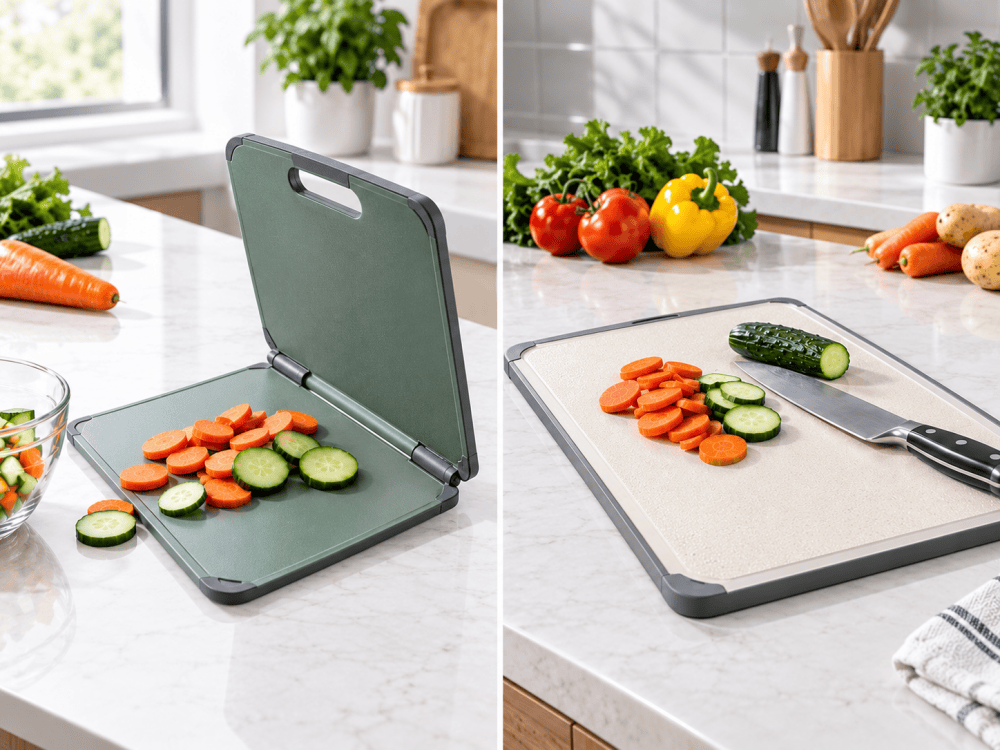
A foldable cutting board is a cutting surface designed with flexible sections, folding areas or structural features that allow part of the board to bend or fold.
Some foldable boards can be bent into a shallow funnel shape after food has been chopped. This allows vegetables, fruit, meat or other ingredients to be transferred more easily into a bowl, pan or cooking pot.
Other designs focus primarily on compact storage. Instead of remaining completely flat, the board can be folded or collapsed to reduce the amount of space required in a kitchen cabinet or drawer.
Common Features of Foldable Cutting Boards
- Flexible or segmented construction
- Foldable sections for easier food transfer
- Space-saving storage design
- Lightweight construction
- Portable format for travel or outdoor cooking
- Non-slip surfaces or edges
- Potentially multifunctional designs
For manufacturers and kitchenware brands, foldable structures also create opportunities for product differentiation through material combinations, shapes, colors, thicknesses, handles and packaging.
What Is a Standard Cutting Board?
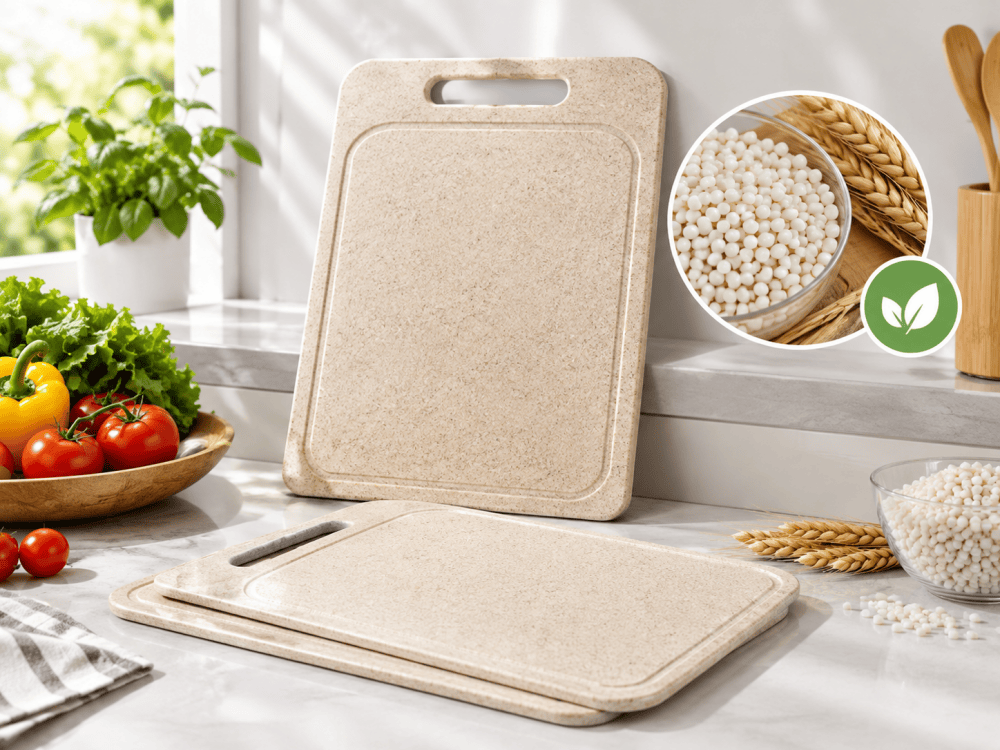
A standard cutting board usually refers to a traditional flat cutting board without a folding mechanism. It may be made from plastic, wood, bamboo, composite materials, stainless steel or other materials depending on the product design.
Standard cutting boards are widely used because their construction is simple and familiar. A flat board provides a consistent surface for slicing, chopping, dicing and other food-preparation tasks.
Plastic cutting boards are particularly common in household and commercial applications because materials such as PP and HDPE can offer lightweight handling, easy cleaning and flexible manufacturing options.
Kitlucy currently offers multiple cutting board designs, including PP cutting boards, multi-size sets, color-coded boards and customized cutting boards for wholesale and private-label applications.
Foldable Cutting Board vs Standard: Which Is Easier to Store?
If storage space is a major concern, a foldable cutting board usually has an advantage.
A traditional cutting board remains flat, so its storage footprint is determined mainly by its length and width. This is not a major issue in a large kitchen, but it can become inconvenient in small apartments, RVs, dormitories or compact kitchens.
A foldable design can reduce the space required for storage or allow the board to fit into smaller cabinets and drawers.
Best choice for simple cabinet storage: Standard cutting board.
Which Cutting Board Is More Stable?
For basic chopping and slicing, stability is one of the most important factors. A standard cutting board has a structural advantage because it does not need a folding mechanism.
However, foldable does not automatically mean unstable. A well-designed foldable cutting board can incorporate non-slip materials, raised edges, textured surfaces or a reinforced structure to improve countertop stability.
When comparing two products, look beyond whether the board folds. Check:
- Overall thickness
- Material stiffness
- Non-slip feet or edges
- Countertop contact area
- Folding structure
- Whether the board remains flat during cutting
For brands developing a foldable cutting board, structural testing is particularly important because the product must balance flexibility with sufficient rigidity during use.
Which Is Better for Food Transfer?
This is one area where foldable cutting boards can offer a clear functional advantage.
After chopping vegetables or other ingredients, the sides of a flexible board can sometimes be folded upward to create a funnel-like shape. This makes it easier to move food from the cutting surface into a cooking pot, bowl or container.
With a standard flat cutting board, users normally need to lift or slide the ingredients manually.
For consumers who value convenience and multifunctional kitchen tools, this food-transfer function can make a foldable cutting board more attractive.
Are Foldable Cutting Boards Good for Knives?
The knife-friendliness of a cutting board depends primarily on its surface material and construction, rather than simply whether the board folds.
A suitable plastic or composite cutting surface can provide a practical balance between cutting performance, durability and maintenance. On the other hand, an excessively hard surface may be less suitable for users who prioritize knife-edge preservation.
When evaluating a foldable cutting board, buyers should therefore consider:
- The material used for the cutting surface
- Surface hardness and texture
- Board thickness
- Whether the folding structure affects the cutting surface
- The intended type of food preparation
The same principle applies to standard cutting boards. A flat design alone does not determine whether a board is suitable for knives.
Which Is Easier to Clean?
A standard cutting board often has a simpler cleaning process because its surface is flat and contains fewer structural components.
Foldable cutting boards can also be easy to clean, but buyers should pay attention to the folding areas, joints, grooves and textured sections. These areas should not trap food residue.
| Cleaning Factor | Foldable Board | Standard Board |
|---|---|---|
| Flat Surface | Depends on design | Usually simple |
| Folding Areas | Require additional attention | Usually not applicable |
| Food Residue | Check joints and grooves | Generally easier to inspect |
| Maintenance | Depends on construction and material | Usually straightforward |
Always follow the cleaning instructions for the specific material and product. Dishwasher compatibility should not be assumed simply because a cutting board is made from plastic.
Foldable vs Standard Cutting Board for Small Kitchens
For small kitchens, a foldable cutting board can be particularly practical.
Modern apartments, dormitories, RV kitchens and compact homes often have limited countertop and cabinet space. A cutting board that can be folded or stored efficiently can help reduce kitchen clutter.
A standard board can still work well in a small kitchen if its size is carefully selected. A smaller flat board may actually be preferable when users want a simple product without moving parts.
Therefore, the decision should be based on the user's workflow rather than kitchen size alone.
Foldable vs Standard Cutting Board for Outdoor Use
Foldable cutting boards can also be useful for camping, picnics, RV travel and other portable food-preparation situations.
Their main advantages in these applications are:
- Reduced storage volume
- Easy transportation
- Lightweight construction
- Convenient food transfer
- Compatibility with compact cooking equipment
For outdoor use, however, buyers should also evaluate durability, cleaning requirements, water resistance and resistance to deformation.
Pros and Cons of Foldable Cutting Boards
Advantages
- Space-saving design
- Easy to transport
- Convenient for small kitchens
- Can simplify food transfer
- Strong product differentiation
- Suitable for multifunctional kitchenware concepts
Potential Limitations
- More complex construction
- Folding areas require careful cleaning
- Stability depends on product design
- Material flexibility must be balanced with rigidity
- Some designs may have higher manufacturing costs
Pros and Cons of Standard Cutting Boards
Advantages
- Simple and familiar design
- Stable preparation surface
- Easy to clean when the surface is simple
- Available in many materials and sizes
- Suitable for everyday food preparation
- Easy to develop in different price ranges
Potential Limitations
- Requires more storage space
- Less convenient for food transfer
- Less portable in larger sizes
- Traditional designs can be highly competitive in retail markets
Which Cutting Board Is Better for Wholesale?
For wholesale buyers, there is no universal answer. The better product depends on the target market and retail positioning.
A foldable cutting board may be attractive for brands targeting:
- Small-space kitchens
- Apartment living
- Camping and outdoor cooking
- RV and travel products
- Multifunctional kitchenware
- Innovative kitchen gadgets
A standard cutting board may be more suitable for:
- General kitchenware retail
- Restaurants and foodservice
- Basic kitchenware sets
- Color-coded cutting board systems
- High-volume wholesale programs
- Private-label products focused on simple functionality
What Should Buyers Check Before Ordering Foldable Cutting Boards?
If you are sourcing foldable cutting boards for wholesale or private label, product functionality should be evaluated before price alone.
1. Material
Ask whether the board uses PP, TPU, TPE, rubber, composite materials or another food-contact material. Material selection affects flexibility, stiffness, durability, weight and manufacturing cost.
2. Folding Structure
Check how the board folds and whether the folding area remains secure during cutting. A foldable design should provide useful flexibility without compromising the working surface.
3. Countertop Stability
Ask about non-slip edges, feet or surface treatments. Stability is especially important for products intended for frequent chopping.
4. Cleaning Requirements
Confirm whether the product can be washed by hand or in a dishwasher according to its actual material and construction. Do not rely on generic plastic specifications.
5. Size and Thickness
The unfolded size determines the available cutting area, while the folded dimensions determine storage convenience. Both measurements should be included in the product specification.
6. Customization
For private-label projects, ask whether the supplier supports custom colors, logos, packaging, dimensions, materials and set combinations.
Foldable Cutting Board OEM & ODM Opportunities
Foldable cutting boards can provide more opportunities for product differentiation than a basic flat board because the structure itself can become part of the product's selling point.
For example, brands can develop different combinations of:
- Board size and thickness
- Foldable or flexible sections
- PP, TPU or other material combinations
- Non-slip edges
- Handle or hanging-hole designs
- Custom colors
- Custom logos
- Retail packaging
- Multi-board sets
Kitlucy provides OEM and ODM customization for cutting boards and other kitchen tools, including custom materials, shapes, sizes, colors, logos, packaging and product configurations. Its customization service is designed for distributors, retailers and private-label kitchenware brands.
Foldable vs Standard Cutting Board: Which One Should You Choose?
The right choice depends on the user's priorities.
| If You Prioritize... | Recommended Design | Why |
|---|---|---|
| Compact storage | Foldable | Can reduce storage footprint |
| Food transfer | Foldable | Can funnel ingredients into containers |
| Portability | Foldable | Convenient for travel and outdoor use |
| Simple cleaning | Standard | Simple flat designs are easier to inspect and clean |
| Stable cutting surface | Standard | Rigid flat construction is straightforward and stable |
| Traditional kitchen use | Standard | Simple design suits everyday food preparation |
| Innovative retail positioning | Foldable | Offers more opportunities for functional differentiation |
In short, foldable cutting boards are mainly about convenience, flexibility and space efficiency, while standard cutting boards are mainly about simplicity, stability and familiar everyday use.
Frequently Asked Questions
Are foldable cutting boards better than standard cutting boards?
Not for every user. Foldable cutting boards are useful when storage, portability and food transfer are important. Standard cutting boards are often preferred for simple, stable everyday food preparation.
Are foldable cutting boards stable?
They can be stable when properly designed with sufficient rigidity and non-slip features. Stability depends on the material, thickness, folding structure and countertop contact area.
Are foldable cutting boards good for small kitchens?
Yes. Their compact storage design can be useful in apartments, dormitories, RVs and other kitchens with limited cabinet or drawer space.
Are foldable cutting boards easy to clean?
Many are easy to clean, but folding areas, joints, grooves and textured sections should be checked carefully. Always follow the manufacturer's cleaning instructions.
Do foldable cutting boards damage knives?
The folding function itself does not determine knife performance. The cutting surface material, hardness, texture and construction are more important factors.
What materials are commonly used for foldable cutting boards?
Common materials include PP, TPU, TPE and other flexible or semi-flexible food-contact materials. The best material depends on the required balance of flexibility, rigidity, durability, weight and cost.
Can foldable cutting boards be customized for private label?
Yes. OEM and private-label cutting boards can be customized in areas such as material, dimensions, colors, logos, packaging and product configuration, depending on the supplier and project requirements.
Which cutting board is better for wholesale?
Foldable boards can be suitable for innovative, space-saving and multifunctional kitchenware markets, while standard boards can be suitable for general kitchenware, foodservice and high-volume retail programs. Buyers should select based on target customers, price positioning and product requirements.
Looking for Custom Foldable or Standard Cutting Boards?
Kitlucy supports wholesale, OEM and private-label cutting board projects for global distributors, retailers and kitchenware brands. Customize materials, sizes, colors, logos, packaging and product configurations according to your market requirements.
Explore OEM & ODM KitchenwareRelated Blogs