Are Titanium Cutting Boards Bad for Knives? Knife Safety & Edge Wear Guide
Are Titanium Cutting Boards Bad for Knives? Knife Safety & Edge Wear Guide
Titanium cutting boards have attracted attention because of their durability, corrosion resistance, and modern appearance. However, one question is especially important for anyone who uses quality kitchen knives: are titanium cutting boards bad for knives?
The short answer is that a titanium cutting board can be less forgiving to a knife edge than softer cutting surfaces such as wood or many plastic boards. The effect depends on the titanium material, board construction, knife steel, edge geometry, cutting technique, and how much force is used.
That does not mean every titanium cutting board will immediately damage a knife. Instead, the key issue is that a rigid cutting surface can contribute to faster edge wear compared with a more knife-friendly cutting board.
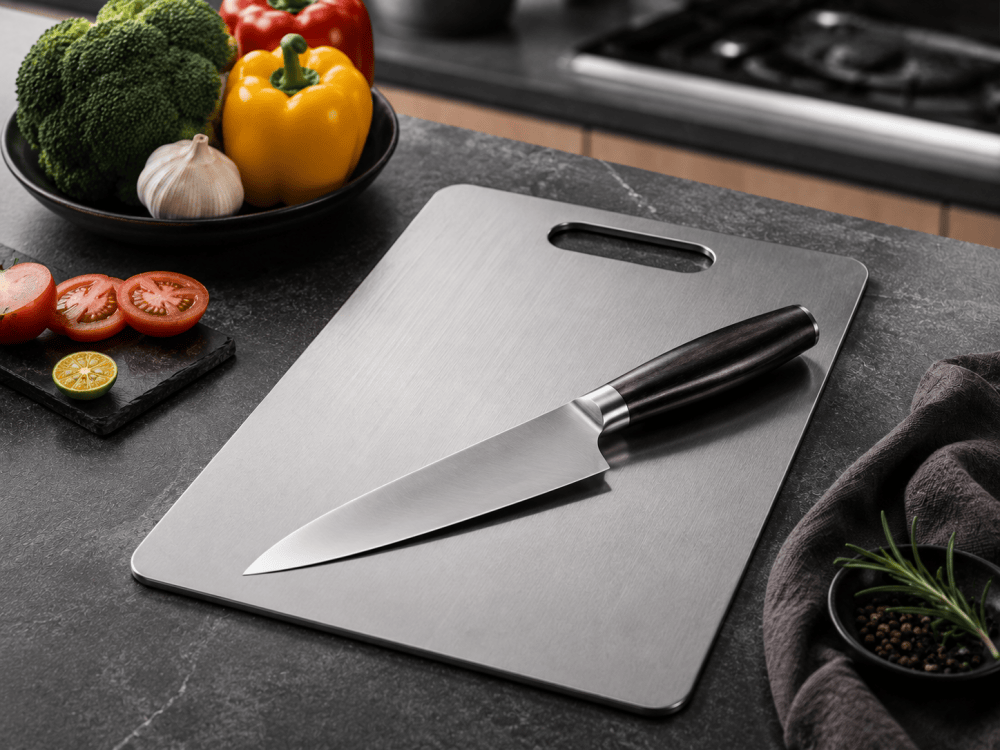
Do Titanium Cutting Boards Dull Knives?
Yes, titanium cutting boards can contribute to knife dulling, particularly when knives are used with heavy downward force, chopping motions, or repeated impact.
A knife becomes dull when its cutting edge gradually changes shape through use. The cutting board is part of that system. When a sharp edge repeatedly contacts a very rigid surface, the edge can experience greater mechanical stress than it would on a more forgiving material.
This does not mean that titanium automatically makes a knife unusable. Knife wear is influenced by several factors, including:
- The hardness and geometry of the knife edge
- The hardness and rigidity of the cutting board
- The type of knife steel
- The cutting angle
- Chopping force and cutting technique
- How frequently the knife is used
- The type of food being prepared
For everyday kitchen use, these factors matter more than simply asking whether a cutting board is made from titanium.
Why Can a Hard Cutting Surface Affect Knife Edges?
A sharp knife edge is extremely thin. During cutting, the edge comes into contact with food and eventually with the cutting surface underneath it.
A softer, slightly more forgiving cutting surface can absorb some of the impact. A very rigid surface provides less cushioning. Repeated contact can cause the knife edge to deform, roll, or wear more quickly.
This is particularly relevant when using a thin or finely sharpened knife. A delicate edge designed for precision cutting may be more sensitive to hard cutting surfaces than a thicker, more robust kitchen knife.
Does Titanium Damage Knife Edges?
The word "damage" can be misleading because different types of knife-edge wear can occur during normal use.
A knife edge may experience:
- Edge rolling: The thin edge bends slightly to one side.
- Edge deformation: Repeated impact changes the geometry of the cutting edge.
- Abrasive wear: Material is gradually removed from the edge.
- Chipping: Small pieces of the edge can break away when a brittle edge experiences excessive impact.
The actual result depends on the knife steel, heat treatment, edge angle, cutting technique, and cutting board material. Therefore, it is more accurate to say that a rigid titanium surface may increase edge wear under certain conditions rather than claiming that titanium cutting boards automatically damage every knife.
Are Titanium Cutting Boards Good for Japanese Knives?
Extra care is recommended when using titanium cutting boards with Japanese-style knives.
Many Japanese kitchen knives are designed with relatively thin blades and fine cutting edges. Their geometry can provide excellent cutting performance, but a fine edge may also require more careful handling.
For expensive chef knives, gyuto knives, santoku knives, petty knives, and other precision-oriented blades, a knife-friendly cutting surface can help reduce unnecessary impact on the edge.
If maintaining maximum sharpness and edge retention is a priority, a quality wood or suitable plastic cutting board may be a better everyday pairing.
Titanium vs. Wood Cutting Boards for Knife Safety
Wood is widely preferred by knife enthusiasts because it provides a relatively forgiving surface for knife edges. End-grain wood is especially well known for its knife-friendly characteristics.
| Feature | Titanium | Wood |
|---|---|---|
| Knife friendliness | Moderate to low depending on construction and use | Generally high |
| Rigidity | High | Lower and more forgiving |
| Edge wear | Can be higher with repeated impact | Generally lower |
| Durability | Very high | Good, but requires maintenance |
| Water resistance | Excellent | Depends on wood type and maintenance |
| Cleaning convenience | Generally easy | Requires appropriate cleaning and drying |
For buyers who prioritize knife edge retention, wood generally has an advantage. For buyers who prioritize durability, corrosion resistance, and a low-maintenance surface, titanium may offer different benefits.
Titanium vs. Plastic Cutting Boards for Knife Safety
Plastic cutting boards are another common choice for everyday kitchen preparation. Food-grade polyethylene and polypropylene boards can provide a more forgiving surface than rigid materials.
| Feature | Titanium | Plastic |
|---|---|---|
| Knife edge protection | Moderate to low | Generally good |
| Durability | Very high | Good |
| Weight | Can be relatively heavy depending on thickness | Usually lightweight |
| Cleaning | Easy | Easy |
| Maintenance | Low | Low to moderate |
| Knife wear | Potentially higher | Generally lower |
For professional kitchens and home cooks who frequently sharpen their knives, a suitable plastic board can provide a practical balance between hygiene, durability, and knife protection.
Which Cutting Board Materials Are Best for Protecting Knives?
There is no single cutting board material that is perfect for every kitchen. However, materials can be broadly compared based on how forgiving they are to knife edges.
| Cutting Board Material | Knife Friendliness | Typical Use |
|---|---|---|
| End-Grain Wood | Excellent | Premium home kitchens and professional knife users |
| Wood | Very Good | Everyday food preparation |
| HDPE / Food-Grade Plastic | Good to Very Good | Home and commercial kitchens |
| PP Plastic | Good | Everyday kitchen use |
| Bamboo | Good to Moderate | General food preparation |
| Titanium | Moderate to Low | Durability-focused applications |
| Stainless Steel | Low | Specialized applications |
| Glass | Very Low | Generally not recommended for preserving knife edges |
If your primary goal is to keep kitchen knives sharp for as long as possible, a forgiving cutting surface is usually the better choice. If durability, corrosion resistance, and easy maintenance are more important, a rigid material may offer advantages that justify the trade-off.
How to Reduce Knife Wear on a Titanium Cutting Board
If you already own a titanium cutting board or are considering one, several practices can help reduce unnecessary stress on your knives.
1. Use a Controlled Cutting Motion
Avoid excessive force and repeated heavy chopping. A controlled slicing motion can reduce the impact between the knife edge and the cutting surface.
2. Avoid Twisting the Knife
Do not twist or pry with a sharp kitchen knife against the board. Lateral forces can place additional stress on a fine cutting edge.
3. Choose the Right Knife
A robust everyday chef's knife may be more suitable for a rigid cutting surface than an extremely thin precision blade.
4. Avoid Cutting Hard Materials
Do not use a kitchen knife on bones, frozen foods, or other materials that require excessive force simply because the cutting board itself is highly durable.
5. Maintain the Knife Edge Properly
Regular honing and sharpening can help maintain cutting performance. However, sharpening should not be used as a substitute for choosing an appropriate cutting surface.
Is Titanium Better Than Wood or Plastic?
Not necessarily. The best material depends on what the buyer values most.
Titanium may be attractive when durability, corrosion resistance, and easy maintenance are important. Wood may be preferable for users who prioritize knife edge retention and traditional cutting performance. Plastic can offer a practical middle ground for everyday preparation.
Instead of asking whether titanium is universally better, consider the specific application:
- For premium kitchen knives: prioritize a knife-friendly cutting surface.
- For everyday home cooking: wood or food-grade plastic can provide a balanced solution.
- For durability-focused applications: titanium may be worth considering.
- For heavy chopping: choose a surface and knife combination designed to handle repeated impact.
Who Should Consider a Titanium Cutting Board?
A titanium cutting board may be suitable for users who place a high value on durability, corrosion resistance, and easy maintenance.
However, buyers who regularly use premium knives and want to maximize edge retention should carefully consider the interaction between the knife and the cutting surface.
For B2B buyers, this is also an important product-positioning consideration. A titanium cutting board can be marketed around durability and maintenance benefits, while knife-focused products may be better positioned around edge protection and cutting performance.
Frequently Asked Questions About Titanium Cutting Boards and Knives
Are titanium cutting boards bad for knives?
Titanium cutting boards can be less forgiving to knife edges than wood or suitable plastic boards. Repeated impact on a rigid surface may contribute to faster edge wear, especially with thin or finely sharpened knives.
Do titanium cutting boards dull knives?
They can contribute to faster dulling compared with softer, more forgiving cutting surfaces. The actual rate of edge wear depends on the knife, cutting technique, board construction, and frequency of use.
Can titanium cutting boards damage knife edges?
They can increase mechanical stress on a knife edge under heavy or improper use. However, titanium does not automatically damage every knife. Edge wear depends on several factors, including blade geometry and cutting technique.
Are titanium cutting boards suitable for Japanese knives?
They can be used with Japanese knives, but extra care is recommended for thin, finely sharpened blades. If maximum edge retention is the priority, a more forgiving cutting surface may be preferable.
What is the best cutting board for knife edge retention?
End-grain wood and suitable food-grade plastic boards are generally considered more knife-friendly choices than very rigid surfaces. The best option depends on the knife, food preparation style, cleaning requirements, and intended use.
Should I stop using a titanium cutting board with my kitchen knives?
Not necessarily. If you use a titanium board, controlled cutting techniques and an appropriate knife can help reduce unnecessary edge wear. If preserving the sharpness of a premium knife is your highest priority, however, a knife-friendly board may be a better everyday option.
Final Verdict: Are Titanium Cutting Boards Bad for Knives?
Titanium cutting boards are not automatically bad for knives, but their rigid construction can make them less forgiving to knife edges than wood or suitable plastic cutting boards.
For buyers who prioritize knife sharpness and edge retention, a quality wood or food-grade plastic cutting board is generally a safer choice. For those who prioritize durability, corrosion resistance, and low maintenance, titanium can still be an interesting option.
The most important consideration is not simply the material itself, but how the cutting board, knife, and cutting technique work together. Choosing the right combination can help extend knife performance while meeting the practical requirements of everyday food preparation.
Looking for Custom Cutting Board Solutions?
Kitlucy supports B2B buyers with cutting boards and kitchen tools for different material, size, design, and market requirements. If you are developing a private-label kitchenware line, our team can help you evaluate suitable product options.
Explore OEM & ODM KitchenwareRelated Blogs