Titanium Cutting Board Pros and Cons: Are They Worth Buying?
Titanium Cutting Board Pros and Cons: Are Titanium Cutting Boards Good?
If you are considering a titanium cutting board, you may have already seen claims about its durability, easy cleaning, food-contact safety, and modern design. At the same time, one important concern keeps coming up: are titanium cutting boards bad for knives?
Titanium cutting boards are different from traditional wood, bamboo, and plastic boards because they use a metal cutting surface. That gives them some unique advantages, but it also creates trade-offs that are important to understand before buying.
This guide takes a practical look at the titanium cutting board pros and cons, including durability, hygiene, knife performance, cleaning, noise, stability, cost, and how titanium compares with other popular cutting board materials.
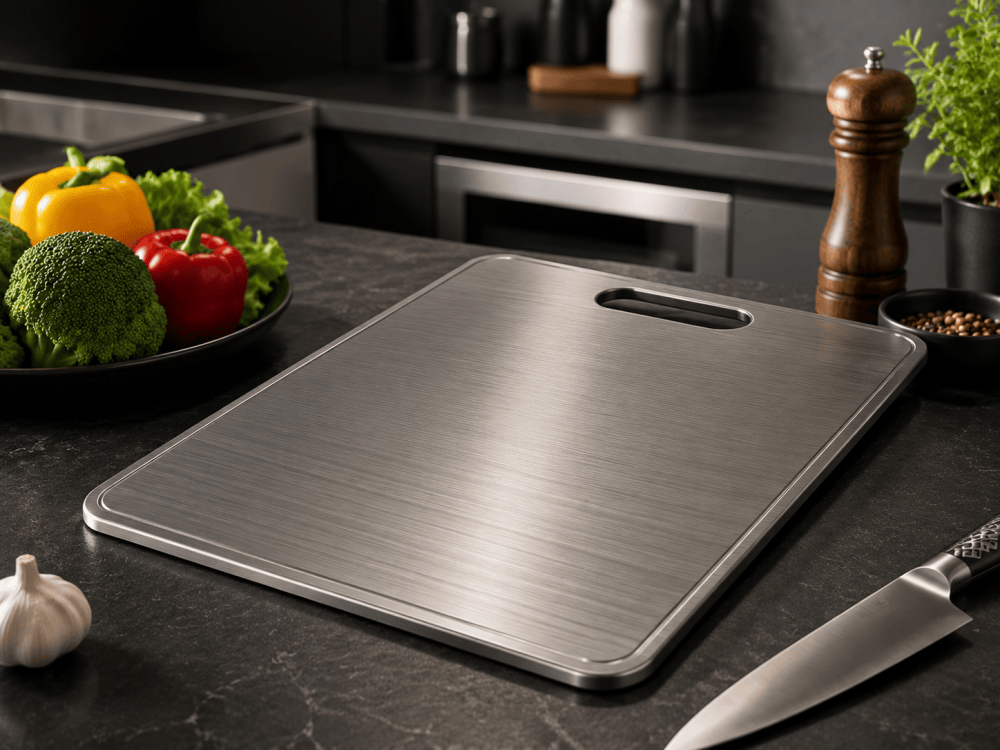
Titanium cutting boards can be a good choice for buyers who prioritize durability, a non-porous surface, easy maintenance, and a modern appearance. However, they are not the most knife-friendly cutting boards. For frequent chopping with high-quality kitchen knives, wood or suitable plastic surfaces are generally more forgiving.
Titanium Cutting Board Pros and Cons at a Glance
The biggest advantage of titanium is its combination of strength, corrosion resistance, and a non-porous metal surface. The biggest drawback is that a rigid metal cutting surface provides much less cushioning for a knife edge than traditional wood or plastic.
| Feature | Potential Advantage | Potential Disadvantage |
|---|---|---|
| Durability | Highly resistant to moisture-related warping and cracking | Higher upfront cost than many plastic boards |
| Food-contact surface | Non-porous and easy to wipe and wash | Food-contact suitability still depends on material grade and manufacturing quality |
| Knife performance | Very resistant to surface damage from normal use | Less forgiving to knife edges than wood or softer plastic |
| Cleaning | Simple surface with no wood grain to oil | Specific care instructions vary by product construction |
| Appearance | Modern metallic appearance | Less traditional than walnut, maple, or bamboo |
| Price | Premium positioning can support higher-end product lines | Usually more expensive than basic plastic cutting boards |
| Weight | Solid and stable construction can feel substantial | Can be heavier than thin plastic boards |
What Is a Titanium Cutting Board?
A titanium cutting board is a cutting surface manufactured using titanium or a titanium-based construction. Unlike conventional boards made from wood, bamboo, polyethylene, polypropylene, or other plastics, titanium boards use a metal surface as the primary cutting area.
Titanium is valued in many industries because of its strength-to-weight ratio and strong resistance to corrosion. These characteristics make the material interesting for kitchenware applications where moisture resistance, durability, and long-term surface stability are important.
However, the word titanium alone does not tell you everything about a cutting board. Buyers should determine whether a product is made from commercially pure titanium, a titanium alloy, or another material with a titanium coating or finish.
Pure Titanium vs Titanium Alloy vs Titanium-Coated Products
Not every product marketed as a titanium cutting board has the same construction. This distinction is particularly important when comparing products online or evaluating suppliers.
| Construction | What Buyers Should Check | Typical Consideration |
|---|---|---|
| Commercially Pure Titanium | Material grade, thickness, food-contact suitability | Premium material positioning and strong corrosion resistance |
| Titanium Alloy | Exact alloy composition and intended application | Performance can vary according to alloy formulation |
| Titanium-Coated Surface | Base material, coating thickness, coating durability | Performance depends heavily on the underlying material and coating process |
When comparing a titanium cutting board, do not evaluate the product based on the word "titanium" alone. Ask for the actual material specification, construction method, surface treatment, thickness, and applicable food-contact documentation.
Are Titanium Cutting Boards Safe?
One of the most common questions from consumers is: are titanium cutting boards safe?
The answer depends on the actual material and manufacturing process. Titanium itself is known for strong corrosion resistance and is widely used in applications where material stability and biocompatibility are important. However, a finished cutting board is more than just its base metal.
Food-contact safety can also be affected by:
- The specific titanium grade or alloy
- Surface treatments and finishes
- Welding or joining processes
- Adhesives or non-metal components
- Rubber, silicone, or plastic feet
- Manufacturing and cleaning requirements
For this reason, buyers should look for clear material specifications and appropriate food-contact documentation rather than assuming that every product labeled "titanium" has identical safety characteristics.
Does Titanium React With Food?
Titanium is generally valued for its chemical stability and corrosion resistance. This is particularly relevant for kitchen environments where cutting boards may come into contact with water, salt, meat juices, vegetables, and mildly acidic ingredients.
Nevertheless, food-contact performance should be evaluated for the complete finished product, especially when the board contains coatings, mixed materials, or accessories.
Advantages of Titanium Cutting Boards
- Non-porous metal surface
- High resistance to corrosion
- Strong long-term durability
- Low moisture absorption
- Easy routine cleaning
- Modern premium appearance
- Suitable for premium kitchenware positioning
1. Excellent Resistance to Moisture and Corrosion
One of the strongest material advantages of titanium is its resistance to corrosion. Unlike wood, titanium does not absorb water into a natural fiber structure, and it does not have the same swelling and shrinking behavior associated with moisture-sensitive materials.
This can make a titanium cutting board attractive for kitchens where the cutting surface is frequently exposed to water and food juices.
2. Non-Porous Cutting Surface
A titanium surface does not have the open cellular structure found in natural wood. As a result, liquids and food residues are less likely to penetrate into the cutting material itself.
This can make routine cleaning more straightforward, particularly when preparing foods that leave strong odors or visible juices.
However, "non-porous" does not automatically mean "self-sanitizing." The surface still needs to be properly washed after food preparation.
3. Long-Term Durability
Another reason consumers consider titanium is durability. A properly manufactured titanium board is resistant to many forms of moisture-related deterioration that can affect wood and some lower-quality composite products.
For premium kitchenware brands, this long service-life positioning can also provide a different value proposition from inexpensive cutting boards that are designed to be replaced periodically.
4. Easy Routine Maintenance
Unlike wooden boards, titanium does not normally require periodic mineral oil conditioning simply to maintain the material structure.
For users who prefer low-maintenance kitchen products, this can be a major advantage.
5. Modern Premium Appearance
The metallic appearance of titanium gives cutting boards a distinctive visual identity. This can appeal to minimalist, contemporary, and premium kitchenware markets.
For brands and retailers, this also creates an opportunity to position titanium cutting boards differently from conventional wood, bamboo, and plastic products.
Are Titanium Cutting Boards Bad for Knives?
Titanium cutting boards have a rigid surface that may be less forgiving to knife edges than wood or suitable plastic cutting boards. If knife sharpness and edge retention are your main priorities, the choice of cutting surface is worth considering.
Want to learn more about how titanium affects knife edges? Read our complete guide to titanium cutting board knife safety and edge wear.
Do Titanium Cutting Boards Dull Knives?
A rigid cutting surface may contribute to faster knife edge wear, especially with frequent chopping or thin, finely sharpened blades. The actual effect depends on the knife and how the cutting board is used.
Why Does a Hard Cutting Surface Affect Knife Edges?
A knife edge is extremely thin. When the blade repeatedly contacts a rigid surface, the edge experiences mechanical stress.
Wood and some plastic cutting boards provide a degree of compliance. The knife edge can penetrate the surface slightly rather than receiving the full impact of a rigid surface.
A titanium board provides much less cushioning. This is why the material can be excellent for durability while being less ideal for knife-edge preservation.
How to Use Titanium Without Unnecessarily Dulling Your Knives
If you like the hygiene and durability advantages of titanium but still want to protect your knives, the best approach is to adjust how you use the board.
- Use controlled slicing and rocking motions instead of heavy downward chopping.
- Avoid twisting or prying with the knife edge against the board.
- Do not use your best thin-bladed knives for chopping bones or frozen foods.
- Consider using a softer board for everyday vegetable and herb preparation.
- Keep titanium as a dedicated surface for foods where easy cleaning is especially important.
You do not necessarily have to choose between titanium and wood. A two-board setup can combine the easy maintenance of titanium with the knife-friendly characteristics of wood or suitable plastic.
Titanium Cutting Board vs Wood: Which Is Better?
The choice between titanium and wood depends heavily on what you value most.
| Feature | Titanium | Wood |
|---|---|---|
| Durability | Excellent | High |
| Moisture Resistance | Excellent | Moderate |
| Knife Friendliness | Lower | Excellent |
| Maintenance | Low | Higher |
| Natural Appearance | Low | Excellent |
| Premium Positioning | High | High |
Choose titanium if your priorities are durability, moisture resistance, and low maintenance. Choose wood if protecting knife edges and achieving a warm, traditional kitchen appearance are more important.
Titanium Cutting Board vs Plastic: Which Should You Choose?
Plastic cutting boards remain popular because materials such as HDPE and PP offer a practical balance of cost, weight, durability, and knife compatibility.
| Feature | Titanium | Plastic |
|---|---|---|
| Price | Premium | Budget to Mid-Range |
| Weight | Moderate to Heavy | Lightweight |
| Knife Friendliness | Lower | Good |
| Moisture Resistance | Excellent | Excellent |
| Surface Durability | Excellent | Moderate to High |
| Color Options | Limited | Wide Range |
Plastic may be the more practical choice for households that need several affordable boards, while titanium may appeal to buyers looking for a premium, long-lasting cutting surface.
Best Titanium Cutting Boards: What Should You Look For?
If you are searching for the best titanium cutting boards, the material name should not be the only factor you consider. Construction quality, surface finish, thickness, stability, food-contact suitability, and overall design can have a major impact on the actual user experience.
Two products may both be advertised as titanium cutting boards but provide very different performance depending on how they are manufactured.
1. Check the Actual Titanium Construction
First, determine whether the product is made from titanium throughout the cutting surface or uses a titanium coating over another substrate.
A product description should ideally identify the material grade or construction rather than simply stating "titanium."
For wholesale buyers, this information is particularly important because material specifications can affect product positioning, certification requirements, durability, and pricing.
2. Consider Board Thickness
Thickness affects stability, weight, rigidity, and handling.
A very thin titanium cutting board may be lightweight and easy to store, but it may not provide the same stable cutting experience as a thicker construction.
A thicker board can feel more substantial and stable, but increased thickness also means more weight and potentially higher shipping costs.
For retail products, the best thickness is therefore not necessarily the thickest option. It should match the intended application and target market.
3. Look at the Surface Finish
The surface finish can influence cleaning, appearance, grip, and the overall cutting experience.
A smooth surface is generally easy to wipe and clean, while textured or specially finished surfaces may be designed to improve visual appeal or reduce ingredient movement.
Buyers should also check whether the surface treatment is durable enough for repeated food preparation.
4. Check the Edges and Corners
Edges are often overlooked when consumers compare cutting boards online.
A well-designed titanium cutting board should have carefully finished edges without unnecessarily sharp exposed corners.
Rounded corners, beveled edges, or an integrated frame can make a rigid metal cutting surface more comfortable to handle.
5. Consider Non-Slip Features
Because titanium is a rigid material, stability becomes especially important.
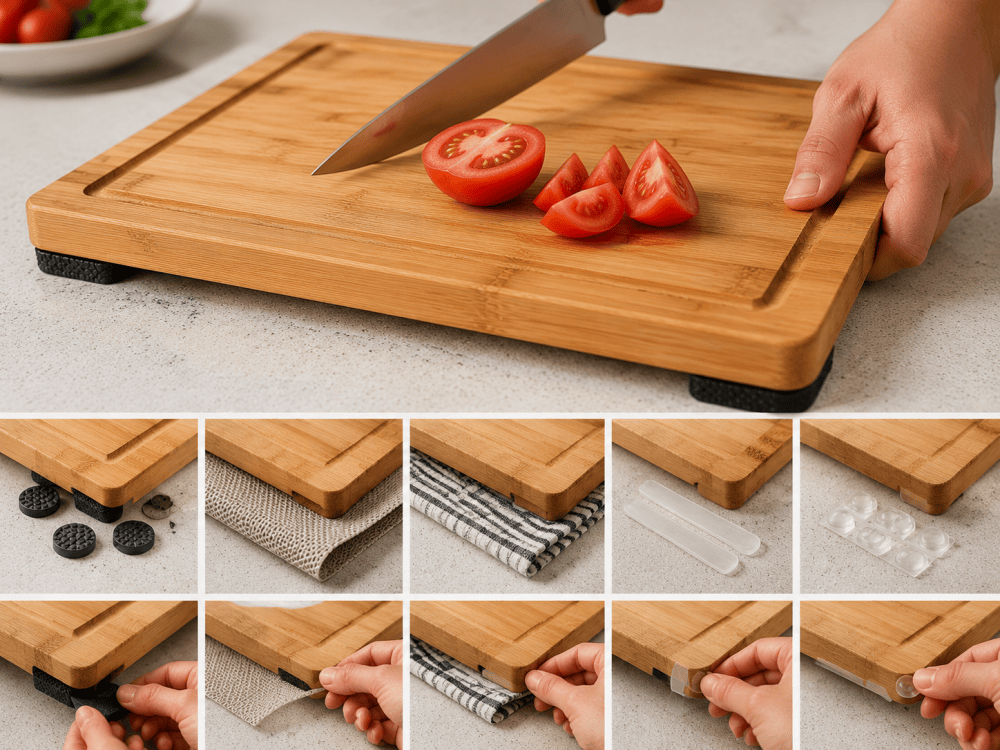
Non-slip silicone feet, rubberized edges, or other anti-slip structures can help keep the board in position during cutting.
For commercial and household applications, a stable cutting board can improve both comfort and safety.
6. Evaluate the Complete Product, Not Just the Board Material
A titanium cutting board may include additional materials such as silicone feet, handles, edge protection, storage accessories, or packaging components.
These components can influence durability, cleaning requirements, and food-contact considerations.
When comparing titanium cutting boards, check the actual material construction, thickness, surface finish, edge treatment, anti-slip design, dimensions, weight, food-contact documentation, and manufacturer's quality-control process.
What Size Titanium Cutting Board Is Best?
There is no single best size for every kitchen. The right dimensions depend on how much food is normally prepared and how much counter space is available.
| Board Size | Best For | Main Consideration |
|---|---|---|
| Small | Fruit, herbs, small ingredients | Easy to store but limited workspace |
| Medium | Everyday household preparation | Good balance between workspace and storage |
| Large | Meat, vegetables, family meal preparation | More workspace but heavier |
| Extra Large | Professional or high-volume preparation | Requires more counter and storage space |
For brands developing a titanium cutting board collection, offering multiple sizes can be more effective than relying on a single universal size.
Are Titanium Cutting Boards Good for Meat and Seafood?
Titanium cutting boards can be particularly interesting for users who frequently prepare meat and seafood because the surface is non-porous and resistant to moisture.
Raw meat and seafood can leave liquids, odors, and residues on a cutting surface. A properly finished metal surface can be straightforward to wash after preparation.
However, easy cleaning does not eliminate the need for proper food hygiene.
Can You Use a Titanium Cutting Board for Raw Meat?
Yes, a properly designed food-contact titanium cutting board can be used for raw meat preparation when it is cleaned and sanitized appropriately after use.
Users should still follow basic food-safety practices:
- Wash the board after preparing raw meat.
- Clean the surface before preparing ready-to-eat foods.
- Avoid cross-contamination between raw and cooked ingredients.
- Follow the manufacturer's cleaning instructions.
Can You Use a Titanium Cutting Board for Fish?
A titanium cutting board can also be used for fish and seafood preparation. Its resistance to moisture and odors can be useful when working with seafood.
However, knife considerations remain important. Frequent fish preparation with very sharp fillet knives may benefit from a softer cutting surface that provides more protection for the blade edge.
Are Titanium Cutting Boards Easy to Clean?
Easy cleaning is one of the strongest selling points of titanium cutting boards.
Because titanium does not have the porous grain structure of natural wood, there is no need to condition the surface with mineral oil to maintain the board's material structure.
For routine cleaning:
- Remove food particles from the surface.
- Wash with warm water and an appropriate dish detergent.
- Rinse thoroughly.
- Dry the board after cleaning.
- Follow the manufacturer's instructions for sanitation or dishwasher use.
Can Titanium Cutting Boards Go in the Dishwasher?
Do not assume that every titanium cutting board is automatically dishwasher safe.
The titanium itself may tolerate water and cleaning conditions well, but the complete product may contain silicone feet, adhesives, coatings, handles, or other components with different temperature limits.
Always check the manufacturer's care instructions before placing a titanium cutting board in a dishwasher.
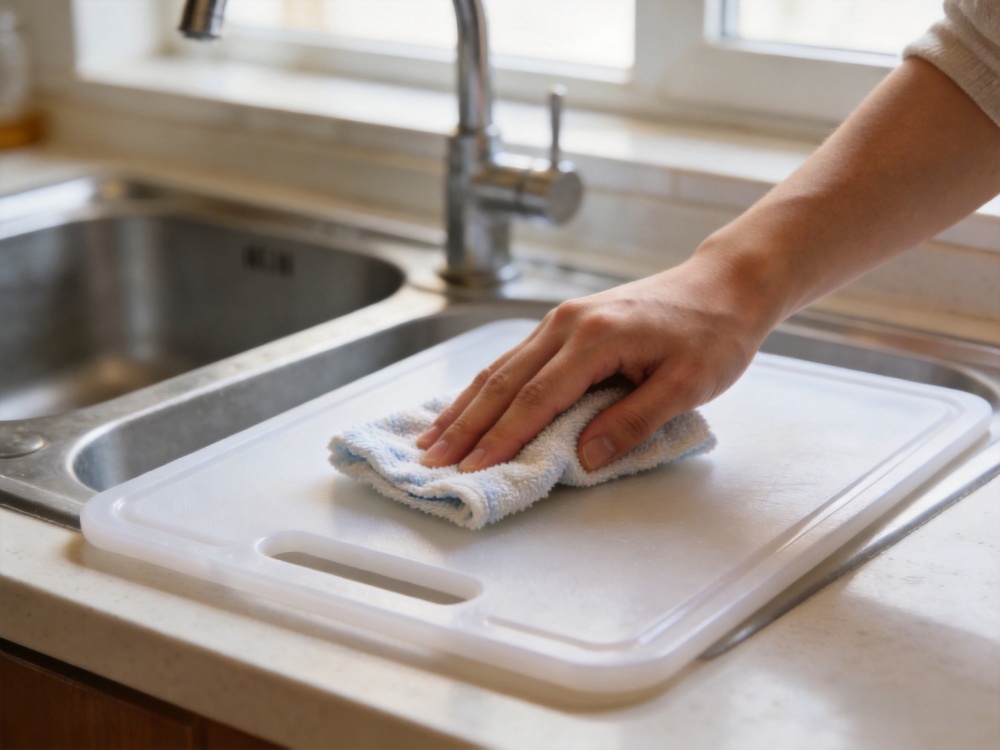
How to Clean a Titanium Cutting Board
For most titanium cutting boards, regular cleaning should focus on removing food residue and maintaining a clean food-contact surface.
Step 1: Remove Food Residue
Use a soft scraper or suitable utensil to remove larger food particles before washing.
Step 2: Wash the Surface
Wash the board using warm water and a suitable kitchen detergent.
Step 3: Rinse Thoroughly
Remove detergent and food residues with clean water.
Step 4: Dry Completely
Dry the board before storing it to keep the surrounding area clean and reduce moisture accumulation around accessories or non-metal components.
Cleaning requirements depend on the specific construction of the product. A titanium-coated board, for example, may require different care from a board made entirely from titanium.
Titanium vs Stainless Steel Cutting Board
Consumers comparing metal cutting boards often encounter both titanium and stainless steel products. Although both are corrosion-resistant metals, they are not identical materials.
| Feature | Titanium | Stainless Steel |
|---|---|---|
| Corrosion Resistance | Excellent | Excellent |
| Weight | Relatively lightweight for its strength | Generally heavier for comparable rigid construction |
| Premium Positioning | Very High | High |
| Cost | Generally Higher | Generally Lower |
| Kitchen Market Familiarity | Emerging | More Established |
| Knife Friendliness | Limited compared with wood or plastic | Also less forgiving than wood or suitable plastic |
If the primary objective is maximum durability and premium material positioning, titanium may have an advantage. If cost efficiency and established metal-kitchenware manufacturing are more important, stainless steel may be more commercially practical.
Titanium vs Stainless Steel Cutting Board: Which Is Better?
There is no universal winner between titanium and stainless steel.
Titanium may appeal to premium markets because of its material story, lightweight strength, and corrosion resistance. Stainless steel, on the other hand, benefits from widespread familiarity and a well-established kitchenware supply chain.
For consumers, the better choice depends on price, weight, design, cleaning requirements, and how frequently the board will be used.
For B2B buyers, the decision should additionally consider production capability, target retail price, minimum order quantity, packaging, certification requirements, and market positioning.
Titanium vs Bamboo Cutting Board
Bamboo and titanium represent two very different approaches to cutting board design.
| Feature | Titanium | Bamboo |
|---|---|---|
| Material Type | Metal | Natural grass-based material |
| Moisture Resistance | Excellent | Moderate to High with proper care |
| Knife Friendliness | Lower | Moderate |
| Maintenance | Low | Medium |
| Appearance | Modern / Metallic | Natural / Warm |
| Price Positioning | Premium | Entry to Mid-Range |
Bamboo may be a better choice for consumers who want a natural appearance and a more traditional cutting experience. Titanium may be more attractive to buyers who prioritize low maintenance and long-term resistance to moisture.
Titanium vs Glass Cutting Board
Glass cutting boards are sometimes marketed as hygienic and easy-to-clean kitchen surfaces. However, glass is extremely hard and rigid, which makes it particularly demanding on knife edges.
Titanium and glass therefore share one important disadvantage: neither provides the same knife-friendly cushioning as a suitable wood or plastic cutting board.
For users who frequently use high-quality kitchen knives, this is an important factor to consider before choosing either material.
Are Titanium Cutting Boards Better Than Wood or Plastic?
The answer depends on what "better" means for the user.
| If Your Priority Is... | Consider... |
|---|---|
| Maximum knife edge protection | Wood or suitable plastic |
| Low maintenance | Titanium or plastic |
| Natural appearance | Wood or bamboo |
| Long-term moisture resistance | Titanium |
| Affordable everyday use | Plastic |
| Premium modern appearance | Titanium |
| Traditional chef's cutting experience | Wood |
This is why it is difficult to call titanium the single "best" cutting board material. A material that performs exceptionally well in one category may perform less well in another.
Who Should Buy a Titanium Cutting Board?
A titanium cutting board may be a good fit for users who value the following characteristics:
- Long-term durability
- Low routine maintenance
- Resistance to moisture and corrosion
- Easy-to-clean surfaces
- Modern kitchen aesthetics
- Premium kitchenware design
Titanium May Be a Good Choice for:
- Modern home kitchens
- Premium kitchenware buyers
- Minimalist kitchen designs
- Consumers interested in alternative cutting board materials
- Gift and premium kitchenware markets
- Retailers looking for differentiated kitchen products
Who May Be Better Served by Another Material?
- Professional chefs who prioritize knife edge retention
- Japanese knife users
- Knife collectors
- Users who prefer a traditional wood cutting experience
- Consumers looking for inexpensive replacement boards
Titanium Cutting Board Made in USA: What Should Buyers Know?
The search term titanium cutting board made in USA reflects interest in premium domestic manufacturing and product sourcing.
When evaluating a USA-made titanium cutting board, buyers should look beyond the country-of-origin claim and consider how much of the product is actually manufactured domestically.
Important questions include:
- Where is the titanium material sourced?
- Where does cutting and forming take place?
- Where are surface treatments performed?
- Where is the final product assembled?
- What food-contact documentation is available?
- What quality-control procedures are used?
For consumers, domestic manufacturing may be an important purchasing preference. For B2B buyers, country of origin can also affect product positioning, import strategy, labeling, and retail marketing.
If you are sourcing titanium cutting boards for a private-label or wholesale collection, request clear documentation about material composition, manufacturing origin, testing, packaging, and product specifications before making a sourcing decision.
Is a Titanium Cutting Board Worth the Higher Price?
Whether a titanium cutting board is worth buying depends on how you value durability and maintenance compared with knife friendliness and price.
If you want a cutting board that can remain stable in a wet kitchen environment, is easy to clean, and has a premium appearance, the higher price may be justified.
If your main goal is protecting expensive knives while keeping costs low, plastic or wood may offer better overall value.
| Buyer Priority | Value of Titanium |
|---|---|
| Durability | ★★★★★ |
| Moisture Resistance | ★★★★★ |
| Easy Maintenance | ★★★★★ |
| Knife Protection | ★★☆☆☆ |
| Affordability | ★★☆☆☆ |
| Premium Appearance | ★★★★★ |
In other words, titanium is best understood as a specialized premium cutting surface rather than a universal replacement for wood and plastic.
How Retailers Can Position Titanium Cutting Boards
For kitchenware brands, distributors, and wholesalers, titanium cutting boards can occupy a different position from conventional cutting boards.
Instead of competing directly with low-cost plastic products, titanium can be positioned around:
- Premium material selection
- Modern kitchen design
- Long service life
- Low-maintenance ownership
- Alternative kitchen technology
- Premium gifting
However, marketing should also acknowledge the knife-related trade-off. Transparent product positioning can improve consumer trust and reduce unrealistic expectations.
Recommended Product Positioning
A titanium cutting board can be marketed as a durable, low-maintenance, premium cutting surface rather than claiming that it is automatically superior to every wood or plastic board.
This balanced positioning is especially useful for brands targeting consumers who research materials carefully before purchasing kitchen products.
Frequently Asked Questions About Titanium Cutting Boards
Are titanium cutting boards safe?
A titanium cutting board can be suitable for food preparation when it is manufactured with appropriate food-contact materials, surface finishes, and quality-control processes. The safety of the finished product depends on its complete construction, not simply the word “titanium” in the product name.
Are titanium cutting boards bad for knives?
Titanium cutting boards can be harder on knife edges than wood or suitable plastic cutting boards. Their rigid surface provides less cushioning during cutting, so frequent use may contribute to faster edge wear.
Do titanium cutting boards dull knives?
Yes. A titanium cutting board can dull knives faster than softer cutting surfaces, particularly when used frequently with thin, highly sharpened blades. The effect also depends on knife steel, edge angle, cutting technique, and frequency of use.
Are titanium cutting boards good?
Titanium cutting boards can be good for users who prioritize durability, moisture resistance, easy cleaning, and a modern appearance. They are less ideal for users whose primary concern is maximizing knife edge retention.
What are the main titanium cutting board pros and cons?
The main advantages include excellent durability, corrosion resistance, low maintenance, and a premium appearance. The main disadvantages are higher cost, greater rigidity, and potentially faster knife edge wear compared with wood or suitable plastic cutting boards.
What is the best titanium cutting board?
The best titanium cutting boards should combine suitable food-contact materials, reliable construction, a well-finished surface, stable dimensions, comfortable edges, and an appropriate thickness. Buyers should evaluate the complete product rather than choosing solely based on material claims.
Can you cut raw meat on a titanium cutting board?
Yes, a properly manufactured titanium cutting board can be used for raw meat preparation. As with any cutting surface, it should be thoroughly cleaned after handling raw meat and should not be used in a way that creates cross-contamination with ready-to-eat foods.
Can you cut vegetables on a titanium cutting board?
Yes. Titanium cutting boards can be used for vegetables, fruits, herbs, and other ingredients. However, users who frequently use high-quality kitchen knives may prefer wood or suitable plastic if knife edge preservation is a priority.
How do you clean a titanium cutting board?
Wash the surface with warm water and suitable dish detergent, rinse thoroughly, and dry it after use. Whether a specific titanium cutting board is dishwasher safe depends on its complete construction, so always follow the manufacturer's care instructions.
Are titanium cutting boards better than stainless steel cutting boards?
Neither material is universally better. Titanium can offer premium positioning, excellent corrosion resistance, and a strong strength-to-weight ratio, while stainless steel is more familiar in kitchenware and can provide a more cost-effective metal construction. Both are relatively hard surfaces and are less knife-friendly than suitable wood or plastic.
Titanium vs stainless steel cutting board: which should I choose?
Choose based on your priorities. Titanium may be more attractive for premium and differentiated products, while stainless steel may be more practical when cost, established manufacturing processes, and broad market familiarity are important.
Are titanium cutting boards made in the USA better?
Not necessarily. A titanium cutting board made in USA may appeal to buyers who prioritize domestic manufacturing, but country of origin alone does not determine product quality. Material specifications, food-contact suitability, construction, surface finishing, and quality control should also be evaluated.
Titanium Cutting Board Pros and Cons: Final Verdict
So, are titanium cutting boards worth buying?
The answer depends on what you expect from a cutting board.
If your priorities are durability, moisture resistance, easy maintenance, corrosion resistance, and premium modern design, titanium can be an interesting alternative to conventional cutting board materials.
However, titanium is not necessarily the best choice for every kitchen. Its rigid surface can be harder on knife edges than wood or suitable plastic. For chefs, knife enthusiasts, and consumers who invest heavily in high-performance knives, knife friendliness may be more important than maximum material durability.
A titanium cutting board is best viewed as a premium, low-maintenance cutting surface rather than a universal replacement for wood and plastic. Its biggest strengths are durability and easy maintenance, while its biggest trade-off is reduced knife friendliness.
Who Should Choose a Titanium Cutting Board?
A titanium cutting board may be worth considering if you:
- Want a highly durable cutting surface
- Prefer a modern or minimalist kitchen aesthetic
- Want a board that resists moisture and odors
- Prefer low-maintenance kitchen products
- Are interested in premium or alternative kitchenware materials
- Want a differentiated product for a premium kitchenware collection
Who Should Choose Wood or Plastic Instead?
Wood or plastic may be a better choice if you:
- Use expensive kitchen knives frequently
- Want maximum knife edge protection
- Prefer a softer cutting surface
- Need an affordable everyday cutting board
- Prefer the traditional feel of a wood cutting board
For many households, keeping more than one type of cutting board can also be practical. A softer wood or plastic board can be used for everyday knife work, while a rigid, easy-to-clean surface can serve specific food-preparation needs.
Buying Guide for Wholesale and Private Label Buyers
For kitchenware importers, distributors, retailers, and private-label brands, titanium cutting boards represent a relatively differentiated product category. Before placing an order, buyers should evaluate more than the appearance and advertised material.
Material and Construction
- Confirm the actual material composition.
- Request material specifications from the manufacturer.
- Check whether the board is solid titanium or uses a titanium surface layer.
- Review surface treatment and finishing methods.
Food-Contact Requirements
Ask the manufacturer which food-contact requirements apply to the target market and request relevant documentation or testing where appropriate.
Requirements can differ between the United States, European Union, United Kingdom, and other markets, so product compliance should be evaluated according to the destination market rather than relying on a generic “food grade” claim.
Product Design
For retail products, practical design details can have a significant influence on customer satisfaction.
- Board dimensions
- Thickness
- Weight
- Edge treatment
- Non-slip structure
- Handle or hanging hole
- Storage requirements
- Packaging configuration
Target Market Positioning
Titanium cutting boards are generally more suitable for premium or differentiated product lines than highly price-sensitive mass-market collections.
Potential positioning includes:
- Premium kitchenware
- Modern kitchen accessories
- Minimalist kitchen collections
- Premium gifts
- Alternative-material kitchen products
- High-end private-label collections
Before developing a titanium cutting board for private label, confirm the target market, required dimensions, material construction, packaging, testing requirements, target retail price, and expected order quantity. This helps manufacturers design the product around the actual market instead of simply adding a titanium surface to an existing board concept.
How to Decide If Titanium Is Right for Your Product Line
For brands considering a titanium cutting board, a simple priority-based approach can make the decision easier.
| Primary Product Goal | Recommended Direction |
|---|---|
| Premium material story | Titanium |
| Maximum knife friendliness | Wood or suitable plastic |
| Low retail price | Plastic |
| Natural appearance | Wood or bamboo |
| Minimal maintenance | Titanium or plastic |
| Long service life | Titanium |
| Established mass-market category | Plastic or stainless steel |
Final Thoughts
The growing interest in the titanium cutting board reflects a broader kitchenware trend toward alternative materials, premium product design, and low-maintenance kitchen tools.
However, the most important consideration is not whether titanium is simply “better” than wood, plastic, or stainless steel. Each material solves a different set of problems.
Titanium stands out for durability, corrosion resistance, easy cleaning, and premium positioning. Wood remains attractive for its knife-friendly cutting experience and natural appearance, while plastic continues to offer excellent practicality and cost efficiency.
Therefore, the right choice depends on your kitchen habits, knife collection, budget, and priorities.
For consumers, understanding these trade-offs can help avoid choosing a cutting board based solely on marketing claims. For retailers and kitchenware brands, the same analysis can help identify where titanium products fit within a broader cutting board portfolio.
Looking for Customized Cutting Board Solutions?
Kitlucy develops and supplies cutting board solutions for kitchenware brands, wholesalers, retailers, and distributors. Our product range covers plastic, PP, wood, and other cutting board designs for different market requirements.
Whether you are developing a new cutting board collection, looking for OEM/private-label products, or comparing materials for a new kitchenware project, our team can support product development and customization.
Related Blogs