Wheat Straw vs Plastic Cutting Board: Which Is Better?
Wheat Straw vs Plastic Cutting Board: Which Is Better?
When choosing a cutting board, plastic remains one of the most popular options because it is affordable, lightweight, easy to clean, and suitable for everyday food preparation. Wheat straw cutting boards, particularly wheat straw and polypropylene (PP) composite boards, offer a newer alternative that combines plant-based fiber with the practical properties of plastic.
But is a wheat straw cutting board actually better than a traditional plastic cutting board?
The answer depends on what you value most. Wheat straw PP boards can offer an appealing balance of lightweight construction, easy maintenance, modern design, and reduced reliance on virgin plastic. Traditional plastic boards, meanwhile, remain highly practical, widely available, and cost-effective.
In this guide, we compare wheat straw PP cutting boards and traditional plastic cutting boards across material, durability, knife friendliness, cleaning, dishwasher use, environmental considerations, price, and everyday performance.

Wheat Straw Cutting Board vs Plastic: What Is the Difference?
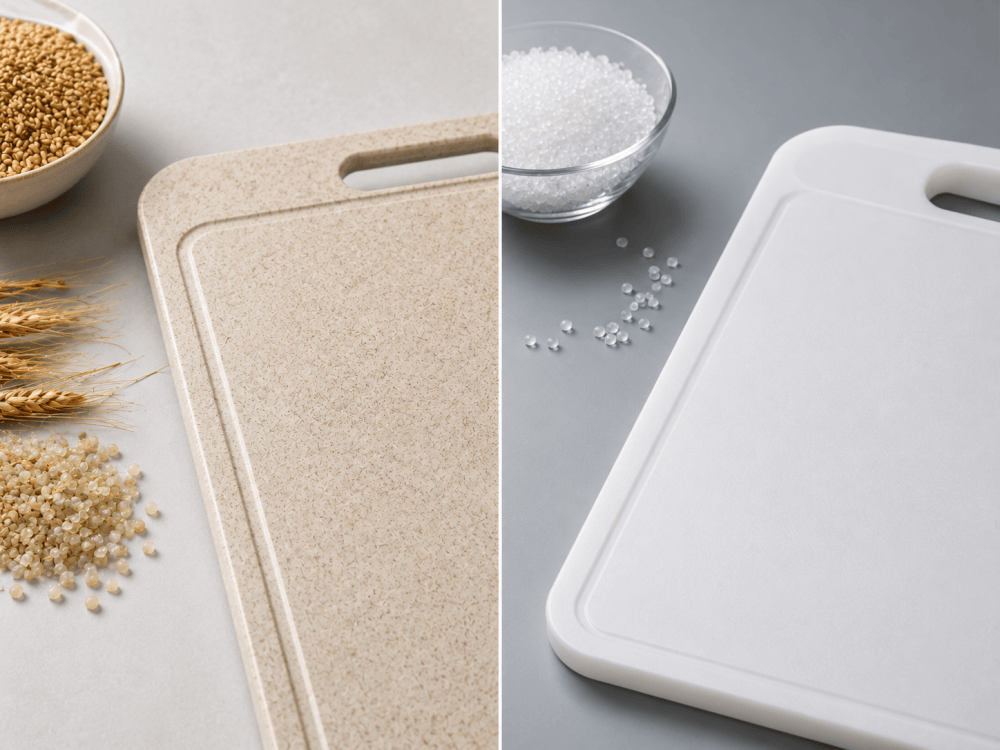
The biggest difference is not that one is completely natural and the other is completely synthetic. Most modern wheat straw cutting boards are composite products that combine wheat straw fiber with polypropylene (PP).
The wheat straw fiber is derived from agricultural residue, while PP provides the plastic matrix that gives the finished product its strength, stability, moisture resistance, and moldability.
Traditional plastic cutting boards are generally made from materials such as polypropylene (PP) or high-density polyethylene (HDPE) without the addition of wheat straw fiber.
| Feature | Wheat Straw PP Cutting Board | Traditional Plastic Cutting Board |
|---|---|---|
| Basic material | Wheat straw fiber + PP composite | Usually PP, HDPE, or another food-contact plastic |
| Weight | Generally lightweight | Generally lightweight |
| Moisture resistance | Good when properly manufactured | Good |
| Cleaning | Easy daily cleaning | Easy daily cleaning |
| Knife marks | May develop marks with repeated cutting | May develop grooves with repeated cutting |
| Dishwasher suitability | Depends on product construction and manufacturer instructions | Many products are dishwasher safe |
| Environmental positioning | Uses plant-based agricultural fiber in the composite | Primarily petroleum-derived plastic |
| Customization | Good potential for color, shape, size and design customization | Also highly customizable |
| Price positioning | Typically affordable to mid-range depending on design | Very broad range, including low-cost options |
1. Material: Wheat Straw PP vs Traditional Plastic
Material is the most obvious difference between the two categories.
Wheat Straw PP Cutting Boards
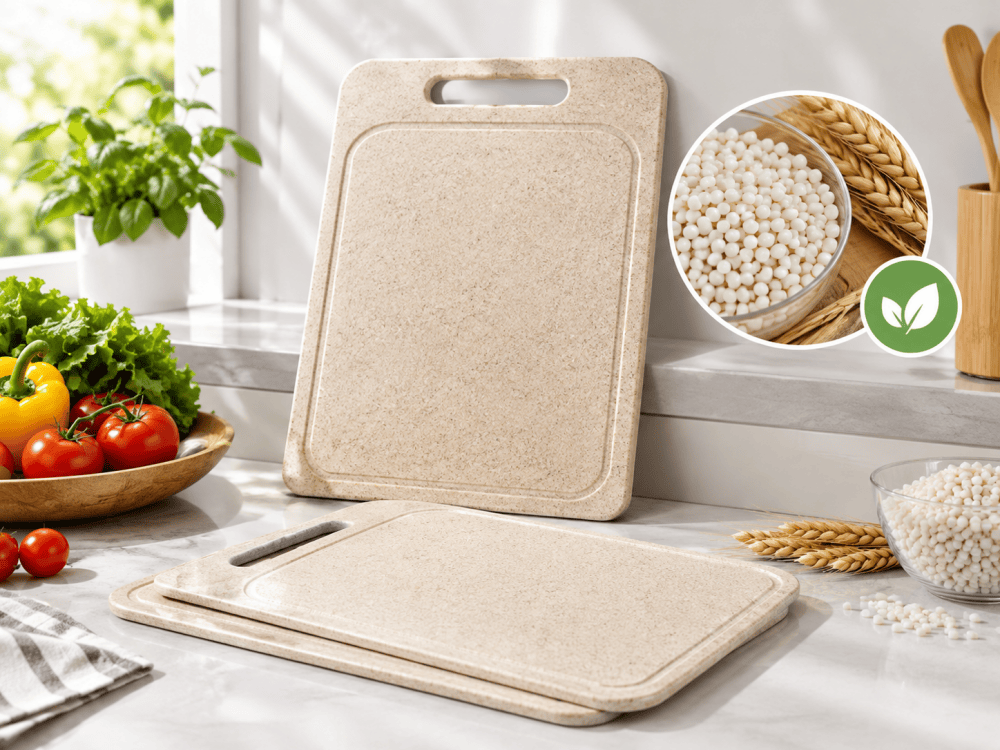
Wheat straw PP boards use plant-based wheat straw fiber as part of a composite material. The PP matrix helps bind the fibers together and gives the finished cutting board a smooth, stable surface.
This approach allows manufacturers to incorporate agricultural byproducts into a molded kitchen product rather than relying entirely on conventional plastic resin.
However, it is important to use accurate terminology. A wheat straw PP cutting board is not the same as a 100% wheat straw or fully biodegradable cutting board. Because PP is still part of the material, the finished product remains a plastic-based composite.
Traditional Plastic Cutting Boards
Traditional plastic cutting boards are commonly manufactured from PP or HDPE. These materials are widely used because they provide a useful combination of flexibility, moisture resistance, low weight, affordability, and ease of processing.
For buyers, the important point is that “wheat straw” describes a material component, not an automatic guarantee of sustainability or food safety. Product quality depends on the formulation, manufacturing process, additives, and compliance testing used by the manufacturer.
2. Which Is More Eco-Friendly?
This is one of the main reasons consumers and retailers are interested in wheat straw cutting boards.
A conventional plastic cutting board is primarily made from plastic resin. A wheat straw PP cutting board incorporates wheat straw fiber into the material, which can reduce the amount of conventional plastic required for the product depending on its formulation.
That gives wheat straw PP an environmental advantage in terms of using agricultural fiber as part of the material.
However, wheat straw PP should not be marketed as completely plastic-free or automatically biodegradable. The PP component remains part of the finished product.
For brands and retailers, accurate environmental claims are important. Instead of simply calling a product “100% eco-friendly,” manufacturers should explain the actual material composition and provide appropriate documentation when making sustainability claims.
3. Durability: Which Cutting Board Lasts Longer?
Durability depends heavily on the exact material formulation, board thickness, manufacturing quality, cutting habits, and maintenance routine.
Both wheat straw PP and traditional plastic boards can develop knife marks after repeated use. Plastic cutting boards are known to develop grooves as knives repeatedly contact the surface. When a board becomes excessively worn or develops deep, difficult-to-clean grooves, replacement is recommended.
Wheat straw PP boards can behave similarly because the PP component remains a relatively forgiving cutting surface rather than an extremely hard material.
For both categories, durability can be improved by selecting an appropriate thickness and avoiding unsuitable uses such as cutting bones or extremely hard frozen foods.
What Affects Cutting Board Lifespan?
- Board thickness and overall construction
- Frequency of use
- Knife sharpness and cutting technique
- Whether the board is used for heavy-duty chopping
- Exposure to excessive heat
- Dishwasher temperature and cleaning frequency
- Material quality and manufacturing consistency
4. Which Is Better for Knives?
For most everyday kitchen knives, neither wheat straw PP nor conventional PP/HDPE plastic is considered an extremely hard cutting surface. This makes these materials generally more forgiving to knife edges than hard surfaces such as glass, stone, or ceramic.
The exact experience depends on the hardness and texture of the cutting board.
A softer, slightly resilient cutting surface can absorb some of the force generated during chopping, while a very hard surface can contribute to faster edge wear.
For consumers who frequently use finely sharpened kitchen knives, the surface feel and hardness of the specific board may be more important than whether the board is labeled “wheat straw” or “plastic.”
5. Cleaning and Hygiene: Wheat Straw vs Plastic
Both wheat straw PP and traditional plastic cutting boards have an important advantage over porous wooden surfaces: they can be cleaned relatively easily because their surfaces are designed to resist significant moisture absorption.
For food safety, the cleaning method matters more than simply choosing one material over another.
The USDA recommends washing cutting boards with hot, soapy water after each use, rinsing them with clean water, and allowing them to dry. It also recommends using separate boards for raw meat, poultry, and seafood and for ready-to-eat foods to reduce the risk of cross-contamination.
What About Knife Grooves?
One potential problem with plastic-based cutting boards is that repeated cutting can create grooves and scratches.
Shallow surface marks are normal over time. However, when a board becomes heavily scarred and difficult to clean thoroughly, replacing it is a better option.
This applies to both traditional plastic boards and wheat straw PP boards because both use plastic-based cutting surfaces.
6. Are Wheat Straw Cutting Boards Dishwasher Safe?
This is one area where you should avoid making a blanket statement.
Some wheat straw PP cutting boards are designed to be dishwasher safe because PP provides good resistance to moisture and common cleaning conditions. However, dishwasher suitability depends on the specific product design, material formulation, thickness, and manufacturing process.
Traditional plastic boards also vary. Many PP and HDPE cutting boards are dishwasher compatible, but buyers should always follow the manufacturer's instructions.
For retailers and private-label buyers, dishwasher testing should therefore be considered part of product validation rather than simply assuming that every wheat straw or plastic board will perform identically.
7. Weight and Everyday Convenience
Both wheat straw PP and conventional plastic cutting boards are usually lighter than thick hardwood cutting boards.
This makes them convenient for:
- Small kitchens
- Apartments and dormitories
- Everyday vegetable preparation
- Meal preparation and food prep stations
- Families that need multiple cutting boards
- Consumers who prefer easy storage and handling
Wheat straw PP boards can also be molded into a wide variety of shapes and designs, making them suitable for modern kitchenware collections where appearance and functionality need to work together.
8. Price: Is Wheat Straw More Expensive?
Price depends on the material grade, thickness, size, construction, surface treatment, packaging, and additional features.
Traditional plastic cutting boards have a very broad price range. Basic PP or HDPE boards can be extremely affordable because the materials and production processes are well established.
Wheat straw PP boards may cost more than the most basic plastic boards because they involve a composite material and may include additional design features or sustainability-focused positioning.
However, wheat straw PP can still occupy an accessible price range compared with premium hardwood, specialty composite, or advanced multi-layer cutting boards.
For brands, this makes wheat straw PP particularly interesting for the mass-market, mid-market, sustainable kitchenware, and private-label segments.
9. Which One Is Better for Different Uses?
| Use Case | Wheat Straw PP | Traditional Plastic |
|---|---|---|
| Daily vegetable preparation | Excellent | Excellent |
| Fruit preparation | Excellent | Excellent |
| Raw meat preparation | Good, with proper cleaning | Good, with proper cleaning |
| Lightweight kitchen use | Excellent | Excellent |
| Eco-conscious product positioning | Strong | Limited |
| Lowest-cost product positioning | Good | Excellent |
| Private-label customization | Excellent | Excellent |
| Heavy-duty commercial chopping | Depends on construction | Depends on material and thickness |

10. Wheat Straw vs Plastic Cutting Board: Pros and Cons
Wheat Straw PP Cutting Board Advantages
- Combines plant-based wheat straw fiber with PP
- Lightweight and easy to handle
- Easy to clean for everyday food preparation
- Good moisture resistance when properly manufactured
- Suitable for modern sustainable kitchenware collections
- Offers opportunities for custom colors, shapes, sizes, and designs
- Can reduce reliance on conventional plastic depending on material formulation
Wheat Straw PP Cutting Board Limitations
- Still contains polypropylene and is not automatically biodegradable
- Can develop knife marks with repeated use
- Performance varies between manufacturers and formulations
- Dishwasher suitability depends on the specific product
- May cost more than entry-level conventional plastic boards
Traditional Plastic Cutting Board Advantages
- Widely available
- Affordable across many price levels
- Lightweight
- Easy to clean
- Available in PP, HDPE, and other material options
- Suitable for color-coded food preparation systems
- Established manufacturing and food-service applications
Traditional Plastic Cutting Board Limitations
- Primarily relies on conventional plastic resin
- Can develop knife grooves over time
- Deep scratches may become difficult to clean
- Environmental positioning is weaker than plant-fiber composite alternatives
- Low-cost products may vary significantly in material and manufacturing quality
11. So, Which Is Better: Wheat Straw or Plastic?
There is no single answer for every kitchen.
If your priority is the lowest possible price, established plastic materials, and simple everyday functionality, a traditional PP or HDPE cutting board remains an excellent choice.
If you want a lightweight cutting board with a plant-fiber component, modern appearance, and a stronger sustainability story, a wheat straw PP cutting board can be a compelling alternative.
The most important point is that wheat straw PP should not be treated as a completely different category from plastic. It is better understood as a plant-fiber-containing plastic composite that combines some benefits of agricultural fiber with the practical properties of PP.
12. How to Choose a High-Quality Wheat Straw PP Cutting Board
If you are considering wheat straw PP for your kitchen or product line, look beyond the material name.
Check the Material Composition
Ask the supplier what materials are actually used and how the wheat straw fiber is incorporated into the PP matrix.
Check Food-Contact Compliance
For commercial products, ask for appropriate food-contact documentation and testing based on the target market. Compliance should be verified for the finished product and its intended use.
Check Thickness and Construction
A well-designed board should have enough thickness and structural stability for its intended application. Very thin boards may be easier to store but may provide less stability during heavy cutting.
Check Dishwasher Performance
If dishwasher use is important to your customers, confirm that the specific product has been designed and tested for dishwasher conditions.
Check Surface Quality
A smooth, well-finished surface can improve the user experience and make daily cleaning easier. Edges, corners, handles, grooves, and non-slip features should also be inspected.
13. For Brands: Why Wheat Straw PP Cutting Boards Are Worth Considering
From a product development perspective, wheat straw PP offers more than just an alternative material story.
Because PP is highly moldable, manufacturers can develop different shapes, sizes, colors, handles, grooves, hanging holes, and packaging formats for different retail markets.
This makes wheat straw PP suitable for:
- Private-label kitchenware
- Supermarket and homeware collections
- Eco-conscious retail programs
- Online kitchenware brands
- Promotional kitchen products
- OEM and ODM cutting board projects
For B2B buyers, the most important factors should be consistent material quality, food-contact compliance, production stability, product design, packaging, and quality control rather than simply choosing a product because it contains the words “wheat straw.”
Frequently Asked Questions
Is wheat straw better than plastic for cutting boards?
Wheat straw PP can be a better choice for buyers who want to incorporate plant-based agricultural fiber into their kitchen products. However, it is still a PP-based composite, so it does not eliminate plastic completely. Traditional plastic remains competitive in price, availability, and everyday functionality.
Are wheat straw cutting boards made of plastic?
Most wheat straw cutting boards are composite products made with wheat straw fiber and a plastic binder such as polypropylene (PP). Therefore, they should not be considered completely plastic-free.
Do wheat straw cutting boards dull knives?
Wheat straw PP boards are generally softer than very hard cutting surfaces such as glass or stone. Their effect on knife edges depends on the exact surface hardness and construction, but they are generally designed for everyday food preparation rather than aggressive knife wear.
Can wheat straw cutting boards go in the dishwasher?
Some wheat straw PP cutting boards are dishwasher safe, but not all products have the same construction or testing. Always check the manufacturer's instructions before putting a specific board in the dishwasher.
Are wheat straw cutting boards biodegradable?
Not necessarily. A wheat straw PP cutting board contains plant-based wheat straw fiber, but the polypropylene component remains plastic. The finished product should not automatically be described as fully biodegradable or compostable.
Which is cheaper, wheat straw or plastic cutting boards?
Traditional plastic cutting boards can be cheaper, especially at the entry-level end of the market. Wheat straw PP boards can remain affordable but may have a higher cost depending on material formulation, design, thickness, and additional features.
How should I choose between wheat straw PP and traditional plastic?
Choose wheat straw PP if plant-fiber content, sustainability-oriented positioning, and modern product design are important. Choose traditional plastic if your priority is the lowest cost, broad availability, and established plastic cutting board performance.
Final Verdict
Wheat straw PP and traditional plastic cutting boards are not completely different types of products. Both are designed to provide a lightweight, moisture-resistant, easy-to-clean cutting surface for everyday kitchen preparation.
The main difference is that wheat straw PP incorporates agricultural wheat straw fiber into the plastic matrix. This gives manufacturers and brands an opportunity to reduce the reliance on conventional plastic and create products with a stronger plant-fiber and sustainability story.
However, the best cutting board is ultimately determined by material quality, construction, intended use, food-contact compliance, maintenance, and product design.
For everyday consumers, both options can be practical. For kitchenware brands, retailers, and importers, wheat straw PP provides an additional material option for developing differentiated cutting board collections.
Looking for Custom Wheat Straw Cutting Boards?
Kitlucy supports OEM and ODM kitchenware projects with customizable cutting board designs, materials, sizes, colors, packaging, and private-label solutions. If you are sourcing wheat straw PP cutting boards for retail, wholesale, or private-label markets, our team can help develop a product according to your requirements.
Explore OEM & ODM SolutionsRelated Blogs