Are Wheat Straw Cutting Boards Dishwasher Safe?
Are Wheat Straw Cutting Boards Dishwasher Safe?
Dishwasher compatibility is one of the most common questions people have when buying a wheat straw cutting board. Because these boards are often marketed as lightweight, easy-to-clean kitchen products, it is natural to wonder whether they can simply be placed in the dishwasher after use.
The short answer is: some wheat straw cutting boards are dishwasher safe, but not every wheat straw cutting board should automatically be put in a dishwasher.
Most wheat straw cutting boards are made from a composite material that combines wheat straw fiber with polypropylene (PP). While PP can offer good resistance to moisture and everyday kitchen conditions, the finished product's dishwasher performance also depends on its material formulation, thickness, molding process, construction, and design.
This guide explains what makes a wheat straw cutting board dishwasher safe, what can happen during repeated dishwasher cycles, how to clean one properly, and what B2B buyers should check before launching a dishwasher-safe wheat straw cutting board.
What Are Wheat Straw Cutting Boards Made Of?
Before discussing dishwasher safety, it is important to understand the material structure.
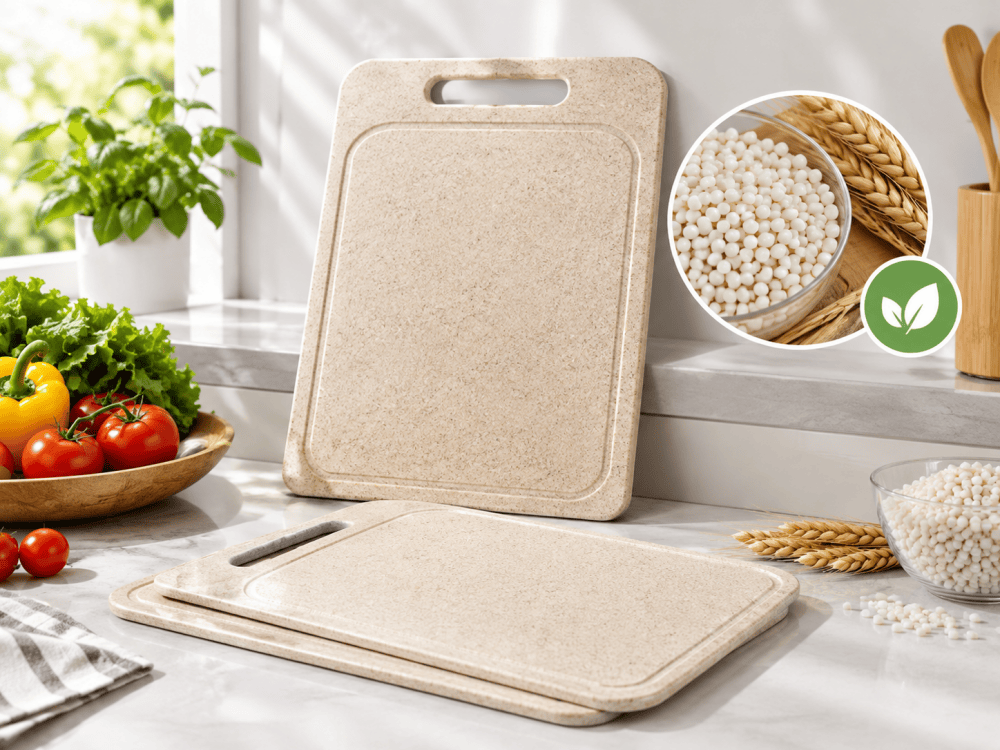
Many wheat straw cutting boards are not made from wheat straw alone. Instead, wheat straw fiber is incorporated into a plastic matrix, commonly polypropylene (PP), to create a molded composite product.
The wheat straw fiber can contribute to the product's appearance and material positioning, while PP provides the structural properties required to form the cutting board.
This means dishwasher performance should be evaluated based on the finished composite product, rather than assuming that all products containing wheat straw fiber will behave in the same way.
Are Wheat Straw PP Cutting Boards Dishwasher Safe?
Some are, and some are not.
A wheat straw PP cutting board may be designed for dishwasher cleaning, but the manufacturer needs to consider the temperatures, water exposure, detergent environment, and mechanical conditions involved in dishwasher cycles.
The safest rule for consumers is straightforward:
Do not assume that two visually identical cutting boards have identical dishwasher performance. Different formulations, thicknesses, additives, molding conditions, and structural designs can produce different results.
Why Does Dishwasher Temperature Matter?
Heat is one of the most important factors when evaluating dishwasher performance.
A dishwasher exposes kitchenware to elevated temperatures during washing and drying. Plastic-based products can respond differently to heat depending on their formulation and geometry.
Excessive or repeated heat exposure may contribute to:
- Warping or dimensional changes
- Loss of flatness
- Changes in surface appearance
- Stress around thin sections or molded features
- Faster deterioration of certain product designs
This does not mean that all PP cutting boards will warp in a dishwasher. Properly designed PP products can be engineered for repeated exposure to normal dishwasher conditions.
The important point is that dishwasher safety is a product-level performance characteristic, not simply a material label.
What Can Happen If a Non-Dishwasher-Safe Cutting Board Goes in the Dishwasher?
Putting a cutting board into the dishwasher against the manufacturer's instructions can increase the risk of damage.
Warping
The most obvious problem is deformation. A board that becomes warped may no longer sit flat on the kitchen counter.
A stable cutting surface is important because movement during food preparation can make cutting less comfortable and potentially less safe.
Surface Changes
Repeated heat, water, and detergent exposure can affect the appearance or feel of some plastic composite surfaces.
Structural Stress
Thin sections, handles, hanging holes, textured areas, and other molded features may experience different levels of thermal stress during repeated washing.
Shorter Product Life
Even if a board does not show immediate damage, repeated exposure to conditions outside its intended use may contribute to premature wear.
Dishwasher vs Hand Washing: Which Is Better?
For a dishwasher-safe wheat straw cutting board, either dishwasher cleaning or hand washing may be appropriate when performed according to the manufacturer's instructions.
However, hand washing generally gives the user more control over water temperature, cleaning time, detergent exposure, and drying.
| Cleaning Method | Advantages | Things to Consider |
|---|---|---|
| Dishwasher | Convenient, saves manual cleaning time, consistent cleaning cycle | Higher heat, detergent exposure, mechanical movement, product-specific limitations |
| Hand washing | Greater control over temperature and cleaning method, gentle on the product | Requires manual cleaning and proper drying |
If a product is explicitly dishwasher safe, dishwasher cleaning can be a convenient option. If dishwasher compatibility is unclear, hand washing is the more conservative choice.

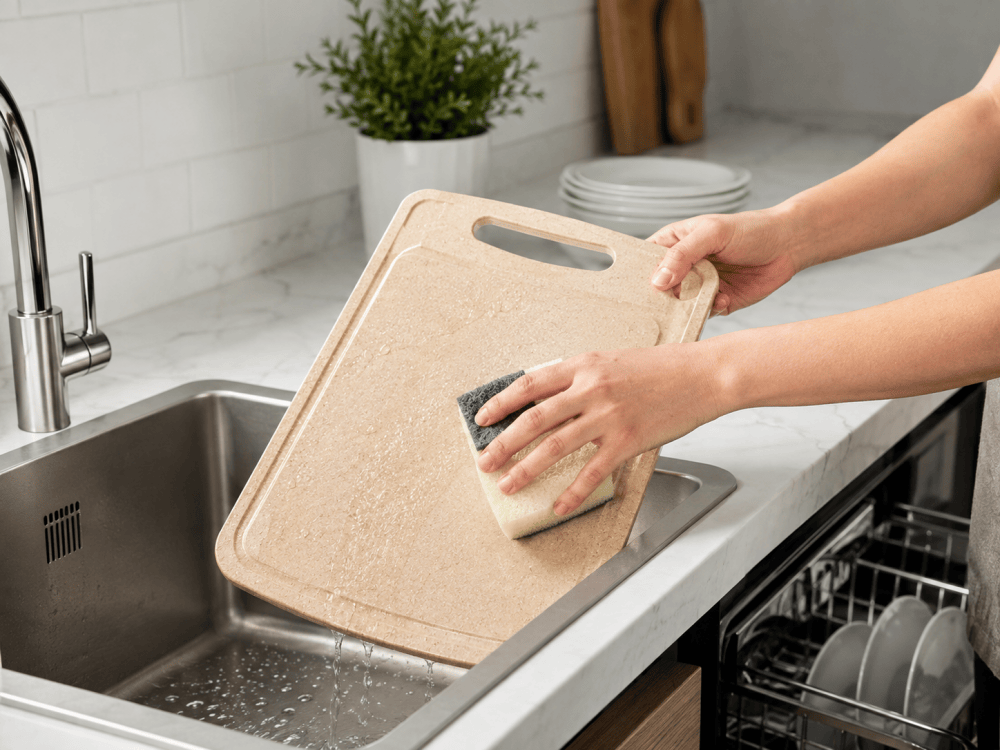
How to Clean a Wheat Straw Cutting Board by Hand
Hand washing is a simple option for wheat straw cutting boards that are not rated for dishwasher use.
- Remove food residue. Scrape or rinse away loose food particles after preparation.
- Wash with dish soap and water. Clean the entire cutting surface, including edges and corners.
- Rinse thoroughly. Remove remaining soap and food residue with clean water.
- Dry completely. Allow the cutting board to air dry in a clean, ventilated location.
- Inspect the surface. Regularly check for deep grooves, cracks, warping, or other signs of excessive wear.
Can You Use Hot Water to Clean a Wheat Straw Cutting Board?
Warm or hot water can be used for cleaning when permitted by the product's care instructions, but extremely high temperatures should be avoided unless the product has been specifically designed for them.
The fact that a cutting board can tolerate normal hot-water cleaning does not necessarily mean that it can tolerate the full temperature and drying conditions of a dishwasher cycle.
This distinction is important because dishwasher conditions involve a combination of heat, water, detergent, mechanical movement, and sometimes heated drying.
How to Tell If a Wheat Straw Cutting Board Is Dishwasher Safe
If you are a consumer, check the product packaging, label, or manufacturer's care instructions.
Look for wording such as:
- Dishwasher safe
- Top-rack dishwasher safe
- Dishwasher compatible
- Suitable for dishwasher cleaning
If the product documentation does not mention dishwasher use, do not assume that it is safe.
For B2B buyers, the evaluation should go further than checking a label.
What B2B Buyers Should Check Before Claiming Dishwasher Safety
For retailers, wholesalers, importers, and private-label kitchenware brands, dishwasher safety can be an important product feature.
However, it should be supported by appropriate product testing rather than being added as a marketing claim without validation.
Material Composition
Confirm the exact formulation of the wheat straw PP composite and any additives used in the product.
Product Thickness
Thickness and geometry can affect how a cutting board responds to repeated heating and cooling cycles.
Shape and Design
Handles, hanging holes, grooves, textured areas, non-slip features, and other design elements can influence dimensional stability.
Dishwasher Cycle Testing
If dishwasher safety is an important selling point, the finished product should be evaluated under representative dishwasher conditions to assess warping, surface condition, dimensional stability, and overall performance.
Packaging and Instructions
Clear care instructions should be included with the finished product so consumers understand whether dishwasher use is permitted and what limitations apply.
Does Dishwasher Use Shorten the Lifespan of Wheat Straw Cutting Boards?
It can, depending on the product.
A cutting board that is not designed for dishwasher use may experience faster deterioration when repeatedly exposed to high heat and other dishwasher conditions.
By contrast, a wheat straw PP cutting board specifically designed and tested for dishwasher cleaning should be better equipped to handle those conditions.
Even then, dishwasher use is only one factor affecting product lifespan. Cutting frequency, knife marks, impact, heat exposure outside the dishwasher, and general maintenance also matter.
For a deeper discussion of product lifespan, see our guide: How Long Do Wheat Straw Cutting Boards Last?
Dishwasher-Safe vs Hand-Wash-Only Wheat Straw Cutting Boards
| Feature | Dishwasher-Safe Design | Hand-Wash-Only Design |
|---|---|---|
| Cleaning convenience | High | Moderate |
| Heat exposure | Designed for specified dishwasher conditions | Should avoid dishwasher heat |
| User maintenance | Simple when used according to instructions | Requires manual washing |
| Product design requirements | Requires consideration of thermal and dimensional stability | More flexibility in design if dishwasher use is not claimed |
| B2B selling point | Strong convenience feature | Suitable for markets where hand washing is acceptable |
Common Mistakes When Cleaning Wheat Straw Cutting Boards
1. Assuming Every Wheat Straw Board Is Dishwasher Safe
The phrase “wheat straw” does not automatically mean dishwasher safe. Always check the product-specific instructions.
2. Using Excessive Heat
Do not expose the cutting board to temperatures beyond the manufacturer's recommended range.
3. Leaving the Board Wet for Long Periods
After cleaning, allow the board to dry completely rather than storing it while wet.
4. Ignoring Deep Knife Grooves
Cleaning cannot restore a cutting surface that has become heavily damaged. If deep grooves, cracks, or severe wear develop, replacement may be appropriate.
5. Using the Cutting Board as a Hot Trivet
A standard cutting board should not automatically be treated as a heat-resistant trivet. Direct contact with hot cookware can cause deformation even if the product is dishwasher safe.
Can Dishwasher-Safe Wheat Straw Cutting Boards Be More Convenient?
Yes. Dishwasher compatibility can be a meaningful convenience feature for consumers.
Busy households may prefer kitchen products that can be placed directly into the dishwasher after food preparation.
For retailers, dishwasher-safe functionality can also help position a wheat straw PP cutting board as a practical modern kitchen product rather than focusing only on its material story.
This is particularly useful when developing kitchenware collections that emphasize easy cleaning, convenience, lightweight design, and everyday usability.
Wheat Straw Cutting Boards and Food Hygiene
Dishwasher compatibility is only one part of cutting board hygiene.
Regardless of whether a cutting board is made from wheat straw PP or conventional plastic, it should be cleaned properly after use.
Using separate cutting boards for raw meat, poultry, seafood, and ready-to-eat foods can also help reduce the risk of cross-contamination.
A cutting board should also be replaced when deep grooves, cracks, or other damage make the surface difficult to clean effectively.
Frequently Asked Questions
Are wheat straw cutting boards dishwasher safe?
Some wheat straw cutting boards are dishwasher safe, while others are designed for hand washing only. Check the manufacturer's instructions for the specific product before using a dishwasher.
Can wheat straw PP cutting boards go in the dishwasher?
Some wheat straw PP cutting boards are designed and tested for dishwasher use. However, PP composition alone does not guarantee dishwasher safety because the final product's thickness, design, formulation, and construction also matter.
Will a wheat straw cutting board warp in the dishwasher?
It may warp if the product is not designed for dishwasher conditions or is exposed to temperatures beyond its intended range. Dishwasher-safe products should be designed to better withstand normal dishwasher conditions.
Is it better to hand wash a wheat straw cutting board?
Hand washing is a conservative cleaning method when dishwasher compatibility is unclear. It also gives users greater control over water temperature and cleaning conditions.
Can I use hot water on a wheat straw cutting board?
Warm or hot water may be appropriate depending on the manufacturer's care instructions. Extremely high temperatures should be avoided unless the product has been specifically designed for them.
How do I know if my wheat straw cutting board is dishwasher safe?
Check the product packaging, label, or manufacturer's care instructions. If dishwasher safety is not stated, hand washing is the safer option.
Does dishwasher use reduce the lifespan of a wheat straw cutting board?
It can if the board is not designed for dishwasher conditions. A properly designed dishwasher-safe board should be better suited to repeated dishwasher cleaning, although normal cutting wear and other factors still affect its lifespan.
Final Verdict
So, are wheat straw cutting boards dishwasher safe?
Some are, but not all.
The most important factor is the design and specification of the finished wheat straw PP cutting board. The presence of wheat straw fiber does not automatically determine whether a product can withstand dishwasher conditions.
If the manufacturer specifically states that the board is dishwasher safe, consumers can use the dishwasher according to the recommended instructions. If dishwasher compatibility is not confirmed, hand washing is the safer choice.
For B2B buyers, dishwasher safety should be treated as a product performance claim that requires appropriate validation. Material composition, thickness, shape, molding quality, and repeated-cycle performance should all be considered before adding “dishwasher safe” to product packaging or marketing materials.
Looking for Dishwasher-Safe Wheat Straw Cutting Boards?
Kitlucy supports OEM and ODM cutting board projects for retailers, wholesalers, importers, and private-label brands. We can help customize wheat straw PP cutting boards by size, shape, color, thickness, features, packaging, and product specifications for different markets.
Explore OEM & ODM SolutionsRelated Blogs